No Picture
News Briefs

‘Somebody has to make a big move’: Catholic priest who walked Belfast gauntlet on reconciliation

September 5, 2020 CNA Daily News 1

CNA Staff, Sep 5, 2020 / 04:00 am (CNA).-  

On Sept. 3, 2001, Fr. Aidan Troy set off with a group of children in the Ardoyne district of north Belfast walking to their Catholic school. To reach it, they had to pass through a Protestant area.

Troy, a Passionist priest from Dublin, had recently arrived in Northern Ireland from Rome. He was about to undergo a baptism of fire.

“We set off on Sept. 3 and they asked me to walk with them. And it was horrendous,” he recalled.

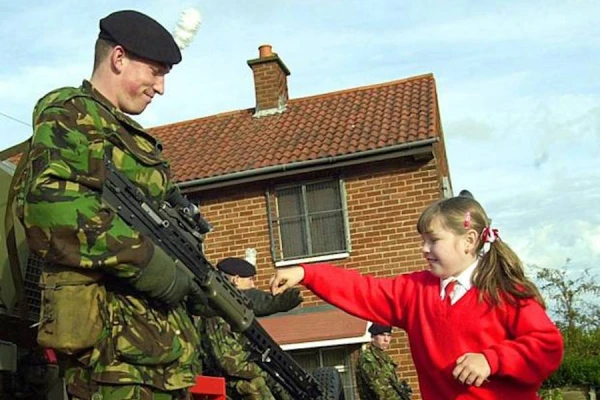
Protesters attempted to block the road leading to the school, forcing girls as young as four to run a terrifying gauntlet, with the help of the police, backed by the British Army. The children and their parents were showered with jeers and sectarian abuse, as well as stones and bottles.

The incident caught the attention of the global media and shocked observers because it occurred after the 1998 Good Friday Agreement, which many thought had ended the Troubles that had raged since the late 1960s.

“Looking back now, I think that the community living near the school — we’ll call them the unionist community — had reached a desperation point, where they felt that nobody really cared, and that there was nobody to defend their rights against their fears,” Troy told CNA.

“Their fears were very, very real: they were afraid that their houses would be attacked and taken over. There was a big shortage of housing. They had very little leadership.”

“Therefore when they ran out of options, they said, ‘The only way we can do this is that the perceived enemy is the nationalist community in Ardoyne, and they are bringing their children up and down to school. If we can disrupt that then we’re going to at least get some attention, and we may be able to do something about it.’ So they blocked the road.”

As the new local pastor, Troy had been appointed chair of the board of governors of Holy Cross Girls’ School. Tensions had flared around the school in June, before his arrival. As pupils prepared to return after the summer vacation, the priest had asked parents what they wanted to do. They told him they wished to bring their children to school via the front gate, and he agreed to lead them.  

On the second day, there were more ugly scenes. On the third, protesters threw a blast bomb — an improvised explosive device — towards the children and their parents. The children scattered in all directions while Troy held up his arms, urging parents not to panic.

Troy recalled that he was prepared to die rather than abandon the children.

“When I went back to Dublin, people used to say to me: ‘You’re mad. What in the name of God are you doing going up and down that road with those children?’ And they were throwing urine, this and that, and all sorts of terrible things. But you believed that those children were going to grow up and they were either going to know that they were as good as the next or they weren’t,” he said.

He added: “The bishop gave me a terrible tough time. He wanted me to tell the parents to bring them in through the back gate. And I said, ‘Well, if you’re telling me to do that, I’m taking the train back to Dublin tomorrow.’”

Troy feared most that if he backed down, then paramilitary groups would step in.

He said: “No one will ever know, thank God, but some of the paramilitaries might have taken it over and then it would have ended in bloodshed. And that’s what kept me walking, because I said: ‘This can be solved.’”

With the situation deteriorating, Troy realized that the two communities needed to find a communication channel. But reaching out might be regarded as an act of betrayal and, besides, it wasn’t clear who to talk to among the protesters.

Nevertheless, the priest began speaking to unionist leaders.

“And then some of the protesters were invited in, and they were terrible meetings. They were so bad, because the animosity, particularly against me as a Catholic priest, was horrendous,” he said.

“We stuck at it, and eventually, I remember handing over my mobile number to them and saying: ‘This is ridiculous. We keep meeting every two weeks. The children are suffering. You’re suffering.’”

The two sides met separately with politicians at Stormont, the Parliament Buildings in Northern Ireland. Slowly, a plan was formulated that would end the protests.

“On Nov. 23, 2001, the local community in Glenbryn had a meeting and by a very narrow majority, I believe, they agreed to suspend the action of blockade,” he said.

It would take two years to iron out the protocols enabling the girls to walk the route to school.

“Bit by bit by bit, it died down,” Troy recalled. “There was the occasional flare-up. Maybe at the beginning of the school year in September there would be a pipe bomb at the school gate. I know it sounds blasé, but that was minor in comparison to what we’d come through.”

Troy aimed throughout to ensure that no one felt that they were either a victor or a loser.

Speaking of the protesters, he said: “I had actually got to know one or two of them sort of by sight, and occasionally, just to nod to them and say hello. And one of them, his sister died very suddenly. Through the clergy I found his phone number and I called him and expressed my sympathy. Well, he didn’t know what to say and he didn’t know what to do.”

“That’s what I mean by saying, never rub salt in the wound and say: ‘This is a battle to the death till one side or the other wins.’”

“Now, I’m a football supporter. In sport, a draw’s no use. You have to win. But in reconciliation, you have to find a higher level, and that is where both sides can go on living, even though one side is right and one side is wrong.”

Only a minority of those involved in the conflict — both Catholics and Protestants — were weekly church-goers, Troy said, but nevertheless they were all shaped by Christianity.

“There was a sort of allegiance — even if it was only like a folk memory — to a higher value, which was the kingdom of God in some sense, of a church, a spiritual thing, and I could use that quite significantly,” he noted.

“When I was talking to them in the school hall, I could actually appeal to them morally. And that, I think, is a very powerful thing. It won’t always be a Christian thing. It won’t always be a very religious thing. But I do think you need to be able to lift the argument beyond where the argument started, or else it can never end.”

He added: “I found that Christianity was the platform that I used. I wore my habit every day. I never denied who I was. If they were going to kill me, they knew who they were killing.”

Today, almost 20 years on, Troy is pastor of St. Joseph’s, an English-speaking Catholic parish in Paris. He told CNA that he had been following the unrest in the United States after the killing of George Floyd in May. He was struck by both the similarities and differences to what he experienced in Belfast.

The 74-year-old priest said that between law enforcement and the government, on one side, and protesters, on the other, there needed to be a third group.

“You need within that somewhere — I don’t know who they would be, they might be religious people — somebody doing a little bit of what we were doing: talking across the divide,” he explained.

He continued: “The biggest thing of all in those situations is to keep listening and watching. And if you see a glimmer of light — it might be the most insignificant-looking thing — maybe that’s the breakthrough.”

“I don’t know enough to speak with any sort of certainty. But it breaks my heart to see what’s happening because it’s the exact same as Holy Cross in that sense: there are no winners in this.”

“Most of all, you need somebody with a prophetic voice. And oftentimes within any community there are prophets. And if we could find that, it’s extraordinary,” he observed.

Troy, who lived in the U.S. for two years in the 1980s while studying at the University of San Francisco, said that the deep historical roots of the unrest made reconciliation difficult. But he was hopeful because there was an “underlying spiritual awareness” in America.

“This is such a long-standing and such a deep issue that it is going to take a huge amount. But something has to be done to defuse the level it’s at the moment. It’s just terrible, night after night,” he said.

He recalled that peace only came to Northern Ireland after politicians dared to do “the unthinkable.” He gave the example of John Hume, the former SDLP leader who died Aug. 3, deciding to hold talks with Sinn Féin president Gerry Adams.

“That would be like asking the leaders of the protesters to talk to Donald Trump personally,” he said. “Somebody has to make a big move.”

He added: “If there’s any lesson out of Northern Ireland, it was that if everybody had stayed where they were then we would still be pouring blood down our streets, bombs would still be going off, and people would still be living in absolute misery at what was going on.”


[…]

No Picture
News Briefs

SF archbishop: City’s worship restrictions show ‘callous unconcern’ for spiritual needs

September 4, 2020 CNA Daily News 0

Denver Newsroom, Sep 4, 2020 / 06:00 pm (CNA).-  

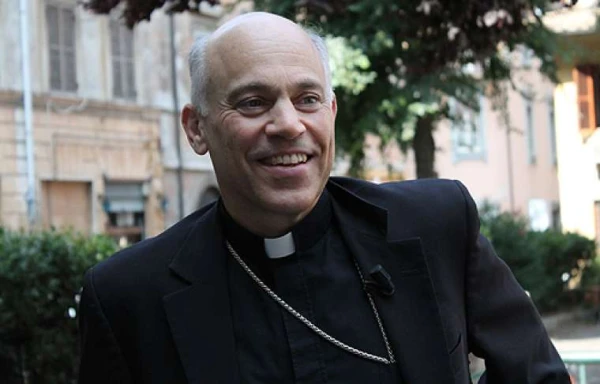
Archbishop Salvatore Cordileone of San Francisco said Friday that the city’s current restrictions on public worship— which prohibit indoor services of any kind, as opposed to other entities such as retail which have been allowed to reopen indoor operations— show “callous unconcern” for people’s spiritual needs.

“Let alone the fact that the city is judging religious services as less important, and treating them more harshly than other activities— the city has no authority at all over the Church’s right to worship,” Archbishop Cordileone told CNA Sept. 4.

“It is not the job of the state to decide what religious services are essential or inessential: that is the Church’s job.”

The San Francisco County Department of Health is currently limiting outdoor worship services to 12 people, with indoor worship services prohibited. The archdiocese covers the city and county of San Francisco— where the cathedral is located— as well as San Mateo and Marin counties.

The state’s legitimate concern for health and safety does have some bearing on how the Church operates, he said— for example, there are good reasons why church buildings must be built with respect to code.

“But the state does not tell the Church how to arrange the liturgical space—that pertains to the internal life of the Church, over which the state has no authority. The same principle applies to worship services: the state has no right whatsoever to tell the Church it cannot worship, but it has every right and responsibility to tell the Church which practices it must observe to keep people safe during worship,” Cordileone continued.

“Those practices, though, cannot be so restrictive as to effectively ban public worship, such as only outdoors with no more than 12 people.”

Cordileone said priests at many parishes around the archdiocese, including the Cathedral of St. Mary of the Assumption, are celebrating multiple Masses every Sunday— outside, and spaced out— in order to adapt to the restrictions.

“The Body and Blood of Christ is the source and summit of our Faith. People are hungry for the Eucharist, and many priests are responding to the call as best they can,” he said.

The City of San Francisco has been closely monitoring Catholic churches in the city and has repeatedly issued warnings to the archdiocese for apparent health order violations.

Cordileone said he himself has noted “very few” violations of the city’s health orders by parishes in the archdiocese, although the few that have occurred have garnered heavy criticism in the secular press.

Even while protesting the city’s apparent unequal application of health restrictions, the archbishop has encouraged his priests to lead their parishes in following the city’s guidelines.

“Wearing a face covering is one of the simplest and most effective things you can do.  And if that is not enough, then wear one simply for the sake of good manners,” he appealed. 

“Do not show a lack of compassion for people who are afraid of catching a disease that is quite deadly to many people with comorbidities and the elderly, which we Catholics should particularly respect and protect.”

While Cordileone said city officials have been “cordial and respectful” in their dialogue with the archdiocese, Cordileone said the city still has not responded to the archdiocese’ safety plan— outlining how churches could be safely opened for indoor services— which they submitted in May.

“Whereas retail stores sent in safety plans, had them approved by the City, and then resumed indoor retail at 50% capacity.  And yet, churches can be safer environments than stores,’ Cordileone noted.

In a letter to San Francisco’s Mayor London Breed and other city officials, Cordileone last week called on the city’s secular authorities to, “at a minimum, remove the excessive limits on outdoor public worship.”

“Particularly for us as Catholics, attending the Mass and receiving the Body and Blood of Christ in person is the source and the summit of our faith, and we have shown we can celebrate the Mass safely,” Cordileone wrote Aug. 31.

He cited a recent article on Mass attendance and COVID-19, authored Aug. 19 by doctors Thomas McGovern, Deacon Timothy Flanigan, and Paul Cieslak for Real Clear Science.

Over the last 14 weeks, the doctors said, approximately 17,000 parishes have held three or more Masses each weekend, as well as daily services, combining to equal more than 1 million public Masses celebrated across the United States since shelter-in-place orders were lifted.

By following public health guidelines, these Masses have largely avoided viral spread. The doctors said in their article that there is no evidence that church services are higher risk than similar activities when guidelines are followed, and no coronavirus outbreaks have yet been linked to the celebration of the Mass.

“Catholics have developed responsible safety protocols to conduct the Mass safely. The evidence shows these protocols are working,” Cordileone told CNA.

“San Francisco’s excessive limits on the Mass are not only a violation of Americans’ First Amendment rights, they show a kind of callous unconcern for our parishioners’ emotional and spiritual needs.”

In a July 30 memo, Cordileone exhorted his priests to be as diligent as possible in bringing the sacraments to their people, including celebrating outdoor Masses each Sunday, and providing Confession in a safe manner as often as possible.

“Please regularly remind people to follow the safety practices necessary to curb the spread of the virus. This is real, it is dangerous, and it has to be taken seriously,” he added.

“The resurgence is due in no small part to people becoming lax once the shelter-in-place rules began to be lifted. Please urge these practices upon them; absolutely do not give them the impression that the coronavirus is not a serious threat to the physical health of our community.”

The Benedict XVI Institute for Sacred Music and Divine Worship, which provides liturgical resources in the archdiocese, shared a petition Aug. 31 in support of Cordileone’s statement calling for the lifting of restrictions on the Mass. To date more than 1,400 people have signed.


[…]

No Picture
News Briefs

New Hampshire sued over Catholic schools tuition policy

September 4, 2020 CNA Daily News 2

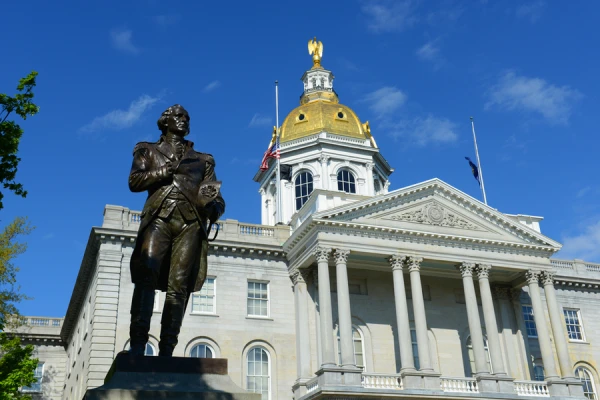
Washington, D.C. Newsroom, Sep 4, 2020 / 08:40 am (CNA).- A New Hampshire family has filed suit against the state after a town tuition program refused to pay for their grandson’s Catholic school education. The suit claims that the terms of the program violate religious discrimination laws and go against a recent Supreme Court ruling.

The lawsuit, Dennis Griffin and Catherine Griffin v. New Hampshire Department of Education, was filed in the Merrimack County, New Hampshire, Superior Court on September 3. 

Dennis and Cathy Griffin are raising their grandson, Clayton in the town of Croydon, New Hampshire. Clayton, an ingoing seventh-grade student, attends a Catholic school in the nearby town of Sunapee. He would be eligible to have his private school tuition paid for by the town of Croydon, except for a New Hampshire law which prohibits town tuitioning programs from paying for “sectarian” schools, which the family argue is illegal under the Supreme Court’s recent decision Espinoza v. Montana Department of Revenue, which struck down a similar exclusion on religious schools.

Croydon, a small town of fewer than 1,000 people, does not have its own public middle school or high school. Instead, the town pays the tuition for resident students to attend public or private schools in nearby towns.

There are approximately 50 towns in New Hampshire that do not have public schools for all grades, and many of these towns have a contract with a specific nearby public or private school. Croydon does not have this kind of contract and allows its school-age students to pick where to go to school. In Croydon, students in fifth grade and above are given a set dollar amount for tuition at either a public or private non-sectarian school. 

In order to be eligible for a tuitioning program in New Hampshire, a private school must be “non-sectarian,” comply with various regulations regarding health and fire safety, be incorporated in New Hampshire, and administer an annual academic assessment. 

Mount Royal Academy, where Clayton is a student, is a lay-run and lay-founded Catholic school, where students are educated in the classical model. The school was incorporated in New Hampshire, complies with all health and safety regulations, and administers standardized assessments. However, as Mount Royal Academy is a Catholic school, the Griffins have to pay tuition. 

The school was formally recognized as a Catholic school by the Diocese of Manchester in 2006, which the school’s website describes as “giving our school community the greatest gift we could ever receive, the Eucharistic presence of Jesus Christ on campus.” It was the first lay-founded school in the diocese to receive this recognition. 

The Griffins say that the state prohibition is a violation of their First Amendment rights, and are asking for the New Hampshire courts to allow religious schools to be eligible for town tuitioning programs. 

In June, the Supreme Court ruled in Espinoza v. Montana Department of Revenue that Montana’s income tax credit program unconstitutionally discriminated against religious schools and those who attend or wish to attend them. The Griffins are arguing that the New Hampshire Superior Court should consider the precedent created in Espinoza and change state law. 

Kirby West, an attorney for the Institute for Justice, the law firm representing the Griffins, told CNA that while the case is similar to Espinoza, the situation is different as the prohibition on sectarian school tuition payments is state law. 

“In Espinoza, the Montana Supreme Court struck the scholarship program down under their state Blaine Amendment because the program included religious schools,” West told CNA.  

“Here, although New Hampshire also has a Blaine Amendment, the anti-religious language is also written directly into the tuitioning statute. So the tuitioning program excludes religious schools on its face,” she said. 

In Espinoza, the Supreme Court ruled that as school choice programs are not mandated, religious schools cannot be left out of the program on the basis of religion–something that is happening in New Hampshire. 

“The principle at issue, however, is exactly the same,” West said. “Once it decides to create an educational choice program, a state cannot exclude religious schools solely because they are religious.” 

“The Griffins qualify for New Hampshire’s tuitioning program in all respects except for the fact that they chose a religious school for their grandson. As the Supreme Court made clear in Espinoza, this discrimination violates the First Amendment,” she said.


[…]

No Picture
News Briefs

San Francisco ministry to share Catholic teaching on end-of-life

September 3, 2020 CNA Daily News 2

Denver Newsroom, Sep 3, 2020 / 04:01 pm (CNA).- The Archdiocese of San Francisco is set to begin training volunteers who will help parishes support Catholics in making end-of-life decisions for themselves and loved ones, informed by Catholic teaching about death.

Deacon Fred Totah, director of pastoral ministry for the archdiocese, told CNA that he fields a lot of questions about end-of-life problems in his parish— more so now than ever, amid the coronavirus pandemic.

The Catholic end-of-life ministry is a response to California’s 2015 legalization of assisted suicide under the End of Life Option Act, which took effect during June 2016. Under the law, patients may request and physicians may prescribe life-ending medications.

The Catholic Church teaches that assisted suicide and euthanasia— which both involve the intentional taking of life— are never permissible. Withholding “extraordinary means” of medical treatment and allowing death to occur naturally can be morally permissible under Catholic teaching.

The bishops of California, along with healthcare leaders, launched an initiative called Caring for the Whole Person in 2016 to help to educate people about Catholic teaching on dying.

The Archdiocese of Los Angeles launched its Whole Person Care ministry during February 2020, and the Diocese of Stockton began doing training for its ministry in March.

Other California dioceses are in the process of building core teams for their ministries, Totah said, and he has reached out to them to offer help building their end-of-life ministries.

‘The door is always open for anybody to partner with us,” he said.

Totah told Catholic San Francisco that it is his hope that every parish eventually will have an end-of-life ministry. The ministry might also be combined with an existing parish ministry, he said, such as grief and consolation, Legion of Mary, or ministry to the sick and homebound.

A five-week Zoom training for the 25 volunteers will begin Sept. 16, and will run until Oct. 14.

The training will encompass five modules, he said, including an introduction to palliative and hospice care; Catholic teaching on end-of-life problems; planning for end-of-life; and grief and bereavement in the parish setting.

The Catholic Medical Association, along with the U.S. Conference of Catholic Bishops and the Catholic Health Association, have long supported an expansion of palliative care— medical care and pain management for the symptoms of those suffering from a serious illness, rather than the premature ending of their life.

The CMA emphasized their position that “the goal of palliative care is to promote effective relief of pain and suffering, not to eliminate the sufferer.”

The United States Conference of Catholic Bishops’ Ethical and Religious Directives for Catholic Health Care Services prohibit Catholic health care facilities from condoning or participating in euthanasia or assisted suicide.

A report from the California Department of Public Health said 374 persons ended their lives by assisted suicide in 2017 – the first full year that the law had been in effect.

The California Catholic Conference reiterated its opposition to assisted suicide in the beginning of 2018, criticizing the lack of data collected and a lack of transparency in the law’s implementation.

In January 2020, a county Superior Court dismissed a legal challenge against the End of Life Option Act, which a group of doctors had filed upon its passage. The US Supreme Court had the year before declined to review the case.

Oregon, Washington, Maine, New Jersey, Hawaii, Colorado, Vermont and the District of Columbia have all legalized assisted suicide and euthanasia along with California. In Montana the practice is legal by a court ruling.

Countries with legal euthanasia are the Netherlands, Belgium, Colombia, Luxembourg, and Canada. Assisted suicide is legal in the Netherlands, Switzerland, and Germany.

The US House of Representatives in October 2019 sent a bill to the Senate that would expand funding and training for palliative care. The bill is currently in a Senate committee.


[…]