No Picture
News Briefs

Which Catholics oppose abortion? A closer look at the data

January 23, 2018 CNA Daily News 2

Washington D.C., Jan 23, 2018 / 02:13 pm (CNA/EWTN News).- A recent Pew study shows that support for legal abortion varies widely among religious groups, with Catholics falling somewhere in the middle when it comes to beliefs about legal abortion.

Among Catholics in the United States surveyed in the study, 48 percent said they were in favor of legal abortion, while 47 percent said they were opposed to it and 5 percent said they didn’t know.

Unitarian Universalists are the most likely religious group to support legal abortion at 90 percent, while Jehovah’s Witnesses were the least likely to support, it at 18 percent, according to the study.

Among both atheists and agnostics, 87 percent support legal abortion; as do 83 percent of Jews; 82 percent of Buddhists; 68 percent of Hindus; 55 percent of Muslims; and 27 percent of Mormons. Among Orthodox Christians, 53 percent support legal abortion.

The numbers may be surprising, as the Catholic Church is one of the most outspoken opponents of legalized abortion in the U.S. and teaches that abortion under any circumstance is a grave sin.

However, a closer look at other available data for Catholics helps to explain some of this discrepancy.

Overall, “the more frequently you go to Mass the more likely you are to oppose to oppose abortion,” Mark Gray, a senior research associate with the Center for Applied Research in the Apostolate (CARA) out of Georgetown University, told CNA.

However, responses vary significantly depending on the frequency of Mass attendance of the respondent as well as on the phrasing of poll questions about abortion, according to data from the General Social Survey analyzed by CARA.

When asked if they would support abortion if a woman wants it for any reason, 85 percent of frequent Mass attendees (those who go weekly) said they would not support abortion, while 56 percent of Catholics who attend Mass less than monthly said they would oppose abortion if a woman wants it for any reason.

Responses changed the most among Catholics when were asked whether they would support abortion in situations in which the “woman’s health is seriously endangered.”

When posed this question, 26 percent of weekly Mass attendees said they would oppose abortion in this circumstance, compared with 5 percent of infrequent Mass attendees saying the same.

The discrepancy between these two different sets of responses may be attributable to a misunderstanding of the principle of double effect, an aspect of moral theology which can be used in evaluating acts which will have multiple effects.

The principle of double effect states that an act which is not inherently evil may be chosen for a good end, even if it is foreseen that this act will have an additional, evil effect, which is not disproportionate to the good end. The actor chooses the positive end, and tolerates the evil effect as a consequence of achieving that good end. The act may never be chosen for the sake of the evil effect.

Therefore, in the case of an ectopic pregnancy, a physician may licitly choose the act of removing the affected area of the mother’s fallopian tubes to achieve the end of saving her life. The consequent death of the embryo or fetus owing to its removal is a foreseen, but unchosen, side effect of that act.

This principle of double effect is sometimes also invoked (incorrectly) to justify an abortion performed to save the life of the mother. However, the principle of double effect does not apply in this case, because the act of abortion is the direct killing of an innocent – an inherently evil act which is proscribed in all cases. Even if the act of abortion is chosen as an end to the means of saving the mother’s life, the act is itself nevertheless evil.

[…]

No Picture
News Briefs

Commentary: Respect is pro-life

January 22, 2018 CNA Daily News 0

Washington D.C., Jan 22, 2018 / 03:55 pm (CNA).- Last week, I attended the national March for Life in Washington, D.C. I have attended the march on several occasions before, and it is always a beautiful and encouraging experience.

But unfortunately, I… […]

No Picture
News Briefs

Why this man says abortion isn’t just a woman’s issue

January 20, 2018 CNA Daily News 1

Denver, Colo., Jan 21, 2018 / 12:00 am (CNA/EWTN News).- A man who lost his own child to abortion believes men have important things to say on the issue, and their voices need to be heard.

“We are told that men shouldn’t talk about abortion,” but it’s an issue that affects them too, Jason Jones told CNA in a recent interview. “It’s a man’s issue and it’s a woman’s issue.”  

“As a man, I have something in me that wants to protect the vulnerable from violence. That is what men do,” he said.

Jones, a national pro-life advocate, said when he speaks frankly in those terms, men respond to him, because “we need to say the truth.”

“When men speak about abortion, it is very effective,” he added.

It might seem natural to think that women are better pro-life “spokespersons,” or that men should have a diminished role, Jones said. But “men have their place” in the discussion.

“Men share their stories, and their stories are sorrowful. Men who are scared, and manipulated or coerced into having an abortion. Men who can be humble and say ‘I coerced my daughter or my girlfriend or my wife into getting an abortion.’ We need to hear those stories.”

When men tell the truth about their own experience with abortion, “it changes people,” he said. “No one has a happy abortion story. When people tell the truth, it influences people.”

Jones, who often shares the story of his own child’s abortion, told CNA he was 17 when he and his girlfriend Katie found out they were pregnant. Still in high school, they planned to hide the pregnancy while he dropped out and joined the army so he could take care of the baby. He was excited to be a father, he said.

However, while still in basic training and during their third trimester, Jones got a call from his girlfriend’s father saying their “secret” had been discovered and “taken care of.” He was devastated.

An atheist who didn’t fully understand what abortion was, Jones said he realized his daughter, whom they had already named Jessica, had been murdered.

“That was it for me. It horrified me. It was unbelievable,” he said. “I had never been to church a day in my life, I knew nothing about politics. I was just a kid who was last in his class in high school, who to me, school was just something I had to do to play football.”

However, since the moment he found out that his daughter had been aborted, he says he has committed his life “to protecting women and children from the violence of abortion.”

Jones, 46, is now a film producer, author, and human rights worker known for his pro-life activism. He remained an atheist for years, though his contact with Christian organizations and study of political philosophy eventually led him, in 2003, to the Catholic Church. 

In his comments to CNA, Jones, who is now married with seven children, said that it can be hard to discuss abortion because the friends and loved ones of someone who has had an abortion often become defensive, saying that to condemn abortion is to condemn a person they care about.

“The irony is that you know your sister had an abortion because she called you crying about it, with a broken heart. And then when that person stumbles upon a pro-life activist, they get angry because they think you are calling their sister a bad person.”

“We need to help people understand that when a woman gets an abortion it’s…an act of desperation,” he said. “She’s a victim just like the child.”

Jones said the pro-life movement needs an “apologetic” that is able to get the truth about abortion across in a simple way, and which teaches men to defend women and children.

“You do not need sophisticated arguments to tell a man: you don’t pay a stranger to kill your baby. As a man, you defend your child from violence … you defend the woman carrying your child from violence…it’s just very simple.”

He said that much of the language used in the pro-life movement is designed for women and to talk to women who are in a crisis situation, but men interact differently and need to be approached in a different way.

“When I talk to men about abortion, I talk to them as a man. I talk to them plainly,” he said. “I talk to them as a man that has lost his child.”

Many people can be cavalier and insensitive about abortion, he said, explaining that he can become passionate and wants to remind people that “we are victims in this too.”

When speaking about abortion, he says men should just be themselves: “Don’t talk about abortion differently that you talk about everything else, don’t put it off to the side. You are allowed, as a man, to talk about an issue like a man.”

Jones said his message to people who might be in a state of fear or crisis because of an unexpected pregnancy, said his message to them would be “what are you afraid of?”

“I had that experience, I became a teen parent,” but looking back, “what was I afraid of? … Being a father is such a beautiful gift … there is no more beautiful thing in the world than being a father.”


[…]

No Picture
News Briefs

Warm weather greets marchers at the 45th annual March for Life

January 19, 2018 CNA Daily News 0

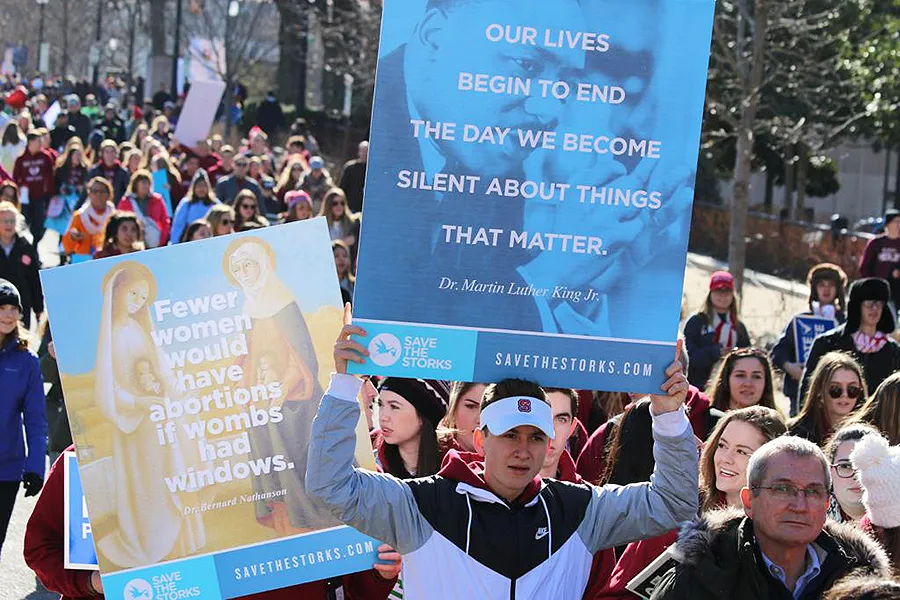
Washington D.C., Jan 19, 2018 / 04:54 pm (CNA/EWTN News).- They came from across the country and the globe to Washington, DC. for one purpose: to stand in solidarity with unborn children.

With a quite a few groups donned in matching hats and scarves – quickly rendered unnecessary due to the unseasonably warm January day – and clutching some innovative signs, the 45th annual March for Life went off without a hitch Jan. 19.

While the rally made history as President Donald Trump became the first sitting president to address the march via livestream video, the individual marchers to whom Catholic News Agency spoke over the course of the day were more concerned with the need to protect the unborn and to promote the dignity of life.

And they were big fans of the nice weather, of course.

The crowd was overwhelmingly young, and large groups from all over the country were spotted on the National Mall. A group of around 400 from Baton Rouge, La., made an impressive entrance, and the wave of white hats continued as far as the eye could see.

<blockquote class=”twitter-tweet” data-partner=”tweetdeck”><p lang=”en” dir=”ltr”>From earlier—here’s a small bit of the 400-strong contingent from Baton Rouge, LA at the <a href=”https://twitter.com/March_for_Life?ref_src=twsrc%5Etfw”>@March_for_Life</a> <a href=”https://t.co/XJN3oKe7ha”>pic.twitter.com/XJN3oKe7ha</a></p>&mdash; Catholic News Agency (@cnalive) <a href=”https://twitter.com/cnalive/status/954493345660919808?ref_src=twsrc%5Etfw”>January 19, 2018</a></blockquote>
<script async src=”https://platform.twitter.com/widgets.js” charset=”utf-8″></script>

The University of Mary had a three-bus contingent of about 150 students, faculty, and staff, who made the 30-hour car ride to Washington, D.C from Bismarck. The prospect of a long bus ride didn’t sway UMary junior Mary Kampa, who was returning to DC for her second March for Life in a row.

“Knowing that it’s not about the bus ride, and it’s not about me, and it’s for something much greater – standing up for the dignity of life,” Kampa told CNA. “I want to be a voice for the voiceless,” she continued.

Last year, the University of Mary contingent led the march. Kampa said that was an honor. This year, 20 students were present in the Rose Garden for Trump’s address.

And true to form, some UMary students were clad in short-sleeved shirts prior to the start of the pre-march rally. Kampa wasn’t surprised by this, considering the weather her and her classmates had left behind in North Dakota.

<blockquote class=”instagram-media” data-instgrm-captioned data-instgrm-permalink=”https://www.instagram.com/p/BeJeT5blJxh/” data-instgrm-version=”8″ style=” background:#FFF; border:0; border-radius:3px; box-shadow:0 0 1px 0 rgba(0,0,0,0.5),0 1px 10px 0 rgba(0,0,0,0.15); margin: 1px; max-width:658px; padding:0; width:99.375%; width:-webkit-calc(100% – 2px); width:calc(100% – 2px);”><div style=”padding:8px;”> <div style=” background:#F8F8F8; line-height:0; margin-top:40px; padding:50% 0; text-align:center; width:100%;”> <div style=” background:url(data:image/png;base64,iVBORw0KGgoAAAANSUhEUgAAACwAAAAsCAMAAAApWqozAAAABGdBTUEAALGPC/xhBQAAAAFzUkdCAK7OHOkAAAAMUExURczMzPf399fX1+bm5mzY9AMAAADiSURBVDjLvZXbEsMgCES5/P8/t9FuRVCRmU73JWlzosgSIIZURCjo/ad+EQJJB4Hv8BFt+IDpQoCx1wjOSBFhh2XssxEIYn3ulI/6MNReE07UIWJEv8UEOWDS88LY97kqyTliJKKtuYBbruAyVh5wOHiXmpi5we58Ek028czwyuQdLKPG1Bkb4NnM+VeAnfHqn1k4+GPT6uGQcvu2h2OVuIf/gWUFyy8OWEpdyZSa3aVCqpVoVvzZZ2VTnn2wU8qzVjDDetO90GSy9mVLqtgYSy231MxrY6I2gGqjrTY0L8fxCxfCBbhWrsYYAAAAAElFTkSuQmCC); display:block; height:44px; margin:0 auto -44px; position:relative; top:-22px; width:44px;”></div></div> <p style=” margin:8px 0 0 0; padding:0 4px;”> <a href=”https://www.instagram.com/p/BeJeT5blJxh/” style=” color:#000; font-family:Arial,sans-serif; font-size:14px; font-style:normal; font-weight:normal; line-height:17px; text-decoration:none; word-wrap:break-word;” target=”_blank”>We are the Pro-Life Generation! #marchforlife2018 #whywemarch #lovesaveslives #lifeatmary</a></p> <p style=” color:#c9c8cd; font-family:Arial,sans-serif; font-size:14px; line-height:17px; margin-bottom:0; margin-top:8px; overflow:hidden; padding:8px 0 7px; text-align:center; text-overflow:ellipsis; white-space:nowrap;”>A post shared by <a href=”https://www.instagram.com/universityofmary/” style=” color:#c9c8cd; font-family:Arial,sans-serif; font-size:14px; font-style:normal; font-weight:normal; line-height:17px;” target=”_blank”> University of Mary</a> (@universityofmary) on <time style=” font-family:Arial,sans-serif; font-size:14px; line-height:17px;” datetime=”2018-01-19T22:36:06+00:00″>Jan 19, 2018 at 2:36pm PST</time></p></div></blockquote> <script async defer src=”//platform.instagram.com/en_US/embeds.js”></script>

“It was negative 20 [degrees] last Sunday, so this is awesome,” she said, laughing.

Another big fan of the weather was Ave Maria University student John-Paul Arias. Arias was at his first March for Life, and unlike many of his classmates who were in DC, he flew up.

Arias said he thought it was important for men to “defend the life that we helped create,” and that they too had an important role in the pro-life movement. He said he was thrilled to be in Washington, and very excited to be at the march.

And despite AMU’s location in southwest Florida, it was somehow warmer in DC on Friday.


[…]

No Picture
News Briefs

Commentary: Aziz Ansari’s hookup was a game of Russian roulette

January 19, 2018 CNA Daily News 0

New York City, N.Y., Jan 19, 2018 / 03:00 pm (CNA).- There are better models of fraternal correction than telling the story of the horrible night you spent with comedian Aziz Ansari to a reporter from a casually crude website. But that was where “Grace” (a pseudonym) went to express what she didn’t have a way to say to Ansari—that he had hounded her physically; pressured her to go farther, faster than she wanted; and left her feeling wretched after their night together.

Grace spoke up, she said, because she saw Ansari wearing a “Times Up” pin and supporting the #MeToo movement, and she couldn’t see how he reconciled his support of women generally with the way he treated her particularly.

Grace’s story sparked many reactions. But if Aziz Ansari is reading all the thinkpieces about him, he must feel most ill-served by his allies. “Aziz Ansari Is Guilty. Of Not Being a Mind Reader” wrote Bari Weiss for the New York Times, exonerating Ansari in a singularly insulting way.

It’s unreasonable, Weiss and others write, to expect Ansari and other men to be able to know if they’re scaring or upsetting their one-night-stands. The solution isn’t for men to pay attention to women’s non-verbal cues, she writes, but for women to be much more aggressive in fending off men who make them feel uncomfortable or unsafe.

For all the worry about women defining themselves as snowflakes or victims, the defense offered to Ansari sounds much more cossetting than comforting.

What virtuous man would feel relieved to be told he is powerless to avoid harming the women he takes to bed? Who would be put at ease, after seeing a woman in tears, to be told that it’s not his fault, he couldn’t help it, there’s no way for him to know—he’s not a mind-reader.

If sex is always such a blind leap, with no way to take care of your partner, what good man could have an assignation and respect himself in the morning. The sexual culture Ansari’s supporters describe is a game of Russian roulette: eventually, every man will wind up deeply wounding a woman he’s taken to bed, but he may never even find out which lovers were the collateral damage of our hookup culture. (And, of course, he also may be coerced, objectified, or abused himself).

Ansari’s critics agree, in part, with his supporters. Those non-verbal cues are hard to read, so men (and women) should stick to a “Yes means yes” model of consent, waiting to hear explicit, enthusiastic consent before pushing things with a partner, they say.

The “affirmative consent” model, viewed simply as harm reduction, is an improvement over the “Not a Mind Reader” defense, but it still sells men and women short. It’s a way of camouflaging the fundamental problem: you can’t have generically respectful and ethical sex.

As long as men and women go to bed as strangers, it will be very difficult for them to take care of each other. The most egregious behavior can be minimized with affirmative consent, but who is aiming for a sex life that is simply “not assault?”

Sex that is a gift of self is intimate and particularized. You make a gift of your particular self to one other particular person. No one makes love to “a woman” or “a man” generically—those who try are engaged in something much more like mutual masturbation than intercourse.

Before couples get intimate—which starts, physically, well before sex—they must know and love each other. There must be trust, in each other, and trust that they share an understanding of what the good is, if each person is relying on the other to will his or her good correctly. (They must also be right about what that good consists of, but the other pitfalls are more obvious).

That means ethical sex starts long before clothes come off. The Catechism of the Catholic Church describes chastity as “the successful integration of sexuality within the person” (CCC 2337) and purity as that which “frees one from wide-spread eroticism and avoids those things which foster morbid curiosity” (CCC 530).

Both must become a habit, before it is possible to offer the gift of one’s sexuality to another. These virtues are a prerequisite to the other step Ansari and Grace skipped, getting to know the other person, to the point where you do know their non-verbal signals, because you see and know them in all their particularity.

One schoold for these virtues (and corrective to the culture) is the Angelic Warfare Confraternity, a fellowship of men and women pursuing chastity through prayer. Even someone not enrolled in the Confraternity can join (from time to time, or even every day) in the 15 Hail Marys that Confraternity member pray daily for chastity and purity. Joining in the Confraternity’s daily prayer is a particularly good redoubt to flee to in the case of temptation.


Leah Libresco Sargeant is the author of Arriving at Amen: Seven Catholic Prayers Even I Can Offer. Her writing has appeared at First Things, FiveThirtyEight, and The Washington Post.  Her opinions do not necessarily reflect the viewpoint of Catholic News Agency.


[…]