No Picture
News Briefs

What’s destroying some Catholic marriages? The answer may surprise you

January 25, 2018 CNA Daily News 1

Washington D.C., Jan 26, 2018 / 12:04 am (CNA).- Of the countless Catholic couples who have come through Father T.G. Morrow’s office in Washington D.C. for marriage counseling, two remain imprinted in the priest’s mind even today.

In many ways, these two Catholic couples were the ideal; they were open to life, they formed their children in the faith and they frequented the sacraments.

But both of these marriages fell apart. The culprit? Anger.

“Anger is a poison,” Fr. Morrow, a moral theologian and author of “Overcoming Sinful Anger” (Sophia Press, 2014) told CNA. “If a husband and a wife are angry with each other a lot, it destroys the relationship. It makes it so painful that people want to get out of that relationship.”

Everyone experiences the feeling of anger. It’s a natural, uncontrollable response to the behavior of others, he said. And anger can sometimes be righteous – St. Thomas Aquinas once said anger that’s aligned with reason is praiseworthy. But most often that natural response of anger morphs into sinful anger, which is motivated by a desire for revenge, the priest noted.

And this sinful anger has a devastating effect on relationships.

“It’s extremely important that people realize that (anger) can be a very serious thing, especially if they have major outbursts that really hurt other people,” Fr. Morrow said.

Anger is so destructive that many marriage experts recommend couples have five positive interactions for every negative interaction.  

“This anger, when it’s expressed badly, is a poison to every relationship,” he said. “Married people need especially to be careful about this…to work on this and to overcome this.”

Since the feeling of anger is natural and unavoidable, Fr. Morrow said it is important to know how to express anger or displeasure in an effective and positive way. The first step: decide if it is worth getting angry.

“People get angry about little, trifling things,” he said. “You have to say “Is this worth getting angry about?” If not, then you have to let it go. Just forget it.”

If your anger is justified and a confrontation would promote the good of the other, use humor or diplomacy to express your anger. If a confrontation would not promote the good of the other, then Fr. Morrow suggested offering that anger to God as a sacrifice for your sins and the sins of the world.

“(Anger) won’t go away automatically in one try,” he explained. “We have to keep giving it to God as a sacrifice.”

Fr. Morrow said this approach to anger does not mean every person should suddenly become a doormat who is too cowardly to express dissatisfaction with the actions of another.  

He used the example of St. Monica, the mother of St. Augustine of Hippo. Many of the men in Tagaste at the time had violent tempers, and St. Monica’s husband was no exception. When he would come home and yell at St. Monica, she would stay quiet. Some time after her husband’s explosion of anger, St. Monica would approach her husband and calmly address his treatment of her and his complaints.

“She was the furthest thing from a doormat,” Fr. Morrow explained. “She had a specific goal that she wanted to become holy and she wanted to covert her son. She pursued her goals ardently and as a result she converted her violent husband and eventually converted Augustine.”

Fr. Morrow’s book “Overcoming Sinful Anger” (Sophia Press, 2014) reads like a manual and draws from his experience as a marriage counselor and spiritual director and his doctorate in Sacred Theology from the Pope John Paul II Institute for Studies on Marriage and Family.

Photo credit: www.shutterstock.com

This article was originally published on CNA Aug. 14, 2015.

[…]

No Picture
News Briefs

Nuns, guns and the Wild West: the extraordinary tale of Sr. Blandina

January 25, 2018 CNA Daily News 0

Santa Fe, N.M., Jan 25, 2018 / 05:26 pm (CNA/EWTN News).- Billy the Kid, a notorious bank and stage-coach robber of the Wild West, met his match in the most unlikely of people when he met Sister Blandina Segale.

According to legend, and to Sr. Blandina’s journal and letters, one of Billy the Kid’s gang members had been shot and was on the brink of death when the doctors of Trinidad, Colo. refused to treat him. Sister decided to take him in and cared for him for three months, nursing him back to health.

But Billy the Kid (William Leroy) was still unhappy. Word got out that the outlaw was coming to town to scalp the four doctors of Trinidad in revenge. When he arrived, Sr. Blandina intervened, and convinced him to call off his mission on behalf of his man she had saved.  

After that incident, Sr. Blandina and Billy the Kid became friends. She once visited him in jail, and he once called off a stage-coach robbery as soon as he realized Sister was one of the passengers.

When she wasn’t calling off outlaws, Sr. Blandina was founding schools, building hospitals, teaching and caring for orphans and the poor, and advocating for the rights of Native Americans and other minorities. All in a day’s work.

Her heroic virtue and enduring works are why her cause for sainthood was opened in New Mexico in 2015, earning her the title “Servant of God” and allowing people to ask for her intercession. Since then, several documents have come to light corroborating her stories, and the necessary miracle for the next big step – beatification – seems to be well on its way.

“Sainthood isn’t about an award, it isn’t about honoring, it’s about helping the faithful know that there is a source of God’s grace being worked on Earth,” said Allen Sanchez, president and CEO for CHI St. Joseph’s Children in Albuquerque, which Sr. Blandina founded. Sanchez also serves as the petitioner for the cause of Sister’s sainthood and has studied her life extensively.

Her early years

Sr. Blandina, born Maria Rosa Segale, was just four years old when she emigrated with her parents from the small town of Cicagna, Italy to Cincinnati, Ohio in 1854 (she had her 5th birthday on the boat ride over).

At the age of 16, Maria Rosa joined the Sisters of Charity and took the name Sr. Blandina. When she was just 22 years old, she was sent – alone – to Trinidad in Colo. territory to teach in the public school there. A few years later, she was sent further south, first to Santa Fe and then to Albuquerque, New Mexico.

It was probably quite an adjustment, Sanchez said, going from Europe and the more settled parts of America to the still very rough-and-tumble west.

While in New Mexico, Sr. Blandina helped found the public health care system and the public school system by building the first hospitals and schools in Albuquerque, often asking for the temporary release of prisoners to help her with the labor.  

Much of what is known about Sr. Blandina’s life comes from a series of letters she wrote her sister, Sr. Justina Segale, who was back in Ohio. The compiled correspondences, which span the years of 1872-1894, were published ten years before Sr. Blandina’s death in 1941.

“You’re able to see the history of New Mexico happening within her interactions,” Sanchez said.

Sister stops a lynch mob

To open a cause for sainthood, examples of heroic virtue of the person must be shown. The specific example of heroic virtue that her petitioners are using involves another story that could only take place in the Wild West; the story that earned her the title “The Fastest Nun in the West” from a 1966 CBS feature on the incident.

Sr. Blandina was teaching school in New Mexico when one of her pupils told her, “Pa’s shot a man, and they’re going to hang him.”   

That’s when Sr. Blandina went to work. She met with the shooter, and was able to convince him to write a confession. She then met with the dying man, and convinced him to forgive his shooter – in person – before he passed away.

After the two men were reconciled, Sr. Blandina then had to face down the lynch mob that was coming to kill the shooter, who, because of Sister, was instead taken to the circuit court and was given life in prison. After nine months, he was released to go back home to care for his four children.

“She disarms them from their guns, their hanging rope and their hate,” Sanchez said of sister and the lynch mob.

“She must have been charming to them!” he added. “I think they would fall in love with her and do what she would ask them to do, because she cared for them and she honestly was able to see the dignity of every human being from the innocent orphans to the guilty outlaws.”

Sr. Blandina also made several trips to Washington, D.C. to meet with legislators and to advocate on behalf of the Native Americans, whose reservation boundaries were being drawn at the time.

And although her own life is being evaluated for sainthood, Sr. Blandina herself knew all about the canonization process – she helped to petition to Rome for the cause of two different saints in her lifetime; St. Elizabeth Ann Seton and St. Kateri Tekakwitha. She also helped bring now-St. Katherine Drexel and her sisters to the West to help serve the Native American populations.

The next step

In order to be beatified – one step away from canonization – there needs to be proof of an otherwise – inexplicable miracle brought about through that person’s intercession. There are several possible examples of this being explored, which makes those petitioning for Sr. Blandina hopeful that her cause will advance quickly.

“We know of a baby that was born prematurely with a malfunctioning valve in the heart and collapsed lungs,” Sanchez said. “This family immediately contacted us, said they were praying the Sr. Blandina novena for the baby. The doctors had very little hope for the baby living, but four days later they couldn’t find the problem in the heart, it was as if it didn’t exist to begin with. Doctors are saying it’s inexplicable, so we’re pursuing that, there’s many stories like that that are being pursued to see if Sr. Blandina was involved.”

The example of her life on earth is also important for the faithful today, Sanchez said, because Sr. Blandina knew how to address both immediate problems as well as more systemic problems of social justice.

“She would follow through from the charity to the social justice,” he said. “For example, she would help feed and house the railway workers, but then she would also ask why the railway workers weren’t being cared for. And that’s the call for us today. Charity is important, that’s where you start, and then you move to the social justice from there.”

Sister’s cause for canonization may take several years, depending on the approval of her heroic virtue and miracles attributed to her intercession, but Sanchez said the board that is petitioning her cause is hopeful that things will progress quickly.

“I’d say we’re more than halfway through the diocesan phase. For her to be called ‘venerable’, we just have to prove her heroic virtue,” he said.

If he had to describe her personality, Sanchez said, he would say she was tough but spunky, holy but unafraid of conflict.

“She wasn’t afraid of conflict and to roll up her sleeves and get the work done,” he said. “And she was always giving credit to the Gospel, to Jesus’ work.”

The best part of the process, Sanchez said, has been getting to know Sr. Blandina.

“I didn’t know this was going to be so fun and so inspiring,” he said. “And I really know her; she’s become my best friend.”

This article was originally published on CNA Aug. 1, 2015.

[…]

No Picture
News Briefs

Gov. Brownback confirmed as international religious freedom ambassador

January 25, 2018 CNA Daily News 0

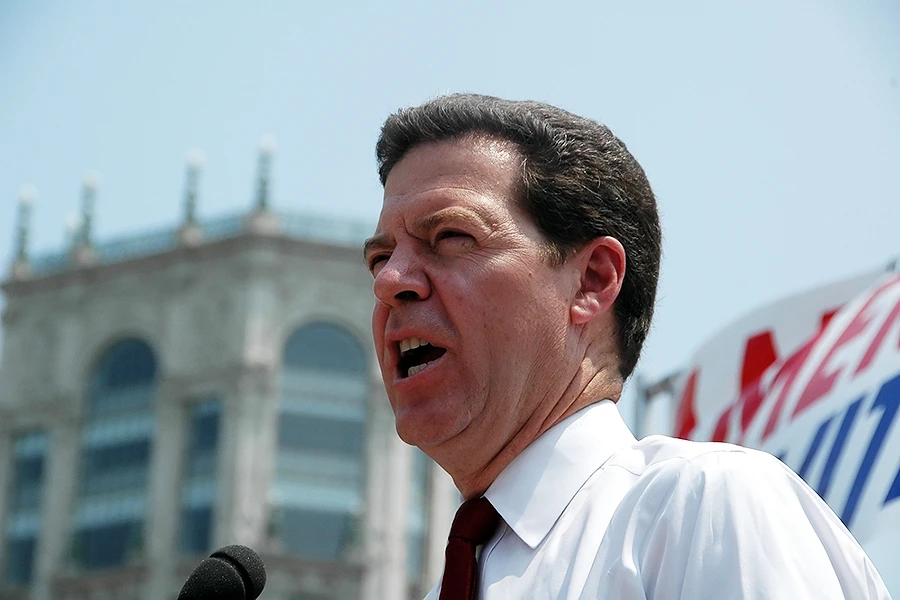
Washington D.C., Jan 25, 2018 / 04:03 pm (CNA/EWTN News).- Kansas Gov. Sam Brownback (R) was narrowly confirmed as the ambassador-at-large for international religious freedom Thursday. The Senate voted 49-49, along party lines, and the tie was broken by Vice President Mike Pence.

On Twitter, Brownback tweeted his appreciation to President Donald Trump, Pence, and everyone in the Senate who voted to confirm. He said he was “looking forward” to his new role and that he will work “hard for the American people and religious freedom around the world.”


Thank you to @POTUS, @VP, and all the Senators who supported my nomination. I’m looking forward to starting my new position as Ambassador and working hard for the American people and religious freedom around the world. #ksleg

— Sam Brownback (@govsambrownback) January 24, 2018


Brownback had to wait an unusually long time from when he was first nominated for ambassador-at-large until he was confirmed. He was nominated for the post in July, and had to be re-nominated in January after the Senate didn’t vote on whether to confirm him to the role.

The position of ambassador-at-large for international religious freedom was created in 1998. In this position, Brownback will now be the head of the State Department’s Office of International Religious Freedom. He replaces David Saperstein, who held the post for President Barack Obama’s second term.

Brownback will officially resign as governor of Kansas on Jan. 31st in order to assume his new position.

[…]

No Picture
News Briefs

Satanic Temple sues to end Missouri pro-life laws

January 24, 2018 CNA Daily News 2

St. Louis, Mo., Jan 24, 2018 / 06:00 pm (CNA/EWTN News).- Pro-life laws in Missouri have drawn the ire of members of the Satanic Temple, which has filed a lawsuit claiming the laws violate their religious freedom.

State law requires abortion providers to distribute a booklet from the Missouri Department of Health and Senior Services which includes the statement: “The life of each human being begins at conception. Abortion will terminate the life of a separate, unique, living human being.”

This law and others drew objections from the Satanic Temple and one of its members, whose lawsuit claims the restrictions violate her religious freedom. The politically active group, based in Salem, Mass., was founded by self-described atheists who profess disbelief in a literal Satan.

The plaintiff goes by the name Mary Doe in the lawsuit, not using her name due to fears of personal attack. In 2015 she traveled to a St. Louis Planned Parenthood clinic from southeast Missouri for the abortion.

The lawsuit seeks to block Missouri’s three-day waiting period for an abortion and a requirement that doctors who perform abortions offer the booklet to women seeking abortions. The suit further objects to requirement that abortionists must offer the women an ultrasound and a chance to hear a fetal heartbeat.

The plaintiff’s complaint says her professed tenets include a belief that a woman’s body is “inviolable and subject to her will alone” and that she makes health decisions regarding her health “based on the best scientific understanding of the world,” according to her complaint. The complaint says a pregnancy is “human tissue” and part of her body that “she alone” can decide to remove.

W. James MacNaughton, a New Jersey lawyer, represented her before the Missouri Supreme Court Jan. 23.

“It is a bedrock principle of our culture (and) of our country that we choose for ourselves what to believe by way of religious beliefs,” MacNaughton told the court, according to the Associated Press. “It’s not the business of government to tell us that.”

The Missouri attorney general’s office is defending the restrictions on abortion, saying religious freedom protections do not apply.

Solicitor General John Sauer told the court that such laws would only protect against obstacles to practicing one’s belief or being forced to violate one’s religion.

MacNaughton, the plaintiff’s lawyer, told the Washington Post the lawsuit was prompted by the Hobby Lobby decision favoring the store owners whose Christian beliefs conflicted with federal mandates to provide abortifacient contraceptives in their employee plans.

“I have thought the really defining issue is religion,” he said. “Are you committing murder when you have an abortion? That’s a religious question.”

The Satanic Temple has filed a similar lawsuit in federal court. Its website says its members and allies have provided “religious exemption and legal protection against laws that unscientifically restrict women’s reproductive autonomy.”

The group’s founders say they identify with Satan’s putative outsider role.

Lucien Greaves is one of the founders. In a statement, he contended the legal case showed the group is “on the front lines working to restore and preserve Enlightenment values.”

In 2014 the group attempted to stage a re-enactment of a satanic “black mass” at Harvard University, initially claiming it would use a consecrated Host from a Catholic Mass. The Harvard Extension Cultural Studies Club had intended to host the event on campus. The event was voluntarily moved from campus and then postponed indefinitely after loss of venue.

The group has also previously engaged in political advocacy.

In 2015 it had planned to place a statue of an occultic Baphomet figure on the grounds of the Oklahoma capitol on religious freedom claims. Shortly afterward, a court ordered the removal of a Ten Commandments monument on the capitol grounds.

In response to a Minnesota town’s debate over a veterans’ memorial that had a cross, the group proposed its own version of a memorial involving pentagrams.

[…]