No Picture
News Briefs

Pope Francis accepts resignation of vice president of German bishops’ conference 

March 25, 2023 Catholic News Agency 2
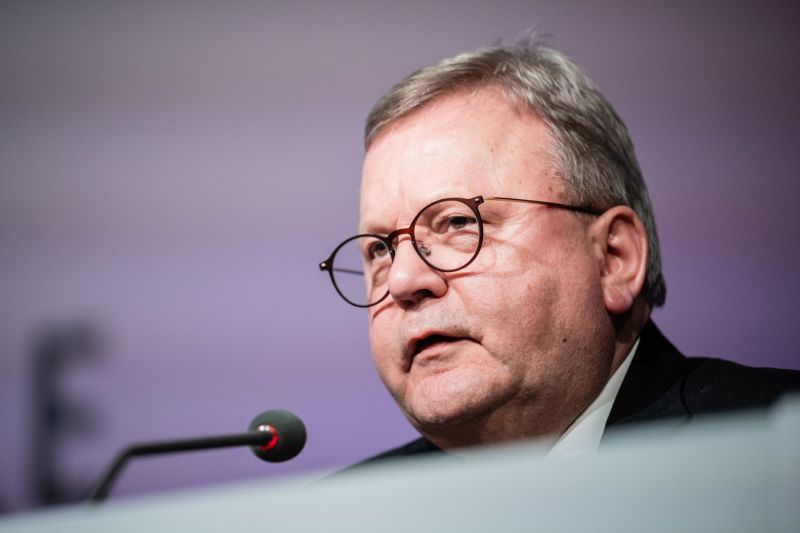
Bishop Franz Josef Bode of the Diocese of Osnabrück served as vice president of the German bishops’ conference from 2017 to 2023. / Courtesy of Synodaler Weg/Maximilian von Lachner

CNA Newsroom, Mar 25, 2023 / 08:56 am (CNA).

Pope Francis accepted the resignation of a German bishop on Saturday who played a key role in the German Synodal Way and had come under pressure over his handling of clerical sexual abuse in his diocese. 

Bishop Franz Josef Bode had previously refused to step down, despite an abuse report finding he had mishandled cases in his diocese in northwestern Germany. 

The Holy See announced March 25 that Pope Francis had accepted the bishop of Osnabrück’s request to resign, CNA Deutsch, CNA’s German-language news partner, reported. There was no indication prior to Saturday’s announcement that Bode had offered to resign.

The 72-year-old bishop had been vice president of the German bishops’ conference since 2017. 

Reacting to the news, Bishop Georg Bätzing — the conference president — said on Mar. 25: “Today I lose my closest companion on the Synodal Way, which still has many stages ahead of us.”

Only two weeks ago, Bode made headlines when he announced he would implement resolutions passed by the controversial process, including the introduction of liturgical blessings of same-sex unions. He previously publicly supported women deacons. 

In a statement published Saturday, Bode said: “In the almost 32 years of my episcopal ministry, almost 28 of them as bishop of Osnabrück, I have borne responsibility in a church that has not only brought blessings but also guilt.” 

“Especially in dealing with cases of sexualized violence by clergy, for a long time I myself tended to focus more on the perpetrators and the institution than on the victims,” Bode admitted. “I misjudged cases, often acted hesitantly, made many wrong decisions, and failed to live up to my responsibility as a bishop.”

Until two months ago, Bode repeatedly refused to resign, despite an interim abuse report published Sept. 20, 2022, finding he had mishandled abuse cases in the diocese he led since 1995.

The 600-page interim report was titled “Sexual violence against minors and vulnerable by clergy in the Diocese of Osnabrück since 1945.”

The report said in the first decades of his term, Bode “repeatedly” kept people accused of abuse in office or appointed them to other positions, including management tasks in youth pastoral care.

In December, an advisory body of sexual abuse survivors called for canonical procedures against Bode.

The victims’ council said it had filed an official complaint in Rome and referred to the decree Vos estis lux mundi, issued in 2019 by Pope Francis, which is aimed at providing norms and procedures for addressing the handling of clerical sexual abuse. The Vatican on Saturday announced that the pope has approved an updated version of those norms, which are now part of canon law.

In a statement accompanying their complaint, the council called on Archbishop Stefan Heße of Hamburg, head of the metropolitan archdiocese, to take “steps of action” against Bode.

In addition to Bode, several other prominent German bishops have been accused of mishandling cases of sexual abuse. They include Synodal Way initiator Cardinal Reinhard Marx, Synodal Way president Bishop Georg Bätzing — the successor to Marx as president of the bishops’ conference — and Hamburg’s Archbishop Heße.

All of them have so far remained in office.

[…]

No Picture
News Briefs

Pope Francis extends ‘Vos estis’ decree to counter both lay and clerical abuse

March 25, 2023 Catholic News Agency 3
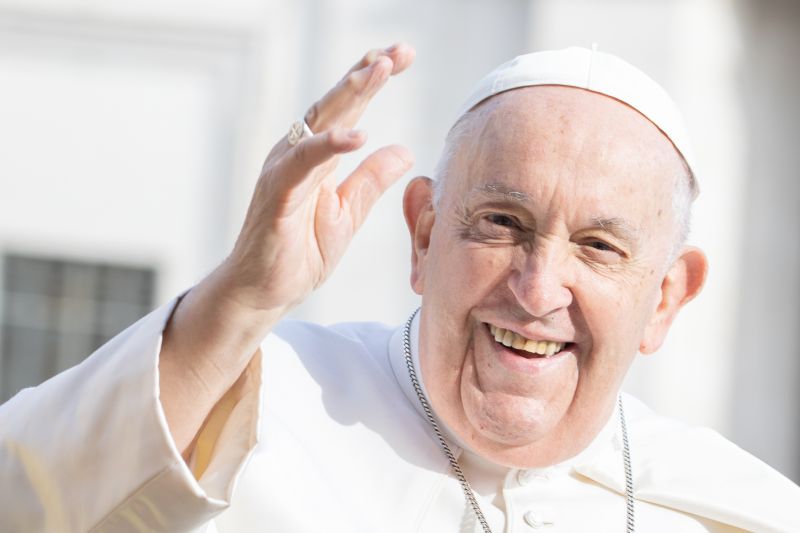
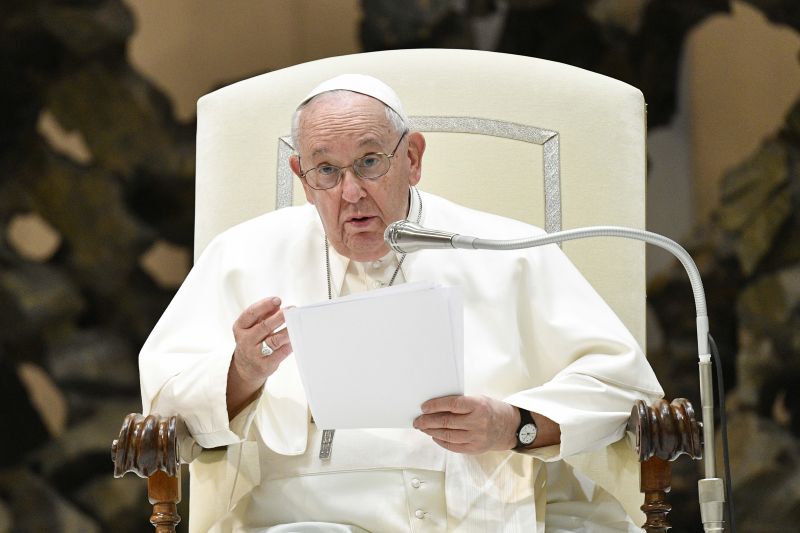
Pope Francis speaks at the general audience in Vatican City’s Paul VI Hall on Feb. 22, 2023. / Vatican Media

Rome Newsroom, Mar 25, 2023 / 08:20 am (CNA).

Pope Francis permanently decreed Saturday an updated version of Vos estis lux mundi, his landmark legislation to counter sexual abuse in the Catholic Church. 

The decree promulgated March 25 extends the Church’s norms for handling of abuse to cover lay leaders of international associations of the faithful recognized by the Vatican. 

Vos estis lux mundi (“You are the light of the world”) reaffirms an obligation to report cases of “vulnerable adult” victims of abuse, including violence against religious women by clerics and cases of harassment of adult seminarians or novices by a superior.

It also includes protections for people who witness acts of abuse, in addition to those who submit reports of alleged abuse, stipulating that no “obligation of silence” may be imposed on those who report, witness, or are victims of abuse.

The new norms will go into force on April 30 and replace the pope’s previous provisional version of Vos estis lux mundi published nearly four years ago.

The norms regard what are called, in canon law, “delicts against the sixth commandment of the Decalogue,” consisting of sexual acts with a minor or vulnerable person; forcing someone to perform or submit to sexual acts through violence, threat, or abuse of authority, and the production or possession of child pornography.

In the apostolic letter signed on the Solemnity of the Annunciation of the Lord, Pope Francis wrote that it is “good that procedures are universally adopted to prevent and combat these crimes that betray the trust of the faithful.”

The pope said that the updated version of the norms takes into account the comments he received from bishops’ conferences and the Roman Curia on Vos estis lux mundi since it was published.

Pope Francis first promulgated Vos estis lux mundi in May 2019 on an experimental basis for a period of three years. 

The norms for the Church’s handling of sex abuse placed seminarians and religious coerced into sexual activity through the misuse of authority in the same criminal category as abuse of minors and vulnerable adults.

The decree also established obligatory reporting for clerics and religious, required that every diocese had a mechanism for reporting abuse, and put the metropolitan archbishop in charge of investigations of accusations against suffragan bishops.

According to the law, the metropolitan archbishop conducts the investigation into a suffragan bishop with a mandate from the Holy See. The metropolitan is required to send reports to the Holy See on the progress of the investigation on a strict timeline.

The metropolitan archbishop may use the assistance of qualified lay people in carrying out the investigation, though it is primarily his responsibility, the norms state. Bishops’ conferences may establish funds to support these investigations.

Since the pope first promulgated Vos estis lux mundi, a number of bishops have been investigated and sanctioned under the norms for mishandling of abuse cases, including U.S. Bishop Michael Hoeppner of Crookston, Minnesota, and several Catholic bishops in Poland.

Brooklyn Bishop Nicholas DiMarzio was cleared after a Vos estis lux mundi investigation found no “semblance of truth” in the allegations of abuse. 

Holding leaders accountable

The new norms call for the presumption of innocence of all those who are under investigation and to safeguard “the legitimate protection of the good name and privacy of all persons involved, as well as the confidentiality of personal data.”

The updated version also requires that dioceses and eparchies must have an office or organization that is easily accessible to the public to receive reports of abuse, which include not only abuse of children and vulnerable adults but also covers sexual violence and harassment resulting from the abuse of authority. 

Archbishop Filippo Iannone, the prefect of the Vatican Dicastery for Legislative Texts, explained that the latest version of Vos estis lux mundi “takes up what has already been established by the new penal law canon law, in force since December 2021, and identifies them in minors, in those who habitually have an imperfect use of reason, and in vulnerable adults to whom the law ensures particular protection.”

“I believe this new norm, wanted by the pope, demonstrates the particular attention that the Church reserves for the weakest and most defenseless people, whose freedom and dignity must be respected and protected by all, punishing their violation in an exemplary way,” Iannone said.

Cardinal Blase Cupich, the archbishop of Chicago, also had high praise for the permanent application of Vos estis lux mundi.

“I think that this document is a clear indication that the Holy Father is saying that people in authority in the Church are going to be held responsible for how they handle [abuse],” Cupich said in an interview with Vatican News published March 25.

“So, it’s a clear indication that the Holy Father is going to hold people responsible, not only those who have committed abuse, but those in authority who have responsibility for handling them in a way that protects victims and gives justice to victims.”

Cardinal Charles Scicluna, the adjunct secretary of the Dicastery for the Doctrine of the Faith, said that the pope’s official confirmation of Vos estis lux mundi introduces new elements “in the history of Canon Law, such as the criminal relevance of the abuse of a vulnerable adult.”

“Among the changes is a further clarification of who the victims of abuse are. Previously, we spoke of minors and vulnerable persons, now we also speak of ‘vulnerable adults’ and ‘persons who habitually have an imperfect use of reason,’” Scicluna said.

He added: “This law concerns the future and makes it very clear that when it comes to an allegation against a lay person in the leadership of an international association, reference must be made to this particular law which has become universal.”

In the pope’s apostolic letter, Francis underlined that “crimes of sexual abuse offend Our Lord, cause physical, psychological and spiritual harm to the victims and harm the community of the faithful.”

“In order for these phenomena, in all their forms, [to] never happen again, a continuous and profound conversion of hearts is needed, attested by concrete and effective actions that involve everyone in the Church, so that personal sanctity and moral commitment can contribute to promoting the full credibility of the Gospel message and the effectiveness of the Church’s mission,” Pope Francis said.

[…]

No Picture
News Briefs

Pope Francis: Christian witness requires consistency between how one lives and what one proclaims

March 22, 2023 Catholic News Agency 3
Pope Francis greets pilgrims at the Wednesday general audience in St. Peter’s Square on March 22, 2023. / Daniel Ibanez/CNA

Vatican City, Mar 22, 2023 / 05:20 am (CNA).

To effectively witness to the Gospel, Christians need to be consistent in what they believe, how they live, and what they preach, Pope Francis said Wednesday.

“The witness of an authentically Christian life involves a journey to holiness,” Pope Francis said on March 22.

Speaking at his weekly audience in St. Peter’s Square, the pope underlined that Christian witness must include “professed faith” of what the Church teaches that transforms both one’s relationships and “the values that determine our choices.”

“Witness, therefore, cannot be separated from consistency between what one believes, what one proclaims, and how one lives,” he said.

“A person is credible if there is harmony between what he believes and how he lives. Many Christians only say they believe, but live something else … and this is hypocrisy.”

The pope asked the crowd to reflect on three questions first posed by Paul VI in his apostolic exhortation on evangelization in the modern world, Evangelii nuntiandi: “Do you believe what you are proclaiming? Do you live what you believe? Do you preach what you live?”

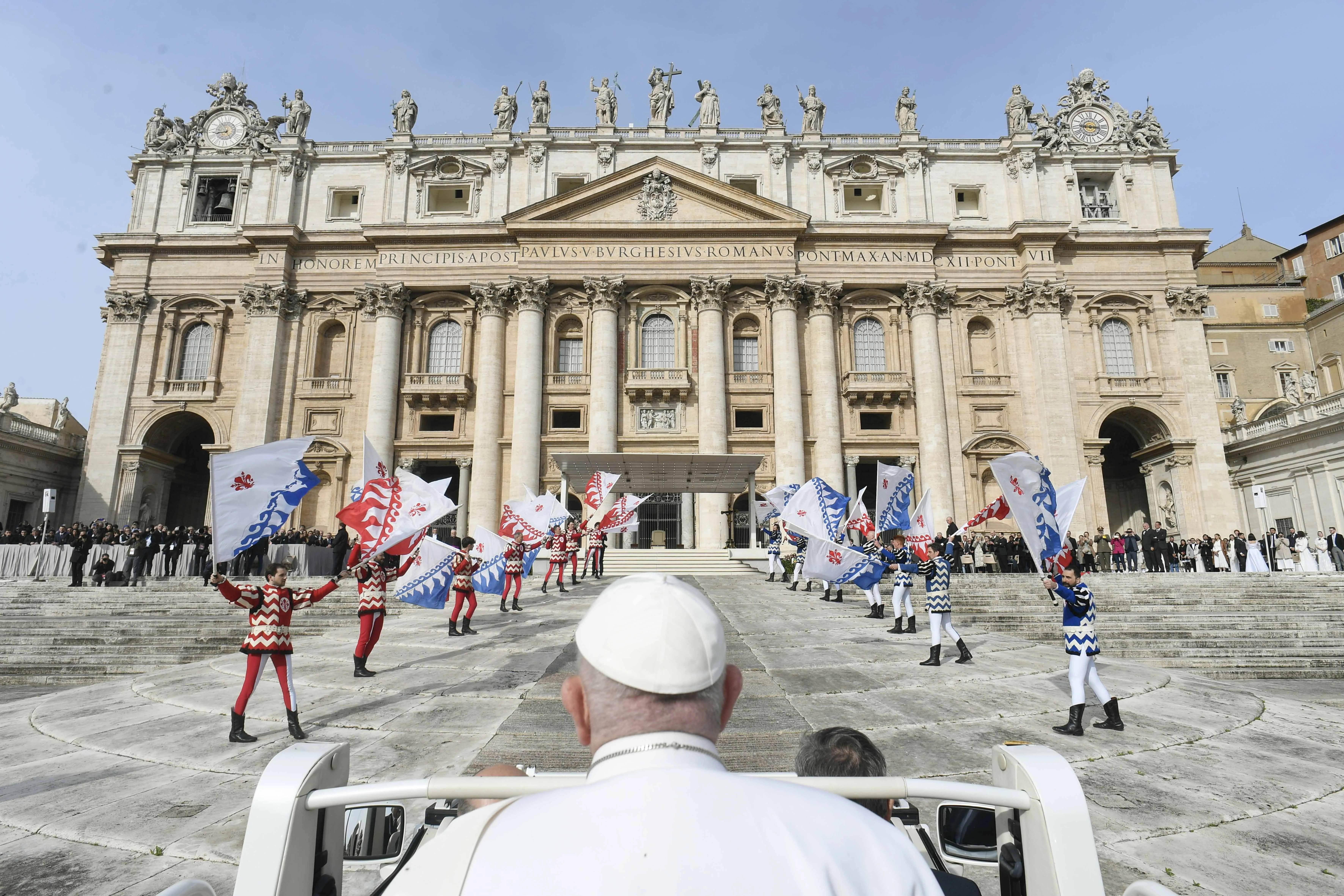
Pope Francis arrived at the general audience in the popemobile to a Florentine flag corps performance by a group that seeks to preserve  Tuscany’s medieval and Renaissance traditions. Vatican Media
Pope Francis arrived at the general audience in the popemobile to a Florentine flag corps performance by a group that seeks to preserve Tuscany’s medieval and Renaissance traditions. Vatican Media

Pope Francis emphasized that holiness is “not reserved for a few” but is “a gift from God that demands to be received and made to bear fruit for ourselves and for others.”

“Paul VI teaches that the zeal for evangelization springs from holiness, springs from a heart that is full of God,” he said.

“Nourished by prayer and above all by love for the Eucharist, evangelization, in turn, increases holiness in those who carry it out.”

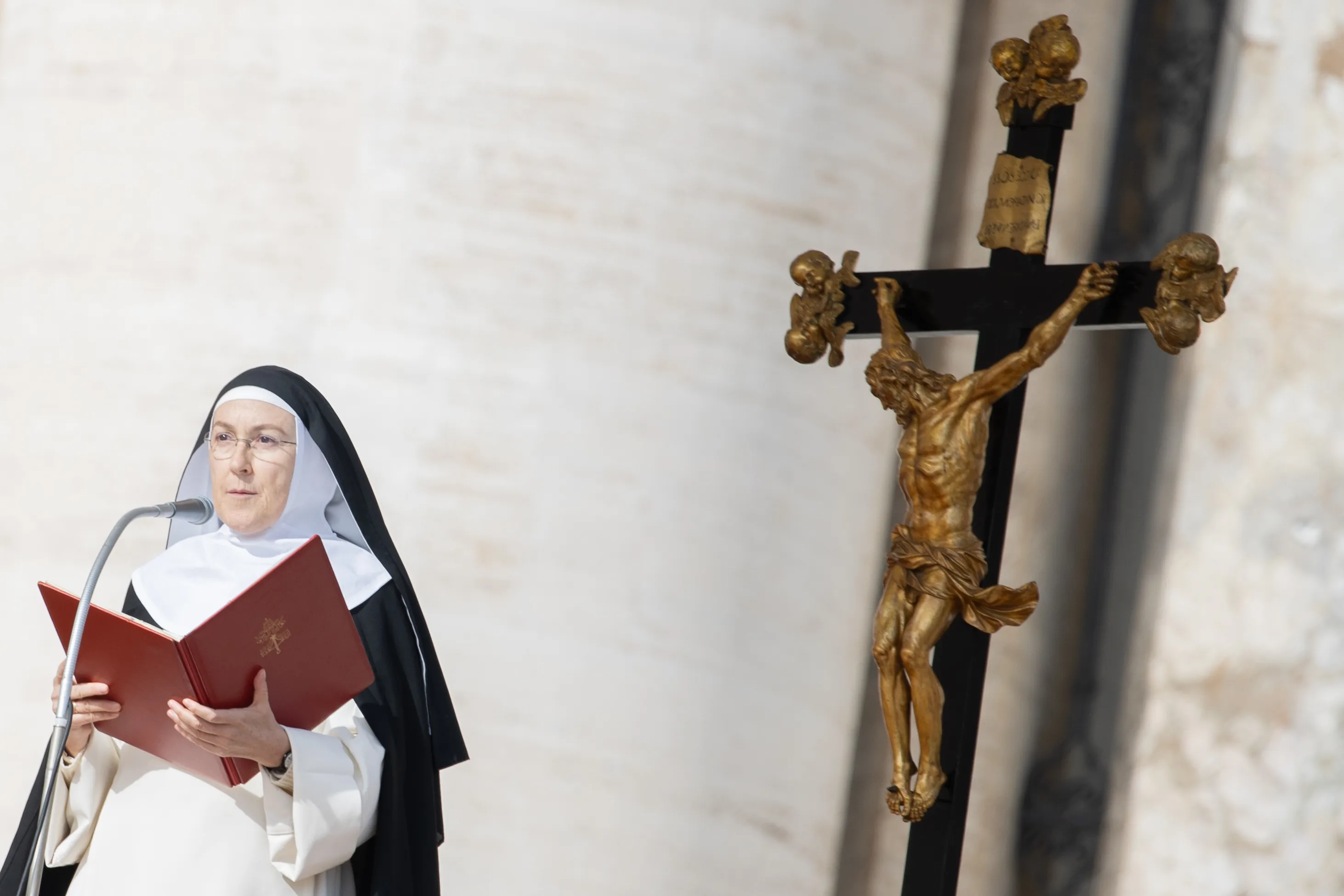
A reading from the New Testament was proclaimed in different languages at the Wednesday general audience in St. Peter's Square on March 22, 2023. Daniel Ibanez/CNA
A reading from the New Testament was proclaimed in different languages at the Wednesday general audience in St. Peter’s Square on March 22, 2023. Daniel Ibanez/CNA

Because of the importance of bearing witness to the Gospel, Pope Francis said that it is necessary for the Church to constantly be “evangelizing herself.”

“Indeed, ‘she needs to listen unceasingly to what she must believe, to her reasons for hoping, to the new commandment of love. She is the People of God immersed in the world, and often tempted by idols … and she always needs to hear the proclamation of the mighty works of God … this means that she has a constant need of being evangelized if she wishes to retain freshness, vigor, and strength in order to proclaim the Gospel,’” he said, quoting Evangelii nuntiandi.

“A Church that evangelizes herself in order to evangelize is a Church that, guided by the Holy Spirit, is required to walk a demanding path of continuous conversion and renewal,” he added.

A traditional Florentine flag corps performed for the pope at the general audience on March 22, 2023. Daniel Ibanez/CNA

Pope Francis arrived at the general audience in the popemobile to a Florentine flag corps performance by a colorfully-clothed group that preserves the music and traditions from Tuscany’s medieval and Renaissance history.

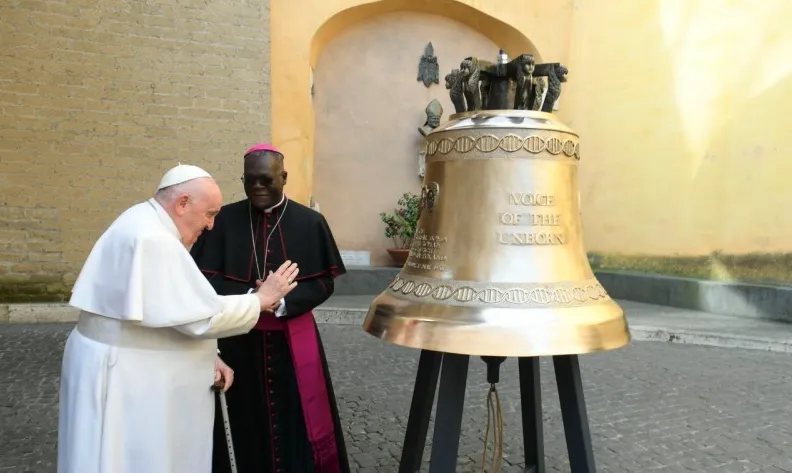
At the end of the audience, the pope blessed a large bell engraved with the words, “Voice of the Unborn,” which will be installed in Lusaka, Zambia.

The giant bell was forged in the workshop of Jan Felczyński in Przemyśl, Poland as part of an initiative by the Polish Yes to Life foundation. Pope Francis has previously blessed “Voice of the Unborn” bells for Poland, Ecuador, and Ukraine.

Francis called the bell a “sign of the need to protect human life from conception to natural death.”

Pope Francis blessed blessed a large bell engraved with the words, “Voice of the Unborn,” which will be installed in Lusaka, Zambia. Vatican Media

“Let its sound carry the message that every life is sacred and inviolable. I bless you from my heart,” he said.

Pope Francis also recalled the upcoming anniversary of his consecration of Russia and Ukraine to the Immaculate Virgin Mary on March 25, the Solemnity of the Annunciation.

“Let us not tire of entrusting the cause of peace to the Queen of Peace,” the pope said.

“Therefore, I would like to invite each believer and community, especially prayer groups, to renew every March 25 the act of consecration to Our Lady, so that she, who is Mother, may guard us all in unity and peace.”

[…]