No Picture
News Briefs

After years of exile, Dominican sisters return to Iraq’s Nineveh Plain

August 9, 2017 CNA Daily News 0

Erbil, Iraq, Aug 9, 2017 / 04:32 pm (CNA/EWTN News).- After three years in exile from Iraq’s Nineveh Plain while it was occupied by the Islamic State, the Dominican Sisters of St. Catherine of Siena are returning to their homeland to face the daunting challenge of rebuilding their destroyed communities.

“Three years ago, we left our homes at night to the unknown. We started a journey of displacement, exile and questioning,” stated an Aug. 6 open letter from the Dominican Sisters in Erbil.

“Despite everything, we always dreamed of going back and finding our houses safe and sound, just as we left them. We strongly wished that we would return and kindle our candles for prayers, harvest our grapes, and read our books,” the letter continued.

In 2014, the Nineveh Plain was overtaken by the Islamic State, forcing tens of thousands into exile and displacement. The Nineveh Plain territory lies between the city of Mosul, the country’s second-largest city, and Iraqi Kurdistan.

In the fall of 2016, two years after the Islamic State claimed the Nineveh territory, Iraqi forces made significant military gains and liberated the Nineveh Plain. Many scattered families were able to return to their towns with hope for the future.

“God showered us with His graces as our towns were liberated, one after the other; ISIS was defeated and the Plain of Nineveh seems to have been liberated,” the Dominican Sisters wrote.

While the territory is now seemingly safe from Islamic State forces, the Sisters said that it “does not mean that the Plain of Nineveh is entirely cleansed from that mentality.”

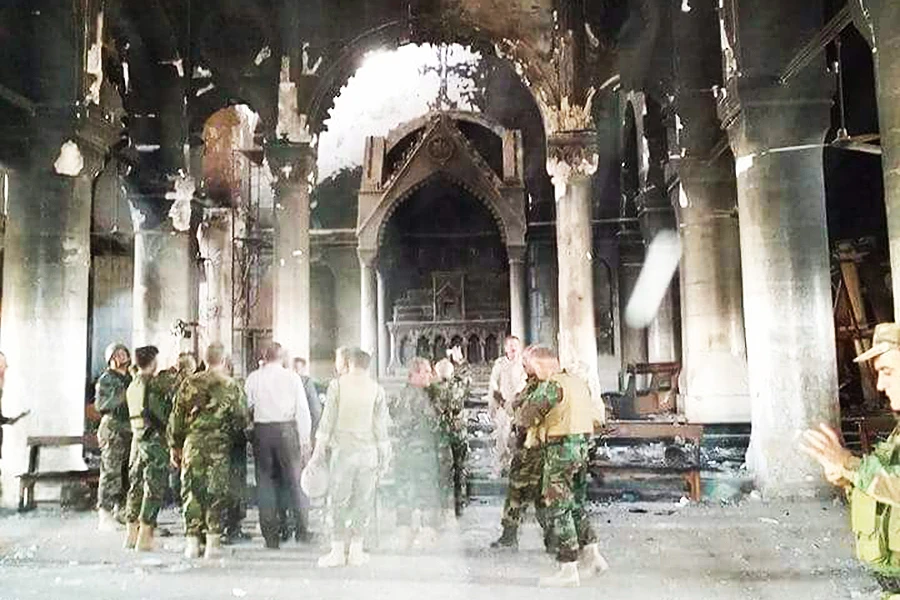
Upon returning to their homes, many found graffiti on the walls in their towns that read “we’re going to break your crosses,” and “you have no place with us.” Some churches were found to have battle instructions etched on the walls, with piles of deadly chemicals in the corners.

In addition, the physical damage left behind is overwhelming. Upwards of 6,000 homes are in need of repair or complete rebuilding just in the city of Bakhdida, also known as Qaraqosh. The families who still have standing houses are few and far between.

“We were so much stunned by the damage we saw. It was badly painful to see all that overwhelming destruction,” the sisters said.

“We immediately realized that it was not military forces or smart weapons that caused all the damage, but hate,” the sisters wrote, saying “hate leaves both oppressed and oppressor deeply winded.”

Some towns, such as Batnaya, were left 90 percent destroyed and the process of cleaning up has only begun. Another town, Bakhdida, was only 30 percent destroyed, but the NGOs who are helping with its repairs “are not enough compared to the destruction.”

Volunteers and locals hope to rebuild or repair as many homes as they can by September, which would be the beginning of the school year. However, the sisters noted that only the Church and some NGOs are actively involved in the long and expensive rebuilding process.

Many families have decided not to return to their communities due to the overwhelming loss of their homes. Others don’t return because they can no longer trust their neighbors. The sisters said that “we knew that it was our neighbors who betrayed us and did us harm, even before ISIS did.”

“It is not easy to decide whether to go back,” the Sisters continued, saying that their own convent in Bakhdida was also partially destroyed.

However, the sisters have decided to return to the Nineveh Plain, and they will be living in a family home in Telskuf until their convent has been repaired. The sisters also need to rebuild the orphanage which had been burnt down, and hope to start a kindergarten by the fall.

Although the aftermath of Islamic State’s occupation of the Nineveh Plain is significant, the sisters are hopeful for the future. Some families have been able to return to their homes, and the sisters are grateful that some of the rebuilding process that has already begun.

“Today, we see the marvelous work of God,” the sisters reflected.

“God is with us and will not leave us. We thank you for all the support you have shown us. Please pray for us as we start this new phase of our lives.”

[…]

No Picture
News Briefs

Vote wisely, seek peace, bishops say ahead of Kenya’s elections

August 4, 2017 CNA Daily News 0

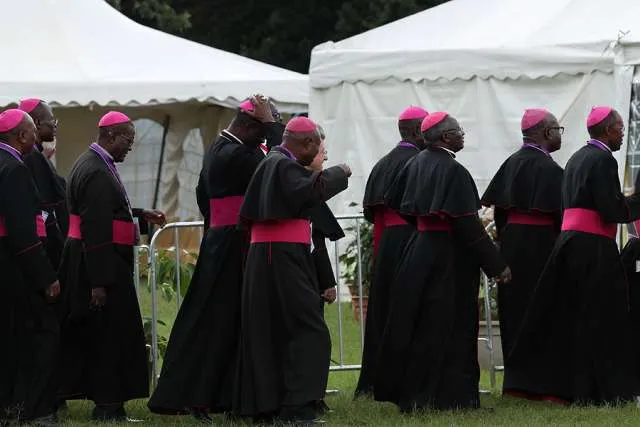
Nairobi, Kenya, Aug 4, 2017 / 05:04 pm (CNA/EWTN News).- With Kenya’s elections fast approaching, the country’s Catholic bishops are asking voters to choose wisely and encouraging all Kenyans to pray for peace.

“We are calling upon all Kenyans to seize this opportunity to exercise our constitutional right and give ourselves leaders of integrity,” Bishop Philip Anyolo of Homa Bay, chairman of the Kenyan bishops’ conference, said on behalf of Kenya’s bishops July 28.

“We need to create a peaceful environment, to demonstrate our patriotism for our wonderful country, and ensure that all parts of Kenya are in peace,” he added.

The bishops’ letter ahead of the Aug. 8 elections takes its title from Jeremiah 29:7, “Seek Peace and Prosperity.” They called on all Kenyans to join in prayer for their country, and a novena for peaceful elections will take place July 30-Aug. 7.

“Peace, Peace, Peace,” the bishops repeated.

Voicing appreciation for the relatively peaceful manner of the political campaigns, the bishops urged candidates to continue to conduct themselves “with decorum and sobriety” in the interests of national unity.

Kenya’s 2007 elections resulted in nationwide ethnic violence that killed 1,300 people and displaced 700,000.

The bishops appealed to young people “to restrain themselves from violence and instead be the agents of peace.”

“We exhort them to uphold to the culture of peace and engage in activities of peace-building,” they said.

The bishops pledged to work closely with election observers, state agencies, and non-state actors involved in the election.

The bishops praised the achievements of the Independent Electoral and Boundaries Commission and encouraged it to secure just, fair, credible and peaceful elections.

The run-up to the election has been marred by the apparent torture and killing of Chris Msando, a systems development manager at the elections commission, the Catholic News Agency for Africa reports. He had been scheduled to test the technology involved in voting and tallying the election results on July 31. His body was found on the outskirts of Nairobi.

The killing was denounced as “barbaric” by the bishops.
“Life is sacred and only God who gives it freely should take it away when He so desires,” they said.

The bishops also addressed the media, calling them a “very crucial actor” in the electoral process, and encouraging the media to show continued professionalism and commitment to fulfilling its duties.

Kenya’s President Uhuru Kenyatta is seeking re-election.

In his 2013 race for the presidency, he and his deputy William Ruto had been indicted by the International Criminal Court on charges of crimes against humanity. His campaign prompted warnings from the U.S. and U.K. governments if he were elected, BBC News reports.

However, the warnings did not have much consequence. He mobilized many African leaders to pressure the international court. Both cases were dropped due to a lack of evidence, with the International Criminal Court saying prosecution witnesses were intimidated and the cases could resume.

Kenyatta, the son of Kenya’s first president, has portrayed his 72-year-old opponent Raila Odinga as an agent of foreign governments who works to serve former colonial powers. He has also portrayed Odinga as an “analog generation” of politicians who must make way for the younger “digital generation.” His family owns a TV channel, a newspaper, and a number of radio stations, among many other business interests.

Odinga, a son of Kenya’s first vice-president, is making his fourth bid for the presidency. He has had different policies alliances in his career and is now running under the National Super Alliance, a coalition of Kenya’s main opposition groups. He aims to win drawing from his ethnic community, the Luo, as well as the Luhya, Kalenjin and Kamba groups.

Odinga studied to be a mechanical engineer in former East Germany, and was MP for Africa’s biggest slum, Kibera. He was imprisoned for attempting to stage a coup in 1982 against a one-party dictatorship. Though he initially denied the claim, he admitted his central role in a 2006 book. He was imprisoned from 1982-1988 and 1989-1991.

He has promised to serve only one term in office and has convinced many potential rivals to back his candidacy instead.

[…]

No Picture
News Briefs

Malawi’s government encourages local Catholic media

August 3, 2017 CNA Daily News 1

Karonga, Malawi, Aug 3, 2017 / 10:03 am (CNA/EWTN News).- Mawali’s information, communication and technology ministry praised the country’s Catholic media this week for their evangelization efforts as part of the 51st Communications Sunday.

Information Minister Nicholas Dausi, a Catholic, extended this support to the Church after touring the offices of Tuntufye FM, the Diocese of Karonga’s radio station.

Later in the day, he addressed Catholic media outlets at St. Mary’s parish in Karonga. In doing so, he challenged them to not be brought down by negativity in their coverage.

“We should not thrive on bad news or something that is defamatory to our colleagues. Using Church media is crucial for the evangelization drive,” he said.

He praised the groups and affirmed the government’s support.

“I am impressed with the way Tuntufye FM of Karonga diocese is doing. They are doing fine, and we will support them,” he said.

Bishop Martin Mtumbuka of Karonga then said Mass, and both issued a challenge and stated his gratitude to those gathered.

“I would like to challenge our media houses and those working in these (media) houses to be more professional. We thank God for the gift of all communication tools. However, we are challenging ourselves to use them effectively. We can do much better than what we are doing with our television stations, radio stations and newspapers,” said Bishop Mtumbuka.

“Let us offer the message of faith for the glory of God and the development of this nation. We are the ones to champion this, and this can be done based on the way we do things. Let’s do things in a coordinated manner and be innovative,” he added.

At the same celebration, Bishop George Tambala of Zomba, the Malawian bishops’ social communications chair, reflected on Pope Francis’ message for World Communications Day.

“Pope Francis challenges us all to break the various circle of anxiety and stem the spiral of fear that results from a constant focus on bad news such as war, terrorism, scandals and all sorts of human failure,” said Bishop Tambala.

He also noted that Francis’ message challenges that “all media practitioners should search for an open and creative style of communication that never seeks to glorify evil but instead to concentrate on solutions and inspire a positive and responsible approach on the part of its recipient.”

Malawi’s Catholic media outlets include the bishops’ social communications commission; Radio Maria Malawi; Radio Alinafe; Tigabane Radio; Tuntufye FM; Luntha Television, Montfort and Likuni Press.

[…]

No Picture
News Briefs

Catholic schools are a pillar of Church in Sudan

August 1, 2017 CNA Daily News 1

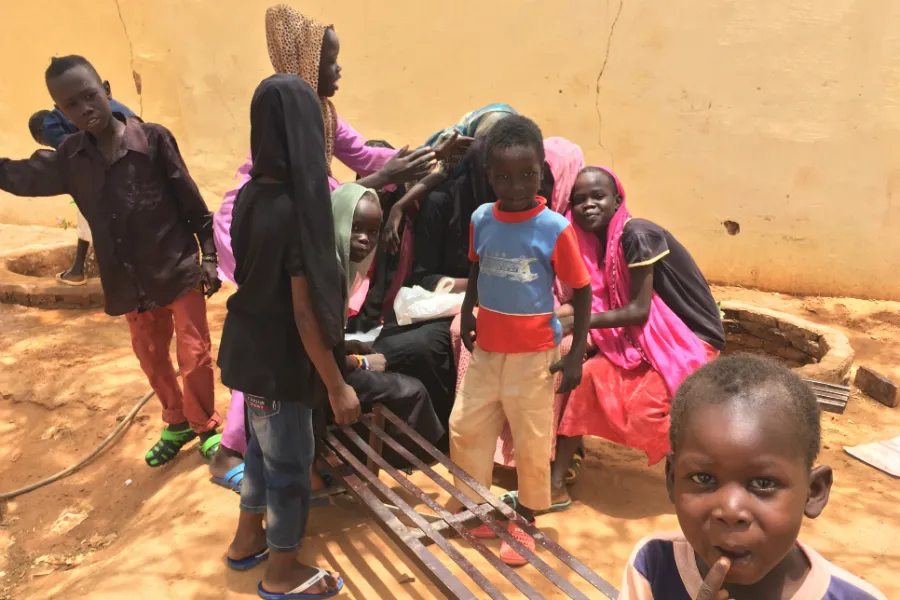
Khartoum, Sudan, Aug 1, 2017 / 06:01 am (CNA).- Dust and mud brick houses everywhere – as far as the eye can see. The houses are indistinguishable in color from the ground on which they stand. Trees are few and far between.

The road leading northwards from the Sudanese capital of Khartoum shimmers in the burning heat. The temperature tops 110 degrees. At a certain point the car turns off into an unpaved road with deep potholes, entering a residential suburb.

“Welcome to the St. Kizito School of Dar es Salaam,” says our host, Father Daniele, as we stand in the courtyard of the school, which is named after the youngest of the Ugandan martyrs. This Italian priest is a member of the clergy of the Archdiocese of Khartoum. His fluent Arabic enables him to communicate with the people of his parish in their own language.

“I belong to the Neo-Catechumenal Way and I studied at our seminary in Beirut. I’ve been living in Sudan now for more than 10 years” – a move he has never regretted, he tells his visitor from international Catholic charity Aid to the Church in Need (ACN).

“But it is an extremely difficult pastoral challenge for priests here,” he adds. This has to do more than anything with the life circumstances of his parishioners.

Fr. Daniele explains: “They are totally uprooted people. The parishioners here are for the most part come from the Nuba mountains in the south of Sudan. Their lives there were marked by the customs and traditions of their villages. But here, far from their homeland, they are completely lost.”

Many of the people many years ago came to the Khartoum area, in search of work or in order to escape the fighting in their homeland. But most of them can only survive as day laborers, and this eats away at the men‘s sense of self-worth.

“Many of them simply drift around idly when they don‘t have any work,” says Fr. Daniele, and many have no work at all. “In their traditional view of themselves, they are herders and warriors. But since there is no fighting no herding to be done here, all the work falls on the shoulders of the women.”

Unlike 90 percent of the Sudanese people, who are Sunni Muslims, the people of the Nuba mountains are Christians. There are often syncretic tendencies, with belief in magic rubbing shoulders with the Christian faith. For this reason Fr. Daniele attaches great importance to helping people grow in their faith. He says: “I want to show people above all that, despite their poverty, God loves them – and each of them individually.”

This is not always easy to understand for people imbued with a tribal way of thinking, he explains. But at least he has no concerns about church attendance. “The people come in large numbers to church. On Sundays our church is full,” he tells us.

“It is extremely important that the church be a beautiful and worthy place,” Fr. Daniele stresses, “as it is undoubtedly the most beautiful place in the lives of these people, who otherwise know only their own poverty-stricken huts and homes.“

Fr. Daniele has a particular concern for the children, and the parish school is his most important resource in this respect.

“Many of the children would spend the whole day roaming around the streets if they didn‘t come to us in school,” he explained. “Their parents show little concern for them. Attention, and even tenderness, is something most of them have never experienced, and above all not from their fathers.”
 
Fr. Daniele works hard to convey to the children a sense of their own self-worth. He says: “We want to show them that they are respected, precious people, loved by God. We do so by listening to each one of them and showing them respect.”

Precisely because the circumstances of the children are so difficult and their families so large and so poor – eight children or more is by no means unusual – the priest places great hope in the schools, saying that “however modest our means are here, without education the children will have no chance of a better life.”

Indeed, the Catholic school system is one of the pillars of the small Church in Sudan. For one Church official, who requested that his name not be used, the Church educational system is crucially important.

The official explains: “Our schools gain us acceptance among the majority Muslim community, and above all with the state. The state is strongly Islamic, but – because of the rapid population growth, the number of people moving into cities and limited public resources – its budget is overstretched and insufficient to provide enough schools. Hence, the government is happy to see the Church involved. As a Church we maintain almost 20 public schools in the city of Khartoum alone, and permission to build schools, unlike permission to construct churches, is something that is always granted to us.”

The schools are attended both by Christians and by Muslims. The Church official acknowledges that the quality of the schools is not the best. He says: “after all, we hardly have money for teachers and books, and nor do our students.”

But no pupil is refused admittance, even if he or she cannot afford the school fees. “For the children of the poorest families the school is the only possibility of bringing a little order into their lives,” the official stresses.

ACN is committed to support the Catholic schools in Sudan.

“The Church in Sudan has asked us for help,” says Christine du Coudray-Wiehe, who oversees ACN-funded projects in Sudan.

“It is an urgent necessity to respond, as the majority of the pupils are from Catholic families from southern Sudan,” she added. “It is vital for these families that are children be able to attend a Christian school – for this is the only way we can prevent them from being Catholics at home and Muslims at school.”


Oliver Maksan writes for Aid to the Church in Need, an international Catholic charity under the guidance of the Holy See, providing assistance to the suffering and persecuted Church in more than 140 countries. www.churchinneed.org (USA);www.acnuk.org (UK);www.aidtochurch.org (AUS); www.acnireland.org (IRL);www.acn-aed-ca.org (CAN)

[…]

No Picture
News Briefs

A Church on mission – Zambia celebrates 125 years of the Catholic faith

July 27, 2017 CNA Daily News 1

Lusaka, Zambia, Jul 28, 2017 / 12:08 am (CNA/EWTN News).- As Zambia concluded a year of celebration marking 125 years since the Church was established in the country, its bishops have said that while it was once a missionary Church, it is now a Church on mission.   

“Share your faith with other people, members of your extended families, and with other Zambians. Faith that is not shared remains small and is infantile. Faith shared is multiplied,” Archbishop Telesphore Mpundu of Lusaka said at a July 14-15 ceremony in the nation’s capital.

“Since the Church in Zambia has grown, it is now time to send missionaries to the world,” agreed the Apostolic Nuncio to Zambia, Archbishop Julio Murat, noting it was time to be a witness to Western countries.

The two-day celebration included a focus on youth and on the variety of Catholic acitivities, highlighting the differences among the 11 Zambian dioceses.

Fr. Stanley Lubungo, superior general of the Missionaries of Africa, or ‘White Fathers’, said that “today should also be about keeping alive the memory of our ancestors in the faith by imitating them. But we will not do that simply through symposiums, workshops or even grandiose liturgies … if we do not continue to look for ways in which the flame of the passion of our ancestors in the faith can empower us to lead the kind of committed lives they led at the service of the needy.”

“It is in that way that our Catholic faith will become a beacon of hope as we strive to reach out to those that society casts to the peripheries,” he added.

The event also attended by the Zambian vice president, Inonge Wina, who praised the Church for its work in education and social support, saying the “the Catholic Church has continued to be a strong and reliable partner with government in not only the delivery of social services but also in advocating for integral development.”

She recognized that although the Zambian government and the Church haven’t always seen eye-to-eye, both parties have similar goals. In a January collaboration, the government and the Church emphasized the need for more communication between the government and the Church as well as the need to combat tribalism.

Zambia was colonized by European nations in the 19th century, and missionaries were among the early European contacts with the natives. Jesuits and Franciscans established missions in the country’s south, while the White Fathers were based in the north, starting in 1891.

[…]

No Picture
News Briefs

How can the Church promote peace in the Holy Land?

July 25, 2017 CNA Daily News 0

Jerusalem, Jul 25, 2017 / 11:35 am (CNA/EWTN News).- As conflict has erupted once again between Israelis and Palestinians in East Jerusalem, the Latin Patriarchal Vicar said that the Catholic Church has a unique role to play in bringing about justice and peace.

“When two religious communities lay claim to the same area, we have a recipe for disaster, particular when members of the two communities are also involved in a political, territorial and historical conflict,” Fr. David M. Neuhaus told CNA July 24.

“The Church has a very special vocation in Israel/Palestine. Without power of any kind, the Church is free from playing political games and can be a voice that speaks out for truth, justice and peace.”

The Church has important assets “to contribute to building a reality of justice and peace instead of the war and violence that dominate,” he said.

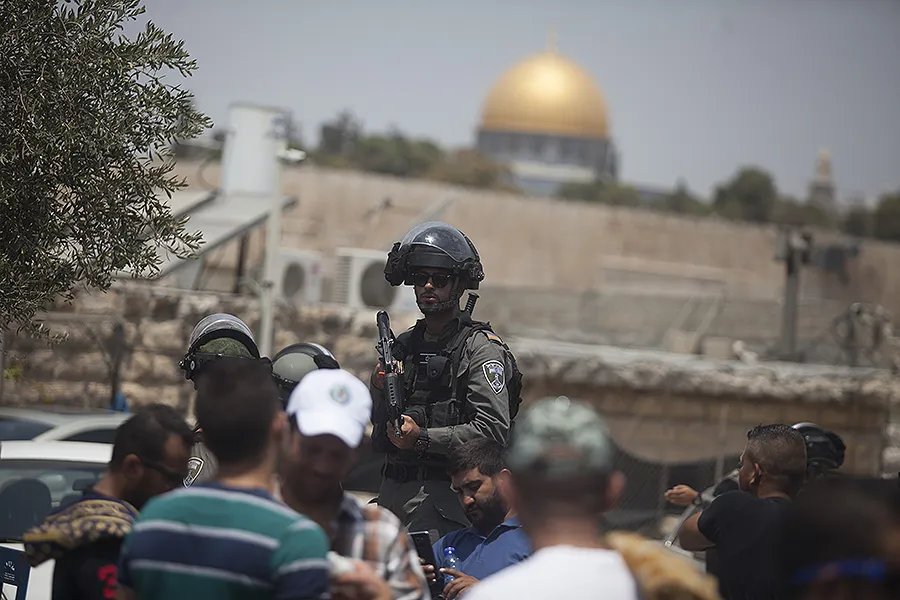
The site known to Jews as the Temple Mount and to Muslims as Haram al-Sharif, where the al-Aqsa Mosque is located, was the scene of another round of violence last week when Israeli authorities installed metal detectors at the entrances of the mosque.

Palestinian objection to the metal detectors manifested in mass protests and escalated to include the killing of three Israelis at a Jewish settlement July 21. Four Palestinians were killed in East Jerusalem and the West Bank.

The controversial metal detectors were removed by Israeli security forces early Tuesday morning.

Fr. Neuhaus said that it can be very difficult to discern what is true and false in the conflict because each side has its own vision of what is happening.

“Why is it so difficult to find a solution to this conflict? Perhaps one part of the difficulty is that each one of the two sides believes in the total justice of its cause and is unwilling to listen with empathy to the other side,” he said.

In the face of these clashes, the Church’s political neutrality has an important role to play, stemming from two important assets, he emphasized.

“One is the Church’s way of speaking, formulating words carefully, words that are built on truth, that teach respect and that promote justice and peace. This language is not diplomatic but rather language that works for reconciliation in the respect of truth.”

The second comes from the Church’s “vast network” of institutions, including schools, universities, hospitals, and homes for the elderly, orphans, the handicapped, and more, he said.

“In these institutions, the discourse of the Church is incarnated as the institutions serve one and all with no discrimination, showing that coexistence in mutual respect is not only possible but is the way forward that can open up the future, offering hope for the next generation.”

In the current controversy, Israel maintains it installed the metal detectors as a safety measure after three Arab Israeli gunmen smuggled homemade machine guns into the al-Aqsa Mosque July 14, shooting and killing two Israeli policemen.

Palestinians claim the metal detectors were a way for Israel to enact more control over access to the site, which is governed by a status quo arrangement which Israel has said it will maintain.

East Jerusalem has been occupied by Israel since its victory in 1967’s Six-Day War.

Israelis seem to live in perpetual fear and Palestinians in unrelenting anger, Fr. Neuhaus said. “Unfortunately, those who speak the language of reason and understanding are unable to garner the support of the masses, who buy into the simplistic slogans of the dominant political elites.”

The political authority in Israel “repeats that it is not changing the status quo and insists on this particularly in front of the international community,” Fr. Neuhaus said.

But at the same time, there are radicals in Israel “who explicitly endorse a change in the status quo” and have been supported in instances by government ministries.

“The central problem is not restricting access to Al-Aqsa but rather the fear that the Israelis seek to replace Al-Aqsa with a Jewish Temple.”

“Any change to the status quo, however minor, is perceived as preparation for a hidden master plan that Palestinians (and the entire Muslim world) formulate as their worst nightmare. The Israelis are fully aware that this is the case as every threat to the status quo has erupted in similar violence in the past.”

Though the status quo for Christians and their holy places (like the Church of the Holy Sepulchre) is less threatened, the conflict between Palestinians and Israelis only serves to worsen the political divide already present among Christians – split between those who are Arabs and thus form one with their Muslim brothers and sisters, and those integrated with the Jewish side.

“Nonetheless, Jewish extremists have manifested their refusal to coexist with Christians in the Holy Land through attacks on churches and other Christian holy sites,” Fr. Neuhaus explained.

Because Christians only make up 2-3 percent of the overall population, they are particularly vulnerable under the ongoing instability and violence, he continued, but “Christians are determined to struggle for full integration in their society, whether Palestinian or Israeli, demanding equal rights and mutual respect.”

“In times of conflict, the Christians are even more insistent in their prayers for peace.”


Miguel Perez Pichel contributed to this report.

[…]

No Picture
News Briefs

Bishops plea for two priests abducted in DRC

July 18, 2017 CNA Daily News 0

Butembo, Democratic Republic of the Congo, Jul 19, 2017 / 12:01 am (CNA).- Gunmen have abducted two Catholic priests in the Democratic Republic of Congo, prompting the country’s bishops to plead that the captives not be harmed.

“Priests are men of God who devote their lives to the good of the population without a political agenda. To hurt them is to harm the community they serve,” said the National Episcopal Conference of Congo.

The bishops called on security forces to do everything they could to free the two priests.

Fathers Charles Kipasa and Jean-Pierre Akilimali were abducted at Our Lady of the Angels parish in Bunyuka just before 10 p.m. Sunday, Reuters reports. About 10 assailants were involved in their abduction.

Bunyuka is in North Kivu province in the country’s east, fewer than 10 miles northeast of Butembo and near the border with Uganda.

The Congolese bishops’ statement noted that three other priests abducted in the same area in October 2012 still have not been released.

The border region, whose lands are rich in minerals, suffers from ethnic tensions and has been the site of wars and rebellions for two decades.

The nearby city of Beni has suffered major violence in the last two years. A series of nighttime massacres took place there beginning in October 2014. Unidentified attackers, mostly using hatchets and machetes, have killed hundreds in the city of 230,000 people.

In June an attack on Beni’s prison killed 11 people and freed over 930 prisoners. Another 12 people were killed in a raid on the city center by the Mai Mai militia coalition.

In December 2016, a nun in Bukavu, in neighboring South Kivu province, was murdered in an apparent robbery.

And that March, Fr. Vincent Machozi Karunzu was murdered by armed militants in North Kivu. He had documented human rights abuses in the country.

[…]

No Picture
News Briefs

Holy tattoo! A 700-year old Christian tradition thrives in Jerusalem

July 9, 2017 CNA Daily News 0

Jerusalem, Jul 9, 2017 / 04:02 pm (CNA).- In the Old City of Jerusalem it’s hard to escape the ancient history that’s still alive within its walls.

A simple smartphone search can send you on a walk to a centuries-old shop, bring you to the steps of a millennium-old Church, or lead you past the 3,000 year-old Temple Mount – all bursting with people and energy.

But it’s only within the stone walls of Razzouk Ink that the modern pilgrim can have that history etched onto his or her body for the rest of their lives.

And Christian pilgrims have come to the tattoo artists of the Razzouk family since the Crusades to receive ancient signs of Christian identity and pilgrimage.

Even today, as the family uses up-to-date procedures and incorporates contemporary trends into some of their artwork, the Razzouk family still draws upon the history and skills passed down through the generations for nearly three-quarters of a millennium. They also incorporate instruments and designs dating back several hundred years, carrying on one of the world’s oldest tattoo traditions.

A family legacy, written in ink

Wassim Razzouk, 43, is a tattoo artist descending from a centuries-long line in the trade: 700 years to be exact.

“We are Copts, we come from Egypt, and in Egypt there is a tradition of tattooing Christians, and my great, great ancestors were some of those tattooing the Christian Copts,” he told me.

The first evidence of a Christian tattoo tradition traces back to the Holy Land and Egypt as early as the 6th or 7th Century. From there, the tradition spread throughout Eastern Christian communities such as the Ethiopian, Armenian, Syriac and Maronite Churches. To this day, many Coptic Churches require a tattoo of a cross or other proof of Christian faith to enter a church. (Tattoo traditions among groups such as Celtic and Croatian Catholics emerged separately and at a later date.)

With the advent of the Crusades beginning in 1095, the existing practice of tattooing pilgrims to the Holy Land expanded to the European visitors. Numerous accounts dating back to the 1600s describe Christian pilgrims taking part in already long-existing customs of receiving a tattoo upon completing a visit to the Holy City – a custom that survives to this day.

While in the tattoo parlor, I witnessed the Razzouk family help a Roman Catholic bishop from Europe plan a tattoo he hopes to receive once he completes a personal pilgrimage later this year. Only weeks prior, Theophilos, the Coptic Bishop of the Red Sea, came to the Razzouk Family receive a pilgrimage tattoo. Other patrons of the Razzouk family have included Christian leaders of Ethiopia, persecuted Christians, and Christian pilgrims of all denominations from around the globe.

The Razzouk family themselves placed their roots in Jerusalem as pilgrims. After many pilgrimages and several generations of tattooing pilgrims and Christians of Jerusalem and the Holy Land, the Razzouk family relocated permanently to the Holy City around 1750.

“A lot of them decided to come to the Holy Land as pilgrims themselves and decided to stay,” Wassim said. “For the past 500 years, we’ve been tattooing pilgrims in the Holy Land, and it’s been passed down from father to son.”

Artifacts and application

The walls of the shop bear witness to this family legacy. Alongside framed newspaper clippings highlighting the work of Wassim and his father, Anton, are shadow boxes with pictures of the Razzouk tattoo artists that preceded them: Wassim’s grandfather, Yacoub, and great-grandfather, Jirius. And artifacts like an early tattoo machine and a traditional hand tool for manually applying tattoo ink are preserved behind glass.

Historically, Christian tattoo artists created their own inks and used stamps to apply images to the skin, before tracing over them with the tattoo implements. While Wassim does not use the old family ink recipe of soot and wine – using instead sterile inks produced specifically for tattoo application – many of the family’s 168 historic wooden stamps are still in use today.

In ages past, the tattooist would use the carved wooden stamp directly upon the pilgrim’s skin, and then use it as a guide for the traditional tattoo instruments. Today, Wassim stamps the design onto transfer paper, which is then applied to the skin for tracing, similar to the process for more contemporary design transfers.

Over the course of my interview with Wassim, nearly every customer used one of these ancient artifacts as part of their tattoo design. Two women from western Armenia – lands now controlled by eastern Turkey – came in and explained that they had just completed their pilgrimage to the Holy Land and wanted to get a traditional pilgrim’s tattoo with no alterations.

They both picked a stamp of the traditional Armenian Cross, a small crucifix that incorporates delicate floral design elements. Razzouk’s work was finished by adding the year “2017” underneath the image of the cross to commemorate the year of their pilgrimage.  If they ever return, Wassim explained, the year of each additional pilgrimage will be added underneath.

After the women left, I was shown a drawer filled with dozens of the carved wooden stamps, each holding a unique design. Several stamps were based upon the Jerusalem cross: a cross with arms of equal lengths, with smaller crosses in each of its quarters. Others offered representations of the Virgin Mary, St. Michael the Archangel, the Resurrection, lambs, roses, or the start of Bethlehem. Each of them held deep Christian symbolism and a story behind its meaning.

Most of these wooden blocks, carved from olive and cedar wood, are believed to date back to the 17th century, before the Razzouk family relocated permanently to Jerusalem. However, since only two of the stamps have confirmed dates of carving – from 1749 and 1912 – it’s difficult to say for sure. However, Wassim’s mother, Hilda, told me that it’s believed many of the blocks may date back at least 500, maybe 600 years, to the Razzouk family’s early days of tattooing in the Holy Land.

Saving a centuries-old tradition

Despite the deep roots of this ancient art form and rite of passage for Christians coming to the Holy Land, traditions of Christian tattooing in Jerusalem have come close to extinction on several occasions.

In the 1947 War for Israeli Independence, many of the Palestinians who practiced tattooing fled from Jerusalem for their safety, including the Razzouk family. After the war, the Razzouk family returned, but they were nearly alone in doing so: few other Christian tattoo artists decided to return, leaving Razzouk Ink as the last ancient Christian tattoo parlor.

The Razzouk family tradition came under threat again a little more than ten years ago, when Wassim and his siblings decided to pursue other professions.

“I didn’t really want to do this,” Wassim told me. “I wasn’t into tattooing and since this was sort of a responsibility, I didn’t want to do it.”

Instead, Wassim studied hospitality and pursued other interests.

“One day I was reading something online, an old article where my father was being interviewed,” Wassim recalled.

“He was saying he was really sad: he thought this tradition and this heritage of our family was going to end because I didn’t want to do it.”

Until a decade ago, Wassim’s father, Anton, was the primary tattooist of the Razzouk family, but none of his children had followed him into the ancient profession. The article and the realization of what it would mean to lose his family’s heritage weighed heavy on Wassim.

“I didn’t want to be that guy whose name was written somewhere in history as the guy who discontinued this – the guy who killed it.”

Wassim began to apprentice under his father as well as contemporary tattoo artists, and made some changes to the business, modernizing its health, safety and sterility procedures and business model. He also moved the shop from its location deep in the alleys of the city’s Christian Quarter to its current place in on ancient St. George’s Street, near the busy Jaffa gate. Today, Wassim and his wife Gabrielle work together at the parlor and have begun to train their children in the craft, though they are careful not to place too much pressure on them to take over the family business.

Visitors to the shop are happy that the Razzouk family legacy has endured. “I don’t think there’s any way that you could better commemorate a pilgrimage than at this shop,” Matt Gates, a pilgrim from Daphne, Alabama told me after he received a tattoo of a Jerusalem Cross.

After a spiritually engaging experience in the Holy Land, Matt said that his new tattoo will hold a particularly special meaning. “That’s just such a cool heritage to come into for me getting tattooed with a 500-year-old stencil,” he said. “I’ve got a ton of tattoos, but this one will mean so much more.”

All photos credit: Razzouk Tattoo in Old City Jerusalem, Israel. Credit: Addie Mena/CNA.

[…]

No Picture
News Briefs

Mali’s first cardinal, Archbishop Jean Zerbo

June 27, 2017 CNA Daily News 2

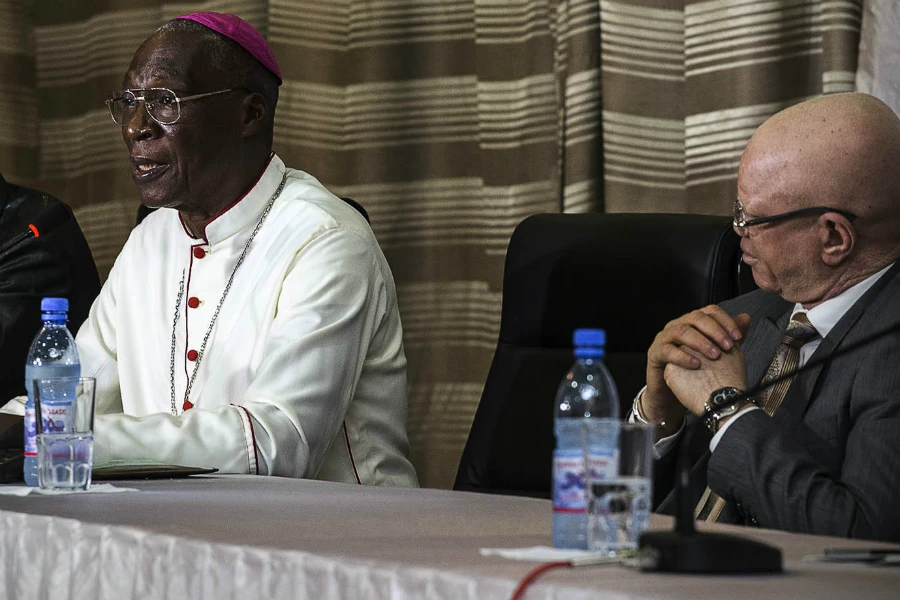
Bamako, Mali, Jun 27, 2017 / 03:33 pm (CNA/EWTN News).- Among those bishops who will be created cardinals at the June consistory is Archbishop Jean Zerbo of Bamako, a man who has already been called the “cardinal of peace.”

In announcing the June 28 consistory at the Regina Coeli on May 21, Pope Francis expressed the desire to choose men who represent the “catholicity” of the Church. His selection of Archbishop Zerbo is particularly noteworthy in this regard, as he will be the first cardinal to hail from Mali.

Born Dec. 27, 1943 in Ségou, Archbishop Zerbo was ordained a priest of the Diocese of Ségou July 10, 1971. He earned his licentiate in Sacred Scripture at the Ponifical Biblical Institute in Rome, studying there from 1977 to 1981. Upon returning to Mali in the early 1980s, he taught at the major seminary in Bamako, Mali’s capital, and served as a pastor in Markala.

In June 1988, St. John Paul II named him auxiliary bishop of Bamako. In 1994, he was appointed Bishop of Mopti, and in 1998 was made Archbishop of Bamako.

Archbishop Zerbo represents Pope Francis’ frequent calls to focus on areas where the Church is persecuted: Mali is a majority-Muslim nation that often sees harsh application of sharia as well as extremist violence against Christians.

Speaking to Cuore Amico in January this year, Archbishop Zerbo described the situation of Christians in the country as “a test comparable to that of the early disciples.”

Mali has recently been ravaged by a civil war, which exploded in 2012 with various rebel forces seizing control of parts of the country, and a subsequent coup. Although it officially ceased in 2015, fighting has continued throughout the country.

The war is largely driven by several factions of Islamist militants seeking to impose sharia, as well as by ethnic separatists. These militant groups occupy much of the northern part of the country.

During his ministry, Archbishop Zerbo has participated actively in peace talks in Mali’s civil conflict. His appointment to the College of Cardinals therefore sends a powerful message in favor of peace in the country, and a red hat will give added weight to the new cardinal’s contributions to talks.

He has also called for humanitarian aid for those suffering from hunger, thirst, and disease due to war in the country. In 2013, he told Fides that “[A] new period of suffering is beginning for the people of Mali. We would welcome support so that we can help the increasing number of displaced and refugees.”

He has stressed the need for conversion, on the part of both Christians and Muslims, saying that “peace can only be achieved through the conversion of the hearts regardless of faith. We Christians are always called to an effort of reconciliation.”

The Church in Mali has recently been accused of embezzlement of funds related to the Swiss Leaks investigation. The Malian bishops’ conference said in a May 31 statement that it “takes issue with the allegations that certain bishops have misappropriated funds from the Catholic faithful” and that it “functions in full transparency.”

The bishops’ conference also asked if “the authors of the tendentious article are aiming at another unavowed objective, rather than bringing constructive information to public opinion? Does this act made at the moment that this Church has just been honored with the nomination of its first cardinal aim at dirtying its image and at destabilizing it? God who sees all and who knows all will one day restore the truth.”

Archbishop Zerbo will be absent from the consistory due to unexpected medical reasons.

[…]