No Picture
News Briefs

Vatican to welcome asylum seekers to Italy

December 2, 2019 CNA Daily News 1

Rome, Italy, Dec 2, 2019 / 10:19 am (CNA).- On Thursday, the Holy See will welcome 33 refugees to Italy as they arrive from the Greek island of Lesbos with papal almoner Cardinal Konrad Krajewski. Another 10 refugees will come later in December.

The a… […]

No Picture
News Briefs

International Conference on Christian Persecution convenes in Budapest

November 26, 2019 CNA Daily News 1

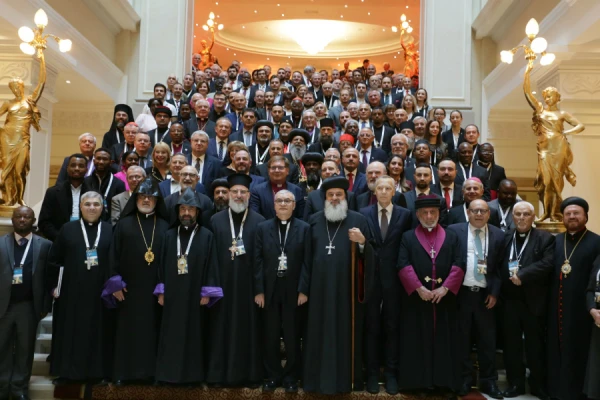
Budapest, Hungary, Nov 26, 2019 / 03:00 pm (CNA).- Patriarchs, cardinals, politicians, and Christians from across the globe are in Budapest this week for the International Conference on Christian Persecution. 

“We have 245 million reasons to be here. This is how many people are persecuted daily because of their Christian belief,” Hungarian State Secretary for the Aid of Persecuted Christians Tristan Azbel said Nov. 26 as he opened the conference.

Azbel has been a driving force behind Hungary Helps, a government initiative to provide international aid specifically to persecuted Christian communities in the Middle East — distinguishing Hungary from most European governments.

Archbishop Bashar Warda of Erbil, Iraq, told CNA that he hopes to see more European leaders acknowledge and respond to the fact that Christians are being persecuted in the Middle East.

“I would ask the European leaders to realize the fact that Christians are being persecuted because until now this voice is still weak,” Warda said. “Hungary and Poland have done the right thing to say clearly and loudly: Christians are being persecuted.”

Since the Hungarian government convened the first International Conference on Christian Persecution in 2017, the event has doubled in size to 650 participants from over 40 countries.

“What brings us together is the cause of persecuted Christians in the Middle East, and our search for the elements that bring about these dire situations for the most ancient Christian communities of the East,” Gewargis III, Patriarch of the Assyrian Church of the East, said at the conference.

The conference, meeting Nov. 26-28, has drawn many Syrian, Iraqi, and Lebanese Christian leaders, including Patriarch of the Syriac Orthodox Church of Antioch Ignatius Aphrem II, Chaldean Catholic Archbishop of Mosul Najeeb Michaeel, and Rev. Joseph Kassab, head of the Evangelical Community of Syria and Lebanon.


About to begin #ICCP_Budapest as hall fills with people who engage helping persecuted Christians. And here’s our three greek-catholic bishops! @HungaryHelps pic.twitter.com/Qhjdg7GpzL

— Eduard Habsburg (@EduardHabsburg) November 26, 2019


Off-the-record conversations were held on “day zero” of the conference Nov. 25 on the Islamic landscape in “a post-ISIS world,” and the role of NGOs in aiding persecuted communities. 

Bishop and Primate of the Armenian Orthodox Diocese of Damascus Armash Nalbandian highlighted in his address that the targeted persecution of Christians is still a very current threat in Syria.

“Not even one month ago, a gunman shot dead Fr. Hovsep Bedoyan the head of the Armenian Catholic community in Syria, Qamishli, near the border of Turkey and his father, Abraham Bedoyan … The attack was claimed by the Islamic State group,” Nalbandian said.

“The local media reported three bombings in Qamishli, which occurred the same day of the assassination, and were also claimed by ISIS, showed concern that militants were also coordinated attacks against Christians in the city,” he added.

Catholic speakers at the conference include Cardinal Peter Erdő, Primate of Hungary and Archbishop of Budapest; Cardinal Gerhard Ludwig Mueller, former prefect of the Congregation of the Doctrine of Faith, Archbishop Antoine Camilleri, apostolic nuncio to Ethiopia, Bishop Oliver Dashe Doeme of Maiduguri, Nigeria, Bishop Matthew Hassan Kukah of Sokoto, Nigeria, and Archbishop Ephram Yousif Mansoor of Baghdad, who represented Syriac Catholic Patriarch of Antioch Ignatius Joseph III Younan at the conference.


Join #Rome Correspondent for @cnalive Courtney Mares, @catholicourtney on the ground in #Budapest for the #ICCP_Budapest 2nd International Conference on #ChristianPersecution. Experience the Sights & Sounds in solidarity with our #Christian brothers & sisters. #Catholic pic.twitter.com/kkbLkTtaSp

— EWTN Vatican (@EWTNVatican) November 26, 2019


Hungarian Prime Minister Viktor Orban gave the plenary address to the conference. U.S. President Donald Trump also wrote a letter to the conference participants, which was read aloud by his assistant Joe Grogan.

The Hungarian and the U.S. governments agreed in November to jointly fund rebuilding projects in Qaraqosh, the largest city in Iraq with a Christian majority.

“Hungarians believe Christian values lead to peace and happiness and this is why our Constitution states that protection of Christianity is an obligation for the Hungarian state, it obligates us to protect Christian communities throughout the world suffering persecution,” Orban said.

“The Hungarians amount to 0.12% of the population of the world. Is there any point for a country of such a size to stand up for the protection of Christians? Our answer is yes,” the prime minister said.

Billy Graham Evangelistic Association Vice President Viktor Hamm reminded the conference that the Hungarian people themselves suffered Christian persecution in the not too distant past under Soviet occupation.

Hamm himself was born in a Soviet labor camp in what is now northwest Russia. “My grandfather was executed by the Soviet regime. My father spent years in the gulags,” he said.

Evangelical Pastor Andrew Brunson was also present at the conference at a Thanksgiving Gala Dinner. Brunson was released in Oct. 2018 after being imprisoned for two years in Turkey. 

“The cross that carried the body of the savior of the world, and that inspired the lives of saints and pastors in the Church for 2 millennia continues today to be the guiding light … that prompts today disciples of the Lord to partake in his cross,” Cardinal Mueller said at the conference.

“Be promoters of peace, and continue the silent witness of the Lord’s presence in the world,” he said.

[…]

No Picture
News Briefs

Irish nuns’ transfer of hospital land criticized over abortion plans

November 26, 2019 CNA Daily News 1

Dublin, Ireland, Nov 26, 2019 / 01:30 pm (CNA).- A pending land transfer from a religious community to the Irish government for the construction of a new maternity hospital has sparked new controversy, as the hospital is expected to perform abortions under new laws permitting the procedure.

The Religious Sisters of Charity currently own the land that is set aside for a $335 million taxpayer-funded National Maternity Hospital. The facility will be built on the campus of St. Vincent’s Hospital in Dublin. The sisters announced two years ago that they were planning to transfer ownership of three local hospitals, including St. Vincent’s, to a group that will no longer follow Catholic medical ethics.

In a May 2018 referendum, Irish voters repealed a constitutional amendment recognizing the right to life of unborn children as equal to mothers’ right to life. Legislators then enacted legislation allowing abortion through 12 weeks of pregnancy, or later in “exceptional circumstances.”

Some Catholics are now arguing that in light of the referendum, the sisters should not go through with the land transfer.

Fr Kevin O’Reilly OP, a moral theologian at the Angelicum in Rome, told The Irish Catholic that the Vatican should block the land transfer, because the Irish government says abortions will take place at the new maternity hospital.

“Thanks to the 36th Amendment of the Constitution, Ireland – to its great shame – now boasts an extremely liberal abortion regime, O’Reilly said.

“It is bewildering that those who have facilitated the process to date clearly do not possess any degree of moral foresight,” he said.

“One can only hope that the competent officials in the Vatican will act in accord with the Church’s constant teaching and the dictates of right reason by forbidding this unconscionable act.”

The National Maternity Hospital is currently located in Dublin’s Holles Street, but will be relocated to the campus of St. Vincent’s Hospital, where patients will be able to receive a wider range of care.

When plans for the new hospital were announced, abortion advocates spoke out against the sisters being involved in its management. Two of the National Maternity Hospital’s board members resigned, citing concerns that the maternity hospital may be run in accordance with Catholic teaching on human life and sexuality, The Tablet reported.

However, the National Maternity Hospital’s board had said the new facility will be run independently. Government officials have indicated that the facility will offer all legal medical procedures, including sterilization, in-vitro fertilization, gender transition surgery, and abortion.

Heather Humphreys, Ireland’s Minister for Business, Enterprise and Innovation, told The Tablet that she does not expect the land transfer will be halted.

“The plans are in place and I am confident that they will go ahead,” she said.

Canon law requires Vatican permission for the religious order to sell or give away property worth more than €3.5 million. The Congregation for Institutes of Consecrated Life and Societies of Apostolic Life normally approves such transactions.

The Religious Sisters of Charity said in a statement that Dublin Archbishop Diarmuid Martin has approved the land transfer and “recommended our decision to the Vatican for formal sign off.” The sisters said they are “confident of a positive outcome shortly.”

In May 2017, Ireland’s Sisters of Charity announced that they would be ending their management of three Dublin hospitals which comprise St. Vincent’s Healthcare Group. The hospitals are to be handed over to a new company, which would be called St. Vincent’s, and the sisters would no longer have any ownership or management of the health care facilities.

Under new management, the facilities will no longer adhere to Catholic medical ethics.

The health care group’s origins date back to 1834, when Mary Aikenhead, the founder of the Religious Sisters of Charity, established St. Vincent’s Hospital.

Until 2017, the St. Vincent’s Healthcare Group included three hospitals. As part of the plan to transfer ownership, two sisters who were on the board of the healthcare group agreed to resign, and the congregation agreed to give up the right to appoint board directors.

In addition, the sisters said, the Religious Sisters of Charity Health Service Philosophy and Ethical Code would no longer be authoritative as the governing documents for the healthcare group. Rather, the documents were to be “amended and replaced to reflect compliance with national and international best practice guidelines on medical ethics and the laws of the Republic of Ireland.”

The Sisters of Charity have committed to paying millions in financial redress to compensate abuse victims who lived the residential institutions they and 18 other religious congregations managed on behalf of the government in previous decades.

[…]

No Picture
News Briefs

German bishops will light ‘Synodal Candle’ to launch controversial process  

November 25, 2019 CNA Daily News 2

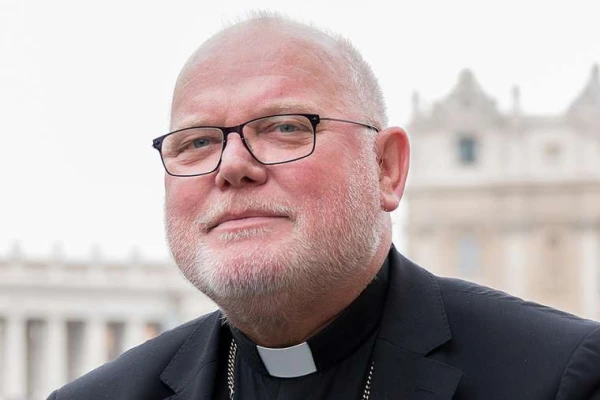
Bonn, Germany, Nov 25, 2019 / 12:55 pm (CNA).- The German bishops’ conference announced Monday that a ceremonial “Synodal Candle” will be lit on the first Sunday of Advent to officially launch the nation’s “synodal process,” which is scheduled to run over two years and pass resolutions about Church life in Germany.

The launch ceremony will be hosted by Cardinal Reinhard Marx, who will light a candle together with lay leader Karin Kortmann in Munich’s famous Frauenkirche, or “Cathedral of Our Dear Lady.”

Draft statutes of the – no longer binding – “synodal process”  were approved Nov. 22 by a majority of the Central Committee of German Catholics (ZdK) at the lay group’s plenary assembly.

During deliberations, a motion to amend the statutes to include a focus on evangelization was rejected.

CNA Deutsch, CNA’s German language news partner, reported Nov. 25 that ZdK member Karl zu Löwenstein reminded fellow delegates of Pope Francis’ call for a new evangelization during Nov. 22 deliberations regarding the synod. Before debating and passing resolutions about the structure of the Church, one should first put Christ’s message at the center, he argued.

However, two vice presidents of the lay Catholic organization disagreed. Both Claudia Lücking-Michel and Karin Kortmann, both German politicians, argued that any amendment would delay the start of the synodal process.

The German bishops had initially planned a “binding” synodal process for German Catholics, which would pass normative resolutions on moral and ecclesiastical issues. But a Vatican intervention raised concerns that the proposed process constituted a particular council, and could not take place without permission from the Vatican. After that intervention, the initial draft statues were amended to ensure they were no longer canonically binding.

On a visit to German last week, Cardinal Robert Sarah expressed concerns about the planned synod.  Sarah has gone so far as to offer a special prayer for the Church in Germany, given developments there, warning “If a synod aims to change the doctrine of faith, then it is no longer a synod.”

In an unusual move, Pope Francis in June personally wrote a letter to all German Catholics, warning of meaningless structural maneuvering and reiterating a call to evangelization ahead of the announced process.

In addition to concerns about a lack of focus on spreading the Gospel, the actual agenda of the process – which exclusively targets the topics of sexual morality, power and ecclesial offices – and public demands of the ZdK for the blessing of homosexual couples and the ordination of women, have come in for sharp criticism from noted theologians
 

CNA Deutsch contributed to this report.

[…]

No Picture
News Briefs

How this Croatian cardinal saved thousands of Jewish lives

November 22, 2019 CNA Daily News 0

Zagreb, Croatia, Nov 22, 2019 / 04:00 am (CNA).- When Esther Gitman proposed a topic for a Fulbright Fellowship, the administrator taking proposals was incredulous.

In her 50s at the time, Gitman was already well past the age of most applicants to the prestigious fellowship. But what shocked the representative was not Gitman’s age, but her story.

“I’ll write about the rescue of Jews in the independent state of Croatia (during World War II),” Gitman said.

“Why in the world would you like to write such a thing?” the representative asked. “Don’t you know that all the Jews and many of the Serbs and Gypsies were murdered there?”

But Gitman was living proof that this was not the full story. She, her mother, and all the Jews she had known in her childhood, had been spared – protected in Italian-occupied territory while the Ustase, the facist puppet-state of the Nazis, controlled Croatia and the surrounding region.

Gitman could barely finish her story of survival before the Fulbright representative blurted out: “Look, I have never heard this story. This is an amazing story. Write a good proposal and then you can even send it to me for a review.”

The proposal was approved. But even when she arrived in Croatia to begin the project, Gitman faced serious doubts from her Croatian collaborators that the research would be fruitful at all. Gitman said she promised to write whatever she found, and if she found nothing, she would describe how she came to find nothing.

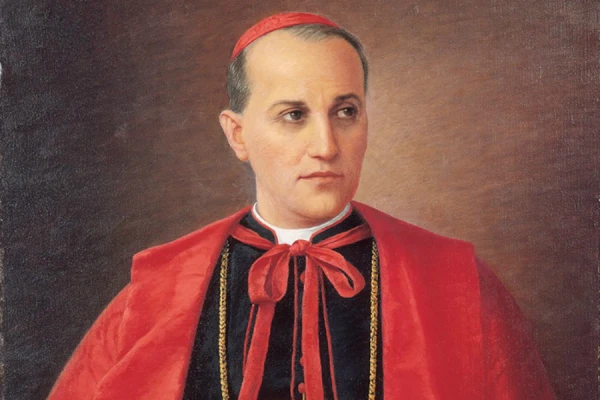
It wasn’t until Gitman was well into her research for her Fulbright fellowship in Zagreb, Croatia that she learned the name of the man to whom she and thousands of others owed their rescue: Archbishop Alojzije (Aloysius) Stepinac.

Learning of Archbishop Stepanic

When Gitman began her application for a Fulbright, she knew little about her own rescue as a Jew from Bosnia-Herzegovina (in the former Kingdom of Yugoslavia) other than that she and all the other Jews she knew during her childhood were spared.

She was spurred to learn more not, initially, out of her own curiosity, but her daughter’s.

“I really never asked my mother and my stepfather about it. I wasn’t interested in it,” Gitman told CNA. Moreover, her family, like most others in the region, didn’t speak of their rescuers out of fear of retaliation from the Communist regime that took control of the region after the war.

“I remember that after the war my family had an expression, ‘the walls have ears,’” Gitman wrote in her book “Alojzije Stepinac: Pillar of Human Rights.”

But her daughter’s questions sent her down a road of research that led her back to school to earn her Ph.D. and a Fulbright fellowship to study those very questions. 

Gitman’s Fulbright research included combing through thousands of pages of documents – including 5,000 specifically related to rescues during the war – and interviewing 67 Croatian survivors and rescuers from the war.

As she amassed page after page on Jewish rescue in the region, Gitman’s husband encouraged her to narrow down her work by selecting a common denominator among the documents on which to focus.

One name, in particular, kept popping up: Archbishop Stepinac.

“When I started to hear the name of Stepinac, I, in my own biased mind, thought: it cannot be that a priest and still an archbishop would save Jews,” Gitman said.

But as she searched through the archives of the Catholic cathedral in Zagreb, where Stepinac was assigned during the war, “I couldn’t believe what this man has done. I had a few hundred documents and I started to interview people and I just collected hundreds and hundreds of them and I saw…what an amazing thing this man has done.”

In total, and through various strategies, Stepinac directly and indirectly rescued more than 6,000 Jews from the Holocaust.

Who was Archbishop Stepinac?

Aloysius Stepinac was born on May 8, 1898 to a farming family in the village of Brezaric, some 30 miles south and west of the capital of Zagreb.

In 1916, he graduated high school and soon after was drafted to fight in World War I as an Austrian officer on the Italian front, where he was taken as an Italian prisoner of war from July-December of 1918. After the war, he briefly enrolled in a university to study agronomy, but soon returned home to work on the farm and further discern his vocation, and he found himself torn between the priesthood and farming.

“If I were a child again…I would still choose as my vocation either to be a priest or a farmer. A man is somehow closest to God there. Look at the peasant: he works and toils, but he sees how, in everything, he depends on God. He finds Him in nature. He observes His traces,” Stepinac once said. In 1924, Stepinac entered seminary and was sent to study in Rome at the Pontifical Gregorian University. His ordination to the priesthood took place on October 26, 1930.

While his heart was that of a parish priest, Stepanic was brought to serve as a master of ceremonies at the archdiocesan chancery by Archbishop Antun Bauer in Zagreb, the capital of Croatia. While there, Stepanic established the Zagreb branch of the Catholic charity Caritas, and founded the Caritas magazine, in which he advocated for better economic policies for the poor and urged the wealthy to donate generously to those in need.

In 1934, Pope Pius XI named Stepanic as the coadjutor to Bauer, effectively naming him as his successor. At the age of 37, Stepinac reluctantly became the youngest bishop in the world at the time, after begging Archbishop Bauer to change his mind.
“It shocked me so much that at first I thought that the old man had lost his reason…on the occasion of the consecration everyone cheered and rejoiced. But my heart bled,” Stepinac would later recall. 

Not long after being made a bishop, as early as 1936, Stepanic knew of the threat facing Jewish people in Europe and sought to raise funds to help those who were fleeing Nazi Germany and Austria.

He appealed to wealthy Croatian Catholics for their help: “Dear Sir, due to violent and inhumane persecution, a large number of people have had to leave their homeland. Left without means for a normal life, they wander throughout the world…Every day, a large number of emigrants contact us asking for intervention…It is our Christian duty to help them…I am free to address you, as a member of our Church, to ask for support for our fund in favor of emigrants. I ask you to write your free monthly allotment on the enclosed leaflet,” he wrote to them.

In an address to students in 1938, Stepanic condemned the racist ideologies of the Third Reich: “Love toward one’s nation cannot turn a man into a wild animal, which destroys everything and calls for reprisal, but it must ennoble him, so that his own nation secures respect and love of other nations.”

In 1939, he launched another fundraising campaign to help Jews and other persecuted migrants fleeing their countries because of the war, again emphasizing the Christian’s duty to help those in need regardless of their race or creed.

Stepinac and the rescue of Jews during World War II

War officially came to the Kingdom of Yugoslavia (which was comprised of modern-day Croatia, Bosnia and Herzegovina, Macedonia, Montenegro, Serbia, and Slovenia) on April 6, 1941, when German forces invaded the region.

During the occupation, the Kingdom of Yugoslavia was divided by the Axis powers, who thought that they could control the region better with divided countries that could be pitted against each other, Gitman said. The Independent State of Croatia was established as a puppet state of the Nazis, with Ante Pavelić at the head of the Ustase – the Croatian fascists loyal to Hitler.

Stepanic, as head of the Catholic Church in the majority-Catholic Croatia, had the difficult task of opposing the Ustase’s violent and inhumane policies while still attempting to maintain peace and order in his country.

“His duty as the head of such a big group (as) the Catholics was to go and establish a working relationship (with Pavelic),” Gitman said, a move that angered many Croatians at the time.

“They hated each other, but he had to establish a working relationship for the sake of peace and order,” she added. 

Stepinac found subtle and not-so-subtle ways to oppose Pavelic and the Ustase regime. Gitman said that, for instance, there were two priests and five nuns in the archdiocese who were of Jewish ethnicity, and therefore had to wear the Jewish star.

At one point, Pavelic decided it was embarrassing to the regime to have priests and nuns wearing the star, and so he absolved them of the obligation. But Stepanic urged the priests and nuns to continue wearing the star, as a sign of solidarity with the Jewish people. It humiliated Pavelic.

“This was an embarrassment to Pavelic that, Stepinac is telling them to wear the sign when they got permission not to wear (it),” Gitman said.

Gitman also learned that the Jewish rabbi in Zagreb came to rely on the friendship and help of Stepinac during the war. Unlike the rabbi, Stepanic was granted what were known as “Aryan rights” under the Ustase regime, which meant he was free to roam around the city like a normal citizen, while Jews were forced to wear a yellow star to identify themselves, and their movements were curtailed and monitored. Stepanic used this right to help those without such privileges.

“So whenever (the rabbi) needed something, he would send a request to Stepinac, and he always did whatever he could,” Gitman said.

Privately, Stepanic organized hiding places for an unknown number of Jews using Croatian Catholic connections he had throughout the country, or raised funds to help them escape to a safer place. When Stepanic’s own life was in danger, he warned all those that he had helped hide, and told them to find a different hiding place so that they would not be found out.

Stepinac also told his priests in no uncertain terms that they were to accept any requests from people who wanted to convert to the Catholic Church in order to try to save their lives – whether they were Jewish, Serbian, Gypsies, or other persecuted groups.

“He had a policy: when you (a priest) are approached by a Jew or a Serb whose life is in danger and they wished to convert, convert them, because the Christian duty is in the first place to save (their) life,” Gitman said.

“When you are visited by people of the Jewish or Eastern Orthodox faith, whose lives are in danger and who express the wish to convert to Catholicism, accept them in order to save human lives. Do not require any special religious knowledge from them, because the Eastern Orthodox are Christians like us, and the Jewish faith is the faith from which Christianity draws its roots. The role and duty of Christians is in the first place to save people. When this time of madness and savagery has passed, those who would convert out of conviction will remain in our church, while others, after the danger passes, will return to their church,” read a note distributed to parishes in Zagreb during the war.

Stepanic also stood up to the Ustase to protect Jewish people in mixed marriages with Christians. Stepanic told the Ustase that if they started sending Jews in mixed marriages to the concentration camps, that he would close his churches indefinitely and their bells would not stop ringing. He was able to save roughly 1,000 Jews in mixed marriages.

A 1943 letter from Nazi agent Hubner to Hans Helms the Nazi police attaché in Zagreb, later reviewed by Gitman, shows that the Nazi’s were aware of Stepinac’s tactic to protect the Jews:

“…the Archbishop promised protection and that he sent a letter to the Pope in Rome. According to the ‘dogmas’ of the Catholic Church, a couple in a mixed marriage cannot be separated. And if the Croat government undertakes action against mixed marriages, then in protest against such acts, the Archbishop will close all the Catholic Churches for a certain period. Such acts he [Stepinac] considers interference in the internal affairs of the church. Furthermore, the rumors circulating in Zagreb are that the Pope turned personally to the Fuehrer to obtain assurances that no actions would be taken against mixed marriages. For the time being, verification of this information cannot be obtained. But it is probable that this information is accurate because it is acknowledged that Stepinac is a protector of the Jews.”

The act of Stepinac that saved the most Jews – roughly 5,000 – from the Holocaust was his appeal to the Vatican to protect the Jewish refugees from Yugoslavia living in Italian-controlled territory.

When the war came to Yugoslavia, Gitman and her mother, along with thousands of other Jews, flocked to the Dalmatian coast, which was controlled by the Italians. Originally from Sarajevo in the country of Bosnia-Herzegovina, Gitman’s mother had heard that Jews would be safe in Italian territory, because they didn’t have the same mentality toward Jewish people as Nazi Germany did. (Gitman’s father died before the war came to Yugoslavia.)

But by 1942, just a year after the start of the war, the governor of this Italian region, Giuseppe Bastionini, “decided that he cannot have so many people unemployed, roaming around his territory and so he will collect all of them and ship them off back to the Ustase, to the Croatian fascists,” Gitman said.

When Stepinac heard this, he knew it would be certain death if the Jews were sent back to the Ustase. Together with the apostolic visitor to Croatia, Benedictine abbot Dom Giuseppe Ramiro Marcone, Stepinac pleaded with the Vatican to help them negotiate permissions for the Yugoslav Jews to remain in Italian territory. According to Gitman, the men emphasized the terrible conditions for Jews under the Ustase, as well as the fact that many of the Jews living in Italian territory were actually Catholic converts.

“Many were (Catholics),” Gitman said, “but not by a large measure. But it helped, and they received the permit to stay and the Italian second army protected them until the capitulation of Italy in 1943.”

In 1943, when Italy surrendered to the Allied powers, the status of the Jews in Italian territory was once again thrown into question. Germans were now invading Italy, and most of the Jews in Italian territory had to be transferred to other regions to stay safe, if they didn’t leave to fight on the Partisan front (comprised of Jewish resistance and local resistance groups).

Gitman and her mother, along with some of the other Jews, were transferred from Korcula (a Croatian island occupied by Italians) to Bari, Italy on the coast of the Adriatic by some fishermen. They remained there until the war ended in 1945.

Stepanic also saved a group of 58 elderly Jews who were living in “Lavoslav Schwarz,” a nursing home in Zagreb. In 1943, German authorities ordered the elderly people to evacuate the building or face deportation to Auschwitz. Stepinac relocated the group to nearby Church property, secured humanitarian aid for them from Switzerland, and frequently visited the home. The elderly Jews lived in the Church-owned building until 1947, and only five of them died during the war of natural causes, Gitman wrote.

Besides the Jews he rescued, Stepanic also spoke out against the Ustase and Nazi ideology in his sermons, which were banned by the Ustase from being printed and redistributed. But that does not mean the people of Croatia listened.

Stepanic’s defense lawyer wrote in 1946: “His sermons were attended in masses, not only by the Catholics but even by those who otherwise did not go to Church. Those sermons were spread, recounted, copied and propagated in thousands and thousands of copies among the people and even penetrated to the liberated territory. They became an underground press, a means of successful propaganda against the Ustase, a substitute for an opposition press.”

Glaise von Horstenau, a German general in Zagreb, said of the sermons: “If any bishop in Germany spoke this way in public, he would not come down alive from his pulpit!”

Stepinac’s activities earned him the ire of the Nazis and the Ustase, who called him and his collaborators “judenfreundlich (friends of the Jews) and therefore enemies of National Socialism.”

Angered by his sermons on the human dignity of all, including Serbs and Jews and Gypsies, a group of Ustase youth wrote to Stepinac: “You have to know that you are ‘Our greatest enemy’, but we are letting you know that if you go on speaking against us as you have been doing till now, and despite your red Roman belt, we will kill you in the street like a dog.”

In 1943, during a visit to the Vatican, Stepanic was informed that he had officially been labeled a traitor by the Nazis and that his life was therefore in danger. He had “no illusions” about the consequences of his words and actions, Gitman wrote, but stood by them, prepared to die. While in Rome, he met a famous Croatian sculptor, and told him he expected to be killed either by the Nazis or by the communist regime that would follow: “With God (a farewell), it is most likely that we will not see each other again. My life is threatened, either the Nazis will kill me now, or the Communists will kill me later.”

Trial and legacy of Cardinal Stepinac

Less than a month after the end of World War II, on June 2, 1945, the communist regime of Josip Broz Tito came to power and once again united Yugoslavia.

Threatened by the influential Stepinac, who also opposed communism, Tito tried to force Stepinac and other Catholic leaders in the country to cut ties with Rome and form an independent Catholic Church in Croatia – one that could be more easily contained and controlled.

Stepinac did not show up to the meetings where such negotiations were taking place, and instead continued to speak out against the regime, including against their imprisoning of priests, prohibition of religious marriages, and the confiscation of Church property, Gitman wrote.

Because of his obstinance towards the regime, and his popularity, Stepinac was seen as an obstacle to the regime’s success. Tito and his official launched a campaign to smear Stepinac’s reputation by trying to paint him as the main Catholic supporter of the Ustase during World War II.

Stepinac was first placed under house arrest, and then under actual arrest in on September 18, 1946, for the charges. After what many considered to be a “bogus” trial, Stepinac was found guilty on all charges and was sentenced to 16 years of hard labor on October 11, 1946.

At the time, Tito said: “It is not true that we persecute the church, we simply do not tolerate that certain people serve with impunity foreign interests instead of the interests of their own people.”

Gitman wrote that even many officials in Tito’s government recognized the trial and verdict as a sham, “because the Ustase had violated every precept of the church, and…Stepinac was not their supporter.”

Milovan Djilas, Tito’s former secretary of media and propaganda, later admitted as much.

“To tell you truthfully, I think, and not only me, that Stepinac is a man of integrity, a strong and unbreakable character. Although really innocent he was convicted; but then history frequently tells of innocent people being convicted for political necessity.”

A dispatch from the American embassy in Belgrade to the U.S. State Department noted on November 9, 1946 – before the trial’s conclusion – that it had been “fixed.”

“Everybody in Yugoslavia knows that Archbishop Stepinac was arrested and condemned by the Communist Party, and that his sentence was fixed outside the court and long before the trial itself took place. While the trial was still in progress, a highly placed Communist in the executive branch of the government said: ‘We can’t shoot him as we should like to do, because he is an archbishop;he will get a term in prison.’”

In 1950, American senators tried to negotiate for Stepinac’s freedom by making it a condition of American aid to Yugoslavia. Tito agreed to the deal but said that once freed, Stepinac must leave Yugoslavia.

But the Vatican rejected the arrangement according to Stepinac’s own wishes, Gitman wrote. “They will never make me leave unless they put me on a place by force and take me over the frontier. It is my duty in these difficult times to stay with the people,” Stepanic had declared. It was a wish he expressed repeatedly – to not leave his people as long as his country was not free. In December 1951, Tito released Stepanic and placed him again under house arrest in his hometown of Krasic, where he died in 1960 from illnesses he had contracted while in prison, according to the Blessed Aloysius Stepinac Croatian Catholic Mission.

“Tito’s acts against Stepinac made him both a Croatian martyr and a Catholic icon,” Gitman wrote. In 1953, Pope Pius XII made Stepinac a cardinal. On October 3, 1998, Stepinac was beatified by Pope John Paul II.

Nevertheless, to this day, there are many today who still oppose Stepinac and try to smear his reputation, Gitman said.

Beginning in the 1950s, many historians within Yugoslavia started arguing in their accounts that while Stepinac did some good during the war, he could have used his position to do much more, and that he dragged his feet in opposing the Ustase.

As an example Menachem Shelah, an Israeli historian from Zagreb, write of Stepinac that while it is true that he worked to save Jews “towards the middle of 1943” and saved Jews in mixed marriages, “Stepinac cannot be absolved because by his procrastination and public expressions he convinced the public that the Ustase were a lesser evil than the communists, because the Ustase crimes were a childhood malaise…Stepinac’s failure in taking action against dozens of priests who willingly took part in the murders.”

According to Gitman: “Historians who argued that Stepinac could have done much more are arguing in hindsight and on wishful thinking. Thus, such declarations are speculative because their claims could be neither evaluated nor substantiated by facts. Can any historian rightfully claim that if Stepinac had acted differently the outcome would have been substantially different and more Jews, Serbs and others would have survived? The answer clearly is no.”

Stepanic also continues to face criticism from many Serbians, in large part because of the propaganda promulgated against Stepinac in their country, and because of Croatia and Serbia’s hundreds of years of fraught history over border disputes, accusations of genocide against one another, and religious conflicts between the Catholic Croatia and the Orthodox Serbia.

“As I said, Stepinac is an icon. He represents in the Croatian psyche everything that is good, righteous and so on. And he believed that the Catholic church in this part of the world should remain and exist. He did everything to accomplish that,” Gitman said.

“Whereas the objective of King Alexander (a Serb), of Tito, and the communist regime…was  always to annex Croatia and make a greater Serbia. And I think without the glue, which is Stepinac, that keeps the people so loyal to him – and no matter under what circumstances, they believe in him – without his image, without his persona, they would be able to achieve it because there were many communists in Croatia also,” Gitman added.

Nevertheless, the Catholic Church has long held that Stepinac was a holy man who acted to uphold human dignity in some of the most difficult times his country had seen. Upon Stepinac’s death in 1960, Pope Pius XII called Stepinac “a shepherd who is an example of Apostolic zeal and Christian fortitude.”

At his beatification, Pope John Paul II called Stepinac an “outstanding figure of the Catholic Church” who risked his own life to help others.

“In his human and spiritual journey Blessed Alojzije Stepinac gave his people a sort of compass to serve as an orientation. And these were its cardinal points: faith in God, respect for man, love towards all even to the offer of forgiveness, and unity with the Church guided by the Successor of Peter,” Pope John Paul II said.

“He knew well that no bargains can be made with truth, because truth is not negotiable. Thus he faced suffering rather than betray his conscience and not abide by the promise given to Christ and the Church.”


[…]

No Picture
News Briefs

Politician of Spain’s Vox party offers ultrasounds outside Madrid abortion clinics

November 20, 2019 CNA Daily News 0

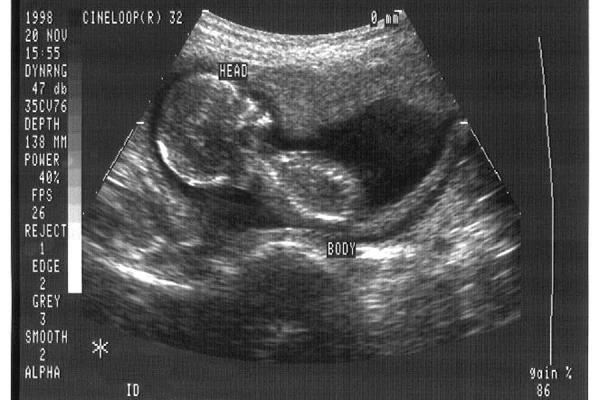
Madrid, Spain, Nov 20, 2019 / 10:56 am (CNA).- Gádor Joya, a pediatrician and a legislator of the Assembly of Madrid from the Vox party, operates the “Life Ambulance Project” outside abortion clinics in the city, offering ultrasounds to pregnant women.

“I and other doctors have been giving these women ultrasounds… Precisely because I have been doing this, I know what has been hidden from these women. Most of them, when they receive the information and hear the heartbeat, decide to go forward with their pregnancies,” Joya said at a meeting of the regional health committee Nov. 5, according to Madrid daily El País.

The ultrasounds are performed in a van near the clinics. The van has been authorized by the health department.

Joya has long been a pro-life advocate. She spoke at the 2014 French march for life, saying that “we know that at the end the Truth will triumph, and abortion will disappear from our society.

The Life Ambulance Project is opposed by Mónica García of Más Madrid, a progressive regional party.

García said that “what we could not have imagined is that there would be people performing ultrasounds on the street. It’s extremely serious.”

Vox is often described as a far-right party. In this month’s Spanish general election, the party took 52 seats. The party opposes both abortion and same-sex marriage.

The November general election was inconclusive. The Spanish Socialist Workers’ Party took 120 seats, and will try to form a coalition government, which it failed to do following the last general election, held in April.

Vox more than doubled its seats thismonth, having won 24 in April.

Santiago Abascal, leader of Vox, said after the Nov. 10 election that “today a patriotic alternative and a social alternative has been consolidated in Spain that demands national unity and the restoration of constitutional order in Catalonia.”

[…]

No Picture
News Briefs

Disagreements escalate over Notre-Dame rebuilding project

November 14, 2019 CNA Daily News 3

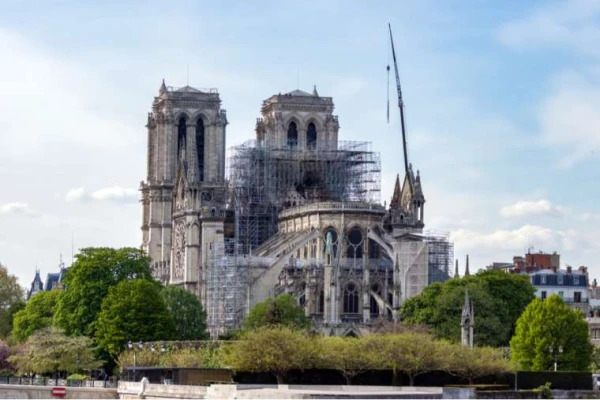
Paris, France, Nov 15, 2019 / 12:35 am (CNA).- Tensions are reportedly running high between French authorities overseeing the rebuilding of Notre-Dame Cathedral in Paris, as they create plans to rebuild the church damaged by fire earlier this year.

Army General Jean-Louis Georgelin and the architect on the project, Philippe Villeneuve, disagree over whether the cathedral’s new spire should look modern or medieval, the BBC reports.

Georgelin, at a meeting of the French National Assembly’s cultural affairs committee late Wednesday, reportedly told the architect that he should “shut his mouth” over the spire’s design, adding that a final decision on the spire would be settled on in 2021.

The roof of the 850-year-old cathedral caught fire April 15, destroying the building’s spire and most of the roof. The stone vaults survived mostly intact, as did most of the cathedral’s artwork and relics.

Villeneuve has said previously that the only way French President Emmanuel Macron’s ambitious five-year restoration deadline can be met is if the spire is a replica of the one that burned, the BBC says.

Villenueve has expressed concern about the integrity of the structure’s stonework. In July, temperatures in Paris reached 108.7 degrees Fahrenheit (42.6 C), the highest ever recorded in the city, which Villenueve said combined with the water damage sustained during the firefighting effort could weaken the joints and masonry of the stone vaults.

France’s parliament over the summer passed a bill declaring that Notre-Dame must be rebuilt exactly the way it was prior to the fire. Supporters from around the world have pledged nearly a billion euros to date to aid in the church’s reconstruction.

Before the fire, officials had been in the process of a massive fundraising effort to renovate the cathedral against centuries of decay, pollution, and an inundation of visitors. French conservationists and the archdiocese announced in 2017 that the renovations needed for the building’s structural integrity could cost as much as $112 million to complete.

Due to France’s laws regarding secularization, the French government owns all churches built before 1905, including Notre-Dame. The government lets the Archdiocese of Paris use the building for free, and will continue to do so in perpetuity. The Archdiocese of Paris is responsible for the upkeep of the church, as well as for paying employees.

The cause of the fire at Notre-Dame is still undetermined. On June 15, Mass was celebrated at one of the side altars for the first time since the fire.

[…]

No Picture
News Briefs

Record floods in Venice damage St. Mark’s Basilica

November 13, 2019 CNA Daily News 0

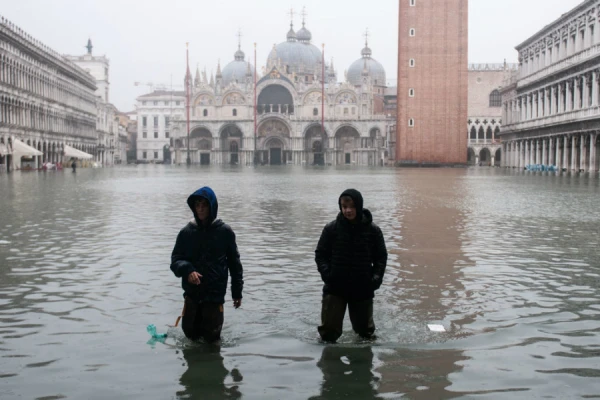
Venice, Italy, Nov 13, 2019 / 08:05 am (CNA).- The crypt of S. Mark’s Basilica is left completely flooded Wednesday after Venice’s water levels hit the highest level in more than 50 years.

Local authorities have called for a state of emergency after one man died in the worst flooding in Venice in decades. The high water mark reached over 6 feet, the highest level since 1966.

The Patriarch of Venice Francesco Moraglia and the city’s mayor, Luigi Brugnaro, inspected the damage at St. Mark’s Basilica together on Nov. 13, the morning after the heavy rains subsided.

“St. Mark’s Basilica has suffered serious damage, as has the entire city and the islands,” Venice mayor Brugnaro confirmed after the visit.

“Venice is on its knees,” Brugnaro wrote in a Twitter Nov. 13 post with photos of him and the patriarch at the basilica.


#Venezia è in ginocchio. La Basilica di San Marco ha subito gravi danni come l’intera città e le isole.
Siamo qui con il Patriarca Moraglia per portare il nostro sostegno ma c’è bisogno dell’aiuto di tutti per superare queste giornate che ci stanno mettendo a dura prova. pic.twitter.com/3Qy7070hZn

— Luigi Brugnaro (@LuigiBrugnaro) November 13, 2019


Patriarch Moraglia said he is concerned above all for those who sleep on the streets of Venice, and said that he hopes that Venice parishes will be the first to open their doors to them.

“To my Venetians, so much closeness, I have asked Caritas to be active in all possible ways, and I also make available emergency funds for charity,” Moraglia said, according to ACI Stampa.

In St. Mark’s Basilica’s 926 year history, there have been only six floods of similar severity. In October 2018, flood waters inside the basilica damaged part of the marble mosaic floor of the Madonna Nicopeia chapel.

Church staff cleared water and mopped the floors of the flooded basilica Nov. 13 to avoid repeating the damage caused last year when part of the nearly 1,000 year old marble floor of the basilica was left under flood water for 16 hours.

“We are here with Patriarch Moraglia to show our support, but we need everyone’s help to overcome these days that are putting us to the test,” Mayor Brugnaro said after his visit to the basilica.

[…]

No Picture
News Briefs

This Japanese painter found the faith through sacred art

November 13, 2019 CNA Daily News 0

Rome, Italy, Nov 13, 2019 / 03:01 am (CNA).- Osamu Giovanni Micico had never read the Bible, knew nothing of the stories of Christ in the gospels, and had never heard of the apostles, when his experience studying sacred art in Italy brought him to the Catholic faith.

“When I came to Italy, painting was the only street for me as far as my profession goes. Thank God, that is also where God gave me my spiritual rebirth,” Micico told CNA.

Catholicism “transformed my life. The way I relate to others, the way I view the world. And the direction I’m taking in my life. The meaning of suffering. It all changed. My conversion gave life to death.”

From his childhood and adolescence in Tokyo, Micico was interested in drawing and painting, but he originally pursued a science-based career to please his parents.

During university, however, he encountered an artist who inspired him to pursue his passion for painting.

The 37-year-old artist moved to Florence in 2008 to study the paintings of the Old Masters, such as Michelangelo and Leonardo da Vinci.

He told CNA that at the time he mostly painted landscapes or portraits, except when he copied the great masterpieces to learn from them. But he did not know what he was looking at.

“I was with my Catholic friend, asking my friend, who are those fishermen?” the artist said. In a way, he noted, he encountered the gospel the same way it was encountered by people in the Middle Ages who could not read, through the symbols of art.

“I was ‘reading’ those paintings before I knew the gospel. I didn’t know what stories they represented,” he explained.

“I think like music, those paintings spoke to me with harmony and it animated my soul. It was not just technique – that they made a realistic painting – but there was something else that was very holy there.”

Another personal encounter was influential in Micico’s conversion: his friendship with Irish religious artist and Catholic Dany MacManus, who was then living in Florence.

While Micico still knew nothing about the Bible, MacManus invited him to a lecture he was giving on St. John Paul II’s Theology of the Body. “That left an impression,” Micico said.

MacManus became Micico’s godfather at his baptism in 2010.

“Art was the entrance. I think that even without words, like with the music of Bach, one can intuit the beauty of a creator,” he said. “Ultimately, God the merciful was represented in the painting … That’s what spoke to me.”

Micico now creates sacred art himself.

“I wanted to spread this Good News using the same medium,” he said. “I’m sure there are a lot of people who will be touched by contemporary sacred art. And if I can give my hand to this beautiful mission, by my profession, that’s fantastic. It was very natural.”

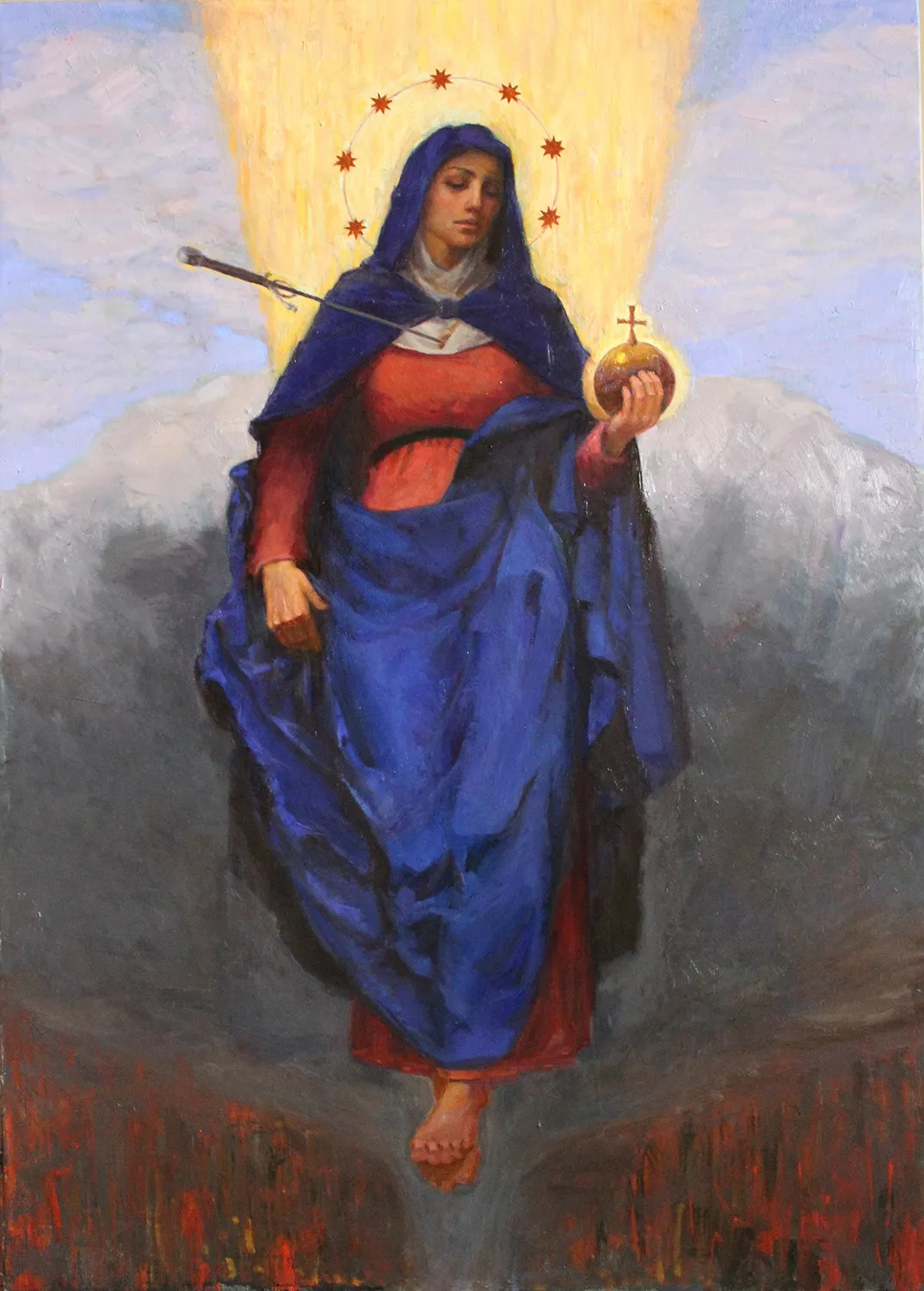
In November 2018, one of Micico’s paintings was gifted to the Archdiocese of Nagasaki. Micico’s “Holy Mother of Sorrow and Hope” was hung in Nagasaki’s Immaculate Conception Cathedral in the Marian chapel, which is dedicated to the victims of the 1945 atomic bomb.

It shows Our Lady of Sorrow in the foreground, with the background depicting the exploding atomic bomb and the burning city beneath.

“I experienced that painting can be an instrument, very useful, very strong,” the painter said. “And it goes directly to the heart, like music. Even without understanding it people can stand in front of it with mouth wide open, looking at it, contemplating it.”

After his conversion, Micico learned more about the history of Christian persecution in Japan. Christianity was outlawed starting around 1600 until 1873. In the late 16th century, military ruler Toyotomi Hideyoshi expelled the missionaries who had brought the faith to Japan, had religious objects and Bibles destroyed. There were thousands of martyrs.

The few Catholic lay people who survived preserved the faith orally and through baptism, the only sacrament they had, for hundreds of years. During this period, they created their own sacred art, Micico said.

Some pieces were visibly religious, such as “Ecce Homo” style images of Christ. In many others, however, the Christian symbolism, for safety, was hidden in a Buddhist or Shinto style. For example, they would paint a traditional Buddhist female figure, but add a baby to her arms to create an image of the Madonna and Christ child.

“This clandestine art is so beautiful to see, as their devotion took form in this visible form,” Micico said.

“When I think of myself in that situation, I think, why would someone risk their life by painting sacred pictures? I mean, it would have been easier for them to survive without painting those pictures, but they wanted to manifest their love for the Lord.”

“Sacred art,” he said, “is not for one person, or one group of people, but for everybody, for all the generations.”

[…]