No Picture
News Briefs

Who was Carlo Acutis? A CNA Explainer

October 1, 2020 CNA Daily News 3

Denver Newsroom, Oct 1, 2020 / 10:28 am (CNA).-  

Carlo Acutis, an Italian teenager who died in 2006, will be beatified Oct. 10 in Assisi.

Acutis, a gamer and computer programmer who loved soccer and the Eucharist, has been the subject of interest around the world. So who was Carlo Acutis? Here’s what you need to know:

Who was Carlo Acutis?

Carlo Acutis was born May 3, 1991, in London, where his parents were working. Just a few months later, his parents, Andrea Acutis and Antonia Salzano, moved to Milan.

As a teenager, Carlo was diagnosed with leukemia. He offered his sufferings for Pope Benedict XVI and for the Church, saying “”I offer all the suffering I will have to suffer for the Lord, for the Pope, and the Church.”

He died on Oct. 12, 2006, and was buried in Assisi, at his request, because of his love for St. Francis of Assisi.

His cause for canonization began in 2013. He was designated “Venerable” in 2018, and will be designated “Blessed” October 10.

So, he was pretty holy, huh?

From a young age, Carlo seemed to have a special love for God, even though his parents weren’t especially devout. His mom said that before Carlo, she went to Mass only for her First Communion, her confirmation, and her wedding.

But as a young child, Carlo loved to pray the rosary. After he made his First Communion, he went to Mass as often as he could, and he made Holy Hours before or after Mass. He went to confession weekly.

He asked his parents to take him on pilgrimages — to the places of the saints, and to the sites of Eucharistic miracles.

There was fruit of Carlos’ devotion in his life. His witness of faith led to a deep conversion in his mom, because, according to the priest promoting his cause for sainthood, he “managed to drag his relatives, his parents to Mass every day. It was not the other way around; it was not his parents bringing the little boy to Mass, but it was he who managed to get himself to Mass and to convince others to receive Communion daily,”

He was known for defending kids at school who got picked on, especially disabled kids. When a friend’s parents were getting a divorce, Carlo made a special effort to include his friend in the Acutis family life.

And he promoted Eucharistic miracles, especially through a website he built to promote them.

On the site, he told people that “the more often we receive the Eucharist, the more we will become like Jesus, so that on this earth we will have a foretaste of heaven.”

When Carlo got sick, his life of faith increased. He was intentional about offering up his suffering for the Church, the pope, and for people who were suffering with illness.

And he was a gamer?

Here’s what we know: Carlo loved playing video games. His console of choice was a Playstation, or possibly a PS2, which was released in 2000, when Carlo was nine. We know he only allowed himself to play games for an hour a week, as a penance and a spiritual discipline, but he wanted to play much more.

Here’s what we don’t know: What games he liked to play. Tony Hawk Pro Skater 2? Gran Turismo 3? We’re pretty curious, and if CNA finds out, we’ll report it.

He was also a programmer, and, as we mentioned, built a website cataloguing and promoting Eucharistic miracles.

Carlo also apparently liked sports and the outdoors. But, well, a lot of saints liked soccer. How many liked playing Kingdom Hearts? (or whatever game he liked to play.)

And was his body incorrupt?

Initially, there were reports that the body of Carlo Acutis was found to be incorrupt.

A spokeswoman for Acutis’ beatification told CNA that the entire body was present when it was exhumed, but “not incorrupt.”

“Today we … see him again in his mortal body. A body that has passed, in the years of burial in Assisi, through the normal process of decay, which is the legacy of the human condition after sin has removed it from God, the source of life. But this mortal body is destined for resurrection,” Archbishop Domenico Sorrentino of Assisi said at a Mass at the opening of the tomb Oct. 1.

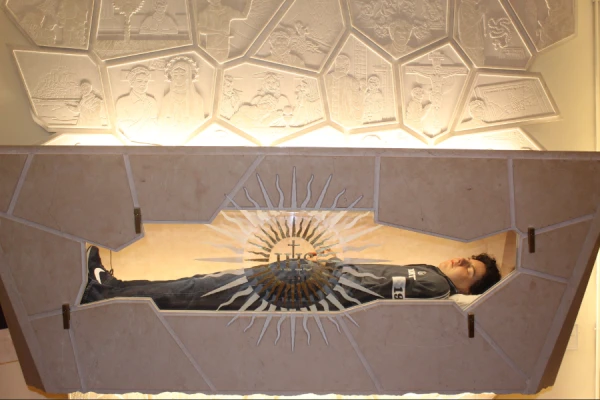
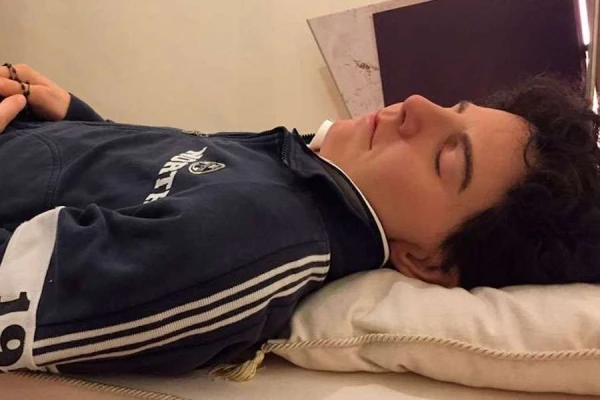
He will, however, lie in repose in a glass tomb where he can be venerated by pilgrims until Oct. 17. He is displayed in jeans and a pair of Nikes, the casual clothes he preferred in life.

And his heart, which can now be considered a relic, will be displayed in a reliquary in the Basilica of St. Francis in Assisi. His mother said that his family had wanted to donate his organs when he died, but were unable to do so because of the leukemia. 


[…]

No Picture
News Briefs

Tomb of Carlo Acutis is opened for veneration ahead of beatification

October 1, 2020 CNA Daily News 0

Rome Newsroom, Oct 1, 2020 / 09:00 am (CNA).-  

The tomb of Venerable Carlo Acutis was opened for public veneration Thursday ahead of the computer-programming teen’s beatification. 

A spokeswoman for Acutis’ beatification told CNA that the entire body was present, but “not incorrupt.”

“Today we … see him again in his mortal body. A body that has passed, in the years of burial in Assisi, through the normal process of decay, which is the legacy of the human condition after sin has removed it from God, the source of life. But this mortal body is destined for resurrection,” Archbishop Domenico Sorrentino of Assisi said at a Mass at the opening of the tomb Oct. 1.

The bishop explained that Acutis’ body was “reassembled with art and love.”

Acutis, who died of leukemia in 2006 at the age of 15, was known for his computer-programming skills, and love of the Eucharist and the Virgin Mary.

The heart of Acutis, which can now be considered a relic, will be displayed in a reliquary in the Basilica of St. Francis in Assisi. His mother said that his family had wanted to donate his organs when he died, but were unable to do so because of the leukemia.

“Carlo is a boy of our time. A boy of the internet age, and a model of holiness of the digital age, as Pope Francis presented him in his letter to young people around the world. The computer … has become a way of going through the streets of the world, like the first disciples of Jesus, to bring to hearts and homes the announcement of true peace, that which quenches the thirst for the infinite that inhabits the human heart,” Sorrentino said.

The rector for the Sanctuary of Spoliation in Assisi, where Acutis’ tomb is located, told EWTN that reconstruction work on Acutis’ face was necessary before the public viewing of the tomb. 

Acutis had brain hemorrhaging at the time of his death, and he offered his suffering for the pope and the Church. 

“His body was discovered to be fully integral, not intact, but integral, having all its organs. Work was done on his face,” Fr. Carlos Acácio Gonçalves Ferreira said.

“In some way, his earthly face will be seen again. But that face — let us not forget — by now does not point to itself, but to God,” Archbishop Sorrentino said.

Acutis’ tomb is open for public veneration Oct. 1-17 in Assisi to allow as many people as possible to make a prayerful visit in the weeks before and after his beatification Oct. 10, despite coronavirus measures limiting attendance.

In his interview with EWTN, Ferreira lauded Acutis as a witness that holiness is attainable for teenagers. 

In the tomb, Acutis is dressed in the casual clothes he wore in daily life. While he was not buried in this clothes, it is hoped that they will give evidence of the teen’s life.

“For the first time in history we will see a saint dressed in jeans, sneakers, and a sweater,” the rector said.

“This is a great message for us, we can feel holiness not as a distant thing but as something very much within everyone’s reach because the Lord is the Lord of everyone.”

In the year before he died, the Italian teen researched Eucharistic miracles to create a website cataloging and sharing this information with others.

As part of the 17-day celebration of Acutis’ beatification in Assisi, two churches are hosting exhibitions of the Eucharistic miracles and Marian apparitions cataloged by Acutis. 

Acutis’ tomb is in Assisi’s Sanctuary of the Spoliation, where a young St. Francis of Assisi is said to have cast off his rich clothes in favor of a poor habit.

“Carlo Acutis, like St. Francis, had in common, in addition to love for Jesus and in particular for the Eucharist, a great love for the poor,” Archbishop Sorrentino said as he announced Oct. 1 that a soup kitchen would be opened near the Sanctuary of the Spoliation in remembrance of Acutis.

Carlo’s mother, Antonia Salzano (pictured above), said that she was very moved by the opening of her son’s tomb for public veneration.

“We are thrilled that finally Carlo’s tomb has been opened, especially because the faithful that Carlo has scattered around the world will be able to see him and to be able to venerate him in a stronger and more engaging way,” she said.

“We hope that through the exposition of Carlo’s body, the faithful can raise their prayers to God with more fervor and faith who through Carlo invites us all to have more faith, hope, and love for him, and for our brothers just as Carlo did in his earthly life. We pray that Carlo will intercede for all of us with God and obtain many graces for us.”


[…]

No Picture
News Briefs

Bishop: Claims that Church in Belarus being used by US ‘complete nonsense’

September 30, 2020 CNA Daily News 0

CNA Staff, Sep 30, 2020 / 12:03 pm (CNA).- The Vicar General of the Archdiocese of Minsk-Mohilev on Tuesday denied reports from Russia’s foreign intelligence agency that the Church in Belarus is being used by the US, calling them “complete nonsense, fake information.”

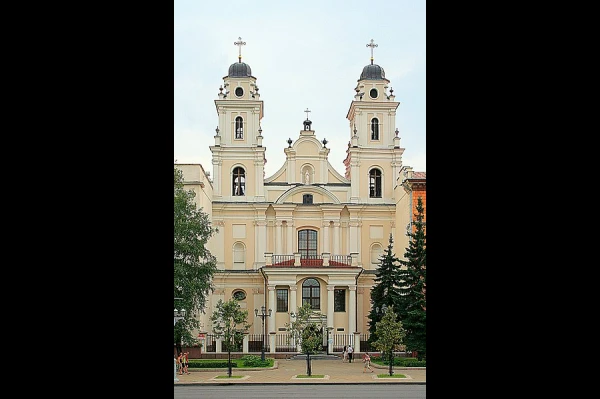
“Some media outlets published information provided by the head of Russia’s foreign intelligence service Sergey Naryshkin. This is a fake, this is nonsense. He spoke about some provocations, about the fact that the United States, the CIA and other organizations are trying to use the Catholic Church to undermine the state system in our country. This is complete nonsense, fake information, lies that have nothing to do with the truth … This is information that should be treated with a touch of irony,” Bishop Yury Kasabutski said during his homily at a Sept. 29 Mass at the Cathedral of the Holy Name of the Blessed Virgin Mary in Minsk.

Naryshkin is director of Russia’s Foreign Intelligence Service. The Russian news agency Interfax reported Sept. 29 that Naryshkin had said, “the United States is also unceremoniously interfering in the religious situation in Belarus … The clergy of the Roman Catholic Church are being asked to openly criticize the Belarusian authorities and to use religious events, including sermons, prayers, religious processions, to conduct opposition political propaganda among believers.”

The Russian foreign intelligence director added that “According to the plan of the Americans, this should force Minsk to take harsh retaliatory measures against the Roman Catholic Church.”

Naryshkin said the Belarusian opposition is planning a “resonant provocation” during which a high-ranking cleric “would be arrested or even wounded or killed,” with the intention of increasing opposition sentiment among Catholics in the country.

Belarus has seen widespread protests in recent weeks following a disputed presidential election. Protests began Aug. 9 after president Alexander Lukashenko was declared to have won that day’s election with 80% of the vote. Lukashenko has been president of Belarus since the position was created in 1994.

The US and the EU no longer recognize Lukashenko as the Belarusian president. Canada and the UK placed sanctions on Belarus Sept. 29.

Lukashenko secured a $1.5 billion loan from Russian president Vladimir Putin earlier this month, and Putin has denounced “external pressure” on Belarus.

The president of the Belarusian bishops’ conference, Archbishop Tadeusz Kondrusiewicz of Minsk-Mohilev, has been exiled. His passport was invalidated, and he was blocked from returning from Poland by border guards Aug. 31. The archbishop has spoken in defense of protests following last month’s presidential election.

Lukashenko has suggested the archbishop might be a citizen of more than one country. The archbishop told CNA Sept. 1 that “today I was accused that I received from Warsaw some instructions, or something, but I didn’t visit Warsaw.” He said he had visited eastern Poland to celebrate the First Communion of a relative.

Bishop Kasabutski told Catholic.by Sept. 29 that “Our clergy do not receive any instructions from anyone, and not only of a political nature … No one makes any calls to the priests for an open statement during the divine services of one or another attitude to the authorities. This information has no real basis.”

He added that the claim the US or other states are trying to influence the Church “sounds completely unrealistic.”

“Perhaps these statements have something to do with the Church’s position. Today the Church in Belarus speaks the truth about the situation in the country, opposes violence, encourages people to solidarity, unity, harmony, peace, and forgiveness,” the bishop reflected.

Bishop Kasabutski continued: “Maybe in this way we are preventing someone from implementing certain scenarios aimed at division in society, at the bloody development of events. Maybe someone is trying to use this situation to divide people on the principle of religion to accuse us of what we are trying to avoid by praying to God for peace and harmony in our society. But we do not succumb to such ‘brainwashing’ and remain faithful to the commandments of love left to us by Christ.”

He added that relations between Catholics and the Eastern Orthodox in Belarus are warm, and that “we now see a very strong solidarity of people regardless of religion.”

Protests have taken place across Belarus since the August election, and thousands of protesters have been detained. At least four people have died in the unrest.

Electoral officials said that the opposition candidate, Sviatlana Tsikhanouskaya, earned 10% of the vote. The opposition claims that she actually garned at least 60% of votes.

Tsikhanouskaya was detained for several hours after complaining to the electoral committee. She and several other opposition leaders are now in self-imposed exile in Lithuania or other nearby countries.


[…]