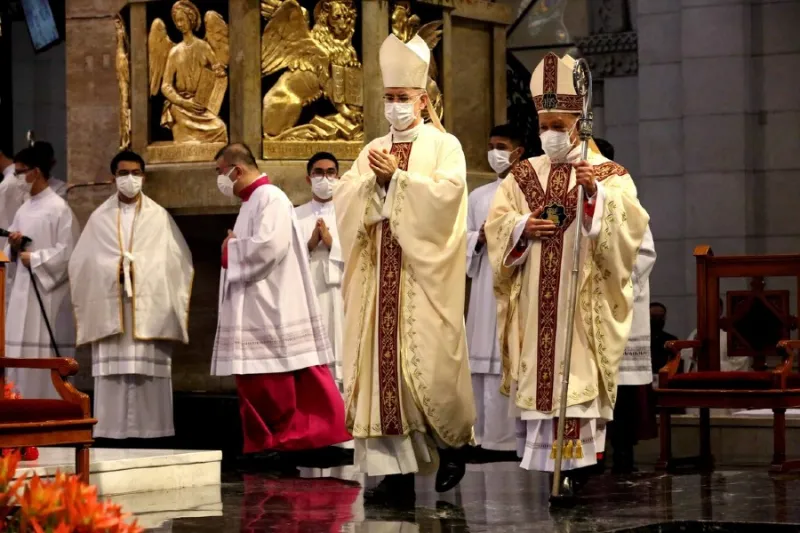
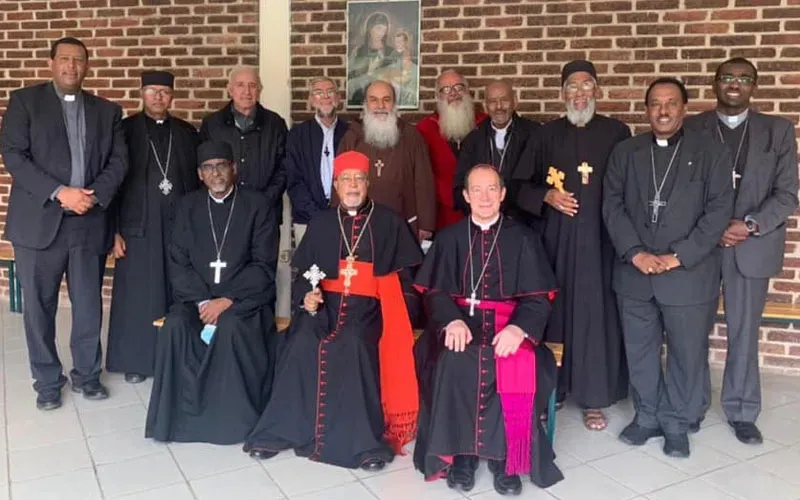
 Ethiopia’s bishops during their plenary assembly in Mojo, July 2021. Credit: Ethiopian Catholic Secretariat via Facebook.
Addis Ababa, Ethiopia, Jul 22, 2021 / 18:01 pm (CNA).
As the war over control of Ethiopia’s Tigray region expands into neighboring regions, the country’s bishops on Saturday urged an end to the violence.
“It saddens our hearts hearing about war while we all would like to hear about peace and reconciliation,” read a July 17 statement from the Ethiopian bishops’ conference. The conference had held its ordinary assembly July 13-16 in Mojo, about 50 miles southeast of Addis Ababa.
Fighting has been taking place in Tigray since November 2020 between the regional government of the Tigray People’s Liberation Front and federal forces.
In the last week, the Tigray war has expanded into the neighboring Afar region; it had already crossed into the Amhara region.
Ethiopia’s bishops commented that “as Pastors, we cannot but feel the anguish and pain that the people are going through.”
The bishops “prayed for the peace of our country and the safety of our people,” making special mention of Bishop Tesfasilassie Medhin of the Ethiopian Eparchy of Adigrat.
The bishops said they “kindly urge” the parties in conflict to halt the violence and strive toward peaceful co-existence, saying, “War only destroys lives and properties and nothing more and the choice to be made should not be a war but peace and reconciliation.”
Violence, the bishops said, “is never a remedy for wrongs or a solution to a crisis.”
“It is never too late to stop the violence, to acknowledge that the only way forward, for the good of the people, is peace and reconciliation, to satisfy the demands of truth and justice, to ask for and grant forgiveness, to do what is necessary to restore mutual trust, to recognize others as our brothers and sisters, no matter who they are and how deep our disagreements are, and to settle any differences through dialogue and negotiation,” they stated.
The bishops also encouraged the people of God to put their hope in Christ, saying, “It is the only way that we can heal together as a country, as a society, and as a Church.”
They further urge Ethiopians to embrace one another regardless of their differences as “there are no ‘winners’ and ‘losers’, no ‘them’ and ‘us’; we are all brothers and sisters.”
“Living in peace and social harmony may seem like a dream but it is attainable if we stretch out our hands to God, the Father of all, in prayer and allow Him to mold our hearts and minds to think thoughts of peace and fraternity and act accordingly,” the Ethiopian bishops said.
It is their desire, the bishops added, to see a nation where “all Ethiopians embrace each other as brothers and sisters.”
“May The Almighty God who created all of us as brothers and sisters fill our hearts with wisdom to choose brotherhood and sisterhood than hatred and revenge and make us an instrument of peace,” the bishops concluded.
The TPLF dominated Ethiopia’s long-ruling political coalition. That coalition was dissolved in 2018 by Prime Minister Abiy Ahmed’s after he took office. The coalition’s ethnicity-based regional parties were merged into a single party, the Prosperity Party, which the TPLF refused to join.
Tigrayan leaders have said they were unfairly targeted by political purges and allegations of corruption. They have argued that Abiy’s postponement of national elections due to coronavirus have ended his mandate as a legitimate leader.
On Nov. 4, 2020 Abiy announced a military offensive in response to an alleged attack on a military base in Mekelle, the capital of Tigray. The prime minister aims to arrest the regional government heads and to destroy its military arsenal.
Thousands of people are estimated to have been killed on both sides of the conflict, some in massacres. Each side blames the other for the conflict. The war is also exacerbating famine and a water crisis.

[…]