
No Picture
News Briefs

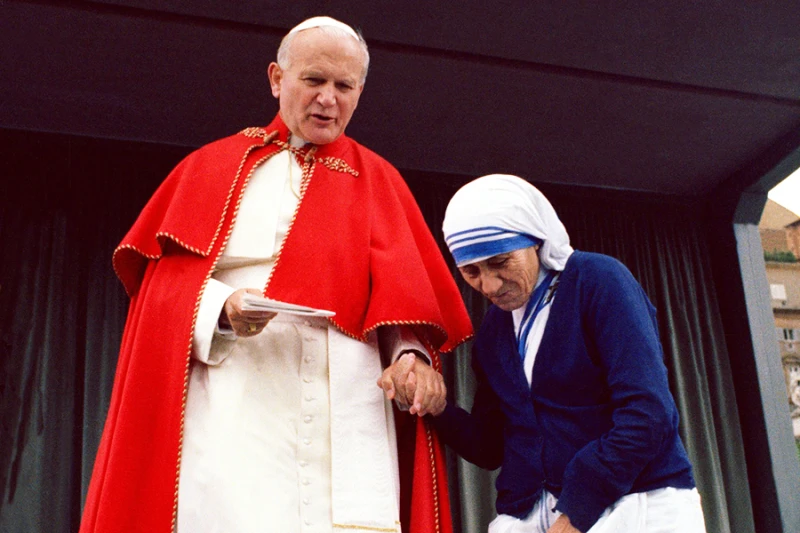
Mother Teresa and St. John Paul II: a look at their holy friendship
September 4, 2024 Catholic News Agency 1
Mother Teresa and John Paul II, May 25, 1983. / Credit: L’Osservatore Romano

CNA Staff, Sep 4, 2024 / 16:46 pm (CNA).

Today is the eighth anniversary of Mother Teresa’s canonization. Pope Francis declared her a saint on Sept. 4, 2016 — just over a dozen years after she was beatified by her friend and fellow saint, Pope John Paul II. 

St. Teresa of Calcutta, who was born Agnes Gonxha Bojaxhiu, gained fame around the world for caring for the poorest of the poor and sharing Christ’s love with them. She founded the Missionaries of Charity, the religious order that carries on her work today around the world. 

St. John Paul II and Mother Teresa, two of the most famous and consequential Catholic saints of the 20th century, weren’t just friends. As followers of Christ, they complemented each other in profound ways, with Mother Teresa putting into practice so many of the Catholic teachings that John Paul eloquently taught. 

“Where John Paul provided the theological and intellectual foundation for understanding human dignity in the face of the great darkness of the 20th century — abortion, euthanasia, atheism, communism, and materialism — Mother Teresa was a living witness to what the pope was teaching,” the editors of the National Catholic Register noted in 2016. 

Though Mother Teresa was a decade older than John Paul, they both experienced significant milestones in their faith lives in 1946 — he was ordained a priest that year and Sister Teresa heard a “call within a call” to serve the poor on the streets of Calcutta. Throughout both of their lives, they were deeply devoted to the Virgin Mary and to the rosary. 

In 1986, the pope visited Mother Teresa’s hospice center, Nirmal Hriday, which she had founded in 1952 in the heart of the slums in Calcutta. Tens of thousands of sick and forgotten people, who would otherwise have perished on the streets, died a dignified death at the center over the decades. 

According to news reports, Pope John Paul was “visibly moved” and even disturbed by what he saw at the hospice, such that he was rendered speechless. He called Nirmal Hriday “a place that bears witness to the primacy of love.”

“Our human dignity comes from God … in whose image we are all made. No amount of privation or suffering can ever remove this dignity, for we are always precious in the eyes of God,” he said in a speech given outside the center.

In Nirmal Hriday, “the mystery of human suffering meets the mystery of faith and love,” the pope continued; there, people ask every day why God would allow such death and suffering.

“And the answer that comes, often in unspoken ways of kindness and compassion, is filled with honesty and faith: ‘I cannot fully answer all your questions; I cannot take away all your pain. But of this I am sure: God loves you with an everlasting love. You are precious in his sight. In him I love you too. For in God we are truly brothers and sisters,’” the pope said. 

Mother Teresa later described the day of the pope’s visit as “the happiest day of my life.” 

At that meeting and whenever they met afterward, John Paul would kiss the top of the diminutive nun’s head and offer her a blessing, while she fervently kissed his papal ring.

Mother Teresa died in 1997. At her beatification in 2003, an aging John Paul said: “I am personally grateful to this courageous woman, whom I have always felt beside me. Mother Teresa, an icon of the Good Samaritan, went everywhere to serve Christ in the poorest of the poor.”

“Let us praise the Lord for this diminutive woman in love with God, a humble Gospel messenger and a tireless benefactor of humanity. In her we honor one of the most important figures of our time. Let us welcome her message and follow her example,” the pope said of his friend.

“Virgin Mary, queen of all the saints, help us to be gentle and humble of heart like this fearless messenger of love. Help us to serve every person we meet with joy and a smile. Help us to be missionaries of Christ, our peace and our hope. Amen!”

[…]

No Picture
News Briefs

Prior to Quito 2024, there have been 4 International Eucharistic Congresses in Latin America

September 4, 2024 Catholic News Agency 0
The President of the Communications Commission of the 2024 International Eucharistic Congress, Father Livingston Olivares (left) accompanies EWTN Vice President for Programming and Production Peter Gagnon (center-right), EWTN Vice President for Spanish-language Production, Marketing and Radio Enrique Duprat (center-left), EWTN Production Director Michael Holmes (far right) and IEC Quito 2024 Communications Coordinator Marcelo Mejía (front, kneeling) at the Monument to the Equator, the exact location of the Equator (from which the country of Ecuador takes its name) on the outskirts of the country’s capital city of Quito, site of the 2024 International Eucharistic Congress. / Credit: Communications Commission of the 2024 International Eucharistic Congress

ACI Prensa Staff, Sep 4, 2024 / 15:46 pm (CNA).

The Catholic Church in Latin America is once again preparing to host an International Eucharistic Congress, the fifth the region has hosted since 1934.

On this occasion, the event will take place in Quito, Ecuador, Sept. 8–15 in commemoration of the 150th anniversary of the country’s consecration to the Sacred Heart of Jesus.

EWTN will provide complete coverage of the opening and closing Masses and Eucharistic processions as well as all the important sessions and speakers.

Eucharistic congresses “are an expression of a particular veneration and love of the universal Church for the Eucharistic mystery, a source of fraternity and peace,” explains the website of the 53rd Eucharistic Congress of Quito 2024.

The first International Eucharistic Congress took place in 1881 in Lille, France. In 1934, the first Latin American city hosted an event of this magnitude dedicated to Christ in the Eucharist.

Below is a brief history of the four international Eucharistic Congresses held in Latin America prior to Quito 2024.

Buenos Aires 1934

During the pontificate of Pius XI, the Argentine capital was chosen to host the 32nd International Eucharistic Congress held Oct. 10–14, 1934, with the theme “The Social Kingship of Christ through the Eucharist.”

The Holy Father appointed Cardinal Eugenio Pacelli, the future Pope Pius XII, as papal legate, and at that time Archbishop Santiago Luis Copello headed the Archdiocese of Buenos Aires.

According to statistics, the events held Oct. 12–14 were attended by an estimated 1 million people, and the main celebrations took place around a large monument several meters high known as the Cross of Palermo.

Rio de Janeiro 1955

Under the pontificate of Pius XII, the 36th International Eucharistic Congress took place in Rio de Janeiro, Brazil. The event was held July 17–24, 1955, with the theme “The Eucharistic Reign of Christ the Redeemer.”

At that time, the archdiocese was headed by Cardinal Jaime de Barros Câmara, and the pontiff sent the secretary of the Sacred Consistorial Congregation, Cardinal Adeodato Giovanni Piazza, as his representative.

On the last day, Pius XII gave a radio message in which he thanked the people for their devotion and in which he stated that if the gift of God, the Eucharist, was truly known, “there would be no member of the faithful who would fail to take an active part in the divine Sacrifice on the Lord’s day.”

Also, the day after the conclusion of the Eucharistic congress, the first General Conference of the Latin American bishops was held in Rio de Janeiro, after which the Latin American Bishops’ Council (CELAM, by its Spanish acronym) was created.

Bogotá 1968

Under the theme “Vinculum Charitatis” (“Bond of Charity”), the 39th International Eucharistic Congress was held in Bogotá, Colombia, Aug. 18–25, 1968, for which Pope Paul VI appointed Cardinal Giacomo Lercaro as papal legate.

On that occasion, the Archdiocese of Bogotá was headed by Cardinal Luis Concha Córdoba.

Although he appointed a representative, the pontiff visited Colombia from Aug. 22–25. During a Mass celebrated in Bogotá, Paul VI noted that the sacrament of the Eucharist offers men and women the “hidden, living, and real presence” of Jesus Christ.

During his visit to the Colombian capital, the pope also inaugurated the second General Conference of the Latin American Bishops, which would take place in Medellín.

Guadalajara 2004

Finally, the 48th International Eucharistic Congress — the fourth in Latin America — was held in Guadalajara, Mexico, under the theme “The Eucharist: Light and Life of the New Millennium.”

The congress took place Oct.10–17 during the pontificate of St. John Paul II, who appointed Cardinal Josef Tomko, then-president of the Pontifical Committee for Eucharistic Congresses, as papal legate.

At that time, the Archdiocese of Guadalajara was led by Cardinal Juan Sandoval Íñiguez.

One of the most popular events was the pilgrimage to the shrine of Our Lady of Zapopan, in which nearly 2.5 million pilgrims participated.

On the last day of the congress, from St. Peter’s Basilica in the Vatican, Pope John Paul II inaugurated the Year of the Eucharist.

This story was first published by ACI Prensa, CNA’s Spanish-language news partner. It has been translated and adapted by CNA.

[…]

No Picture
News Briefs

56,000 killed in Nigeria’s ethnic and religious violence; Christians disproportionately affected

September 3, 2024 Catholic News Agency 0
This image grab made from an AFPTV video taken in Maiyanga village, in Bokkos local government, on December 27, 2023 shows families burying in a mass grave their relatives killed in deadly attacks conducted by armed groups in Nigeria’s central Plateau State. / Credit: Photo by KIM MASARA/AFPTV/AFP via Getty Images

Washington, D.C. Newsroom, Sep 3, 2024 / 18:05 pm (CNA).

A new report has found that ethnic and religious violence in Nigeria has claimed the lives of nearly 56,000 people in the West African country over four years — and the victims were disproportionately Christian.

The report, published by The Observatory for Religious Freedom in Africa, found more than 11,000 incidents of extreme violence from October 2019 through September of 2023. The violence left 55,910 people dead in 9,970 deadly attacks — as well as 21,621 people abducted in 2,705 attacks.

The total number includes civilian deaths, terror group deaths, and Nigerian Armed Forces deaths. Of the total deaths, 30,880 were civilians. 

Of the civilians, at least 16,769 Christians were killed, 6,235 Muslims were killed and 154 adherents of traditional African religions were killed. The religions of 7,722 victims are unknown.

The proportional loss for Christians, however, was much higher in the states where the attacks occurred. In terms of state populations, the report found that Christians were 6.5 times more likely to be killed in the violence. Similarly, when accounting for state populations, Christians were 5.1 times more likely to be victims of abduction.

“Millions of people are left undefended,” Frans Vierhout, a senior analyst at The Observatory of Religious Freedom in Africa, said in a statement.

“For years, we’ve heard of calls for help being ignored, as terrorists attack vulnerable communities,” he added. “Now the data tells its own story.”

According to the report, 81% of civilian killings were land-based community attacks. About 42% of those killings were carried out by armed Fulani herdsmen, which the researchers said invaded small Christian farming settlements to kill, rape, abduct and burn homes.

Fulani herdsmen, who are Sunni Muslim, killed at least 9,153 Christian civilians and at least 1,473 Muslim civilians in community attacks, according to the data. The religion of at least 1,267 victims of Fulani herdsmen attacks is unknown.

About 41% of the land-based community attacks came from a variety of groups, which the report categorizes as “other terrorist groups.” However, the report states that the “other” category likely “consists of different groups of ‘Fulani bandits’ who are as much part of the Fulani Ethnic Militia… as the Armed Fulani Herdsmen.”

The “other” terrorist groups are responsible for 10,274 killings in land-based community attacks, which include at least 3,804 Christians and 2,919 Muslims. The religion of about 3,503 victims is unknown.

At least 78 people killed by Fulani herdsmen and “other terrorist group” attacks adhered to traditional African religions. 

“Fulani Ethnic Militia are targeting Christian populations, while Muslims also suffer severely at their hands,” the Rev. Gideon Para-Mallam, another analyst for The Observatory of Religious Freedom in Africa, said in a statement.

“Kidnappers work to Islamist goals,” he added. “Where young women are kidnapped, tortured, and sexually violated, hope for normal married life, and family, may vanish.”

Islamist groups Boko Haram and the Islamic State West Africa Province carried out about 11% of the community attacks. Boko Haram killed at least 851 Christian civilians and 491 Muslims in such attacks, while the religions of 609 victims are unknown. The Islamic State killed at least 265 Christians and 127 Muslims, while the religion of 296 victims areunknown. 

Nina Shea, the director of the Hudson Institute’s Center for Religious Freedom, told CNA that “the numbers killed and abducted are staggering and the documentation is now irrefutable.”

“Fulani militants are waging a religious war, a jihad, against undefended Christian farming communities in large swaths of Nigeria,” she argued. “Equally undeniable and shocking is the fact that the Nigerian government has idly watched and tolerated these relentless attacks over many years. The goal of the militants to eradicate the Christian presence by murder, forcible conversion to Islam, and driving them out of their homeland appears to be shared by the government in Abuja [the capital of Nigeria] or else it would take action.”

Shea criticized the United States Department of State (DOS) for its repeated refusal to designate Nigeria as a “Country of Particular Concern,” a watchlist of countries responsible for severe violations of religious freedom. 

Nigeria was first included on the list in 2020, the final year of former President Donald Trump’s administration. However, it was removed in 2021, during the first year of President Joe Biden’s administration. The DOS report blamed the Nigerian violence on “intercommunal clashes” and a competition for resources.

[…]