


“The English Church was, and the English Church was not, and the English Church is once again. This is the portent, worthy of a cry. It is the coming in of a Second Spring,” preached St. John Henry Newman from the pulpit of St. Mary’s in 1852. Those words would come to serve as a name for the great flowering in England of conversions to the Catholic Church that began not long before Newman’s own conversion in 1845, a phenomenon attributable to Newman more than to any other mortal being.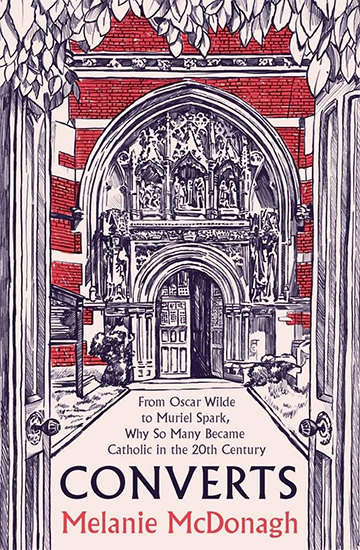
Many will know that the term “Second Spring” refers to those English converts to the Church, even if they have never read Newman’s sermon. It is not just a name; it is a trope. Many of us collect on our shelves books about converts to the Catholic Church, whether the innumerable, fine, often gigantic volumes of Joseph Pearse, such as his great Literary Converts (1999), or Fr. Charles P. Connor’s Classic Catholic Converts (2009), or kindred biographical studies such as Paul Elie’s almost perfect The Life You Save May Be Your Own (2003).
I mention these books because they leap to mind at first thought, but many other such books could be added to the list.
A restrained and subtle work
I, for one, consider the conversion stories of writers, scholars, and other gifted people one of the unguilty pleasures of life; reading of the spiritual drama of Jacques and Raïssa Maritain, for instance, has never gotten old and always inspires me to strive a bit harder for the holiness they themselves exhibited. And so, I would never begrudge the publication of yet another volume in the genre. What caught my eye about Melanie McDonagh’s Converts, besides its stunningly successful pastiche of mid-twentieth-century book cover illustration, was not its superfluity but its publisher: Yale University Press.
We expect to see conversion stories from religious and apologetic presses and from some of the Protestant and Catholic academic presses, such as Brazos or the Catholic University of America Press. But, Yale? I had noticed that Yale’s press had been turning out some quite interesting titles in the last half-decade and more, but even so, I did not see Converts coming. What, if anything, would distinguish a Yale University Press edition of conversion stories from all those other books crowding the shelves of home and parish libraries?
I am consoled to say, very little. McDonagh’s approach to her subject is restrained, subtle, and journalistic. She shows herself to be more concerned with finding a variety of ways to approach the phenomenon of religious conversion than with following a theoretical line to its conclusion, something this book most certainly does not do. Her accounts are generally adequate to their subject and efficient in the telling, serving quite well as enlightening and informative biographical and intellectual studies, sometimes brief, sometimes at length, and with such a brisk turning from figure to figure that it is impossible not to admire the agility of it all.
One way to describe the book is in the limits of its scope and another in her helpful refusal of certain limits. So, first, we may say that McDonagh’s subject is English converts to the Catholic Church from the late nineteenth century up to the Second Vatican Council. She makes passing reference to the kindred phenomena in France, the United States, and elsewhere, but her subject is squarely English, with a little Welsh and Scottish thrown in. To the extent that this book has a thesis, the Englishness of it all proves dispositive
McDonagh defies a limit as well: that of genre. She gives us fifteen chapters of conversion stories with the subjects’ names providing the titles, but she also inserts another nine chapters that attempt to describe the atmosphere of an age and how it led to the conversion of so many distinguished and talented individuals—most of them writers—as well as to the conversion of so many others, who are represented only by a chart in the front matter: a chart giving the estimated number of conversions to the Church in England and Wales from 1911 (more or less) until 2022.
Pearse’s Literary Converts seeks to give us the stories of great authors who entered the Church; his is a work of literary history and biography. McDonagh attends also to distinguished literary and intellectual figures, but what she is trying to understand is a sociological question: After centuries of repression and decline, what led to the widespread realization of the Second Spring in the nineteenth and twentieth centuries?
She answers the question by pointing us to a constellation of figures, rather than to a theory, and this is what makes the book so pleasant to explore. The reader is given a continuous variety of details, not without method, but certainly without any slavish adherence to method. When we read of the infamous Oscar Wilde, for instance, we follow the narrative thread of his prolonged youthful interest in Catholicism, his aesthete’s flirtation with it, his inanition, and finally his deathbed conversion. When we turn, in a late chapter, to Sigried Sassoon, a figure most of us know only from a handful of his poems about the Great War, we find that McDonagh has simply excerpted from a series of letters he wrote to a religious sister in the lead up to his conversion. If the latter seems more like editing than writing, that is no reason to complain. The whole provides us ever-various, never-tedious means of finding our way a bit closer to the age.
McDonagh is so reluctant to go beyond the literary journalist’s account that her introduction restricts itself to posing the broad questions that hold this congeries of stories together; her Epilogue is four short paragraphs and somewhat implausibly concludes, “The story continues.” The story she offers us, to the contrary, has probably concluded long since, but this is no criticism of the book. For, while McDonagh does not engage much in speculation about what all these episodes tell us, the reader is unlikely to miss what she has gathered.
The influence of Newman
In the early pages, she speaks of John Henry Newman and of the “intellectual spadework” he did to make it “much easier for those seeking religious certainty to move from the Church of England for [sic] Rome.” This is an understatement. For Wilde and his contemporaries, Aubery Beardsley, Ernest Dowson, and Lionel Johnson, Newman had been a living, personal presence in their intellectual formation (however distantly). The converts of the next two generations seem to have felt Newman’s influence no less powerfully, though he had died in 1890. Newman’s spirit pervades this volume from beginning to end.
I will digress on this matter for a moment, for it is a complex one, and one about which I have more questions than answers. It seems to me that Newman’s influence was so wide and so great because it was also so varied, striving, and personal. For much of his lifetime, I surmise, Newman’s chief intellectual influence consisted of his tracts and his sermons. These gave shape to the Oxford Movement and helped lead to the rise of Anglo-Catholicism within the Church of England. It is in the sermons that we find Newman’s mind at its most acute and moving with its greatest elegance. They are the words of a living religious faith summoning others to enter into holiness. When James Joyce later praised the “cloistered silver-veined prose” of Cardinal Newman, he must have been thinking, first and foremost, of the sermons.
But there are other Newmans we could point to. The Apologia Pro Vita Sua was published long after his conversion to Catholicism and indeed appeared at a time when his life’s work seemed to have arrived only at disappointment. There are brilliant passages, but style is often subordinated to careful quotation in the service of a self-vindicating case. What, in retrospect, is most conspicuous about the work is how local it is in its way of interpreting things divine.
The questions the Apologia engages are never those of fundamental theology, but rather of how a Victorian Englishman might come, of all things, to submit to Rome. My guess is that it is the Apologia most of the figures are thinking of when they think of Newman, just as most of us, when we think of St. Augustine, think first of the Confessions. With few exceptions, the figures McDonagh attends to are contending with belief or unbelief, Catholicism or materialism, but they do so—again and again—as only the English could. The Church of England had plenty of room for all kinds of belief, including the absolute unbelief we might find in someone like Walter Pater. The Established Church, therefore, represented to these figures personal unbelief, cosmic chaos, and bourgeois prejudice. It might entail sincere, but conventional piety, but it could also stomach unstable, disintegrating faith and a convenient sentimentality singing “Faith of Our Fathers” into the void. If one longed for living piety, order in the soul and in society, and to escape the dead but respectable consensus, there was only one choice: to “go Papist” in Roman Catholicism. All the other religious traditions, including spiritualism and oriental religions, were no rebellion against the Anglican Church; they were just extra furniture for the drawing room. Only Catholicism seemed to mean what it said and to honor the law of noncontradiction.
In our day, Newman is best known for his defense of liberal education, his account of the history and the development of doctrine, and, finally, his probabilistic account of religious belief. These are major subjects and worthy of our attention. They reflect what I see as the central question of Newman’s whole life: how can a modern man—any modern man, not just the intellectual given to making fine, liberal distinctions—give his whole heart to God and be right to do so? Newman’s answers seem incomplete or perhaps even unsatisfactory, but it is the integrity with which he poses the question that most impresses. It will not do to justify the faith of the Christian on the grounds of a highly educated theologian who overcomes all objections by gradually separating his faith from that of the great baptized-but-unwashed. Christian faith can only be justified if the whole faith of the lay faithful, educated and uneducated alike, can be justified. It is not the faith of the scholastic but of an everyday life that is the faith of historical Christianity. Ours is not a Church of an elite, nimble with subtle nuances and qualifications, but a Church that gathers everyone into itself as the Mystical Body of Christ. Newman saw this and sought to vindicate Christianity on those terms and without compromise, even if he individually lacked the resources to do so in a final manner.
There are, then, several Newmans, but it is the personal Newman, speaking not primarily as a man, but as an English gentleman, who was able to articulate the concerns and desires of so many others and thereby bring about, in England, a Second Spring. To understand the history of his influence, we probably have to turn back to those early tracts and sermons at least as much as we turn to The Idea of a University or Essay in Aid of a Grammar of Assent (which was long looked on with suspicions within the Catholic Church and so has had a somewhat limited influence). I could hardly believe how long Newman’s shadow extended over McDonagh’s book, but there it was.
Infinite space and infinite freedom
Two other lines seem to run through this book, neither of which strays very far from Newman.
Those who followed Newman into the Church wished to escape what Newman condemned as “private judgment.” They sought a Church that was, again in Newman’s language, “dogmatic.” In brief, they rejected the conclusions of the Scottish Enlightenment and German Idealism that religion was essentially a kind of moral feeling, a subjective projection, sublime and invigorating, salutary and commendable, but essentially subjective and not an object of knowledge. In consequence, they were drawn toward the ancient and stable Latin liturgy and also to the Church’s doctrine as the spiritual foundation for the order of the soul and the order of society.
One way of putting these two features might be to say that English converts came to appreciate, however vaguely, the Christian Platonism of the Church: Beauty is the splendor of truth, and so spiritual beauty leads us toward salvation; further, there can be no hard “buffer” between the interior life of the soul and the broader social order. If you want to be saved, society must be reformed, but society can only be reformed if you first let the Sacraments reform you. The microcosm of the soul must be infused with the Holy Spirit, and the macrocosm of the body politic must be governed by spiritual authority.
Some of the people McDonagh describes seem more attentive to the aesthetics of Catholic spirituality, while others to its spiritual bureaucracy that could tell you with the minute clarity of St. Thomas Aquinas, what is good and why it must be done. This, as she indicates, is just what the novelist and convert Maurice Baring meant when he wrote that “in becoming Catholic, you bow your head under a narrow door to enter infinite space and infinite freedom.”
Everyone in this book, it seems, was looking for a source of spiritual and social order that the latitudinarianism and indifferentism of the Anglican Church could not provide and which the Catholic Church could offer, as it were, in a splendid excess of clear and rational forms. A striking number of the figures McDonagh discusses had a particular reason to seek both the order of the soul and a moral order for society. Wilde, the dandy poet, playwright, novelist, essayist, and persona-at-large, was, after all, convicted of sodomy. Several of the other figures McDonagh discusses might, but for fortune, also have been, including Wilde’s former lover, Lord Alfred Douglas.
Wobbles and weaknesses
An unfortunate wobble in McDonagh’s style emerges when she discusses this subject. She mentions homosexuality on every occasion where it might reasonably be suspected, even when the evidence is doubtful (if comparing one’s friendship with another man to that of the friendship of Jonathan and David amounts to euphemism for homosexuality, then we are going to have to re-read 1 Samuel more closely). Almost without exception, McDonagh raises the subject as if it were just one more thing to be noted, perhaps by way of explaining so many of these figures’ attraction to the aesthetics of the liturgy as a kind of sacred camp. The novelist Muriel Spark’s late dissent from Church teaching on other sexual matters—abortion and contraception—are also noted but blandly passed over.
But then there are other passages that seem to want us to approve of homosexuality. We are told that the great artist and poet David Jones was “never prudish” about his friends who engaged in homosexual acts. Given that Jones’ mentor, Eric Gill (whom McDonagh also discusses), engaged in incest with his daughters, perhaps a little prudery—so-called—would have been meritorious. In any case, disapproval of sodomy would hardly make Jones a prude or a scold.
When we come to the inevitable chapter on G. K. Chesterton, we find the one passage in this book where McDonagh hazards her own “prudish” judgment. She tells us that Chesterton’s reputation has suffered for his substantial if qualified form of antisemitism. I doubt that claim, but she is not done. His reputation, she continues, “would be diminished further if his views on female suffrage and homosexuality were better known.” Once again, I doubt it, but consider the implication. McDonagh hangs around the neck of the author of Orthodoxy his orthodox view of sexual morality—and does so as if it were a shameful millstone. Are we being asked to gnash our teeth over authentic moral doctrine in a book about Catholic converts?
On this point, I wish McDonagh would attend more closely to her own narrative. She would perhaps then revise these glancing but marked judgments. Consider the episode mentioned above. Wilde has been imprisoned, convicted of sodomy. His sometime lover and, in several ways, the occasion for his imprisonment, Lord Douglas, is told that he should keep away from Wilde thereafter. The very suggestion, Douglas write, he puts “down to the baleful influence of the Catholic Church.” That Church stands in “prudish” contrast with what he calls the “real pagans with a real sense of the supremacy of Greek love . . .” Greek, or “Uranian,” love, as sodomy was often called, in a Platonic euphemism, is not simply forbidden by the Catholic Church. It is, on Douglas’s account, a separate and competing religion. Roman Catholicism must wither, he suggests, before a new religion, this “supremacy of Greek love.”
Douglas understands what is at stake. Catholicism speaks to us of natural and supernatural ends, and so awakens us to them and helps us to realize them. “Greek Love” overthrows all conceptions of natural ends and proposes that the peculiarities of individual desire may run roughshod over the laws of nature as if they amounted to no more than the prudish and curious manners of the age. Catholicism is a slave morality; sodomy is for the free. Douglas, the “pagan,” would wage war against nature. And yet, Douglas, the Catholic convert, will soon submit his soul to an order than transcends it and saves it.
With such testimony right there in McDonagh’s book, one wonders why she seems simply to presume that every right-thinking person would side with the young Lord Alfred rather than the one who joined the ranks of the converts studied in this book. Given the period covered, the new religion of Wilde should have received as serious attention as the influence of Newman and the judgments that manage to break through her restraint ought to have been weighted differently.
The wonder only grows as we reach the final chapter of the book. She marks and (I believe) laments the decline of conversions to the Church after the Second Vatican Council. She speculates that this must be in large part due to the revisions to the liturgy that resulted in the vernacular dialogue Mass. She passes right by what has been the most conspicuous feature of her own book, Newman’s “dogmatic principle.” The converts she depicts may have revered the old Mass, but they did so because it expressed in little the eternal order ordained by God. They were not after gothic chills or Latinate prettiness, but the Truth that transcends our feelings and reorders them to their proper end. What seem at first mere instances of journalistic reserve come, by the end, to seem a willful blindness to the tragic lesson Oscar Wilde and Lord Douglas still have to teach us.
Perhaps McDonagh’s restraint on this point merely reflects the contemporary English moral consensus, perhaps it reflects the editorial decisions of Yale Press. What it does not reflect is either the spirit that compelled past generations to change their lives or the spirit that has, however grudgingly, begun to take hold as yet a Third Spring in the realm that once was Christendom. That is the spirit whose “story continues.”
These criticisms aside, McDonagh’s book is spritely, spirited, and fascinating. It promises to become one of those standard references we will all want to keep on our shelves.
Converts, from Oscar Wilde to Muriel Spark, Why So Many Became Catholic in the 20th Century
By Melanie McDonagh
Yale University Press, 2026
Hardcover/Paperback/Ebook, 368 pages
If you value the news and views Catholic World Report provides, please consider donating to support our efforts. Your contribution will help us continue to make CWR available to all readers worldwide for free, without a subscription. Thank you for your generosity!
Click here for more information on donating to CWR. Click here to sign up for our newsletter.

Authors about things Catholic and who purport to be “Catholic” ought to be expected to provide their “bona fides” as Catholics. There are far too many who call themselves “Catholic” who fail to tell us just how the supposed Catholic faith they say they have is woven into their day to day practices.
Of book author McDonagh, we read that “[s]he passes right by what has been the most conspicuous feature of her own book, Newman’s ‘dogmatic principle.’ The converts she depicts may have revered the old Mass, but they did so because it expressed in little the eternal order ordained by God.”
Six points about the “dogmatic principle” and about the permanence of the “eternal order”:
FIRST, Pope St. JOHN PAUL II recalls a disrupted Church to sobriety in his “Veritatis Splendor”: ‘Having become one with Christ, the Christian ‘becomes a member of his Body, which is [!] the Church (cf. 1 Cor 12:13, 27).” JP II refers to ST. AUGUSTINE speaking to the baptized “for we have become not only Christians, but Christ (…). Marvel and rejoice: we have become Christ!” (n. 21).
SECOND, the entire Chapter II (of three chapters) is entitled “Do not be Conformed to This World (Rom 12:2).”
THIRD, about “the ‘natural law’ [which] is written and engraved in the heart of each and every man,” and then about human reason LEO XIII appealed to the ‘higher reason’ of the divine Lawgiver [….] It follows that the natural law is ‘itself the eternal law’, implanted in beings endowed with reason ….”(n. 44).
FOURTH, On the contrary, “…making freedom self-defining and a phenomenon creative of itself and its values [….] when all is said and done man would not even have a nature; he would be his own personal life-project” (n. 46).
FIFTH, “The Church is no way the author or the arbiter of this [‘moral’] norm” (n. 95)” AND “This is the first time, in fact, that the Magisterium of the Church [!] has set forth in detail the fundamental elements of this [‘moral’] teaching, and presented the principles for the pastoral discernment necessary in practical and cultural situations which are complex and even crucial” (n. 115).
SIXTH, where author McDonagh lingers on homosexuality, “Veritatis Splendor” is abundantly clear about this alternative universe. The reader is invited to the full litany of false sexual freedom, in n. 47 of the encyclical (more than a Jimmy Martin photo op): https://www.vatican.va/content/john-paul-ii/en/encyclicals/documents/hf_jp-ii_enc_06081993_veritatis-splendor.html
SUMMARY: So, where are we today? The dogmatic principle? The eternal order, permanence and human reason? Versus Vatican II read as a whole, and versus ‘Veritatis Splendor?
Instead: Amoris Laetitia’s slippery Chapter 8 and footnote, followed by Fiducia Supplicans’ double-speak blessing of irregular couples as “couples,” followed by “Synodal” Study Group #9 which would make “experience” the sole (soul?) criterion for the truth about the human person? Followed by, what?
As a “convert” (in italics because I did not convert, as I had no religious organization before coming Catholic), in June 1968, I can only say that my life changed so dramatically for the better. I have received a multitude of blessings, and one miracle in particular. Only the Catholic church can give me Communion in its true form.
You call it a “wobble”, but her promotion of homosexuality, coupled with her shaming of Chesterton over it, is a full collapse. Her other scholarship here doesn’t matter; I’m not going to pay someone to commit detraction against good people and misrepresent the faith. Whatever is good in this book, I guarantee we can find elsewhere.