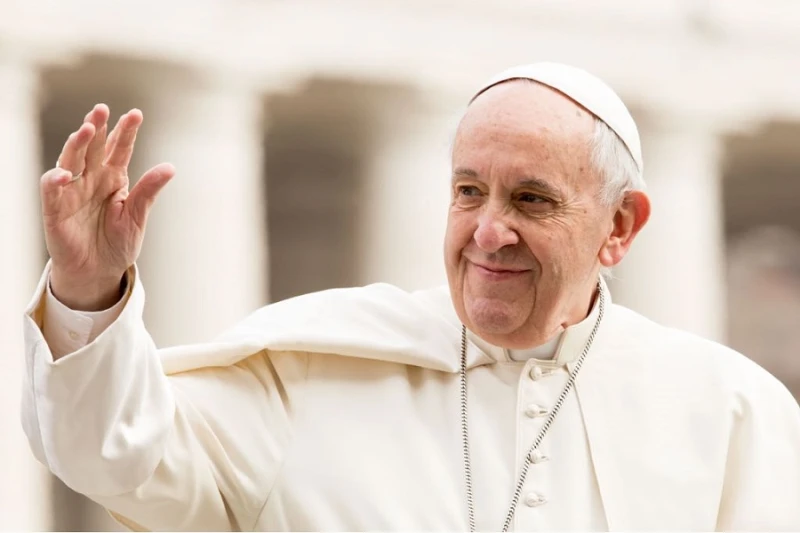
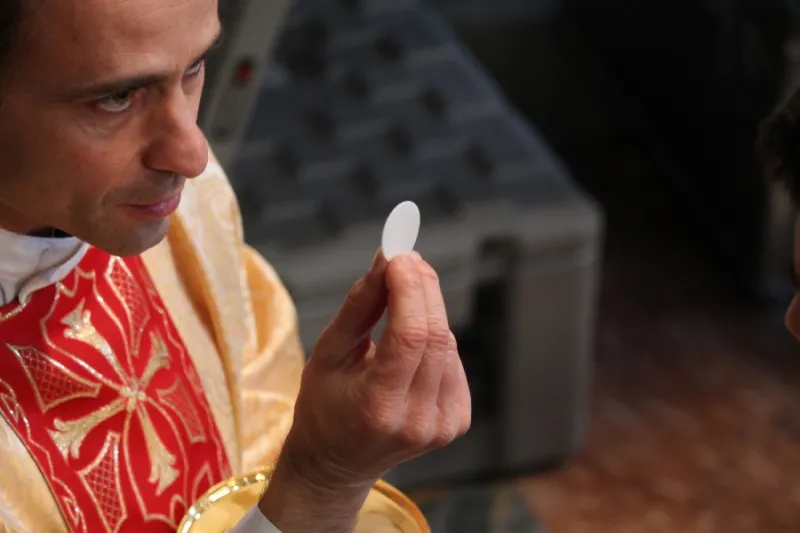
 Priest gives communion on the feast of the Holy Family in St. Peter’s Basilica on Dec. 27, 2015. / Alexey Gotovsky/CNA
Washington D.C., Jun 7, 2021 / 20:01 pm (CNA).
The U.S. bishops next week will deliberate and vote on whether to draft a teaching document on the Eucharist – despite the recent request of some bishops to delay such a discussion.
At the bishops’ virtual spring meeting scheduled for June 16-18, one agenda item that has received scrutiny is consideration of “Eucharistic consistency.” The agenda item is a “proposal to draft a formal statement” on “the meaning of the Eucharist in the life of the Church.” The proposal comes from the bishops’ doctrine committee.
In a May 22 memo to the U.S. bishops, the president of the conference – Archbishop Jose Gomez of Los Angeles – explained that the proposal for such a document came from the doctrine committee. The committee followed the administrative procedures for securing an agenda item on the matter, he said.
Further, the proposed outline of the document “reflects recent guidance from the Holy See,” Archbishop Gomez said, referring to a May 7 letter from the prefect of the Vatican Congregation for the Doctrine of the Faith, Cardinal Luis Ladaria, to Gomez and, by extension, the U.S. bishops.
Gomez added that “the focus of this proposed teaching document is on how best to help people to understand the beauty and mystery of the Eucharist as the center of their Christian lives.”
The conference will not be voting on any final text of a document, but simply on whether to begin drafting a document, he said. If the bishops approve the motion, they will still have the opportunity to deliberate and amend the document when presented in final form at a future meeting.
In its proposal, the bishops’ doctrine committee explained the two-fold need for a teaching document on the Eucharist.
First, the bishops’ three-year strategic plan – approved in November 2020 – has a Eucharistic title, “Created Anew by the Body and Blood of Christ, Source of Our Healing and Hope.” Second, a special working group of the bishops – convened in the aftermath of Joe Biden’s election to the presidency – recommended a teaching document on “Eucharistic consistency.”
That term has its roots in the 2007 closing document of the Aparecida conference of Latin American and Caribbean bishops – a document which then-Cardinal Jorge Mario Bergoglio had a hand in developing. Used in the document, the term refers to the need for Catholic leaders and legislators to defend life and the family against grave evils such as abortion and euthanasia.
Making specific reference to “legislators, heads of government, and health professionals,” the document states, “We must adhere to ‘eucharistic coherence,’ that is, be conscious that they cannot receive holy communion and at the same time act with deeds or words against the commandments, particularly when abortion, euthanasia, and other grave crimes against life and family are encouraged.”
Although individual U.S. bishops have talked about the matter of Communion for pro-abortion politicians in recent months – given that President Biden is Catholic and supports taxpayer-funded abortion – the bishops’ Eucharistic document would be “addressed to all Catholics.”
“In light of recent surveys, it is clear that there is a lack of understanding among many Catholics about the nature and meaning of the Eucharist,” the doctrine committee’s proposal stated.
In 2019, a Pew Research report found that fewer than one-third of Catholics (31%) surveyed believed in the Real Presence, and more than two-thirds (69%) believed the Eucharist to be merely a symbol. Several bishops at the time, citing the survey, emphasized the need for catechesis on the Eucharist.
A proposed outline of the Eucharistic document reveals a comprehensive catechesis on the Eucharist, covering both the sacrament itself and how Catholics must live in accord with the Commandments in their daily lives.
The outline covers teachings such as the “Real Presence” of Christ in the Eucharist, a “recovery of understanding the Eucharist as sacrifice,” “the importance of Sunday as a day of obligation,” the need for beautiful liturgies, Catholics living as a “Eucharistic people” in daily life, the Eucharist as a “call to conversion,” and the importance of practicing the works of mercy.
The third part of the document also includes a section on “Eucharistic consistency,” and “the nature of eucharistic communion and the problem of serious sin.” It cites the teaching of St. Paul in the First Epistle to the Corinthians, “A person should examine himself, and so eat the bread and drink the cup. For anyone who eats and drinks without discerning the body, eats and drinks judgment on himself.”
Some bishops had recently moved to delay the discussion on the Eucharist, citing a Vatican letter to argue against a virtual discussion of such a serious topic.
Archbishop Gomez had written to the Vatican in March, informing them of the plans for the spring meeting. On May 7, Cardinal Ladaria responded to Gomez, addressing the topic of Communion for public officials who support permissive legislation on grave evils such as abortion.
If the bishops were to issue any “national policy” on Communion in these situations, he said, they would first need “serene” dialogue among themselves to ensure unity on Church teaching. Then individual bishops should dialogue with the Catholic politicians in their jurisdictions, to better understand their positions and their “comprehension of Catholic teaching.”
Only after that, he said, should the bishops discern how best to move forward on the matter. Any action they take should ensure consensus, respect the authority of individual bishops in their own dioceses, be framed within the broader context of general worthiness to receive Communion among all Catholics, and must not appear to list abortion or euthanasia as the only grave moral issues, he said.
After the Vatican sent its letter to the bishops, Cardinal Blasé Cupich of Chicago led a letter by some bishops to Gomez, asking that the planned discussion on the Eucharist be delayed. The gravity of the issue necessitated an in-person discourse, Cupich argued, and should first be addressed by provinces or regional groups of bishops before the entire conference deliberated on it.
Gomez, in his May 22 memo, said that the discussion will take place as planned at next week’s meeting. Such a motion is in line with the administrative procedures of the conference and the requests in Cardinal Ladaria’s letter, he said.

[…]