No Picture
News Briefs

How this convert ‘fell in love with Jesus’ through the Byzantine Catholic Church

October 1, 2019 CNA Daily News 3

Tucson, Ariz., Oct 1, 2019 / 04:00 am (CNA).- At Easter, Jessica Rider entered the Church through an avenue with which most Catholics are unfamiliar – she became a member of the Ruthenian Catholic Church.

Rider, 33, was welcomed into St Melany’s Byzantine Catholic Church in Tucson, Arizona at Easter. She described the experience as both intimate and engaging.

“It set a fire in me when I became a part of the Byzantine church. I never experienced so much longing to want to know as much as I possibly can,” she told CNA.

“I fell in love with Jesus Christ when I went to the Byzantine church.”

Some background: Most people think of the Catholic Church as a singular structure and institution. The reality is a little more complicated. The universal Catholic Church is actually a union of 24 different Churches, each of which is in communion with one another and with the pope, who is the visible head of the Church. The largest of those 24 Churches is the Latin Catholic Church, which has more than 1 billion members. The other Churches are much smaller; the second largest, the Ukranian Greek Catholic Church, has 4.4 million members.

The Ruthenian Catholic Church, the one Rider encountered in Arizona, has almost 500,000 members. It is sometimes referred to as the Byzantine Catholic Church, although that term can also be used to describe some of the other Churches in the Catholic communion.

Rider didn’t know most of that when she first stepped into St. Melany’s. But by Easter 2019, she had learned a lot about Byzantine rite Catholicism. It was then that she became a Catholic.

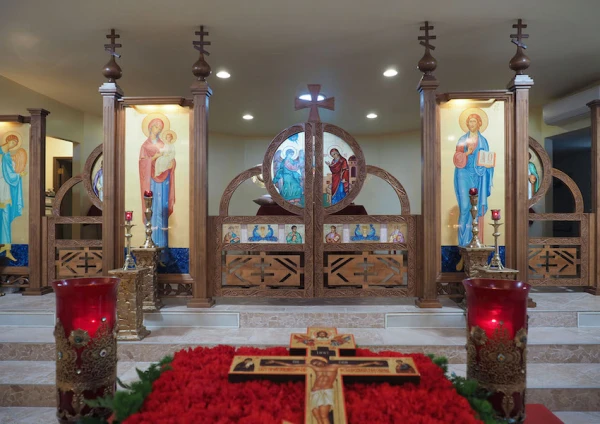
During the Divine Liturgy at the Easter Vigil, she stood with her pastor, Fr. Robert Rankin. They were surrounded by beautiful icons, an eastern tradition of gold leaf and painted wood which often depict biblical stories or images of Christ and the saints.

Rider received the sacraments of baptism, confirmation, which Byzantine Catholics call “chrismation”, and holy communion. She was anointed with chrism on her forehead, her hands, feet, chest, mouth, nose, and eyes.

While her parents had shied away from their Catholic faith when they were young, Rider said she grew up attending Christian services.

Her parents had “experienced something traumatic” in the Church, Rider said. Though their experience led them away from the Catholic faith, they were cautiously supportive of her decision to become Catholic, she explained

“My mom was exposed to the Roman Catholic Church at a very young age and she kind of steered away from it,” she said. “My father also was raised Roman Catholic as well.”

Before she became Catholic, Rider attended Calvary Chapel, an association of evangelical Christian communities.

But when she experienced a trial of suffering, she began looking for answers. The search led her to St. Melany’s.

Two years ago, her brother died in a motorcycle accident. Around the same time, Rider was diagnosed with fibromyalgia, a disease involving fatigue and musculoskeletal pain.

Before those hardships, Rider said, she had begun drifting away from Christianity. But once she started experiencing loss, she began to look at her priorities.

“I made a choice that day when it happened, either fall prey to sin or change your life and go back to Jesus, [my] first love. I chose Jesus and my whole life transformed after that,” she said.

It was after her brother’s accident that Rider met Jacob, the man who last month became her husband. Jacob himself had converted from Protestantism to the Byzantine Catholic faith before he met Jessica.

When they met, Jessica said, she was awakened to something beautiful and mysterious. She told CNA that Jacob did not push his Byzantine faith on her, she said, but politely encouraged her to join him at Divine Liturgy. 

“There was something different about him that I have never seen in anybody else. I was intrigued by that,” she said.

“There was something about him that was just a lot of wisdom. He was also very patient and he wasn’t anxious. He wasn’t an anxious or stressed person at all. So I was just really curious on what happened in his life.”

She said meeting Fr. Rankin was also an inspiration for her conversion. Not only did he speak with wisdom, she said, but the priest had an incredible zeal for Christ.

“I love Fr. Rankin. The way he talks about Lord and the saints, he talks smiling through his eyes…I have never seen anybody talk about God or anything in this manner. So it was kind of hypnotizing to listen to him talk about it.”

The choice she made to follow Christ more closely after her brother’s death has changed everything in her life, Rider said.

“I mean, literally, I got a new job, I have a husband, I have a faith and a church,” she said.

Rider chose St. Faustina Kowalska as her confirmation saint. She said she related to Faustina’s trials and felt connected to the Divine Mercy Chaplet. She said Faustina, who trusted in Christ despite pains, helped her find a purpose in her illness, which still gives her chronic pain.

“The picture of Divine Mercy…was important because it’s my path. Without his mercy, I wouldn’t be here right now,” she said. “[It] truly hit home for me when I was making the choice because I was going through [my trial] …When I saw the image and when I heard her story, there was just no way that she wouldn’t be a part of what I would choose because I felt like that was me.”

“I’ve had to learn that everything comes from his hands and trusting in that there’s a purpose. If I am going to suffer as Christ suffers, then I will do so,” Rider added.

When she heard about the Church’s sexual scandals, Rider said, the crimes, though disturbing, did not dissuade her from entering the Church. She said her faith relies on Christ.

The scandals, she said, are opportunities to pray for Church leaders who have “fallen away, because there’s so much responsibility and authority they have in Church.”

Coming from a Protestant background, Rider said the idea of praying to Mary and the saints was a difficult concept to grasp. But the Byzantine community was a source of information for all her questions, she said. Rider added Catholics should not “sugar coat” the faith for new converts.

“I felt supported in a lot of ways. Any questions that I had, I didn’t feel that I was inconveniencing anyone to explain [it] to me or that it may have been a silly question.”

“I don’t feel like we need to change [Church teaching]…because that’s not what Jesus Christ is about. Sometimes being obedient, it’s hard and it hurts,” she added.

Rider said she fell in love with the Ruthenian Church’s beautiful traditions, songs, icons and community. She described the experience as intimate and captivating. She also mentioned that her parish community was welcoming to her, which has made her feel like she belongs.

“When I came in, I was welcomed,” she said. “It’s always been really important since I’ve come in the church, that we all support each other.”

“It’s very intimate. Everybody that is with you, we’re worshiping and praising, and we’re all holding fast and true to scripture.”

Since she became a Catholic, she said, the Holy Spirit has prompted her to share Christ with her coworkers, who have asked her about an image of St. Padre Pio she wears as a necklace. Although her friends do not fully understand her decision to convert, she said, they are inspired by her faith.

“My coworkers don’t get it. They don’t understand,” she said. “[But,] I have a lot of people ask me because I wear the icon of Padre Pio. It kind of opens up conversation. So it’s an opportunity for me to talk about it.”

“Every day I print out words of wisdom and then I connect the scripture to it and I hand them out to my coworkers … They love it. I mean, if I don’t give it to them by lunchtime, people are asking me where is that? So … he must be moving in a way that I could never.”


[…]

No Picture
News Briefs

Bishops and Catholic Charities condemn new federal refugee limits

September 27, 2019 CNA Daily News 2

Washington D.C., Sep 27, 2019 / 05:00 pm (CNA).- Catholic leaders and organizations have condemned an announcement by the Trump administration that it intends to cap the number of refugees admitted to the United States at 18,000 for the 2020 financial year. 

The 18,000 figure will not include people who are claiming asylum. A person seeking asylum does so after arriving at a port of entry. A refugee is processed before arriving in the United States. 

The new proposed figure marks a 40% drop from the previous year’s ceiling of 30,000.

In a phone call with journalists, a senior administration official explained that the new refugee policy would prioritize refugees by the basis for their application over region of origin. The administration said that the large backlog in asylum cases is part of the reasoning behind the reduced number of refugees. There are nearly 400,000 asylum cases currently being processed by the U.S. government.

“First, we’re prioritizing those who have been persecuted for their religious beliefs,” said the official, explaining that 5,000 places would be reserved for this category.

“The U.S. is committed to advancing religious freedom internationally, including the protection of religious groups across the globe.”  

An additional 4,000 spaces will be reserved for Iraqis who assisted the United States, and an additional 1,500 places will be reserved for Honduran, Guatemalan, and El Salvadoran nationals who do not otherwise qualify for asylum.

The remaining 7,500 spots will go to eligible claimants not otherwise covered by these categories. 

A statement released by the United States Conference of Catholic Bishops condemned the policy shift.

“We are currently in the midst of the world’s greatest forced displacement crisis on record, and for our nation, which leads by example, to lower the number of refugee admissions for those who are in need is unacceptable,” said Bishop Joe S. Vasquez of the Diocese of Austin, who chairs the USCCB Committee on Migration.

“Refugees are among the most vulnerable people, fleeing war, religious persecution, and extreme targeted violence. Turning a blind eye to those in need with such callous disregard for human life would go against the values of our nation and fail to meet the standards that make our society great,” added Vasquez. 

Vasquez also voiced concerns about a proposed executive order that would allow cities and states to turn away refugees. 

“We fear the collateral negative consequences, especially for refugees and their families, of creating a confusing patchwork across America of some jurisdictions where refugees are welcomed and others where they are not.” 

Vasquez urged President Trump and Congress to “work together to restore U.S. refugee resettlement to at normal, historical levels.”

Catholic Charities USA said Sept. 27 that the organization “strongly opposes yesterday’s action by the Administration to historically reduce the number of refugees welcomed into the United States, a record low since the program began in 1980.”

“We call upon the Administration to consider the refugee resettlement program’s mission to provide protection to those in need for humanitarian reasons. The program should return to consistent refugee numbers rather than focus primarily on its use for partisan-based purposes,” Catholic Charities said. 

Catholic Relief Services, which exercises humanitarian ministry around the world, was similarly opposed to the proposed cap. 

“The world depends on the United States taking in its share of the 26 million vulnerable refugees,” said CRS executive vice president for Mission and Mobilization Bill O’Keefe in a statement.

“How can we ask a country like Uganda, a developing country smaller than Wyoming, to take in a million South Sudanese refugees unless we step up and take in at least 95,000 of the most vulnerable? 

“Fundamentally, we are talking about other human beings – children and families – seeking safety and a decent life. Admitting refugees reflects the values on which this nation was built, the teaching of Christianity and other faiths, and basic human decency,” he added. 

U.S. Citizenship and Immigration Services acting Director Ken Cuccinelli told reporters Friday that persecuted Christians seeking refugee status in the U.S. will be turned back if they seek to bypass the refugee cap by seeking asylum at the border.

“I take issue with how you ask your alleged question,” Cuccinelli said, before clarifying that the administration will “turn them back” if persecuted Christians attempted to walk across a national border in order to claim asylum in the counry.

The United States’ refugee ceiling remained relatively stable from the fiscal years 2000-2016, at around 70,000 annually. In his last year in office, President Barack Obama raised the ceiling to 110,000 for the fiscal year 2017. 

President Trump moved to limit the number of refugees who were admitted to the United States as one of his first acts in office. The United States averaged about 67,000 new refugee admissions each year until Trump took office, and that number has since been repeatedly lowered.

[…]

No Picture
News Briefs

Judge rules in favor of Michigan Catholic foster care agency

September 27, 2019 CNA Daily News 1

Lansing, Mich., Sep 27, 2019 / 04:08 pm (CNA).- A federal judge in Grand Rapids has halted a new state policy requiring adoption and foster care agencies to certify same-sex couples, regardless of their religious mission, or else lose state funding.

U.S. District Judge Robert Jonker issued a preliminary injunction against the policy Thursday. He said statements by Attorney General Dana Nessel calling religious foster care agencies, among other things, “hate mongers,” raise a “strong inference of a hostility toward a religious viewpoint.”

Nessel had in March put forth a new state rule that would bar adoption and foster care agencies from state funding if they refused to place children with same-sex couples.

The Michigan Catholic Conference said in a statement to the Detroit News that “it’s encouraging to see that Dana Nessel’s animosity toward Catholics has now been recognized in federal court.”

Michigan’s foster care system currently has nearly 13,000 children in it, and more than 600 children “age out” of the foster care system each year without having been adopted.

St. Vincent Catholic Charities, located in Lansing, recruited more new adoptive families than nearly 90 percent of the other agencies in its service area in 2017, legal group Becket reports.

“This case is not about whether same-sex couples can be great parents…What this case is about is whether St. Vincent may continue to do this work and still profess and promote the traditional Catholic belief that marriage as ordained by God is for one man and one woman,” Judge Jonker wrote in his opinion.

The ACLU first filed a lawsuit in 2017, after two same-sex couples approached St. Vincent Catholic Charities and Bethany Christian Services to adopt children referred to the agencies through the Michigan Department of Health and Human Services. The couples claimed that in 2016 and 2017 the agencies referred them elsewhere.

The State’s health department opened investigations into the complaints. Then on March 22, 2019, Nessel settled with the ACLU and required all adoption agencies to match children with qualified same-sex couples in order to receive state funding.

The settlement came despite a 2015 state law, passed with the support of the Michigan Catholic Conference, protecting the religious freedom and funding of adoption agencies. The settlement provided that the state must enforce non-discrimination provisions in contracts.

St. Vincent Catholic Charities challenged the new rule, along with a married couple and former foster child who had used the agency.

Judge Jonker noted that through the state’s Michigan Adoption Resource Exchange process, certified prospective parents can access children from any other agency, including St. Vincent. Through this process, same-sex couples have in the past been able to adopt children in St. Vincent’s care, he said.

“What St. Vincent has not done and will not do is give up its traditional Catholic belief that marriage as instituted by God is for one man and one woman,” the judge said.

“Based on that belief, St. Vincent has exercised its discretion to ensure that it is not in the position of having to review and recommend to the State whether to certify a same-sex or unmarried couple, and to refer those cases to agencies that do not have a religious confession preventing an honest evaluation and recommendation.”

Jonker called Attorney General Nessel’s efforts to force St. Vincent to certify same-sex couples a “targeted attack on a sincerely held religious belief.”

“Leading up to and during the 2018 general election campaign, she made it clear that she considered beliefs like St. Vincent’s to be the product of hate,” Jonker wrote.

Becket, the law firm representing the adoption agency and several other plaintiffs in the case, called the ruling a “major victory.”

“Our nation is facing a foster care crisis, and we are so glad that Michigan’s foster children will continue having all hands on deck to help them find loving forever homes,” Lori Windham, senior counsel at Becket, said in a Friday statement.

After oral arguments in the case, Melissa Buck, an adoptive mom and one of the plaintiffs in the current case, shared her personal story of working with St. Vincent to adopt five children with special needs.

“It’s the best and the hardest thing we’ve ever done, and there were challenges that we weren’t equipped to face on our own—but we were never alone. St. Vincent was there for us every step of the way, at all hours of the day or night, for anything we needed, even if it was for just a shoulder to cry on,” Buck said.

“We chose to foster and adopt through St. Vincent because the faith and values that motivate their ministry make them the very best at what they do, particularly finding homes for the children who need it most.”

Laws barring discrimination on the basis of sexual orientation or barring state funding from adoption agencies considered discriminatory have shut down Catholic adoption agencies in Boston, San Francisco, the District of Columbia, and Illinois, among others.

[…]