No Picture
News Briefs

Why this Franciscan nun is about to run her 10th marathon
October 3, 2019 CNA Daily News 0

Chicago, Ill., Oct 3, 2019 / 12:00 pm (CNA).- You might say that running 10 marathons is extreme.

Well, Sr. Stephanie Baliga, who is about to run her tenth, is somewhat of an extreme person. Just ask her. She’ll tell you.

She was once even more of an extreme runner, she told CNA.

But while she was a college athlete at the University of Illinois, she was grounded by a foot injury. While she recovered, Baliga, who had been running seriously since she was 9 years old, had some time to reevaluate her life.

“The metatarsal of my foot spontaneously fractured, so I went from being in very good shape to completely messed up because it was a…complete fracture. So I was in a boot and crutches for a very long time,” Baliga told CNA.

“And it made me – it forced me to reevaluate my life priorities and realize that I had pretty much placed running on this pedestal. It was how I defined myself and how I thought, how I understood who I was, and how I explained myself everybody else.”

But the injury, and the time off, made Baliga realize that her approach to running, and to life, was “super-not-sustainable and really didn’t make sense. So I needed to completely reevaluate what I was thinking about my life and who I was.”

It was during that time that Baliga connected with some students from her campus Newman Center and began delving deeper into her Catholic faith. She said when her friends invited her on a retreat, she was ready to go.

“I was pretty open to it,” Baliga told CNA. “It was pretty clear that Jesus was preparing for me to be ready for that point in time.”

It was on that retreat, during Eucharistic Adoration, that Baliga said she encountered the real presence of Jesus in the Eucharist in a new way.

“There was this increasingly intense realization of his presence and the sense, the knowledge that Jesus was really there in the Eucharist and this is real, it’s not just some stuff that people say because it’s nice to talk about, or it’s nice because it ties the theology together. But this is actually real…and that I needed to completely change the ways that I live my life.”

After that retreat experience, it didn’t take long for Baliga to realize she was being called to the vocation of religious life.

“So I’m kind of an extreme person,” Baliga said.

She said after the experience of realizing Jesus is real, she took time to delve more deeply into prayer and her faith community. It wasn’t long after that that she realized she was being called. “It was only like five months, because I’m extreme,” she added.

Baliga said she felt drawn to a Franciscan order from the start of her discernment because of their “love of the Eucharist and focus on the Eucharist, and love of the poor and work with the poor, and then (living in) actual poverty.”

As she was looking into different religious orders, Baliga said she considered one that would have required her to completely give up running, because it wouldn’t have been compatible with that order’s way of life. In prayer, she said, she told Jesus that if he was asking her to give up running, that was ok.

“I told Jesus that if he really would rather me not run ever again, that’s what I’ll do…if that’s what’s needed, that’s what I’ll do,” she said.

“And that was just kind of this experience of freedom in that once I gave run into Jesus, which is what I did at that moment, it then became his. And then he was able to use it for his glory instead of me being selfish and prideful and…showy about my running.”

Around February of her senior year, Baliga found the sisters that she would soon join – the Franciscans of the Eucharist of Chicago. A relatively new religious community, there were only two other sisters in the order at that time.

Baliga decided to join after graduating from the University of Illinois in 2009.

The order encourages sisters to exercise as their schedule allows, and Baliga has been able to keep up her running – though not in full habit, she said.

“I wear a bandana, and a T-shirt, and then a long running skirt with tights,” she said.

“Some orders do run in their habits because they’re shorter, but ours…we have ankle-length habits. It would be kind of a problem.”

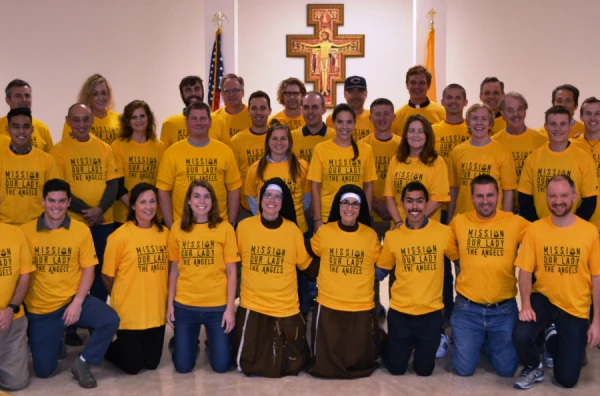
Sr. Baliga ran her first marathon as a sister in 2011, and for the past several years has used the Chicago Marathon as a chance to recruit people to be on a team that raises donations for her order’s mission.

“My community runs a place called Mission of Our Lady of the Angels, and we work with the poor on the west side of Chicago. We are a presence of Jesus here on the west side and this is one of the worst areas in the United States and leading Chicago in murders this year and things of that nature,” she said.

“So we provide a presence of peace, and a presence of love, and a presence of Jesus here in the midst of violence and poverty. We feed about 1,000 families a month with food and provide clothing and household goods for that same group, as well as work with senior citizens and families and do a lot of special events.” 

This year, she’s recruited 105 people for Team Our Lady of the Angels for the October 13 marathon, and so far they have raised more than $126,000 of the $200,000 goal.

The money will go toward the renovation of an old Catholic school building that caught fire in 1950, killing 92 students and three sisters. Sr. Baliga and her sisters plan to transform the building into a community center.

According to the team’s fundraising page, the new outreach center will provide space for the Mission’s donation storage and distribution, a handicapped accessible kitchen and dining room, meeting space for neighborhood and retreat groups, and a 60+ bedroom retreat center for volunteers and retreat guests.

Sr. Baliga also has a personal fundraising page for the marathon, where she is raising $30,000 for the boiler system in the sisters’ church and school.

“I have spent the past 9 years of my life tackling maintenance issues. BY FAR the most annoying, long-lasting, and time-consuming issue was the BOILERS/ heat system. It has innumerable issues. The only advantage has been my opportunity to evangelize at least 10 different HVAC repair companies,” Baliga wrote on her fundraising page.

“This is the year the Lord has made. Both boilers in the school-rectory-church heat system will be replaced by winter 2020-2021. I am running the 2019 Chicago Marathon to end the boiler issues once and for all.”

By press time, Baliga’s page had raised about half of its goal.

Baliga said she would encourage anyone else who finds themselves in a similar situation as herself in college – wonder what God is calling them to do – to be courageous.

“I think the Church right now needs saints and saints in the making. So we need people to be courageous…if people think Jesus is calling them to religious life, he probably is. So people should seriously take that very seriously and not wait,” she said.

“Listen to Jesus and make the sacrifices that he asks because the rewards will be great. Honestly, here on earth, he has provided for us beautifully here. And then obviously we know that he’ll provide infinitely for us in heaven.”


 

[…]

No Picture
News Briefs

Michigan governor axes funding for pregnancy, parenting support

October 1, 2019 CNA Daily News 1

Lansing, Mich., Oct 1, 2019 / 06:34 pm (CNA).- Democratic Governor Gretchen Whitmer has line-item vetoed from the state’s budget $700,000 in funding for the Michigan Pregnancy and Parenting Support Services Program, to the consternation of the Michigan Catholic Conference and a pro-life group active in the state.

“The process that led to these vetoes has been disappointing,” said Tom Hickson, Michigan Catholic Conference (MCC) vice president for public policy.

“It is the hope of this organization that in forthcoming negotiations the Governor and legislature can work together to restore this critical funding.”

The funding in the Michigan budget for pregnancy and parenting support went to Real Alternatives, a Pennsylvania-based nonprofit that has since 1996 provided counseling for pregnant woman on alternatives to abortion, as well as material help such as baby formula and diapers to mothers up to 12 months after they give birth.

The program expanded its operations to Michigan beginning in June 2014, working mainly through local Catholic Charities affiliates, with the backing of the Michigan Catholic Conference.

According to Real Alternatives’ estimates, the Michigan program has served 8,240 women at 31,958 support visits since 2014. The state has appropriated $3.3 million to the program since its inception.

“This year the Democratic governor of Pennsylvania allocated $7.3 million in funding for the same program in that state; Governor Whitmer’s line-item veto of a meager $700,000 will have a negative impact on low-income women in Michigan and should have been avoided,” said MCC’s Policy Advocate Rebecca Mastee.

“Women deserve better than this veto, and we look forward to working with lawmakers on both sides of the aisle to reinsert this funding into the state budget.”

Whitmer issued 147 line-item vetoes Oct. 1, amounting to nearly $1 billion in cuts to the budget she received from the Republican-controlled legislature, mlive.com reported.

Real Alternatives’ founding CEO Kevin Bagatta told CNA in August that if a woman is alone and poor, she may struggle with the pressures of an unexpected pregnancy. What the Real Alternatives program does is provide a counselor, who helps the woman from conception until 12 months after the baby’s birth, training her how to take care of the baby and herself.

He noted that it is primarily a counseling program, not a medical program, although the program offers referrals for medical needs, and saves the state of Michigan money that it might have otherwise spent on additional medical care for pregnant women.

“Real Alternatives is perplexed to hear…that against the wishes of Michiganders, Governor Whitmer has line item vetoed the successful Michigan Pregnancy and Parenting Support Services Program,” Bagatta said in an Oct. 1 statement.

“Not only did Michiganders reach-out to their fellow citizens in need through the program, but it also saved taxpayer monies.”

Bagatta told CNA that research done in the 1980s found that about 80% of surveyed women who had procured an abortion said that they would not have gone through with the procedure if just one person had taken the time to help them.

Today, Real Alternatives runs the Indiana, Pennsylvania, and Michigan programs from their base in Harrisburg. They helped to start a similar program in Texas.

In 2013, the Michigan Catholic Conference asked Real Alternatives to help to explain the program to then-Governor Rick Snyder, who put money in the budget to start the state’s program.

Catholic Charities affiliates in the various states are staffed with licensed social workers and trained counselors.

Under the George W. Bush administration, the program was accepted as meeting the requirements to use Temporary Assistance for Needy Families (TANF) money from the federal government, which states may use as they see fit. This means many of the state programs are funded with federal dollars; Pennsylvania’s program, like Michigan’s, also is funded by some state revenue. Usually the program is accepted in a state with a pro-life governor, Bagatta said.

“Every state gets TANF money. So if you’re a pro-life governor, you can have this program and use your TANF money to do a program like [this],” he explained.

Catholic Charities affiliates are able to dedicate staff specifically for this program as a result of the funding received, Bagatta said, and the funding model provides an incentive for the centers to serve more clients and open specific pregnancy resource programs.

David Maluchnik, communications vice president for the MCC, reiterated in August that Real Alternatives provides needed care for women who would otherwise choose abortion.

“[The program] not only provides support and care, it provides formula and [referrals for] pre- and post-natal meds; it gets clothing and shelter to mom and baby where there may otherwise be none; it helps with parenting tips when there’s no one to talk to; it offsets threats to infant mortality and gives young children and mothers a healthy start and a brighter future.”

“In the end, pulling the rug from under low-income women and her unborn or infant child at a time when they’re most vulnerable would constitute a heartless, calculated political maneuver,” he said.

[…]

No Picture
News Briefs

Split ruling for Virginia abortion regulations

October 1, 2019 CNA Daily News 0

Richmond, Va., Oct 1, 2019 / 04:13 pm (CNA).- A federal judge on Monday overturned two Virginia restrictions on abortion, while upholding several others, saying, “the right to choose to have an abortion is not unfettered.”

“In addition to a woman’s personal liberty interest, the state has profound interests in protecting potential life and protecting the health and safety of women,” wrote U.S. District Judge Henry Hudson, citing Supreme Court precedent.

“The state, therefore, may take measures to further these interests so long as it does not create a substantial obstacle that unduly burdens a woman’s right to choose.”

Hudson ruled Sept. 30 in a case filed last year by abortion advocacy groups including the Center for Reproductive Rights, Planned Parenthood Federation of America, and the Falls Church Healthcare Center. The suit challenged a series of abortion regulations enacted in Virginia.

Hudson upheld a state law requiring an ultrasound and a 24-hour waiting period before an abortion, calling the legislation “a persuasive measure by the State to encourage women to choose childbirth rather than abortion, which is a valid basis upon which to regulate abortion so long as the measure does not amount to a substantial obstacle to access.”

The judge also upheld unannounced inspections of abortion clinics, as well as a law mandating that only physicians may perform abortions. He noted that the state has a legitimate interest in ensuring the safety of abortion procedures.

“Given the potential risk that can arise in the later stages of second trimester abortions, limiting such procedures to physicians only is well-justified, even though it may impose an increased burden on rural residents, especially those who are living at or near the poverty line,” he said.

Hudson overturned a state law requiring clinics that perform first-trimester abortions to meet the health and safety standards of hospitals, saying that safe conditions could be ensured without this requirement, and pointing to previous Supreme Court rulings invalidating similar restrictions.

He also rejected a rule that second-trimester abortions take place in a hospital, saying that medical advancements render this requirement unnecessary for nonsurgical abortions taking place before the baby is viable outside the womb.

“The evidence has revealed minimal medical necessity for requiring non-surgical second trimester abortion procedures to be performed in licensed hospitals. On the other hand, the burden is significant, particularly with respect to costs and availability,” he ruled.

Victoria Cobb, president of the Family Foundation of Virginia, applauded the ruling, according to the Richmond Times-Dispatch, saying, “Once again the abortion industry failed in their zealous attempt to use the courts to do their bidding.”

Rosemary Codding, head of the Falls Church Healthcare Center, said she was “disappointed that our patients did not get their constitutionally-protected right to accessing health care without legislative interference that they are entitled to and that they deserve,” the Times-Dispatch reported.

Virginia is one of several states with abortion regulations being challenged in court. More than a dozen lawsuits have been filed this year against state laws restricting abortion.

Olivia Gans Turner, president of Virginia’s National Right to Life state affiliate, argued in May that raising safety standards surrounding abortion procedures protects the health of women, noting, “Laws requiring that ‘physicians only’ perform abortions exist in 40 states.”

[…]

No Picture
News Briefs

Catholics with special needs ‘show us the face of Christ,’ says Burbidge

October 1, 2019 CNA Daily News 2

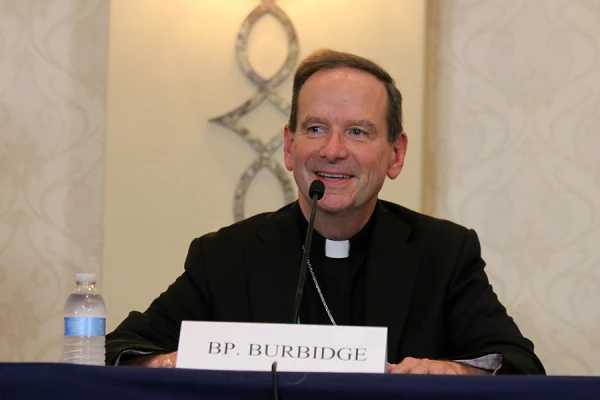
Arlington, Va., Oct 1, 2019 / 12:00 pm (CNA).- Catholics with special needs are a central part of “who we are and what we do” as a community, Bishop Michael Burbidge of Arlington told attendees of the diocesean Mass for Persons with Disabilities on Sunday, Sept. 29. 

Burbidge told the assembly that he hopes and intends to work so that every school and parish in the Arlington diocese is able to offer special education and inclusion programs.

The Mass was sponsored by the diocese’s Office of Faith Formation, Porto Charities, and Holy Spirit Church in Annandale, where the Mass was celebrated. The Virginia-based branch of Porto Charities works to help and support people with intellectual and developmental disabilities. 

Burbidge drew from Sunday’s Gospel reading, the parable of the poor man, Lazarus, going to heaven while the rich man went to hell. 

“I do not think the rich man intentionally and deliberately did anything evil. He did not order Lazarus from the gate. He did not treat him intentionally cruelly,” said Burbidge. 

“The failure of the rich man was that he simply did not notice Lazarus right there in his midst. Instead, the rich man accepted him as part of the landscape.” 

In today’s world, it is important to not become like the rich man and ignore the suffering of those around us, even if this is not an intentional act, Burbidge said. He challenged those at the Mass to search for ways to assist those who may need help, including in the diocese’s schools. Burbidge explained that many Catholic schools in the diocese have programs to include students of varying abilities. 

“I want to highlight today the expanded services and inclusion and options programs that our Catholic high schools and some of our elementary schools [have], where those with learning challenges and gifts are part of who we are and what we do,” said Burbidge.

He said that students with special needs who attend these schools “show others the face of Christ and bring out the best in all of us.”

Fifteen diocesan schools currently enroll students with special educational needs. The bishop said it is his aim that every part of the diocesan community be able to accommodate students with special needs.

“It is my expressed desire and hope and intention to make these expansion programs part of every parish and every school,” said Burbidge. Presently, three of the diocese’s five Catholic high schools have programs that serve students with intellectual or developmental disabilities. 

Dr. Joseph Vorbach, who serves as the superintendent of the Diocese of Arlington’s Catholic schools, told CNA that expanding inclusivity at schools is a “growing priority” in the diocese. 

“With Bishop Burbidge’s vision and support, schools are initiating new programs and expanding existing ones that benefit not only the students with intellectual disabilities, but also entire school communities as everyone becomes more acutely aware of individual differences and challenges,” said Vorbach.  

“Moving in this direction has been possible because of bold leadership at the school level empowering wonderfully creative and mission-focused educators.”

Sacred Heart Academy, a diocesan elementary and middle school in Winchester, VA, was chosen by the Virginia Division of Rehabilitative Services to receive the Winchester Division of Rehabilitative Services “Champion Employer Award.” This award recognizes employers who “go above and beyond” to employ and support people with disabilities.

[…]