No Picture
News Briefs

Notre Dame panel on abuse crisis: Where do we go from here?

September 26, 2019 CNA Daily News 1

South Bend, Ind., Sep 27, 2019 / 12:07 am (CNA).- It has been more than a full year since the sex abuse allegations against the former cardinal Theodore McCarrick and the publication of the Pennsylvania Grand Jury report set off a shockwave of further abuse accusations and investigations in the Church in the United States and beyond.

It has been 17 years since the U.S. Conference of Catholic Bishops (USCCB) implemented the Dallas Charter for the Protection of Children and Young People, which proposed a “zero-tolerance policy” for child abuse in the Catholic Church in the U.S.

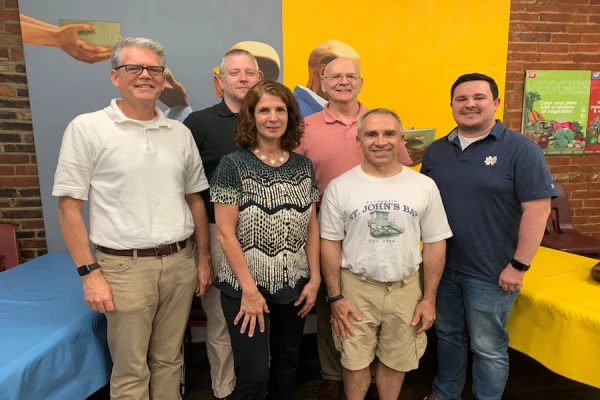
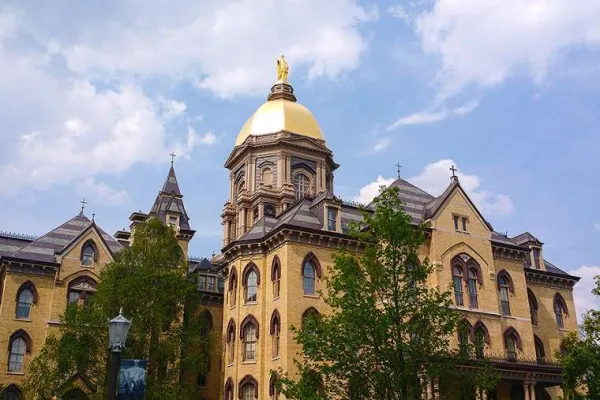
It was just this week that a panel of four experts on the abuse crisis gathered at the University of Notre Dame to discuss the question: “Where are we now?” and to propose ways for the Church to continue moving forward.

Panelists at the Sept. 25 event included Juan Carlos Cruz, an abuse survivor and advocate from Chile whose complaints were initially dismissed by Pope Francis (though were later accepted with an apology from the pope); Archbishop William E. Lori of Baltimore; Kathleen McChesney, a former FBI executive assistant director who helped the USCCB implement the 2002 Dallas Charter; and Peter Steinfels a long-time journalist for Commonweal who wrote a lengthy review of the Pennsylvania Grand Jury report on the sex abuse crisis. John Allen Jr., editor of Crux, moderated the panel.

While much has improved regarding the clerical sex abuse crisis in the U.S. since 2002, the panelists gave a resounding response that even one case of abuse occurring in the Church is too many, and that a change of hearts and attitudes, and not just of policies, is needed for the Church to progress and for victims to heal.

“The one thing that I am certain about is that most of us, myself very much included, know much less about this painful, stomach-churning scandal than we think we know,” Steinfels said.

Steinfels noted that since 2002, the Church in the U.S. made significant progress in the abuse crisis, reducing the number of cases of sexual abuse from about 600 per year in the 1950s-1970s down to roughly 20 or fewer cases per year, post-Dallas Charter.

“Anyone who obscures this dramatic drop in Catholic clergy abuse, as I think the Pennsylvania Grand Jury report did, is not telling the truth,” he noted.

But that is still not enough, Steinfels added, because “one case is one too many,” and these statistics of success “can blind us to the excruciating, life-derailing devastation caused by a single case of abuse.”

He also predicted that news of Church sexual abuse was not going anywhere anytime soon, because “the abuse scandal has gone global. More than 120 million children sexually abused worldwide – it is woeful that even a small fraction has touched the Church.”

Even though the bulk of the abuse crisis in the U.S. occurred decades ago, Steinfels said, there are still victims coming forward who were afraid to share their stories until now, and whose experiences of pain and betrayal “are like landmines left buried in the ground after the war.”

In one suggestion for a way forward, Steinfels encouraged Catholic universities like Notre Dame to compile the history of the sex abuse crisis, from which others could learn.

“A genuine history will require archives, oral history interviews, and study of scandal’s religious, cultural, and economic context,” he said.

“It has been said that we walk backwards into the future looking at our past. A genuine history is needed for our future.”

In his remarks, Cruz said that he would leave the statistics to the experts and speak from the heart. While Cruz’ story of abuse at the hands of his parish priest in Chile was initially dismissed by Pope Francis, the Holy Father later apologized to Cruz and other victims for being “part of the problem” in May 2018.

Cruz told the panel audience that what sustained him through the pain of his experience of abuse was his Catholic faith.

“I decided early on that I wasn’t going to let them win. I wasn’t going to let the bad ones win,” he said. “I believe that the relationship anyone has with God…it’s the most basic human right that one can have, is to believe in what you believe, and nobody can mess with it. And I wasn’t going to let them mess with that.”

In a word of encouragement to abuse survivors, Cruz said that while it is hard to come forward with a story of abuse, there are people who can help.

“There are so many people who want to lend you a hand, to help you through that horrible pain,” he said.

Cruz said that he was encouraged by Pope Francis’ apology and willingness to listen to his story and those of other abuse survivors, but that he was discouraged by the attitudes of some bishops who promise to improve but who continue to cover up and mishandle cases of abuse.

“Pope Francis wants to solve the problem, I’ve talked to him and know he’s sincere,” he said. “However, the bishops go, talk to him, say, ‘absolutely Pope Francis,’ they bow, they kiss his ring, go back to their countries and do the same thing they’ve been doing…nobody holds them accountable and that needs to stop.”

In her remarks, McChesney also called for a change of heart and attitude among the bishops.

“When I first worked for the USCCB, the Dallas Charter was new, we were excited about implementing it, and I talked with many survivors,” she noted. “And one man said: ‘Look, you can have all the programs in the world you want, you can have policies, you can have trainings, you can have background checks and investigations, you can do all of those things, but until the bishops realize that there has to be a true accountability, I and my fellow survivors are not going to heal.’”

“It is so critical for the men and women who have been abused to know that someone is taking responsibility for what has happened to them,” McChesney said.

There has also been a lot of talk about the rethinking of seminary formation in the wake of the abuse crisis, McChesney said, with suggestions to really emphasize the human formation aspect of seminary formation.

But this “puts the cart before the horse,” she argued.

“In my experience, I think that selection is more important than formation…you can have the best formation programs, the best seminaries in the entire world, but if you have selected the wrong person to go into seminary, someone who is so troubled, who doesn’t know what they want to do, has mental health issues…that person is never going to become a healthy cleric. So to have a healthy presbyterate, you need to start with healthy men,” McChesney said.

She also credited lay men and women, as well as some dedicated clergy, with working on the ground levels to bring the abuse numbers down since the Dallas Charter was established and who continue to work with and pressure bishops into doing more.

Because there have been so few cases since the 2002 Charter, McChesney added, it is all the more urgent to thoroughly investigate the cases of abuse that have occurred since then, and to ask how and why they happened.

“There are not as many cases – but there have been cases. Why? Who missed that lesson and why? And where was the oversight of those persons who abused?” she said.

Finally, she added, the Church must fight against issue fatigue and complacency when it comes to the sex abuse crisis.

“We can’t let our tiredness, our sadness, overtake our passion for continuing to work on these issues,” she said.

Archbishop Lori, once a member of the USCCB’s Committee on Sexual Abuse, noted that he was speaking only for himself and not all bishops. Lori said that for him, learning how to really listen to victims of the sex abuse crisis has been one of the “steepest learning curves” in the handling of the sex abuse crisis.

It may be the instinct of a bishop to offer a victim the help and support of the Church, Lori said, but survivors of abuse do not always want that. He had to learn how to really listen and realize that “I as the bishop listening to this cannot fully appreciate the nature of the experience that’s being described to me.”

He had to learn to not try to “be the person that has the answer, not try to be the person who pushes or who offers something that might not be wanted by the victim-survivor in that moment, the victim-survivor has to be in the driver’s seat. It’s not just a question of meeting them or of affirming, it’s a question of listening deeply, and believing them.”

Adding to the chorus of previous comments that “one case is too many,” Lori also echoed the other panelists’ call for conversion among the bishops and other Church clergy and officials.

“The need remains and will always remain not to see the charter, these norms…simply as policies to be complied with,” Lori said. “In the grace of the Holy Spirit, there’s really got to be, on the part of people like me, my co-workers, lay co-workers, a conversion of mind and heart.”

Protecting children and listening to and helping victims of clerical abuse must be “as much as part of the life of the Church…as evangelization, Catholic education, or raising up vocations,” he added.

“We’ve got to continue being held accountable, because the Church’s mission depends on it.”

During the discussion, most panelists also noted that the abuse crisis has in some cases been “weaponized” by both conservative and liberal camps within the Church to push certain other agendas.

This is “a shameful use of what has happened to these men and women,” McChesney remarked.

During a question-and-answer session, Lori added that part of the ongoing solution to the abuse crisis is bringing more lay professional voices to the decision table.

“I need the help of qualified, committed laypersons who have expertise that I’ll never have,” Lori said. “Who’s sitting around the decision table?…that affects Church governance and how we look at this.”

Cruz also called for more young people and more laity, particularly women, to be involved in the decisions and solutions to the abuse crisis.

“We need more women in the Church that are trained, that are prepared, to break this men’s club, to bring all their talent and their training to help us heal,” he said. “We can’t have women in the sacristy, we have to have them front and center in the Church, and we can’t wait for bishops to finish their learning curve, survivors need us now.”

Cruz added that he gets frustrated when he hears bishops or other clergy say that prior to the Dallas Charter and other protocols, they did not know how to act or handle cases of abuse.

“I want to tell them: raping a child has always been wrong – before Christ, after Christ, in the Middle Ages…and it always will be wrong. So you better learn.” 

[…]

No Picture
News Briefs

How these Virginia Catholics are helping the homeless find work 

September 26, 2019 CNA Daily News 0

Arlington, Va., Sep 26, 2019 / 02:59 pm (CNA).- A Catholic group in Arlington, Virginia, is committed to helping homeless people, along with others down on their luck, by equipping them with the tools to find work and build careers.

In 2009, “Christians are Networking” (CAN) was launched by Catholic Charities in the Diocese of Arlington. The ministry began during the financial crisis, when unemployment was high, and those who had held steady careers were struggling to find work.

When the economy improved five years ago, CAN partnered with Christ House, a men’s homeless shelter in Alexandria, Virginia, to offer their services to people who have been living on the streets.

While the organization trains for resume-building, networking, interviewing, and computer skills, volunteer coordinator William Schuyler told CNA that the most important service has been helping participants believe in their own worth.

“The thing that we actually brought to the world was not so much that we could tell you how to write the perfect resume; it was that we reminded people of their value as a human being,” he said.

Christ House has enough space for 14 men at a time, and residents may stay in the house for up to one year. Men have their food, rent, and other necessities provided for them. They can also receive support to obtain identification papers.

The residents can also meet weekly with CAN to discuss career strategies like budgeting and networking. During the Wednesday night meeting, participants discuss progress and setbacks on the job hunt. Then, the job-seekers meets individually with volunteers.

Yvonne Horner, a volunteer coordinator for CAN, has been with the organization since it started at Christ House. With a background in human resources, she instructs clients on tax information and company benefits.

“When a man first enters Christ’s House, he will meet with the volunteers of CAN so they can find out a little bit of information, like education and work history. The volunteers also look to determine the clients’ interests and other areas of skills,” Horner told CNA.

“Then [we] talk a little bit about employment opportunities they might be interested in pursuing. We have a couple of volunteers who specialize in government work so they can help them navigate the government employment website.”

A major part of the program is helping men find a social support group.

Schuyler said that ideally the program will reconnect its clients to family members, like parents, children, and siblings.

The house will also encourage men to seek a community among themselves, he said.

“If [families ties are impossible], what we really tried to do is build ongoing relationships between the men at Christ House itself,” he said.

“Them bonding within the context of Christ … then what that seems to do is enable them to reconnect with other people.”

Through interactions with professionals and other job-seekers, the men are built up with encouragement, he explained.

“It’s important to remind people that they have value” in their dignity and in their work, Schuyler added.

“The organization needs you and it depends on you. Your colleagues are dependent upon you … if you do [your job] well, you are part of a thing that’s making an organization succeed.”

“If you think of only the [task] you’re doing, [like] the washing of the dishes, it’s pretty easy to think of yourself as not having value in this.”  But, he said, “if you think of yourself as part of a team of people that are enabling people to have a delicious dinner, I think you can feel that you will have human value that’s worth it.”

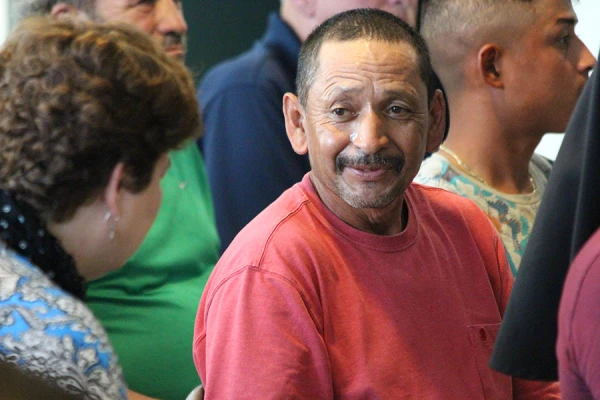
Catholic News Agency spoke with Dorian Spring and Leon Brown, both of whom participated in the program recently. The men had been homeless, and either not working or underemployed. Now, they have promising careers.

Spring entered the program about six months ago, after his landlord sold his home, leaving him homeless. He had been working at a hotel for 15 years, he said, but there was no room to move upwards in the company.

“I was very stressed out and then basically abused,” he said, noting that he had been passed over for promotions despite his lengthy employment and good attendance.

“I had to find something else and I talk[ed] to the CAN group about it,” he said. “They help you make yourself better, like with your resume and [preparation] for interviews and how to present yourself in interviews,” he added.

After coming to Christ House, Spring discovered new approaches to pursuing a higher position in a company.

He is now working for Georgetown University Hotel Conference Center, where he has company benefits and an opportunity for a raise every six months.

Spring explained that because of his background in hotel work, CAN worked with him to discover the goals of his career. He expressed hope that he might eventually be promoted to hotel management. He said CAN also helped him discover skills in his current profession, which are reflected in other professions, like office work.

“They keep you motivated,” he said, noting that the house is always open for people to return for additional help.

“They were very good to me.”

Brown joined Christ House over nine months ago, with no housing and no job. Now, he is working as a dishwasher at Hen Quarters, a restaurant serving Southern comfort food in Alexandria. He cleans dishes, floors, and linens.

Brown said he feels like a valuable part of the team.

“[I] love it and I got a good team with me and they appreciate me and I appreciated them. So I thank CAN group for that,” he said. “The charity really helped us and it made a better me, and I’m just going to continue on getting better.”

Brown said CAN also helped him establish a Facebook profile and track down his son, whom he had not seen in about 15 years.

“I [have] pictures on Facebook – me and my son and my friends,” he said.

 “My family, my workers and people who surround me, especially Christ house and CAN group, I appreciate each one of them.”

Both the men expressed gratitude for the job skills they’ve gained, but they also expressed appreciation for the community. One of their favorite aspects was the annual Christmas event. They said they had never experienced anything like it.

“Best Christmas I ever had,” said Brown.

“God is good all the time,” he said.

[…]

No Picture
News Briefs

At US-Mexico border, bishops emphasize bonds of faith and family

September 26, 2019 CNA Daily News 0

El Paso, Texas, Sep 26, 2019 / 11:15 am (CNA).- At a Mass and press conference held at the US-Mexico border in El Paso, Texas on Wednesday, bishops from the border region emphasized the importance of providing care for migrant families, especially those who share a common faith and baptism with American Catholics.

“These are baptized Christians. From the faith perspective, that’s what we forget sometimes because we’re so focused on the charity part of it,” Bishop Brendan Cahill of the Diocese of Victoria, Texas told CNA Sept. 25.

“But these are baptized Catholics, so these are our brothers and sisters. So respecting national borders, respecting everything else, there’s still a bond there through sacramentality.”


“We know that they’re coming not to take advantage of this wonderful, generous country, but rather to have an opportunity to work and to raise their families in safety and dignity,” Bishop Oscar Cantu said Sept. 25 as bishops prayed at the US border.

Photos: @mckeownjonah pic.twitter.com/F5KYX9zONk

— Catholic News Agency (@cnalive) September 26, 2019


The delegation of bishops, led by Bishop Mark Seitz of El Paso, is visiting the border this week to meet migrants at aid centers and in the fields where many of them work. The visit was designed as a pastoral encounter with migrants and Catholic leaders of the Dioceses of Las Cruces, New Mexico, El Paso, Texas, and Juarez, Mexico. Five bishops were present at the Mass and press conference.

Fr. Robert Stark, Regional Coordinator of the Vatican’s Section on Migrant and Refugees, was also in attendance. Pope Francis has declared Sunday, Sept. 29 as World Day of Migrants and Refugees.

Cahill celebrated the Mass in Spanish on Wednesday evening at the Centro de los Trabajadores Agrícolas Fronterizos, located in South El Paso just a stone’s throw from the border fence. The 8,000 square foot adobe-brown facility has for over 25 years provided aid for the thousands of migrant farmers who cross from Mexico to work in the United States every day.

The bishop related the story of a family he knows: A husband and father drives each day from Mexico across the border to New Mexico to farm, leaving at 3 am and arriving back home around 7 pm. He sleeps, and then does it again the next day.

Most chili farm workers are paid around 79 cents for each large bucket of chilis or onions picked.

“Over these past few days we’ve heard dozens of stories, but to me there’s a similar theme to all of them…it’s really all about family. It’s about parents caring for their children, and I think for any of us that’s our number one concern.”

In Ciudad Juarez, Central American migrants are being treated “very well,” Cahill said, but the threat to the families, and particularly mothers, still has impacted him.

“As I listen to the migrant farm workers’ stories, I hear challenges to keep the family together, opportunities for families because it is work and provides, so I think that has to be admitted that that’s a good, but then to see what we can do even better.”

Though the situation on both sides of the border is “overwhelming,” Cahill emphasized Pope St. John Paul II’s exhortation to pray for the family— not just one’s own family, but for the holiness and wellbeing of all families.

“The experience of being on the border and listening to people’s stories— and these are regular people— is that the family is always the forefront,” he said.

“I want to pray for the family unit, that we protect mothers and fathers and children, and that they can be together. And that’s what I noticed here on the border, a lot of economic forces, a lot of things challenging keeping the family together.”

Seitz said at the press conference that it is unusual to have so many bishops gathered together around one particular theme outside of the regular bishops’ meeting. The special focus of the visit, he said, is on farm workers.

“They’re a quiet reality that have been passing through El Paso, staying in El Paso, moving out from El Paso for many decades here,” Seitz said.

Seitz said the visit was designed to allow those who had not visited the border area before a chance to get a feel for the area, and a border situation that is “changing every day.”

The Mass coincided with a vote taken in Congress Wednesday to block President Donald Trump’s emergency declaration at the southern border, which is designed to divert funds from other projects to build a wall on the border with Mexico. The president is expected to veto Congress’ action.

On Tuesday the bishops visited Ciudad Juarez to visit a large aid facility, as well as a visit to Corpus Christi parish, which is largely serving farm workers and their families. On Thursday, the bishops plan to take a visit to Hatch, New Mexico to meet farmers there who grow and pick the valley’s world famous chilis.

The bishops also met with groups of Central American migrants in Ciudad Juarez who had been waiting in Mexico for a chance to cross the border.

“It’s devastating to see that these dreams that they have, dreams that my own parents had as immigrants to the United States from Mexico some 60 years ago, and people continue with those dreams,” said Bishop Oscar Cantu of San Jose, formerly bishop of Las Cruces.

“We know that they’re coming not to take advantage of this wonderful, generous country, but rather to have an opportunity to work and to raise their families in safety and dignity.”

According to U.S. Customs and Border Protection, apprehensions of “unaccompanied alien children” has risen by nearly 75% from May 2018 to May 2019. The rise in apprehensions is led by El Paso, which has seen a 323% rise in that period.

The rise in apprehensions of families is higher— 463% across the board. El Paso’s rate of apprehension of families rose 2,100%.

Bishop John Stowe of the Diocese of Lexington, Kentucky, formerly a priest of the diocese of El Paso, praised the work of Catholics in the diocese working to welcome migrants. 

“The Diocese of El Paso has given an example for the whole country of how to welcome immigrants, how to love immigrants, how to clothe immigrants, how to provide shelter to immigrants, how to treat them as brothers and sisters and receive them here,”

The Department of Homeland Security announced new Migrant Protection Protocols in January, providing that migrants arriving illegally or without proper documentation “may be returned to Mexico and wait outside of the U.S. for the duration of their immigration proceedings, where Mexico will provide them with all appropriate humanitarian protections for the duration of their stay.”
https://www.dhs.gov/news/2019/01/24/migrant-protection-protocols
These policies, Stowe noted, have meant that that tens of thousands of migrants are “stuck” on the Mexico side of the border, as asylum claims can take years to process.

“It was just months ago that thousands of people were coming across the border, flooding this city, and they were received in shelters throughout this city by people of faith who reached out. Not only our Catholic Church but other churches in town, reaching out and serving them. That’s a beautiful example for the whole country; it’s what our nation was founded on, and it’s specifically important for our Catholic Church.”

In terms of practical actions the faithful in El Paso have taken, Seitz told CNA that the diocese in Oct. 2018 opened a shelter at the pastoral center, a “purely volunteer response,” to deal with the large number of people passing through the city. The temporary shelter has since closed due to a drop in the number of migrants passing through.

“Right now, we’ve seen a huge drop off in the number of people coming because of enforcement actions in Mexico,” Seitz noted.

“So what’s happening is there’s kind of a bottleneck in Ciudad Juarez, and we estimate that there are up to 20,000 people that are pretty much stuck there. They’re afraid to go home, because that’s where they’re fleeing from…they’re afraid to stay in Mexico, because most of them have faced violence there.”

Robberies and kidnappings among the migrants waiting in Mexico are common, he said.

The HOPE Border Institute, along with the Diocese of El Paso, in July initiated a Border Refugee Assistance Fund to send money to organizations working with migrants and refugees in Juarez.

“Do we believe there is a usefulness to a border? Absolutely. The Church has not problem with that usefulness. But we also know that there are higher laws than than the law that has to do with a nation’s border.”

“We are Catholic Christians, and we are citizens. If the two ever come into conflict, we need to be Catholic Christians first,” Seitz told CNA.

The majority of the migrants that the Church in El Paso helps have already been processed by ICE and are awaiting their court date for asylum.

“The fact is that most of these people that are crossing, seeking asylum, are not breaking the law. They’re following the law that was established for people like our ancestors who came here seeking refuge…And we need to try and see things through the eyes of Jesus Christ and through the teachings of our Church. And those teachings should be clear when they say that if we encounter someone in need, we need to do what we can to help them.”


[…]

No Picture
News Briefs

Metuchen diocese holds 9-mile walking pilgrimage for spiritual renewal

September 25, 2019 CNA Daily News 0

Metuchen, N.J., Sep 25, 2019 / 02:48 pm (CNA).- More than 700 people participated in a nine-mile pilgrimage through the streets of New Jersey’s Hunterdon County on Saturday in order to call for a spiritual awakening and increased discipleship in the Diocese of Metuchen.

The Sept. 21 pilgrimage was part of the diocese’s preparation for consecration to Christ through Our Lady of Guadalupe, which will take place on her feast, Dec. 12.

The journey was a loop that began and ended at Immaculate Conception Parish in Annandale, about 30 miles west of Metuchen.

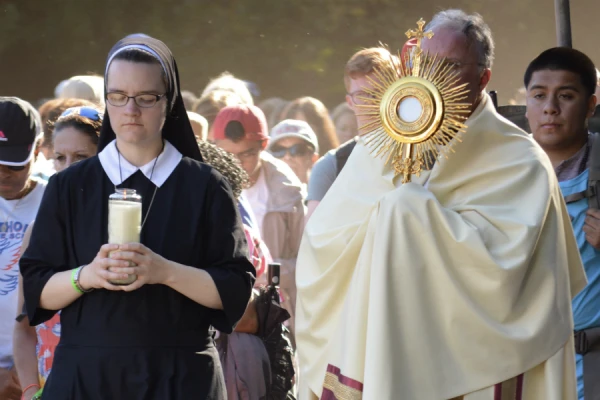
During the pilgrimage the participants, among whom were 23 priests, prayed the rosary in both English and Spanish, and sang Marian hymns. The priests were available to hear confessions during the walk, and there was Eucharistic Adoration and a Holy Hour at the six-mile point of the pilgrimage.

Those who couldn’t join the procession, the parish held day-long Eucharistic adoration.

The choice of a nine-mile pilgrimage was significant to the story of Our Lady of Guadalupe’s apparition in Mexico.

“Deep in our spiritual tradition ‘pilgrimages’ signify and make present our ultimate journey home to heaven, recalling the truth that ‘as Christians, we have no earthly home,’” said Fr. Timothy Christy, vicar general and moderator of the curia for the Diocese of Metuchen. “Our pilgrimage commemorated the miles that St. Juan Diego regularly walked from his home to attend his catechesis to become Catholic in 1524.”

Christy hopes that the people of the diocese will be moved to imitate St. Juan Diego’s spirituality in their own lives, and be centered on Christ and the Church.

“St. Juan Diego’s heart was so moved by the love of Jesus and His Church and love of the Virgin Mary, no obstacle was too much to keep him from being joined to the Body of Christ and so to be able then to be prepared to receive Holy Communion,” said Christy.

“It is our hope that the people of our diocese will be reinvigorated by that same love for Jesus, the same love for His Church and the inspiration and protection of Our Lady of Guadalupe.”

Sr. Anna Nguyen, SSC, described being “overwhelmed with emotion,” and said the experience of the Eucharistic procession was one she will never forget.

Nguyen, a delegate for religious, helped coordinate the spiritual aspects of the pilgrimage.

“To see the faces of the people, all ages – clergy, religious, Eucharistic youth, young people, little children in carriages being pushed by their parents – all experiencing that we do not walk alone, Christ travels the ‘Way’ of our life with us!” said Nguyen.

“Even if (pilgrims) couldn’t see the Eucharist from the back of the procession, the Lord’s presence was palpable,” she added.

Bishop James Cecchio of Metuchen participated in the last three miles of the pilgrimage and celebrated Mass at the conclusion. An additional 300 people were present for the anticipated Mass.

Checchio encouraged those present to be open to sacrifice in their discipleship, and to commit their lives to Jesus.

“By this Eucharist today, by our pilgrimage – 9 miles walking with the Lord and one another – we make a public statement to our Lord and to one another of where we choose to place our heart,” said Checchio.

“We ask the Lord to light our hearts on fire, we ask the Lord to strengthen us for the challenges and the difficulties that we and our families face…as we strive to bring the merciful presence of Christ to all who do not know Him yet,” he said.

“I thank God for your striving to live this way, and I thank God for your witness today that you give through this pilgrimage – the times we live in, our times need more witnesses to Christ.”

[…]