No Picture
News Briefs

House votes to recognize Armenian genocide

October 30, 2019 CNA Daily News 0

Washington D.C., Oct 30, 2019 / 02:00 pm (CNA).- The House of Representatives voted Tuesday to pass a resolution recognizing the genocide of Armenians by the Ottoman Empire.

Rep. Adam Schiff (D-Calif.), sponsor of the resolution, said after the v… […]

No Picture
News Briefs

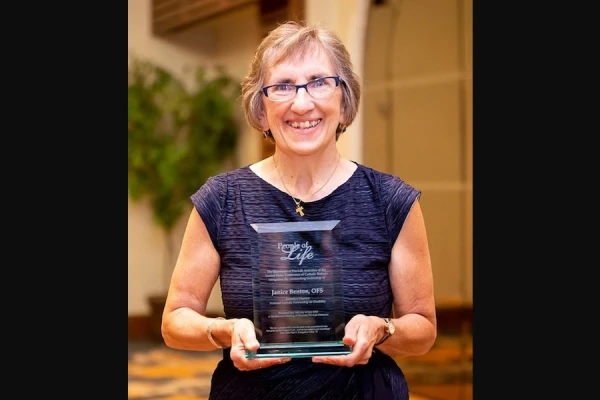
Meet Jan Benton – leading the charge for inclusion of Catholics with disabilities

October 30, 2019 CNA Daily News 1

Washington D.C., Oct 30, 2019 / 01:44 pm (CNA).- When Janice Benton, OFS was attending college in Michigan, she answered an ad in her parish bulletin that was seeking someone willing to be a catechist for children with intellectual disabilities.

That response would begin a career spanning several decades, where she would work to improve inclusion for Catholics with disabilities–a career that would lead her to speaking at the Vatican and leading the National Catholic Partnership on Disability for 15 years.

Benton will be retiring from her position this year and will be honored for her work with Catholics with disabilities at a banquet on Nov. 8. She spoke recently with CNA to discuss how the landscape in the Church has changed for people with disabilities since she began working in the field, and how she hopes things will continue to improve in the future.

After volunteering with children at her parish, Benton started a catechesis program to serve young adults with disabilities, and was working at a nursing home. There, she befriended a young woman with cerebral palsy. She told CNA she had wondered why a young adult was living in a nursing home, and sought out the friendship. She also met another volunteer in a catechetical program who had cerebral palsy.

“So I ended up with friends and family members with disabilities,…and I was blessed to work with folks from the Archdiocese of Detroit to get a lot of their training from them,” Benton said. “They had quite a good program there.”

The National Catholic Partnership on Disability (NCPD) was founded in 1982, and Benton assisted with its creation, having previously worked with the U.S. Bishops’ Advisory Committee on People with Disabilities. Benton took over the role of director of the NCPD in 2004.

Benton said she has seen many positive changes regarding the treatment of Catholics with disabilities during her more than 40 years working in that ministry.

“I think people are more engaged in parish life now, and their gifts are really being recognized,” she said. “I think of it as just recognizing their giftedness and that everybody is called to, everyone belongs in the Church. And they’re called as part of the body of Christ to contribute.”

Specifically, Benton said she is happy to see more and more parishes and schools adopt inclusive models to serve Catholics with disabilities.

“There’s more involvement in parish life itself and less just separate programs (that are) just kind of off to the side to serve people,” she said. “There’s just more appreciation of people for who they are, their giftedness and what they can bring to the faith community.”

While Benton is heartened by these changes, she said there’s still much more work to be done. For instance, the NCPD still receives calls from families with children who were told they would not be permitted to receive their First Communion or participate in faith formation classes due to their disabilities. The USCCB approved the Guidelines for the Celebration of the Sacraments with Persons with Disabilities in 1995, which Benton called a “beautiful resource that’s easy to put into the hands of pastors and catechetical leaders.”

And although there have been substantial improvements in the Church regarding persons with disabilities, especially with the ever-growing list of Catholic schools that are willing and able to accommodate students with special needs, Benton told CNA that Catholics with disabilities are still often overlooked by other members of their parishes.

“I have a friend who says one of the things that hurts her the most is not being seen as a person, (but) kind of being seen as a ‘person with a disability’ and not as somebody you’d want to go out to lunch with or just have fun with,” said Benton.

“And my friend in my parish says what hurts often the most is that nobody wants to sit near her. They kind of keep a wide berth. And, so I think people still tend to exceptionalize disability, and want to make it special or different or kind of focus on what might be a difference, as opposed to the common humanity of everybody.”

As she prepares to leave her role at the NCPD, Benton said she hopes the organization is able to expand its presence into parishes. She hopes that parishes will make the accommodations needed, and include persons with disabilities into their regular programs.

Doing this, she said, will ensure that “people can participate fully and meaningfully–and not just be taken care of, but really share their gifts with the Church community.”

“I want people to know that the Church is here for them, that the NCPD exists,” Benton said.

“I want people with disabilities to really experience the sense of belonging and really experience people treating them with dignity and respect, and that they really are just vital members of the body of Christ.”

[…]

No Picture
News Briefs

What does Joe Biden think about abortion?

October 30, 2019 CNA Daily News 7

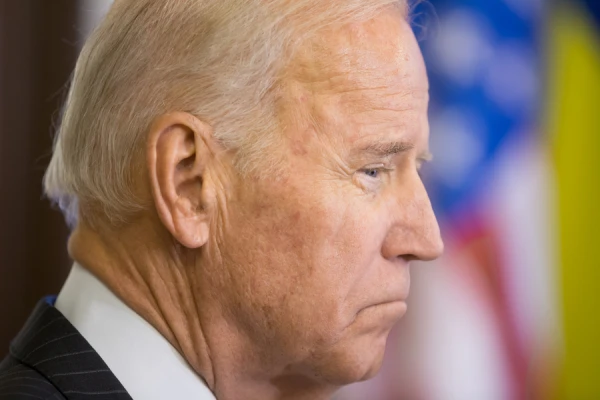
Washington D.C., Oct 30, 2019 / 11:30 am (CNA).- Presidential candidate Joe Biden’s denial of reception of Holy Communion in South Carolina on Sunday has renewed scrutiny of his evolving views on abortion.

Over the course of his decades-long career, the Catholic former Vice President has said that the Supreme Court decision Roe v. Wade went too far, but has now pledged to enshrine its full effects in federal law. He has been for, then against, bans of taxpayer funding for abortion and against, then for extreme practices like partial birth abortion.

Biden was denied Communion on Sunday, at St. Anthony Catholic Church in Florence, South Carolina, pastor Fr. Robert Morey denied Biden Holy Communion as the Catholic presidential candidate was campaigning nearby that weekend and had attended Sunday Mass.

“Sadly, this past Sunday, I had to refuse Holy Communion to former Vice President Joe Biden,” Fr. Morey explained in a statement sent to CNA. “Holy Communion signifies we are one with God, each other and the Church. Our actions should reflect that,” he stated.

“Any public figure who advocates for abortion places himself or herself outside of Church teaching,” he said.

The Catholic Church teaches that life begins at the moment of conception, and that every act of abortion is the wilful taking of innocent human life. In the 2008 “Meet the Press” interview, Biden was asked “as a Roman Catholic” when he thought life began.

He said that he was “prepared as a matter of faith to accept that life begins at the moment of conception,” but added that to impose that belief upon others through the application of law would be “inappropriate in a pluralistic society.”

“There is a debate in our church, as Cardinal Egan would acknowledge, that’s existed. Back in ‘Summa Theologia,’ when Thomas Aquinas wrote ‘Summa Theologia,’ he said there was no–it didn’t occur until quickening, 40 days after conception. How am I going out and tell you, if you or anyone else that you must insist upon my view that is based on a matter of faith? And that’s the reason I haven’t,” Biden said.

In his 1995 encyclical Evangelium Vitae, Pope St. John Paul II warned of a political mentality where “the original and inalienable right to life is questioned or denied on the basis of a parliamentary vote or the will of one part of the people-even if it is the majority.”

“This is the sinister result of a relativism which reigns unopposed: the ‘right’ ceases to be such, because it is no longer firmly founded on the inviolable dignity of the person, but is made subject to the will of the stronger part,” he wrote. “To claim the right to abortion, infanticide and euthanasia, and to recognize that right in law, means to attribute to human freedom a perverse and evil significance: that of an absolute power over others and against others.”

Biden, a Democrat, originally from Scranton, Pennsylvania, was elected to the U.S. Senate in 1972 representing the state of Delaware. He served in that role until 2009, when he was elected Vice President as the running mate of President Barack Obama.

In Biden’s 36 years in the Senate and eight years as Vice President to President Barack Obama, he has reversed himself a number of times on the issue of abortion. 

While largely supported the Supreme Court’s 1973 decision that found a legal right to abortion, Roe v. Wade, Biden previously said he believed the decision “went too far.” In 1981, he voted for a constitutional amendment allowing states to overturn Roe v. Wade; the next year he voted against such an amendment.

In a 2012 vice presidential debate, Biden warned that the opposing ticket would appoint judges who would outlaw abortion, and that the administration he was in would not do that. In the 2008 vice presidential debate, he bragged about spearheading “the fight against Judge Bork,” a Supreme Court judicial nominee in 1987, warning that Bork would have changed Roe v. Wade if he were confirmed to the Court.

In a 2008 interview with NBC’s “Meet the Press,” Biden said Roe is “as close to a consensus that can exist in a society as heterogeneous as ours” in that it left decisions on life to the mother in the first trimester of pregnancy, allowed the states some intervention in the second trimester, and that “the weight of the government’s input” in the third trimester is that the pregnancy is carried to term.

Biden’s 2020 campaign platform calls for the codification of Roe v. Wade as federal law. It also would ensure, as part of a health care “public option,” coverage of “a woman’s constitutional right to choose.”

In 1984 then-Senator Biden supported the Mexico City Policy, which bars taxpayer funding of foreign NGOs that promote or perform abortion as a method of family planning. He was also for years a supporter of the Hyde Amendment, which bars taxpayer funding of elective abortions in the U.S.  

Shortly after announcing his candidacy for president in April this year, Biden reversed his support for Hyde when Democrats highlighted his long-time stance, prompting a backlash from other candidates and the progressive wing of the party. He also abandoned his support for the Mexico City Policy, promising to overturn the rule if elected.

Biden also currently favors reinstating taxpayer funding of Planned Parenthood, the nation’s largest abortion provider.

In 1995 and again in 1997, Biden voted to ban partial-birth abortion, but was vocally critical of the Supreme Court’s decision that upheld a partial-birth abortion ban, saying that it could open the door for the repeal of Roe v. Wade.

A point of consistency for Biden has been his opposition to parental notification laws and laws barring minors from seeking abortions out-of-state, both of which he has spoken against. His 2020 campaign platform calls for ending state “TRAP” laws on abortion, or laws restricting abortion access such as requiring parental notification or mandatory waiting periods.

[…]

No Picture
News Briefs

Dia de los Muertos about more than the ‘bread of the dead,’ bishop says

October 30, 2019 CNA Daily News 1

Los Angeles, Calif., Oct 30, 2019 / 04:00 am (CNA).- Dia de los Muertos, or “Day of the Dead,” is a primarily Mexican way of celebrating the feasts of All Souls Day and All Saints Day.

The celebration is an expression of Latin American culture and Catholic beliefs, which makes use of some familiar symbols to teach and celebrate the Church’s teaching on the communion of the saints and the souls in purgatory.

Annual celebrations typically involve skeletal costumes and face makeup, parades and processions, as well as traditional foods such as “pan de muerte” (bread of the dead) and sugar skulls (calaveras).

Los Angeles Auxilary Bishop Alex Aclan, a native of the Philippines, celebrated a Mass in honor of Dia de los Muertos Oct. 26 at Santa Clara Cemetery in Oxnard, California.

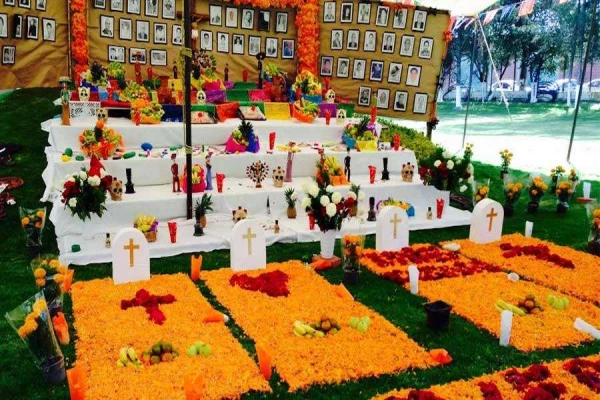
The Mass featured pilgrim images of Our Lady of Guadalupe and San Juan Diego, as well as over “ofrendas,” or altars, which are traditionally used in Dia de los Muertos celebrations to honor deceased loved ones.

Aclan told CNA the celebrations at the cemetery were very typical Mexican style, he said, with the altars set out with pictures and personal items for the faithful to remember and honor loved ones.

There were more than 100 ofrendas set up throughout the cemetery, and participants took part in dancing, processions and prayers for the dead.

Dia de los Muertos is sometimes popularly thought of as “Mexican Halloween,” and the ofrendas may be seen as a means for people to conjure up their deceased loved ones.

“That’s a corruption of the original notion of the celebration of the feast,” Aclan said.

According to the Catechism of the Catholic Church, “all forms of divination are to be rejected” which includes the “conjuring up the dead.”

However, the Church encourages Catholics to pray for the dead as one of the spiritual works of mercy.

Aclan he said he made sure that archdiocesan offices are involved in planning celebrations, to make sure that Dia de los Muertos customs are in accord with Catholicism and the Catholic tradition.

The bishop was quick to point out that the real focus of Dia de los Muertos are the two Catholic feast days within it, not primarily Halloween.

In his native Philippines, Aclan said, celebrations around this time primarily take place on Nov. 1, All Saints Day, which is marked as a national holiday in that country.

“I grew up with that tradition of All Saints Day, and I remember us staying in the cemetery praying all day long for the souls, even though we do it on the day of All Saints rather than All Souls,” he said.

In Mexico, the bulk of the celebrations take place from Oct. 31 to All Soul’s Day, Nov. 2, incorporating both of the Catholic feasts.

“All Saints Day of course for those who are already in Heaven, and All Souls Day for those who are still on their way to heaven,” he said.

Aclan said whenever he preaches or speaks about Dia de los Muertos, he tells people it is a beautiful manifestation of the Church’s belief in the communion of saints.

“I think it’s a wonderful way to teach people about our beliefs as Catholics on the communion of saints,” Aclan commented.

“For Mexicans to celebrate Dia de los Muertos, my experience is the remembering of the dead is really the most important part of it. Making sure that the dead are remembered, that their deceased are remembered, and that we really are one with them even though they’re on the other side and we’re still here.”

“And that’s basically our teaching on the communion of saints. The different parts of the Church: the ones in Heaven, the ones that are still on their way trying to find their way to the gates of Heaven, and us here on Earth, and we are still together as one. We are still one Church.”


[…]

No Picture
News Briefs

Brain death diagnosis for second Michigan teen raises questions

October 29, 2019 CNA Daily News 0

Detroit, Mich., Oct 29, 2019 / 06:36 pm (CNA).- For the second time in a month, a family in Michigan is fighting to keep their teenage son on life support after a hospital has declared the boy brain dead and made plans to remove his life support systems.

Titus Jermaine Cromer Jr., 16, was rushed to Beaumont Hospital in Royal Oak after suffering cardiac arrest, according to local news reports. When he arrived, he could not breathe independently or regulate his own blood pressure. However, after receiving hydration, nutrition, and body temperature regulation, his family’s lawyer says he is showing signs of improvement and can now breathe independently and regulate his own blood pressure.

However, hospital officials have diagnosed the teen as brain dead, after two doctors determined that he had suffered “irreversible cessation of all functions of the entire brain, including the brain stem.”

The hospital made plans to remove his life support systems on Oct. 28, the Detroit Free Press reported.

The family challenged the decision and has asked for additional medical opinions on whether Cromer is actually brain dead.

“As a parent, if there’s a million-to-one chance that he’s going to get better, I’m going to take it,” the family’s lawyer said, according to the Detroit Free Press. “And I’m not going to get two opinions. I’m going to get 20. I’m going to fight for my boy until there’s absolutely no hope at all. And then I’m going to fight some more.”

Oakland County Circuit Judge Hala Jarbou ordered the hospital to continue life support until a Nov. 7 court hearing on the teen’s health status.

The Detroit Free Press said the family’s lawyer described them as “very much guided by their faith, and as Catholics, they believe that removing life support would be murder.”

The case is similar to that of 14-year-old Bobby Reyes, who was rushed to C.S. Mott Children’s Hospital in Michigan last month following a severe asthma attack. Repeat tests in the following days indicated that there was no blood flow or electrical activity in the boy’s brain.

The hospital declared Reyes brain dead and made plans to remove him from life support. Reyes’ family fought the decision but ultimately failed to receive relief from a court, due to a jurisdiction dispute. Reyes was removed from life support on Oct. 15.

The hospital said in a statement, “Continuing medical interventions was inappropriate after Bobby had suffered brain death and violates the professional integrity of Michigan Medicine’s clinicians.” Michigan law recognizes an individual as dead if they have undergone “irreversible cessation of all function of the entire brain, including the brain stem.”

The two Michigan cases have drawn renewed attention to the diagnosis of brain death and sparked concerns over parental rights in cases where family members question a diagnosis.

The National Catholic Bioethics Center (NCBC) maintains that cases of improvement over the course of months or years generally indicate an incorrect diagnosis of brain death in the first place.

“Stories of people continuing on a ventilator for months or years after being declared brain dead typically indicate a failure to apply the tests and criteria for determination of brain death with proper attentiveness and rigor,” said Fr. Tad Pacholczyk, director of education for the center, in a 2005 information sheet.

“In other words, somebody is likely to have cut some corners in carrying out the testing and diagnosis.”

In Cromer’s case, the family believes their teenage son has been misdiagnosed. Their lawyer cited his improvements in independent breathing and blood pressure regulation as “very strong indicia that he has not suffered brain death,” according to the Detroit Free Press.

Medical criteria for diagnosing brain death, while controversial in some circles, have been accepted by most Catholic bioethicists, provided that diagnostic tests are carried out thoroughly and carefully.

In an Aug. 29, 2000 address to the international congress of the transplantation society, St. John Paul II stated that using as a criterion for death “the complete and irreversible cessation of all brain activity (in the cerebrum, cerebellum and brain stem) … if rigorously applied, does not seem to conflict with the essential elements of a sound anthropology.”

The NCBC has also stated repeatedly that “Health care workers can use these neurological criteria as the basis for arriving at ‘moral certainty’ that an individual has died.”

The NCBC noted that determining death by these neurological criteria typically involves bedside testing to assess absence of response or reflexes, apnea testing to assess the absence of the ability to breath, and “possible confirmatory tests to further assess the absence of brain activity (for example, an EEG) or the absence of blood flow to the brain.”

Similarly, the U.S. bishops’ Ethical and Religious Directives for Catholic Health Care Services indicate that “the determination of death should be made by the physician or competent medical authority in accordance with responsible and commonly accepted scientific criteria.”

And in 2008, the Pontifical Academy of Sciences stated that “brain death … ‘is’ death,” and that “something essential distinguishes brain death from all other types of severe brain dysfunction that encompass alterations of consciousness (for example, coma, vegetative state, and minimally conscious state).”

“If the criteria for brain death are not met, the barrier between life and death is not crossed, no matter how severe and irreversible a brain injury may be,” the academy added.

The Pontifical Academy of Sciences said that after brain death, “the ventilator and not the individual, artificially maintains the appearance of vitality of the body. Thus, in a condition of brain death, the so-called life of the parts of the body is ‘artificial life’ and not natural life. In essence, an artificial instrument has become the principal cause of such a non-natural ‘life’. In this way, death is camouflaged or masked by the use of the artificial instrument.”

Still, some pro-life advocates question the medical criteria used for diagnosing brain death and argue that taking organs from individuals diagnosed as brain dead amounts to homicide. The NCBC rejects that stance as “irresponsible” and “in tension with Catholic teaching,” countering that while a body may appear to be alive due to oxygenated blood being mechanically pumped through the body, thorough and rigorous testing can confirm that an individual is truly dead.

Dr. Alan Shwemon, former chief of the neurology department at Olive View-U.C.L.A. Medical Center, is an outspoken critic of the criteria used to diagnose brain death.

Shewmon had diagnosed some 200 patients as being brain dead throughout this career, according to the New Yorker. But he began to have doubts about the condition, which were intensified when he saw the case of a 13-year-old girl in Oakland who had been declared brain dead but began to show signs of improvement after being given tube feeding and hormone replacement.

Over the next four years, the girl was able to respond to simple motor commands and underwent puberty-related physical developments before dying of unrelated conditions, Shewmon said. His analysis of the situation led him to believe that the girl had not been brain dead, but was instead in a “minimally conscious state,” with brain flow in the brain too low to be detected by imaging technology, yet sufficient to prevent the death of brain cells – a condition known as global ischemic penumbra.

“Her case challenges the claimed infallibility of diagnostic criteria for brain death and supports the hypothesis that global ischemic penumbra can mimic both clinical brain death as well as absent blood flow on radionuclide scans,” Shewmon asserted in a December 2018 article.

Cromer’s family is now seeking additional medical opinions and a long-term care facility that will accept their son.

[…]