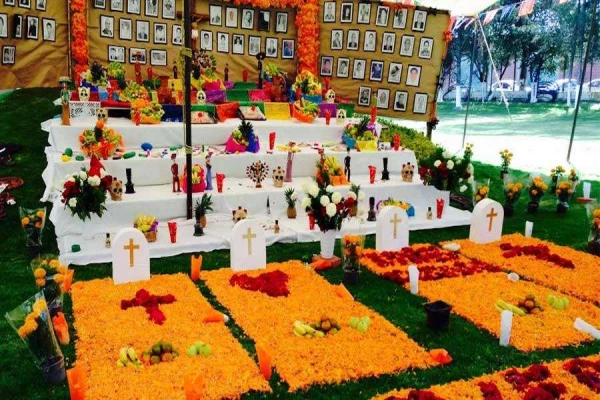
Los Angeles, Calif., Oct 30, 2019 / 04:00 am (CNA).- Dia de los Muertos, or “Day of the Dead,” is a primarily Mexican way of celebrating the feasts of All Souls Day and All Saints Day.
The celebration is an expression of Latin American culture and Catholic beliefs, which makes use of some familiar symbols to teach and celebrate the Church’s teaching on the communion of the saints and the souls in purgatory.
Annual celebrations typically involve skeletal costumes and face makeup, parades and processions, as well as traditional foods such as “pan de muerte” (bread of the dead) and sugar skulls (calaveras).
Los Angeles Auxilary Bishop Alex Aclan, a native of the Philippines, celebrated a Mass in honor of Dia de los Muertos Oct. 26 at Santa Clara Cemetery in Oxnard, California.
The Mass featured pilgrim images of Our Lady of Guadalupe and San Juan Diego, as well as over “ofrendas,” or altars, which are traditionally used in Dia de los Muertos celebrations to honor deceased loved ones.
Aclan told CNA the celebrations at the cemetery were very typical Mexican style, he said, with the altars set out with pictures and personal items for the faithful to remember and honor loved ones.
There were more than 100 ofrendas set up throughout the cemetery, and participants took part in dancing, processions and prayers for the dead.
Dia de los Muertos is sometimes popularly thought of as “Mexican Halloween,” and the ofrendas may be seen as a means for people to conjure up their deceased loved ones.
"That's a corruption of the original notion of the celebration of the feast," Aclan said.
According to the Catechism of the Catholic Church, “all forms of divination are to be rejected” which includes the “conjuring up the dead.”
However, the Church encourages Catholics to pray for the dead as one of the spiritual works of mercy.
Aclan he said he made sure that archdiocesan offices are involved in planning celebrations, to make sure that Dia de los Muertos customs are in accord with Catholicism and the Catholic tradition.
The bishop was quick to point out that the real focus of Dia de los Muertos are the two Catholic feast days within it, not primarily Halloween.
In his native Philippines, Aclan said, celebrations around this time primarily take place on Nov. 1, All Saints Day, which is marked as a national holiday in that country.
"I grew up with that tradition of All Saints Day, and I remember us staying in the cemetery praying all day long for the souls, even though we do it on the day of All Saints rather than All Souls," he said.
In Mexico, the bulk of the celebrations take place from Oct. 31 to All Soul's Day, Nov. 2, incorporating both of the Catholic feasts.
"All Saints Day of course for those who are already in Heaven, and All Souls Day for those who are still on their way to heaven," he said.
Aclan said whenever he preaches or speaks about Dia de los Muertos, he tells people it is a beautiful manifestation of the Church's belief in the communion of saints.
"I think it's a wonderful way to teach people about our beliefs as Catholics on the communion of saints," Aclan commented.
"For Mexicans to celebrate Dia de los Muertos, my experience is the remembering of the dead is really the most important part of it. Making sure that the dead are remembered, that their deceased are remembered, and that we really are one with them even though they're on the other side and we're still here."
"And that's basically our teaching on the communion of saints. The different parts of the Church: the ones in Heaven, the ones that are still on their way trying to find their way to the gates of Heaven, and us here on Earth, and we are still together as one. We are still one Church."
If you value the news and views Catholic World Report provides, please consider donating to support our efforts. Your contribution will help us continue to make CWR available to all readers worldwide for free, without a subscription. Thank you for your generosity!
Click here for more information on donating to CWR. Click here to sign up for our newsletter.

Fr. Richard Cassidy, professor of Sacred Scripture at Sacred Heart Major Seminary, dresses in Roman prisoner garb as he holds a copy of his newest book, “A Roman Commentary on St. Paul’s Letter to the Philippians.” Fr. Cassidy’s eighth scholarly work, the book explores the subversive nature of St. Paul’s Letter to the Philippians, which the apostle wrote from behind bars in a Roman prison cell. / Valaurian Waller | Detroit Catholic
Detroit, Mich., Apr 30, 2022 / 08:00 am (CNA).
It was a tough decision for Rick Cassidy as he began graduate studies at the University of Michigan in mid-1960s. Would he take the course on Imperial Rome, because of his love of history, or the course History of Slavery, because of his deep concern for social justice?
The Dearborn native chose the course on slavery. The insights he acquired have helped to guide Fr. Richard Cassidy’s scholarly work for three decades, including his latest work, “A Roman Commentary on St. Paul’s Letter to the Philippians“ (Herder & Herder, 2020).
Paul’s letter, composed in chains and secreted out of his Roman jail cell, is intentionally “counter-slavery” argues Father Cassidy, professor of Sacred Scripture at Sacred Heart Major Seminary since 2004, as well as “counter-emperor.” At its core, Philippians is an underground epistle that subverts the Roman power structure and the “lordship pretensions of Nero.” Reviewers praise the “distinctive thesis” of Father’s groundbreaking work as “fresh and illuminating,” making for “fascinating reading.”
This is Father Cassidy’s seventh book that examines the influence of Roman rule on the writers of the New Testament, and his eighth book overall. He returned to Ann Arbor on a rainy afternoon in late June to discuss his newest work.
Dan Gallio: St. Paul’s Letter to the Philippians is most known for its soaring declaration of the divinity Christ, before whom one day “every knee must bend,” and “every tongue proclaim” his universal lordship (2:6-11).
Your new book presents a unique argument: Paul’s letter is primarily a “subversive” document of resistance against the Roman Empire—particularly against emperor worship and slavery. How did you arrive at this against-the-grain interpretation?
“A Roman Commentary on St. Paul’s Letter to the Philippians” (Herder & Herder, 2020) is Fr. Cassidy’s eighth book and a follow-up on his 2001 work, “Paul in Chains: Roman Imprisonment and the Letters of St. Paul”. Valaurian Waller | Detroit Catholic
Father Cassidy: These insights were the result of long hours with the text, spending a lot of prayer time for guidance, as to Paul’s situation.
The issue of slavery came into play strongly. I now saw that Jesus was executed as a violator of Roman sovereignty, condemned by Pilate, executed under Emperor Tiberius—and that this was the slave’s form of death. This is a crucial point.
In regards to the two topics you mention, I had the intuition that the Letter to the Philippians was “counter-emperor cult” and “counter-slavery.” First, the self emptying of Christ from on high—descending downward into human form, downward, downward to the point of the slave’s death on a Roman cross—and then you have St. Paul’s wonderful words in chapter 2, verses 9-11.
My insight was that there is going to be a redressing of what has happened. Because of the great faithfulness of Jesus Christ, the Father intervenes and begins the lifting up, the ascending of Christ, where the Father exalts Jesus and bestows upon him “the name above every other name.”
So I can now speak about this famous passage in terms of a kind of “drama”: four scenes that represent the descent of Jesus, and four scenes that represent his ascent, akin to a medieval passion play. The Father intervenes on Christ’s behalf, conferring upon him the name of “Lord.” Now all of creation, including the emperor, the governor, the imperial personnel, are all subject to Jesus. They have to prostrate themselves before the name of Jesus.
DG: So, essentially, Philippians is subversive because it makes a political statement as much as a theological one.
FC: Yes, but for some, it is a great privilege to genuflect at the name of Jesus. This includes slaves! Paul had integrated slaves into his community in Philippi. They were empowered now to proclaim the name of Jesus, standing alongside free men and women. They are standing alongside the Roman imperial power structure, all involved in the same process of bowing before Christ and proclaiming his name.
A security guard at Sacred Heart Major Seminary helps Fr. Cassidy don his “prisoner’s clothing” for a photo shoot promoting Fr. Cassidy’s latest book, “A Roman Commentary on St. Paul’s Letter to the Philippians,” which details Paul’s experience behind bars and the conditions under which he wrote his Letter to the Philippians. Valaurian Waller | Detroit Catholic
And that name is “Lord.” Jesus is being acclaimed as Lord, and not the emperor, to the glory of God the Father. This is the decisive element of Philippians 2:6-11, blended together in this one passage.
DG: You provide a forty-four-page introduction to the social situation of the Roman colony of Philippi. Why did you feel such an informative but lengthy introduction was necessary to support your thesis?
FC: I had to establish that conditions at Philippi mirror conditions at Rome. This is important. Philippi was like “Little Rome.” When Paul is speaking of conditions at Philippi, his is also experiencing the same oppressive conditions at Rome as a chained prisoner. I had to establish that emperor worship was everywhere, in Philippi’s renowned amphitheater, in the streets, in public artifacts. That is why I had to go into an extensive introduction to set the stage of what Paul is doing in his letter.
DG: Your appendices are extensive, too, like bookends to the introduction, driving the thesis home again using illustrations.
FC: There is one illustration of a monument where slaves are chained, and a slave trader is proclaiming his prowess as a slave trader. This monument to the degradation of slavery was at a city adjacent to Philippi. Paul almost certainly passed by it on his way to and from Philippi. It was discovered back in the 1930s and almost destroyed in the war by Nazi bombings.
DG: Paul is sometimes criticized by revisionist commentators for not rejecting the institution of slavery in his letters. Is your book an answer to these critics?
FC: Paul’s approach to slavery is complicated. There are some letters where he seems to envision the imminent return of Christ. Possibly he minimized the importance of slaves being freed in these letters. However, in Philippians, his final letter before his death, he addresses the issue definitively. It is very undermining of slavery.
I intended to de-establish the idea that Paul acquiesced to slavery. He did not acquiesce. The laudatory prepublication comments by scholars make me think the book will have a decisive role in re-imaging Paul.
Against a prevailing notion that St. Paul “acquiesced” to the idea of slavery in his writings, Fr. Cassidy’s book aims to counter the idea by showing how St. Paul’s Letter to the Philippians actually served a subversive purpose in a Roman empire dominated by emperor worship and tight controls. Valaurian Waller | Detroit Catholic
DG: Back to Philippians 2:6-11. Why do you maintain this passage is not a hymn or baptismal catechesis, as is customarily believed, but is an original composition of Paul? Is this position another example of your counter exegesis?
FC: This is not some other preexisting hymn. No! This is fresh imaging. Visceral imaging. This is intensity from identifying with Christ as the “slave crucified.” No one else could have composed this passage. And Paul could not have composed this passage until he was in Roman chains and could see the threat posed against Jesus by the counterfeit claims that Emperor Nero is Lord.
DG: It’s almost like the passage is “supra-inspired,” that he would get such an original insight while in such dreadful circumstances.
FC: Correct. And there is a real question as to how this letter could be transmitted from prison, with the security and censorship. In garments? In pottery? It is possible the original written letter was confiscated. So how is Paul is getting his subversive thoughts past the Roman guards?
I suggest in my book that Paul was drilling his associates, Timothy and Epaphroditus, to memorize his letter, given the role of memory in early Christian life.
DG: With your busy teaching and pastoral duties, where to you find the motivation and energy to produce such a thoroughly researched, and beautifully written, work of scholarship?
FC: It’s Spirit driven!
DG: Is the Spirit driving you to another book?
FC: I would say so. After a book comes to publication, there is always a kind of mellowing period. So right now I have not identified the next project. I am appreciating the graces I have received from this book, and trusting that the same Spirit who has shepherded me through this sequence will still stand by me, guiding me forward.
Bridgeport, Conn., Jan 5, 2019 / 06:22 pm (CNA).- The Bishop of Bridgeport condemned anti-Semitism Saturday, after a swastika was found painted on the doors of Bridgeport’s cathedral.
“I am appalled and outraged by this act of vandalism ag… […]
Govenor Gavin Newsom of California. / Karl_Sonnenberg/Shutterstock
Sacramento, Calif., Sep 25, 2021 / 05:01 am (CNA).
California Governor Gavin Newsom signed a pair of bills Sept. 22 that relate to privacy surrounding abortion, both of which cou… […]
Leave a Reply