Analysis: What guides Vatican diplomacy?
January 10, 2018 CNA Daily News 0

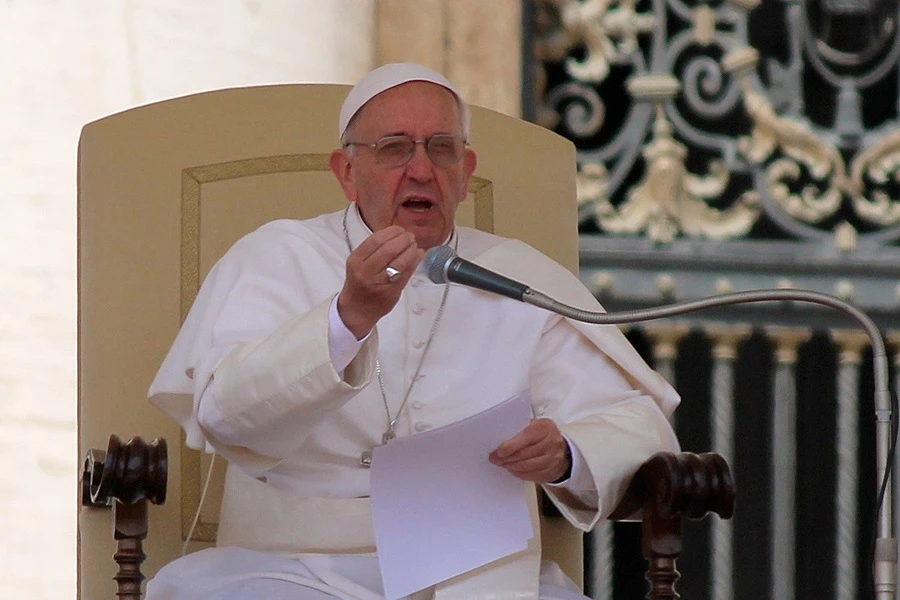
Vatican City, Jan 10, 2018 / 02:00 pm (CNA).- At a traditional new year’s meeting between Pope Francis and diplomats to the Vatican, the pope painted a picture of pontifical diplomacy around the globe: An international mission working to secure the common good, an always increasing network of relations, and the certainty of an impartial voice working for peace.

The Pope’s speech sets the basis and the guidelines for the Holy See’s diplomatic activities during the year. If the guidelines are based on concrete issues, then pontifical diplomacy has three main threads —three themes that include all the others.

The first is a commitment to peace; the second is a commitment to human dignity; and the third is a commitment to fight poverty.

In the mind of the Pope, all three seem linked to one another.

The Vatican’s commitment to peace is practiced via the art of mediation, and the Holy See has been a critical participant in the mediation of global conflict for decades. The Vatican’s commitment to human dignity is based on the principle that all people are equal and dignified in the sight of God. And the Church’s commitment to fight poverty is expressed in its diplomatic work for peace, international development, and support for marginalized. On that front, Pope Francis has asked who, in the end, is poorer than an unborn child, or than the forgotten or marginalized elderly.

These three commitments will shape the Holy See’s diplomatic activity for the upcoming year. Within that framework, there are two clear priorities for the diplomatic work of the Holy See in the upcoming year.

The first is advocating for migrants and refugees. The United Nations are finalizing a Global Compact on Migration, that follows the New York Declaration for Refugees and Migrants issued in September 2016. The Holy See participated in all of the meetings, and presented 20 points of actions on the issue gathered under the four keyworks “welcome, protect, promote and integrate.”

The Pope has made migration a core issue of his pontificate: he established a special section for Migrants and Refugee within the ranks of the Vatican dicastery for the Promotion of the Integral Human Development, and the Pope is personally chairing it. The theme for the World Day of Peace 2018 was “Migrants and Refugees: Seekers of Peace,” underscoring the importance the issue has for the Holy See.

The second diplomatic focus is on peacekeeping. The Holy See is aims to helping and assisting countries in achieving peace.

Archbishop Silvano Maria Tomasi, a former papal nuncio now counsellor at the Vatican Dicastery for the Integral Human Development, stressed to CNA that for at least the past 50 years, “peacekeeping and the search for peace have dominated the Holy See’s public interventions.”

The Holy See is working to create a path to peace, Tomasi said, by working on “the formation of a new mentality, thanks to the World Day of Peace; the Holy See’s involvement in discussions on disarmament; and the Holy See’s encouragement to develop effective international institutions.”

How does the Holy See carry on its commitment?

First of all, with its work into the multilateral institutions, namely the United Nations and other global institutions.

The Holy See Mission at the United Nations in New York provided data on the Holy See’s work at the UN during the last year.

The Holy See at the UN in New York delivered 82 interventions, and 10 of them were delivered by Archbishop Paul Richard Gallagher, Vatican “foreign ministry,” who led the Holy See’s delegation at the 72nd session of the UN General Assembly in September.

Archbishop Gallagher also signed the Treaty on the Prohibition of Nuclear Weapons for the Holy See and in the name of and behalf of the Holy See.  The Holy See’s  mission noted that “the Holy See was an active participant in negotiations, and was one of the 122 States that voted in favor of the treaty, adopted on July 7, 2017.  The signing took place during the High Level Ceremony for the opening of the signing of the Treaty, in which the Holy See joined more than 40 states in signing the treaty, and was joined by only Thailand in simultaneously ratifying the treaty.”

The Holy See Mission at the UN Office in Geneva, led by Archbishop Ivan Jurkovic, delivered 48 interventions, participating in many panels on the Global Compact on Migrations. The Holy See Mission in Geneva also represents the Holy See at the International Organization for Migration: the Holy See has been a member state of the IOM since 2012.

Those are only examples of the Holy See’s considerable involvement in multilateral international organizations. It is noteworthy to remember that there is also a Holy See Diplomatic Mission in Vienna, accredited to the Organization for Security and Cooperation in Europe, and to other special organizations like the International Atomic Energy Agency, to which the Holy See is a member state and founder.

No less important is the Holy See’s Mission at the Food and Agriculture Organization in Rome. Pope Francis has personally demonstrated that fighting world hunger is a priority to the Holy See. The Pope has visited the FAO headquarters two times, Nov. 20, 2014 and Oct. 16, 2017, and went to the World Food Program Headquarters June 13, 2016. In addition to that, the Pope symbolically donated $25,000 dollars to the FAO to support the Eastern African populations facing food insecurity and famine.

The Holy See’s diplomatic network of bilateral relations also continues to grow.In 1900, only about 20 countries had diplomatic relations with the Holy See. In 1978 the number was 84; in 2005 it was 174. During Benedict XVI’s pontificate, six new countries were added to the list, and, under the leadership of Pope Francis that number has climbed to 183, with Myanmar, also called Burma, joining the list of states with full diplomatic ties with the Holy See.

There are only 13 States who have no diplomatic ties with the Holy See.

Out of them, 8 have no Vatican envoy: Afghanistan, Saudi Arabia, Bhutan, the People’s Republic of China, North Korea, Maldives and Tuvalu. The Holy See has apostolic delegates, not fully recognized as ambassadors, in four countries: Comoros, Somalia, Brunei and Laos. The Holy See has started negotiations with Vietnam to reach full diplomatic ties, and in 2011 the Holy See appointed the first non-residential Vatican envoy to Hanoi.

The diplomatic efforts of the Holy See are considerable, and, as Pope Francis emphasized, committed to important and deeply Catholic international goals.
 

[…]

Speaker Paul Ryan will headline March for Life

January 10, 2018 CNA Daily News 2

Washington D.C., Jan 10, 2018 / 12:52 pm (CNA/EWTN News).- Speaker of the House Paul Ryan (R-Wisc.) will address the upcoming March for Life, organizers announced on Wednesday. This is the first time Ryan has spoken at the March for Life in person sinc… […]

Dominican sisters help educate Iraqi children returning home

January 10, 2018 CNA Daily News 1

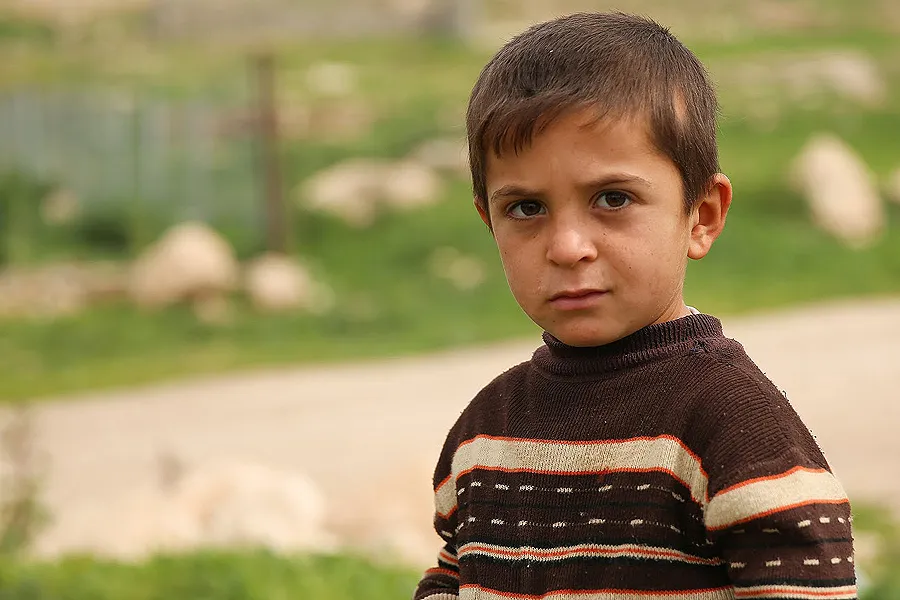
Mosul, Iraq, Jan 10, 2018 / 11:34 am (ACI Prensa).- When Iraqi residents fled their homes during the Islamic State invasion, they left behind their houses, neighbors, and day-to-day lives.

For the children who fled, leaving their home behind also meant an interruption in their education – in some cases for months or years.

While some refugee camps offer classes for children, challenges abound and students often fall behind.

Now, a group of Dominican sisters in one Iraqi town is working to help educate displaced children as their families return to their homes and work to rebuild their lives.

With the support of Catholic charity Aid to the Church in Need in Spain, the Dominican Sisters of Saint Catherine of Sienna were able to restore their convent, which had been destroyed by the Islamic State in Iraq. Today, they offer classes to hundreds of children who had been displaced by the war.

“We try to help the children, giving them peace: in our convent we offer them a safe place,” Sister Ilham told ACN in late December. Despite the expulsion of ISIS, security in the area remains unstable.  

In May 2017, ACN funded the restoration of Our Lady of the Rosary Convent with a grant of $54,000. Located in Teleskuf, north of the plain of Nineveh, the convent is just over 20 miles outside of Mosul.

The sisters worked 12-hour days to prepare the convent to welcome the children, Sister Ilham said.

They provide daycare for children between three and five years old. In the mornings, they teach about 150 children between the ages of six and 12. In the evenings, they teach students 12 years of age and older.

Sister Ilham, 57, was working for a church in Mosul when the rapid advance of the Islamic State forced her and her community to flee. However, after the fall of the terrorist group, she returned to the area and today is helping those displaced from Teleskuf.

“None of us wanted to leave where we come from, but as the attacks continued, we had to flee to save our lives,” she said.

“In 2016 some 6,000 people had to leave Telskuf. When I returned to this area, all the houses were abandoned and many of them destroyed,” she continued. “In Teleskuf all that is left of many of buildings are the ruins. The school and the children’s home are destroyed, the doors of the convent were forced open and the sisters’ home was sacked.”

In addition to teaching at the convent, the sisters visit the members of the Christian community in their homes, teach catechism to the children, and prepare them for their First Communion.

Once the local school is rebuilt, the children will no longer need to attend the convent classes. In the meantime, the sisters hope they can help the children from falling too far behind in their studies.

“Before the Islamic State invasion, there were five sisters in the convent, while now there are only two of us. Fortunately, we are will soon receive reinforcements,” Sister Ilham said.

In addition to helping fund the convent reconstruction, Aid to the Church in Need is currently helping rebuild 13,000 houses and more than 300 church properties destroyed by the Islamic State in Iraq.


This article was originally published by our sister agency, ACI Prensa. It has been translated and adapted by CNA.

[…]

Pope taps Colombian bishop to oversee Sodalitium amid ongoing crisis

January 10, 2018 CNA Daily News 0

Vatican City, Jan 10, 2018 / 09:00 am (CNA).- The Vatican announced Wednesday that Colombian Bishop Noel Antonio Londoño Buitrago C.Ss.R. has been appointed papal commissioner for the Sodalitium Christianae Vitae, a Catholic society of apostolic life.  

Londoño will oversee the community as they continue a process of reform, following revelations that their founder, Luis Fernando Figari, committed serial acts of abuse while leading the community. Several former leaders of the community have faced related allegations.
 
Londoño’s appointment was announced in a Jan. 10 communique from the Vatican, which stated that Londoño, the Bishop of Jericó, would carry out his role alongside Cardinal Joseph Tobin of Newark, who has served as papal delegate overseeing the SCV’s reform process since May 2016.

Tobin will continue to be the group’s liaison with the Vatican’s Congregation for Institutes of Consecrated Life and Societies of Apostolic Life, and will focus primarily on reforming economic matters. In his role as Commissioner, Londoño will serve oversee the leadership of order as they continue to reform their governing policies and formation procedures.

The Sodalitium Christianae Vitae was established by Figari in 1971 in Peru, and was granted pontifical recognition in 1997. Alejandro Bermúdez, executive director of CNA, is a member of the community.

In addition to founding the SCV, a community of men, Figari also founded the Marian Community of Reconciliation and the Servants of the Plan of God, a community of women and an order of women religious. In 2002, he was named a consultor to the Pontifical Council for the Laity, and served in subsequent consultative roles at the Vatican.  

Figari stepped down as superior general of the Sodalitium Christianae Vitae in 2010, after allegations of abuse surfaced in Peru. The current superior general is Alessandro Moroni Llabres.

The community was investigated after the publication of a book in 2015 by journalists Paola Ugaz and Pedro Salinas, chronicling years of alleged sexual, physical and psychological abuse by members of the SCV. In addition to Peru, the community operates in Argentina, Brazil, Colombia, Costa Rica, Chile, Ecuador, the United States, and Italy.

Figari and other former leaders of the community remain the subject of criminal investigations in Peru.

In May 2016 the Pope named Archbishop Tobin as the pontifical delegate charged with overseeing the community’s handling of the investigation and their process of reform.

In February of 2017, a team of independent investigators commissioned by the Sodalitium reported that “Figari sexually assaulted at least one child, manipulated, sexually abused, or harmed several other young people; and physically or psychologically abused dozens of others.”

As a result, the Vatican’s Congregation for Institutes of Consecrated Life issued a decree the same month forbidding Figari from any contact with the religious community, and banning him from returning to Peru without permission from the current superior of the Sodalitium. Figari was also forbidden to make any public statements.

The Vatican made a similar move in the case of the Legionaries of Christ after it was discovered that their founder, Fr. Marcial Maciel, had been living a double life.

In 2006, with the approval of the Pope, the Congregation of the Doctrine of the Faith imposed upon Maciel “a retired life of prayer and penance, renouncing any form of public ministry.” Due to his advanced age, Maciel was not the subject of a formal canonical trial.
 
From that point on, Benedict XVI carried out a process of reform for the Legionaries, and in 2010 named then-Archbishop Velasio de Paolis as papal delegate to serve in a role similar to what Londoño will have for the SVC.

After his appointment, De Paolis formed a commission charged with drafting new constitutions for the Legionaries. He completed his mandate in 2014 when the new constitutions were approved by Pope Francis. The cardinal died in September 2017.

No specific time frame was given for Londoño’s mandate as Commissioner and it is not yet known what steps he will take, however, he is likely to follow the model set by De Paolis, and step aside when the community has a clear path forward.


[…]

Pope Francis gives 2,000 poor, prisoners a day at the circus

January 10, 2018 CNA Daily News 1

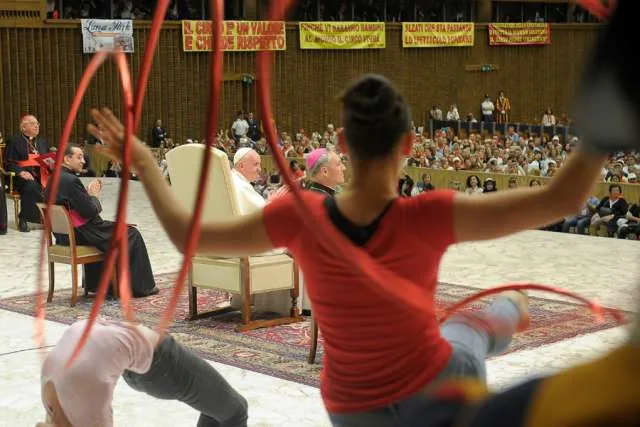
Vatican City, Jan 10, 2018 / 03:37 am (CNA/EWTN News).- Tomorrow afternoon some 2,100 of Rome’s poor, homeless, refugees, prisoners and volunteers will head to the circus courtesy of Pope Francis in yet another act of charity for those who are less fortunate.

Tickets to the performance were provided through the Papal Almoner’s office, which manages the Pope’s charities.

The show, announced by the Almoner’s office Jan. 10, will take place the afternoon of Thursday Jan. 11, at Rome’s Circo Medrano under a large tent put up specifically for the event, which has been dubbed the “Circus of Solidarity” by the organizers.

A makeshift medical station will also be set up with volunteer doctors and nurses available for attendees who want an exam or a check-up. Each participant will also be provided with a sack lunch at the end of the show.

Pope Francis made a similar gesture in January 2016, when he sent 2,000 poor, homeless and migrants to the Rony Roller Circus for a special show that opened with a song written and performed by a Spanish singer who had once been homeless himself.

The Pope frequently speaks of the importance of the performing arts, and has held several audiences for circus performers. During the Jubilee of Mercy, he welcomed some 6,000 of these performers to the Vatican for a special Jubilee weekend in their honor.

In a past general audience, Francis said those who are involved in circus life “create beauty, they are creators of beauty, and this does good for the soul. How much we need beauty!”

Since Pope Francis was elected, his almoner, Polish Archbishop Konrad Krajewski, has kept busy with several similar initiatives aimed at both helping and evangelizing Rome’s poor and needy through culture.

Showers and a barbershop were installed in the bathrooms of St. Peter’s Square in 2015 to help the homeless in the Vatican area to stay clean. They have also been invited to participate in several other initiatives, including concerts, a visit to the Vatican Museums, special lunches during papal events and beach days with a pizza lunch during the summer.

[…]

The story behind an anti-Nazi priest and a Florida miracle

January 9, 2018 CNA Daily News 1

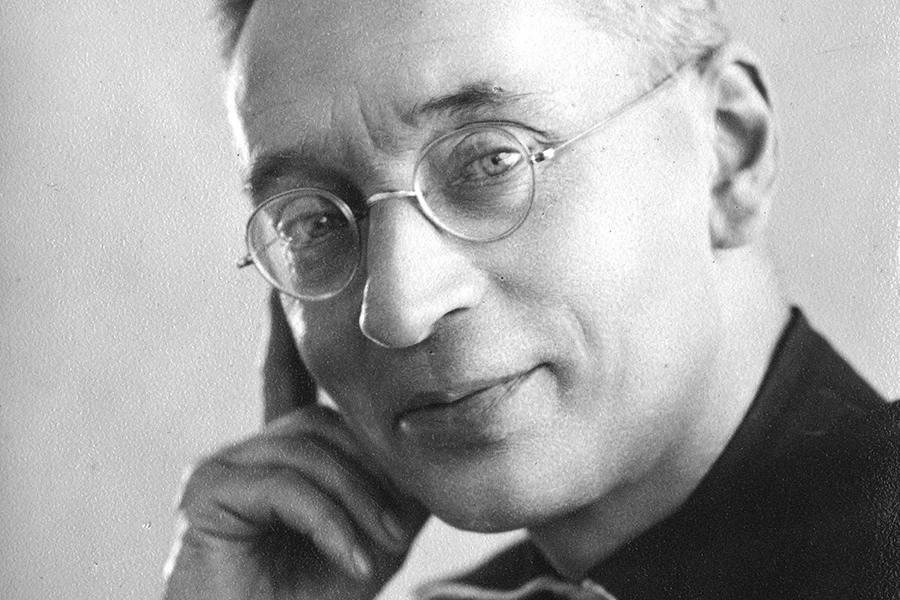
Palm Beach, Fla., Jan 9, 2018 / 04:57 pm (CNA/EWTN News).- More people need to know about the Dutch priest Blessed Titus Brandsma and his heroic death in a Nazi concentration camp, according to a Florida priest who says Brandsma’s intercession led to a miraculous healing from cancer.
 
“He was bold. He was brave,” Father Michael Driscoll, 76, told CNA. “He knew when he was in the pulpit preaching that there were people in the congregations taking notes for the Nazis about what he would be saying. Yet he continued.”
 
Driscoll has faced his own struggles. He was diagnosed with advanced melanoma in 2004. Shortly after that, someone gave him a small piece of Brandsma’s black suit, which the American priest applied to his head each day.
 
He underwent major surgery, with doctors removing 84 lymph nodes and a salivary gland. He then went through 35 days of radiation treatment, the Boca Raton Sun-Sentinel reports.
 
Still, his cancer had a very poor survival rate, of only 10 to 15 percent after ten years.
 
“Doctors have stated Fr. Driscoll’s cancer is now gone and have said his good health over the past 12 years defies all odds,” the Diocese of Palm Beach said Dec. 13. “They have stated his healing and recovery from Stage 4 cancer cannot be explained medically.”

Driscoll recounted his doctor’s words three and a half years ago: “no need to come back, don’t waste your money on airfare in coming back here. You’re cured. I don’t find any more cancer in you.”

The apparent miracle could lead to the canonization of Bl. Titus Brandsma. The Palm Beach diocese, where Driscoll serves as a retired priest, sent its findings and evidence to the Vatican in December 2017.

Brandsma, a Netherlands-born Carmelite priest, was a professor and a journalist. He was a strong critic of Nazi ideology. After the Nazis occupied his country in May 1940, they persecuted Jewish citizens and laid increasing restrictions on others.

The priest defended freedom of Catholic education and of the Catholic press against Nazi pressures.

“He was a spokesperson for the Dutch bishops,” Driscoll said. “He got the message across against the Nazis and what they were doing against the Catholic press, the Catholic schools, the persecution of Jews, you name it.”

Due in part to Brandsma’s refusal to expel Jewish children from Catholic schools and because he opposed mandatory Nazi propaganda in Catholic newspapers, he was arrested by the Nazis in January 1942. He was was eventually sent to the Dachau concentration camp in Germany, joining 2,700 other clergy. He faced inhumane conditions and abuse from his captors.

“He apparently was very kind to other prisoners, telling them to forgive the people who were persecuting them and punishing them in this prison, giving up little bits of his food to others,” Driscoll recounted.

Non-German priests weren’t allowed to celebrate Mass in the camp, where the majority of the priests were Polish.

Still, Brandsma carried out priestly duties.
 
“The German priests used to smuggle the Eucharist to him so he could distribute it to various prisoners, by an eyeglass case. That’s where he hid the Eucharist,” said Driscoll. “He would go around giving encouragement to other prisoners and giving them the Eucharist too, as best he could.”

Brandsma, who was always frail, was sent to the prison hospital.
 
“It is said that anybody who went to this prison hospital never came out,” Driscoll said. “Probably when he went there, he knew all sorts of things might happen to him.

The hospital’s doctors regularly engaged in human experimentation.
 
Driscoll said a nurse gave Brandsma a lethal injection on July 26, 1942 and he died immediately. His remains were likely cremated within a day. He was 61 years old.
 
A nurse on duty at the time of the priest’s death later testified that the Gestapo, the Nazi secret police, had ordered his death.
 
“Before he died, he gave this person his rosary, which was a rather primitive rosary, made with some kind of beads,” Driscoll said. “He told her to pray the rosary. She objected that she didn’t understand how and wasn’t a believer anymore.”
 
“He said all you have to do is go from bead to bead and say ‘pray for us sinners, now and at the hour of our death, Amen.’ And just keep saying ‘pray for us sinners, pray for us sinners’. And that’s enough,” the American priest recounted.
 
Brandsma was beatified in November 1985 as a martyr for the faith.
 
For Driscoll, the priest’s life teaches us “to preach the gospel boldly, forcefully, and not be afraid.”
 
“I think that’s one of the important issues,” he said. “Being kind to one another, as he was to his fellow prisoners, and try to console them when they fell down. I assume many of them were totally depressed by their condition. He encouraged people.
 
Driscoll also reflected on the nature of faith, sickness and healing. Those who suffer illness should “try their best… try to not lose hope.”
 
“It’s faith that heals. I believe, and that’s important,” he said. “I tell people ‘It’s not the touching of this piece of cloth to you. It’s faith that saves.’ You should not give up hope, but have faith. Jesus says ‘ask and you shall receive.’ You keep praying for that. Certainly everybody’s prayer is answered somehow. It may not be the way that you like, but it is answered.”
 
Fr. Mario Esposito, a Carmelite priest from New York, is a vice-postulator for the case. He told the Sun-Sentinel that he knows of no other miracles attributed to Brandsma that are under investigation.
 
“We hope this could be the one, but there are very exacting standards, and Rome is going to go over this case with a fine-toothed comb,” Esposito said.


[…]

Indiana latest state to consider assisted suicide

January 9, 2018 CNA Daily News 0

Indianapolis, Ind., Jan 9, 2018 / 04:46 pm (CNA/EWTN News).- A bill to legalize assisted suicide in Indiana has come under fire by Catholic and pro-life groups shortly after it was introduced in the Indiana Legislature.

House Bill 1157, which was introduced by State Rep. Matt Pierce (D-Bloomington), would allow adults who have been diagnosed with a terminal illness to end their own lives with the assistance of a doctor, following a 15-day waiting period and other psychological examinations.

Pierce submitted a similar bill during last year’s legislative session, however, the bill did not make it out of committee.

Glenn Trebbe, the executive director of the Indiana Catholic Conference, told the Chicago Tribune that he thinks the bill’s characterization as one that allows patients to choose “death with dignity” is a “misnomer” as it will result in doctors being given permission to kill people.

“We see that as a misnomer, really, because what the bill does is allow doctors to assist in killing their patients,” Trebbe said. Trebbe also told the Tribune that there are better ways to treat a dying person with dignity than by offering them drugs that will kill them.  

Currently, six states, plus the District of Columbia, have legalized assisted suicide. The most recent of these was the District of Columbia, whose law went into effect in February of 2017.

The proposed bill in Indiana was modeled after laws in Oregon. Oregon was the first state to legalize physician-assisted suicide, in 1994, but the law did not go into effect until 1997. In 2016, the most recent year statistics are available, doctors in Oregon prescribed lethal drugs to 204 patients. Slightly under two thirds of this number chose to end their own life. More than three-fourths of the patients who ended their lives via assisted suicide in Oregon had been diagnosed with cancer. The next largest percentage of patients had been diagnosed with amyotrophic lateral sclerosis (ALS), which is also known as Lou Gehrig’s disease.

According to the USCCB’s fact sheet against assisted suicide, some seriously ill patients in Oregon have been told by their insurance companies that they will not cover the cost of treatment, but will cover the cost of drugs to commit suicide. Further, since assisted suicide was legalized, the state’s overall suicide rate has steadily increased and is now above the national average. The USCCB advocates for improving palliative care for the dying, instead of hastening someone’s death.

House Bill 1157 is awaiting committee hearings.

[…]