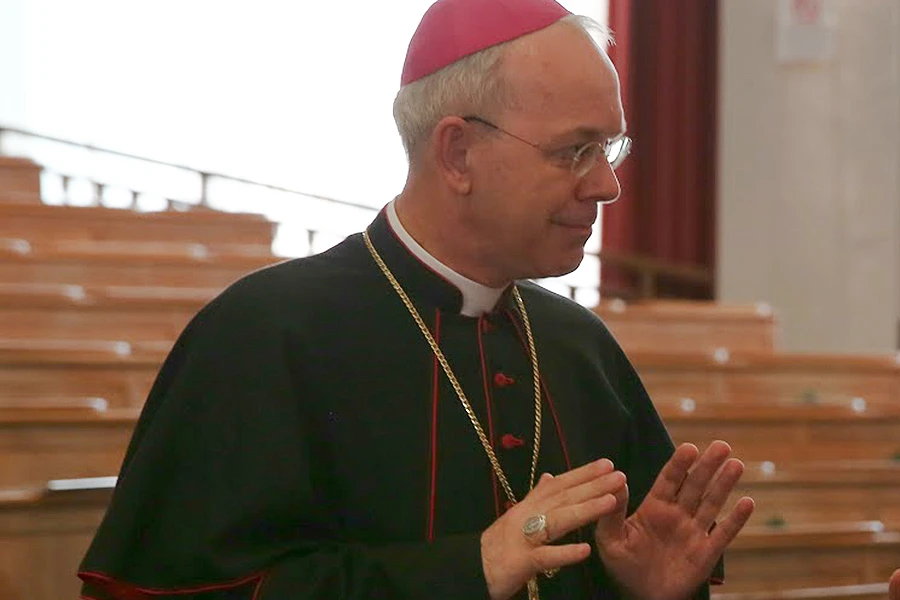
Bishop Schneider explains the Kazakhstani profession of truths on marriage

January 11, 2018 CNA Daily News 7

Astana, Kazakhstan, Jan 11, 2018 / 04:28 pm (CNA/EWTN News).- Fidelity to the words of Christ makes it necessary to profess the truth about sacramental marriage, Bishop Athanasius Schneider told CNA in a recent interview.

Bishop Schneider, an auxiliary bishop of Maria Santissima in Astana, was a drafter of the “Profession of the immutable truths about sacramental marriage” issued by three Kazakhstani bishops Dec. 31, 2017.

The bishops stated it is not licit to admit to sacramental communion Catholics who are divorced-and-remarried, if they are not living according to the long-standing teachings of the Church.

The three bishops – Bishop Schneider, along with Archbishop Tomash Peta of Maria Santissima in Astana and Archbishop Jan Pawel Lenga, Bishop Emeritus of Karaganda – wrote that “an approval or legitimation of the violation of the sacredness of the marriage bond, even indirectly through the mentioned new sacramental discipline, seriously contradicts God’s express will and His commandment.”

Since the open letter was issued, several more bishops have reportedly added their names as signatories.

Archbishop Luigi Negri, Archbishop Emeritus of Ferrara-Comacchio, spoke to La Nuova Bussola Quotidiana about his decision to sign the text, and Cardinal Janis Pujats, Archbishop Emeritus of Riga, has also been confirmed as a signatory.

Archbishop Carlo Maria Viganò, Apostolic Nuncio Emeritus to the US, and Bishop Andreas Laun, Auxiliary Bishop Emeritus of Salzburg, have also reportedly to signed onto the Kazakhstani bishops’ profession. Bishop Laun was among the first to sign a declaration of fidelity to the Church’s unchangeable teaching and uninterrupted discipline on marriage.

Cardinal Pietro Parolin, Vatican Secretary of State, told Vatican News Jan. 10 that Amoris laetitia is the result of “a new paradigm” which he claimed Pope Francis promotes “with wisdom, prudence, and patience.” The cardinal added that difficulties around the apostolic exhortation “are due to this change of attitude the Pope is asking of us,” as well as “some aspects of content.”

Bishop Schneider recently corresponded with CNA about the profession, discussing the occasion of the letter, the importance of prayer, and the common understanding of Church teaching and its implications among the bishops of Kazakhstan.


Below is the conversation between CNA and Bishop Schneider:

CNA: Your excellency, would you speak to the need for the profession made by you, Archbishop Peta, and Archbishop Lenga? What occasioned its drafting?

Bishop Schneider: Already for a number of years there has existed in the Church the obvious and undeniable situation of a widespread confusion regarding the sacramental discipline of those Catholics who are called “divorced and remarried”. The relevant pastoral norms of several dioceses and regional and national bishops’ conferences ultimately give permission to these Catholics to receive Holy Communion in spite of the fact that they have not the intention to stop sexual relationships with a person who is not their legitimate spouse. Such norms in practice contradict divine revelation and the infallible universal and ordinary magisterium of the absolute indissolubility of a ratified and consummated marriage. Recently there was published even in the Acta Apostolicae Sedis, the official publishing organ of the Holy See, the approval which Pope Francis gave to the pastoral norms of the bishops of the Buenos Aires region, which foresee ultimately, even though in individual cases and after a so-called discernment process, such a new sacramental praxis. However, this praxis contradicts divine revelation, which prohibits always and in every circumstances sexual acts outside a valid marriage. Everyone who still believes in the divine words of Christ and takes them seriously, must acknowledge how detrimental such norms are for the faith and for the unmistakable witness of the Church against the “plague of divorce” and against the “hardheartedness” of men towards the command of God, who demands unequivocally “Thou shall not commit adultery.” To continue to be silent in such a situation or to pretend that the danger does not exist, would mean to deny reality or to eliminate one’s own thinking.

CNA: How does your recent profession relate to the appeal to prayer you issued nearly a year ago, Jan. 18, 2017? Is it right to read these two documents in light of one another?

Bishop Schneider: The appeal to prayer which was made a year ago had the aim to implore for the Holy Father Pope Francis the necessary gifts of God so that he may confirm in a most unambiguous way the immutable doctrine about the indissolubility of the marriage and the relevant sacramental praxis. Since the Pope has not yet done so, and has even approved the above mentioned pastoral norms of the bishops of the Buenos Aires region, it was necessary to make a public profession of the immutable doctrine and praxis of the Church. But one thing is certain: no sincere prayers will be in vain. When a large number of faithful, and especially children and sick people, pray fervently, the moment will come when the Apostolic See will confirm again with clarity – as has been handed down by the infallible ordinary and universal magisterium – the immutable doctrine and sacramental praxis regarding people living in non-marital sexual relationships, i.e. people living in adultery. We have to believe in these words of Our Lord: “Will not God give justice to his elect, who cry to him day and night? Will he delay long over them?” (Lk 18:7).

CNA: There are three more bishops in Kazakhstan, as well as an apostolic administrator, who have signed on to neither the profession nor the appeal to prayer. Were they invited to do so? Have they indicated a different understanding of Amoris laetitia?

Bishop Schneider: The bishops and ordinaries of Kazakhstan have substantially no different understanding of Amoris laetitia. As to the manner of expressing publicly one’s own convictions we respect mutually the freedom of each one according to the decision of his own conscience.

[…]

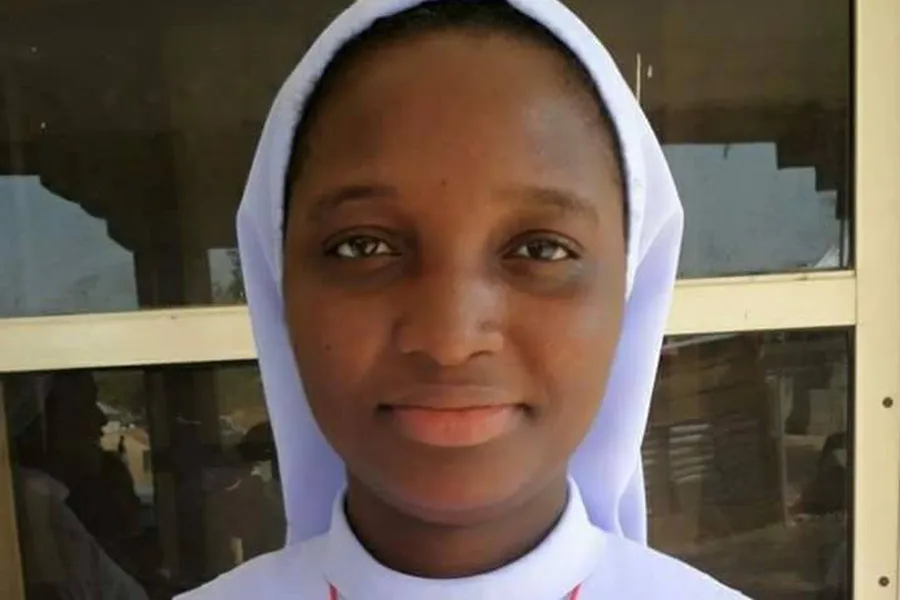
Six kidnapped nuns liberated in Nigeria

January 11, 2018 CNA Daily News 0

Uromi, Nigeria, Jan 11, 2018 / 03:15 pm (CNA/EWTN News).- During a two day police operation, six women religious who were captured in Nigeria’s Edo state two months ago were released unharmed on Saturday, generating much joy from the Christian community.

The women were freed during a Jan. 6 police operation, but their captors were able to escape.

They had been kidnapped Nov. 13, 2017 from the Eucharistic Heart of Jesus Convent in Iguoriakhi. Taken by unknown gunmen, three of the women were professed nuns (Sister Roseline Isiocha, Sister Aloysius Ajayi and Sister Frances Udi), and the other three were aspirants. Sister Ajayi was released first, followed several hours later by the others

“We are happy; to God be the glory,” said the convent’s mother superior, Mother Agatha Osarekho.

“They are fine and are receiving some medical checkup in a hospital,” she added, according to the Scottish Catholic Observer.
 
Sister Agatha received a ransom request of $55,000 for the women’s return, but she did not pay it.

Although the criminals were not captured, Sister Agatha applauded the efforts of authorities.

Fr. Kevin Oselumhense Anetor, a priest of the Diocese of Uromi, whence the women were kidnapped, posted on Facebook thanking “all the men and women of goodwill who worked and prayed tirelessly behind the scenes for the release of our sisters. We thank the mother superior of the EHJ for her patience and strong will, and her sisters for their solidarity during these days of trial.”

“We thank the Catholic Archdioceses of Benin and Lagos for their support and prayers, and indeed the Catholic and non-Catholic World, for their vigilance and prayers,” he added.

Archbishop Alfred Martins of Lagos had, earlier that week, urged government authorities to intensify their investigation into the abduction, saying, “We still do hope that the security agencies would do much more than is being done now to ensure that the sisters are released.”

Nigeria’s bishops had decried the nuns’ kidnapping in December, calling it a product of the “agents of darkness.”

Pope Francis also brought attention to the plight of the religious women, praying for them at his Dec. 17 Angelus address.

An Italian missionary priest, Fr. Maurizio Pallù, was kidnapped in Edo state for a week in October 2017. In Imo state, Fr. Cyriacus Onunkwo was kidnapped and killed in September of the same year.

[…]

Why Pope Francis will visit Chile’s Araucania region

January 10, 2018 CNA Daily News 0

Temuco, Chile, Jan 10, 2018 / 03:03 pm (ACI Prensa).- Pope Francis will spend a day in Temuco, the capital of a Chilean region with a large indigenous population, during his Jan. 15-18 visit to the nation. The city’s bishop has said the Pope decided to come to the area because it represents Chile’s peripheries.

“If we look at where the Pope likes to go when on a visit, it is precisely the borders, the existential borders, where there is pain, where there is suffering, where there are wounds, where there is poverty, Bishop Hector Vargas Bastidas of Temuco told ACI Prensa, CNA’s Spanish-language sister news agency.

Temuco is the capital of Araucania, a region in south-central Chile where one-third of the population is ethnic Mapuche, who are by far the country’s largest indigenous group.

Bishop Vargas offered the indigenous population, their conflict with the Chilean state, and the region’s poverty as three reasons Pope Francis has chosen to visit Temuco.

During his Jan. 17 visit to the city, the Pope will say Mass at Maquehue Airport and will lunch with inhabitants of Araucania at the Madre de la Santa Cruz house.

Bishop Vargas explained that some 200,000 Mapuche people live in Araucania and live profoundly  “their Mapuche identity, their worldview.”

While many Mapuche have moved to Santiago, the Chilean capital, many who have remained in Araucania live in their communities led by and encouraged by their ancestral authorities.

“There is a very great richness there,” the bishop explained. “This is a region where the issue of inter-culturalism is lived out and understood more and more, so this is a very important reason that the Pope certainly considered in planning his visit.”

He cited the Mapuche conflict as a second reason for Pope Francis’ visit.

Chile incorporated Araucania by military conquest between 1861 and 1883, and the manner of the region’s “pacification” led to “a major rift  between the government and the Mapuche people,” Bishop Vargas explained.

“A very great historic debt was created with this people, who are still waiting for this debt to be rectified,” he said.

Mapuche communities ask for the return of ancestral lands, respect for their cultural identity, and even autonomy.

Even though the majority of those involved in trying to settle the conflict are working to find solutions, the bishop pointed out that some radicalized groups in the minority “unfortunately think that this can be solved or that much more rapid progress can be made through violence.”

From 2014 through 2017, thirteen Catholic churches were burned by these groups.

“The violence has only brought more poverty, new injustices, and new suffering,” the Bishop of Temuco lamented. In 2016 he took on the responsibility of acting as a facilitator in talks between the government and the Mapuche people.

Finally, Bishop Vargas explained that among the country’s 15 regions, Araucania “ranks first in poverty in Chile.”

According to a 2015 government survey, 23.6 percent of the people in this region are living below the poverty line, the highest rate in the country. And a 2017 survey showed an unemployment rate in the region of 8.4 percent, the nation’s second highest.

Given this situation, Bishop Vargas said that “the transformation that one and all hope for in Araucania is going to come only if all of us who live here changes our hearts.”

“First of all, we have to change our hearts, we have to grow in humanity; then, laws and decrees will have their place. What people want will not be achieved if first we don’t undergo a conversion and a major transformation, and that is something only the Lord can give,” he concluded.

<iframe width=”560″ height=”315″ src=”https://www.youtube.com/embed/j0ky1F4B2bc?rel=0″ frameborder=”0″ allow=”autoplay; encrypted-media” allowfullscreen></iframe>


This article was originally published by our sister agency, ACI Prensa. It has been translated and adapted by CNA.

[…]