‘My mother was told to abort me’, priest says to March for Life youth

January 19, 2018 CNA Daily News 0

Washington D.C., Jan 19, 2018 / 11:56 am (CNA/EWTN News).- Father Martino Choi told some 18,000 teens and adults about his mother’s decision in favor of life at a Youth Rally and Mass for Life held in Washington, D.C., on Friday morning.

“I know a woman who went in for her ultrasound, and was told by the doctors that the child’s organs were not developing properly. The child would probably not make it a year after birth, and they recommended abortion,” Fr. Choi said during his homily at the Capital One Arena Jan. 19.

“This woman is my mother, and I am that child,” he stated.

Choi is a parish priest at St. Patrick’s parish in Rockville, Md., about 20 miles northwest of the District of Columbia. He said the doctors had told his mother that abortion would shield him and her from unnecessary suffering. He continued: “The devil knows who to disguise evil with a lie that somehow death is better than life … but death is never better than life.”

The young priest also shared stories from his parish where he has counseled parents who lost a child between days and months after the child’s birth.

“Not a single one of those families comes to me and says, ‘You know what, Father, we wish we hadn’t had this child. We wish we hadn’t had to suffer through this.’ None of them say that. They all say, ‘Thank God that we got to love this child, even if it was just for a couple of days.’”

“One family, whose kid never left the hospital, said that in his three months of life their son taught them the depths of love and courage that we could not understand before his birth…”

These stories resonated with the teens at the Mass for Life, who came from dioceses both across the U.S. and internationally.

“I thought that it was really amazing,” Kelly Lambers, a high school student from the Archdiocese of Cincinnati, told CNA. “His mother didn’t give him up even though she knew he didn’t have that long to live, but now look at him; he’s a priest!”

Lambers traveled nine hours by bus with her classmates from Mother of Mercy High School to attend the rally and the March for Life. She said she is particularly proud of her friends’ signs that read, “Pro-Life is Pro-Women.”

Tajil Baptiste, a young man from the U.S. Virgin Islands, also shared why he and his friends traveled to D.C. for the March for Life: “It is a a religious event for us, traveling so far from a little island, but the message that we will be bringing back to our community and our Church is ‘Let’s be pro-life, let’s change the world.’”

There were nearly 200 priests, 20 bishops, and three cardinals concelebrating the youth Mass, according to the Archdiocese of Washington. Cardinal Donald Wuerl of Washington was the principal celebrant.

“We are gathered here to proclaim the value, the worth, and the dignity of all human life,” Cardinal Wuerl told the crowd before the Mass.

The Apostolic Nuncio to the U.S., Archbishop Christophe Pierre, shared a message from Pope Francis with the youth and extended an invitation to tag the Holy Father as they stand up for life on Twitter and Instagram using #iStand4Life.

After the Mass for Life, the youth groups walked from the Capital One Arena to the National Mall for the March for Life.
[…]

The world needs you, Francis tells young people at children’s home

January 19, 2018 CNA Daily News 0

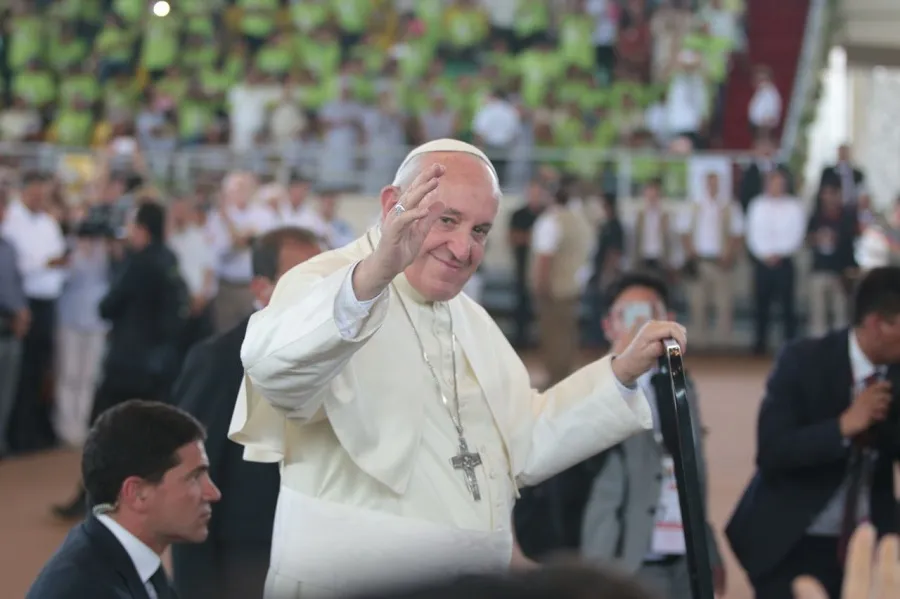
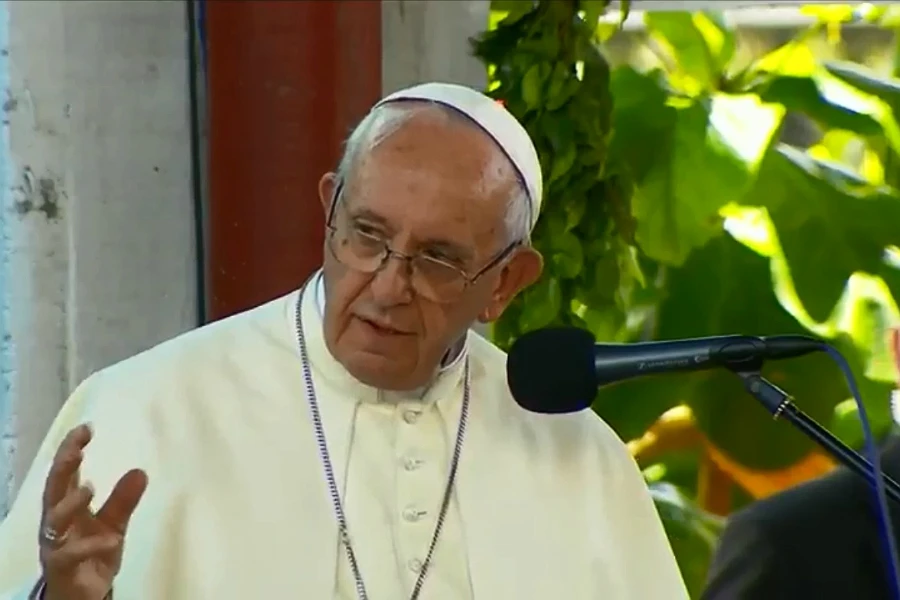
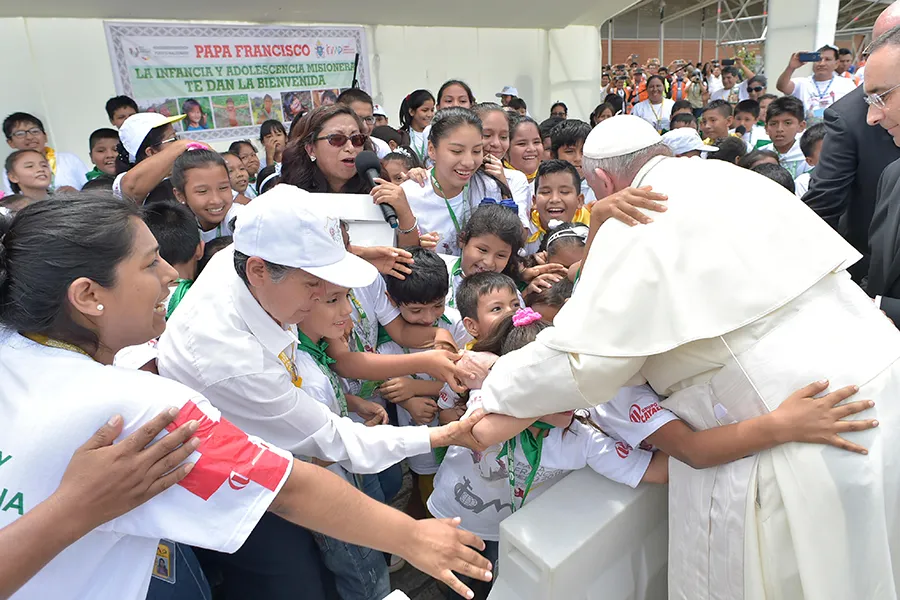
Puerto Maldonado, Peru, Jan 19, 2018 / 11:35 am (CNA/EWTN News).- Speaking to kids at a home for orphaned and abandoned children on Friday, Pope Francis said they have much to offer the world by being themselves and sharing their experiences.

“The world needs you, young men and women… and it needs you as you are. Do not be content to be the last car on the train of society, letting yourselves be pulled along and eventually disconnected. We need you to be the engine, always pressing forward,” the Pope said Jan. 19.

“Share what you learn with the world, because the world needs you to be yourselves, who you really are, and not an imitation of someone else. We need you to be authentic, young men and women who are proud to belong to the Amazonian peoples and who can offer humanity an alternative for a true life.”

Francis spoke at the “Hogar Principito” (“Little Prince Home”) in Puerto Maldonado on the second day of his Jan. 18-21 visit to Peru. The children’s home was founded in 1996 to help deal with with the high rate of neglect and child exploitation that occur in the city.

It currently houses around 40 children and adolescents, who have come from orphanages, at-risk families, or illegal mining camps. Some have been abandoned or been victims of physical, sexual, or psychological abuse.

Pope Francis met with the children and their caretakers on the basketball court of the home.

Before his speech he was greeted by the director of the home, Fr. Xavier Arbex, and listened to the testimony of Dirsey Irarica Piña, a woman who was raised in the home. He also watched performances by the children of songs and a choreographed dance.

Irarica described having been orphaned at the age of 11, and being welcomed into the Hogar Principito a couple of years later, saying the home “was ready immediately to give me the fullness of support and love … I thank my teachers and the ‘little father’ for filling this void in me. Thank you for this unconditional love which makes us feel at home.”

She now lives in Tacna, where she works and studies psychology.

In his address after listening to Irarica, the Pope referenced the recent celebration of Christmas, where our hearts were touched by the coming of the Child Jesus.

“He is our treasure. You children are his reflection, and you too are a treasure for all of us, the most precious treasure that we have, and one that we are called to guard,” Francis said.

He asked forgiveness for the times that adults have neglected to care for them and protect them as they deserve, saying how their lives demand a greater commitment and effort on the part of everyone – that we do not remain indifferent to children who suffer and are in need.

“Without a doubt, you are the greatest treasure that is ours to care for,” he underlined.

Speaking to Irarica, who gave a testimony before his speech, he said she was brave to share that sometimes she feels very hurt, and misses her father and mother.

“You told me; ‘I hope my message may be a light of hope,’” the Pope referenced. “But let me tell you something. Your life, your words, and the lives of all of you, are a light of hope.”

He said a wonderful witness “is offered by all of you young people who have travelled this road, who found love in this home and now are able to shape your own future! You demonstrate to all of us the enormous potential of each person. For these boys and girls, you are the best example to follow, a sign of hope that they will be able to do the same. We all need good role models: children need to look to the future and have positive role models.”

“Everything that you young people can do, like coming here to be with them, to play and spend time together, is important,” Pope Francis said. “Be for them, as the Little Prince says: the little stars that light up the night,” referring to the Antoine de Saint-Exupéry character for whom the children’s home is named.

The Pope went on to note how the children who came from indigenous communities may have been witness to the destruction of their home, saying: “today those woodlands have been laid waste by the intoxication of a misguided notion of progress.”

“Young people, do not be resigned to what is happening! Do not renounce the legacy you have received from your elders, or your lives and dreams.”

He also encouraged them to study and to take advantage of the educational opportunities available to them.

“Listen to your elders; value their traditions; do not curb your curiosity. Get in touch with your roots, but at the same time open your eyes to new things; bring the old and the new together in your own way,” he encouraged.

Society often needs correction and you, young people, can help greatly with this “by teaching us a way of life based on protection and care, not on the destruction of everything that stands in the way of our greed,” he said.

[…]

Amazon not a ‘no man’s land’, but a treasure, Pope Francis says

January 19, 2018 CNA Daily News 0

Puerto Maldonado, Peru, Jan 19, 2018 / 10:34 am (CNA/EWTN News).- Pope Francis visited one of Peru’s most biodiverse regions Friday, telling its inhabitants that while remote, their land is not forgotten and must be cared for.

He also stressed the importance of fighting such scourges as corruption and human trafficking.

“’We are not a no man’s land.’ It is something that needs to be emphasized. You are not a no man’s land. This land has names. It has faces. It has you,” the Pope said Jan. 19 to the people of Puerto Maldonado, the capital of the Madre de Dios Region in the Amazon basin.

He was responding to comment made by a local couple, Margarita Martínez Núñez Valer and her husband Arturo, who while sharing their testimony said their land is one “that is mostly forgotten, wounded and marginalized…but we are not a no man’s land.”

Pope Francis noted that Mary also came from Nazareth, a remote and isolated village that many also considered “a no man’s land.”

Mary, he said, is not only an example but a mother, and when we have a mother, “we don’t have that terrible feeling of belonging to no one, that takes hold when our sense of belonging to a family, to a people, to a land, to our God, begins to fade.”

The Madre de Dios Region, then, “is not a land of orphans, but a land that has a Mother! And if it has a mother, it has sons and daughters, a family, a community.” While the problems might not disappear, when there is a mother, a family and a community “we certainly find the strength to confront them differently.”

He visited Puerto Maldonado on the first full day of his Jan. 18-21 visit to Peru, after spending three days in Chile. The Amazonian region is of special interest to the Pope, considering his 2015 encyclical on care for our common home, Laudato si’, and his decision to hold a Pan-Amazonian synod in 2019 to discuss the challenges the area faces.

Before meeting with the inhabitants of Puerto Maldonado, he met with members of the Amazonian community, and distributed copies of Laudato si’ which had been translated into the local languages.

Held in the city’s Jorge Basadre Institute, the encounter with the people of Puerto Maldonado began with a greeting from Bishop David Martinez de Aguirre Guinea, Vicar Apostolic of Puerto Maldonado, and the testimony of a catechist.

Francis said it is painful for him to see how some people seek to exploit the territory and therefore make Madre de Dios “a nameless land, without children, a barren land.”

Referring to what he has often dubbed the “throwaway culture,” he said this is a mentality which isn’t satisfied with simple exclusion, but continues to advance “by silencing, ignoring and throwing out everything that does not serve its interests; as if the alienating consumerism of some is completely unaware of the desperate suffering of others.”

“It is an anonymous culture, without bonds, without faces,” and which only wants to consume, he said, adding that both land and people are treated according to the same logic: “forests, rivers and streams are exploited mercilessly, then left barren and unusable,” while people are “used until someone gets tired of them, then abandoned.”

He then spoke out against the temptation of corruption and the practice of human trafficking, saying forcefully that the term slavery should be used instead: “We have become accustomed to using the term ‘human trafficking’, but in truth we should speak of slavery: slavery for work, sexual slavery, slavery for profit.”

“It is painful to see how in this land … so many women are devalued, denigrated and exposed to endless violence. Violence against women cannot be treated as ‘normal’, maintaining a culture of machismo blind to the leading role that women play in our communities. It is not right for us to look the other way and let the dignity of so many women, especially young women, be trampled upon.”

He noted that many people, desperate to escape poverty, come to the area to work in the gold mines, but he cautioned that gold can quickly turn into “a false god that demands human sacrifices.”

“False gods, the idols of avarice, money and power, corrupt everything. They corrupt people and institutions, and they ruin the forest,” he said, adding that Christ called these “demons that require much prayer to expel.”

The Pope then urged the community to continue forming movements and organizations aimed at overcoming the plagues of corruption and trafficking. “I likewise encourage you to gather, as people of faith and vibrant ecclesial communities, around the person of Jesus,” he said.

“Through heartfelt prayer and hope-filled encounter with Christ, we will be able to attain the conversion that leads us to true life. Jesus promised us true life, authentic life, eternal life. Not a make-believe life, like the one offered by all those dazzling false promises; they promise life but lead us to death.”

Salvation, he said, “is not something generic or abstract. Our Father looks at real people, with real faces and histories. Every Christian community must be a reflection of this gaze, this presence that creates bonds and generates family and community. It is a way of making visible the kingdom of heaven, in communities where everyone feels a part of the whole, where they feel called by name and encouraged to be a builder of life for others.”

Pope Francis closes his speech telling the people they live in one of “the most exuberant explosions of life on our planet,” and urged them love the land and to “realize that it belongs to you. Breathe it in, listen to it, marvel at it.”

“Fall in love with this land called ‘Madre de Dios,’ commit yourself to it and care for it,” he said, and “do not use this land as a mere disposable object, but as a genuine treasure to be enjoyed, cultivated and entrusted to your children.”

[…]

Pope says accusations against Chilean bishop are ‘calumny’

January 19, 2018 CNA Daily News 2

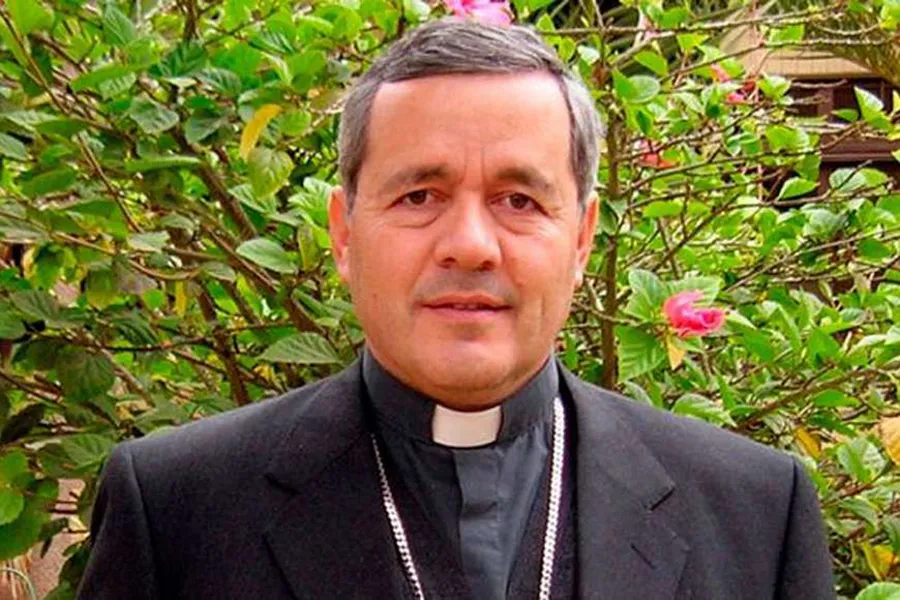
Santiago, Chile, Jan 19, 2018 / 09:58 am (CNA/EWTN News).- At the end of his three-day visit to Chile, Pope Francis came to the defense of a controversial bishop, saying accusations that he helped cover up abuse are unproven and amount to “calumny.”

Responding to a Chilean journalist who asked about the issue, Pope Francis said “the day they bring me proof against Bishop Barros, I’ll speak. There is not one shred of proof against him. It’s all calumny. Is that clear?”

The 2015 appointment of Bishop Juan Barros Madrid to lead the Diocese Osorno, continues to draw harsh criticism from activists and abuse victims who accuse the bishop of covering up the crimes of his longtime friend, Father Fernando Karadima.

Karadima, who once led a lay movement from his parish in El Bosque, was convicted of sexually abusing minors in a 2011 Vatican trial, and at the age of 84, he was sentenced to a life of prayer and solitude.

Barros has repeatedly insisted that he knew nothing of the abuse, at one point telling the Associated Press that “I never knew anything about, nor ever imagined the serious abuses which that priest committed against the victims.”

“I have never approved of nor participated in such serious dishonest acts and I have never been convicted by any tribunal of such things.”
 
In January 2015 Francis named Barros to head the Diocese of Osorno in southern Chile, setting off a wave of objections and calls for his resignation from several priests. Dozens of protesters, including non-Catholics, attempted to disrupt his March 21, 2015 installation Mass at the Osorno cathedral.

Days later, Archbishop Fernando Chomali Garib of Concepcion said that Pope Francis had told him that there was “no objective reason at all” that the bishop should not be installed. The pontiff had been kept up-to-date on the situation.

On March 31, 2015, the Vatican’s Congregation for Bishops also released a statement, saying that the office had “carefully examined the prelate’s candidature and did not find objective reasons to preclude the appointment.”
 
The then-apostolic nuncio to Chile, Archbishop Ivo Scapolo, said that all information about Barros was passed on to Pope Francis. Most of the people in the church, he said, were not protesters, but “people who love their bishop.”

On May 6, 2015, five months after Barros was appointed to lead the Diocese of Osorno, Deacon Jaime Coiro, general secretary of the Chilean episcopal conference, told Pope Francis that the Church in Osorno “is praying and suffering for you.”

“Osorno suffers, yes,” Pope Francis said, “for silliness.” According to a video of the conversation released by Chile’s Ahora Noticias, the Pope had told Coiro that “the only accusation against that bishop was discredited by the judicial court.”

“Think with your head, and do not be carried away by the noses of the leftists, who are the ones who put this thing together,” the Pope added.

In his first speech after landing in Chile Jan. 15 Pope Francis acknowledged the pain and distress the scandal has caused to the local Church and to the wider Chilean society, telling the country’s civil authorities he feels “pain and shame at the irreparable damage caused to children by some ministers of the Church.”

Asking for pardon, he said “I am one with my brother bishops, for it is right to ask for forgiveness and make every effort to support the victims, even as we commit ourselves to ensuring that such things do not happen again.”

However, in response to the Pope’s comment Jan. 18, Juan Carlos Cruz – one of Barros’ most outspoken accusers and one of Karadima’s victims – tweeted: “As if I could have taken a selfie or a photo while Karadima abused me and others and Juan Barros stood by watching it all…These people are truly crazy, and the pontiff talks about atonement to the victims. Nothing has changed, and his plea for forgiveness is empty.”

[…]

Pope in Peru: Don’t just protect the Amazon, protect its people

January 19, 2018 CNA Daily News 0

Puerto Maldonado, Peru, Jan 19, 2018 / 09:16 am (CNA/EWTN News).- Speaking to members of Peru’s indigenous Amazonian communities Friday, Pope Francis said that contrary to the consumerist mentality that places material objects above the good of the people, protecting the Amazon also means taking into account the best interests of those who live there.

“Allow me to state that if, for some, you are viewed as an obstacle or a hindrance, the fact is your lives cry out against a style of life that is oblivious to its own real cost,” the Pope told indigenous Peruvians Jan. 19.

“We have to break with the historical paradigm that views Amazonia as an inexhaustible source of supplies for other countries without concern for its inhabitants,” he continued, emphasizing that Amazonians are “a living memory of the mission that God has entrusted to us all: the protection of our common home.”

Pope Francis is visiting Peru from Jan. 18-21. During his first full day in the country, he met with indigenous people of the Amazon region in the city of Puerto Maldonado. The city lies in the Madre de Dios region in southeast Peru, and is considered the gateway to the southern Amazon jungle.

There are about 332,000 indigenous Peruvians living in the country’s Amazon region, of which 29,000 are within the Apostolic Vicariate of Puerto Maldonado.

The encounter included a performance of songs and dances by the ancient Arambut and an address by the Apostolic Vicar of Puerto Maldonado, Bishop David Martinez de Aguirre Guinea, O.P.

Before speaking, Francis also heard the testimonies of three Amazonian people. Copies of his 2015 encyclical, Laudato Si, translated into the local languages, were also distributed. Later in the day, he will have lunch with representatives of the Amazon.

In his speech, the Pope listed the different native groups which live in the Peruvian Amazon, thanking them for their attendance, and for giving him the opportunity to see, “closer up, in your faces, the reflection of this land.”

“It is a diverse face, one of infinite variety and enormous biological, cultural and spiritual richness,” he said.

The Pope also drew attention to the threats native Amazonians face on their own land, stating that at present they are probably some of the worst they’ve experienced.

He listed the different challenges they currently face, including “neo-extractivism,” which is when large businesses try to take possession of the petroleum, gas, lumber, and gold in the region.

There are also other movements that, “under the guise of preserving the forest, hoard great expanses of woodland and negotiate with them,” leading to situations of oppression for native people, who lose access to the land and its resources, he said.

Pointing to human trafficking, which he called a “devastating assault on life,” Francis strongly condemned, in particular, slave labor and sexual abuse, which are often linked with illegal mining, saying “the defense of the earth has no other purpose than the defense of life.”

He said that we cannot forget the words of St. Turibius, who at the Third Council of Lima in the 1500s said, “that not only in times past were great wrongs and acts of coercion done to these poor people, but in our own time many seek to do the same.”

“Sadly, five centuries later, these words remain timely,” he noted. “That prophecy must remain alive in our Church, which will never stop pleading for the outcast and those who suffer.”

Francis also focused on the good work of the Church in the Amazon, and the many missionaries throughout history who have devoted themselves to the region, defending its people and their cultures.

“Each culture and each worldview that receives the Gospel enriches the Church by showing a new aspect of Christ’s face,” he said. “Do not yield to those attempts to uproot the Catholic faith from your peoples.”

“The Church is not alien to your problems and your lives, she does not want to be aloof from your way of life and organization. We need the native peoples to shape the culture of the local churches in Amazonia,” he said.

He encouraged people to help their bishops and missionaries to be one with them, so that through inclusive dialogue they can help to shape the face of the Church.

It was in this spirit, Francis explained, that he decided to convoke an upcoming Synod of Bishops on the Amazon, which will take place in 2019.

The Pope also voiced his encouragement for those who use art, literature, craftsmanship and music to share their worldview and cultural richness with the world.

Much has been written and said about you by others, he said, but “it is good that you are now the ones to define yourselves and show us your identity. We need to listen to you.”

This is the reason I wanted to visit you and listen to you, he explained. “So that we can stand together, in the heart of the Church, and share your challenges and reaffirm with you a whole-hearted option for the defense of life, the defense of the earth and the defense of cultures.”

[…]

Nigerian bishops deplore dehumanizing trends of violence

January 18, 2018 CNA Daily News 0

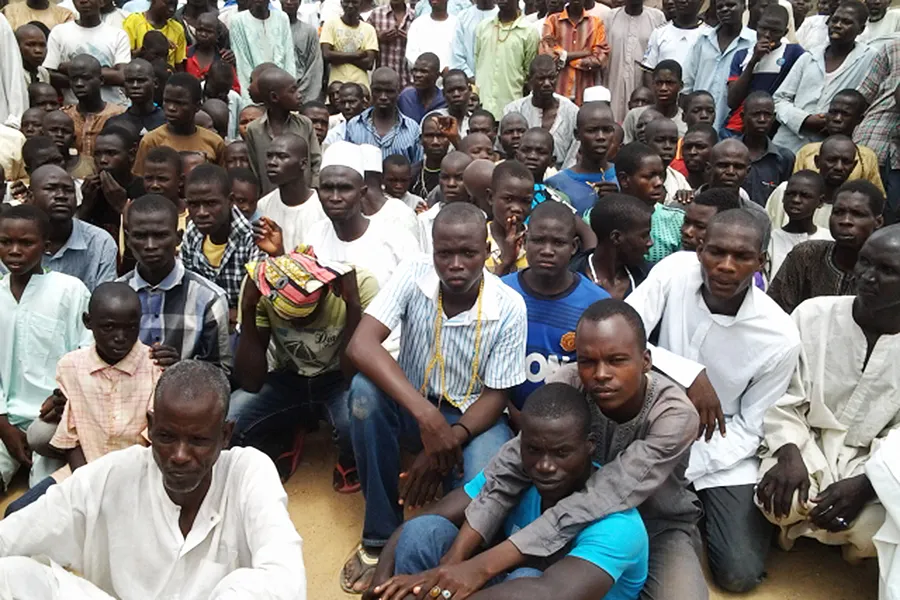
Abuja, Nigeria, Jan 18, 2018 / 09:08 pm (CNA/EWTN News).- Nigeria’s bishops challenged government authorities Tuesday to resolve the country’s violent disputes, especially after recent attacks by Fulani herdsmen have resulted in over 100 deaths just this year.

A Jan. 16 statement from the Nigerian bishops’ conference focused on clashes between herdsmen and farmers; a spate of kidnappings; and the large number of internally displaced persons and refugees.

“The recent mass slaughter of unarmed citizens by these armed herdsmen in some communities in Benue, Adamawa, Kaduna and Taraba States has caused national shock, grief and outcry” read the statement.
 
“We believe that, if there is some degree of political will, our public authorities can take adequate steps to put an end to these human tragedies.”

Signed by Archbishop Ignatius Kaigama of Jos and Bishop William Avenya of Gboko, the president and secteary of the Nigerian bishops’ conference, respectively, the statement also urged officials to attend to increased kidnappings causing fear among citizens and humanitarian issues occurring in refugee camps.

On Jan. 11, thousands of Nigerians gathered in Makurdi, the capital of Benue State, to mourn the death of 73 people. The deaths were a result of suspected Fulani herdsman who have raided nearby farming communities with automatic rifles since the beginning of the year.

Additionally, at least 55 people were killed by the nomadic herdsman in the neighboring state of Taraba. However, the violence has not ended and the death toll is likely to rise.

Violence between Fulani herdsmen and farmers has increased in recent years since climate issues have pushed herders further south. The bishops understood the herdsmen’s concern “to save their livestock and economy” but condemned the “massacres of innocent people” that have resulted.

“Our perilous situation calls for more security consciousness,” the statement read, and the bishops urged authorities to take measures to disarm and unmask the criminals responsible for the attacks.  

They maintained that “a better alternative to open grazing should be sought rather than introducing ‘grazing colonies’ in the country. Government should rather encourage cattle owners to establish ranches in line with international best practice.”

“Farmers and herdsmen have a lot to contribute to the socio economic prosperity of our nation. A more enduring strategy must be worked out for their peaceful co-existence and mutual respect,” the bishops wrote.

Without government intervention, the bishops are worried the conflict would breed situations of long term violence, and that farmers would have to result to self-defense, creating a state of anarchy.

“This will, no doubt, lead to the complete breakdown of law and order in the country,” wrote the bishops. “It is wiser and easier to prevent a war than to stop it after it has broken out,” they later added.

The bishops, though, applauded the government’s successful efforts to remove one terrorist group, but were also saddened by the incidents of kidnapping and the lack of police efforts to prevent such widespread crimes.

“While thanking God and the federal government for the successes so far recorded in the fight against Boko Haram terrorists in the north east, we are appalled by the repeated occurrence of other ugly incidents,” read the message.

Recent kidnappings from have seeded fear among Nigeria’s citizens, the bishops said, noting that no individual “no matter how old, sacred or highly placed” has been safe from the humiliating attacks.  

An Italian priest, who had been missionary in Nigeria for three years, was kidnapped in October 2017. He was taken while driving in Benin City, the capital of Edo, a southern state of the country. Likewise, six religious women were taken last November from their convent near Benin City.

All the mentioned parties have been released, but the bishops expressed frustrations that “communities should be better policed” considering the monthly allowance set aside by the Federal Republican of Nigeria for security forces.

Two American and two Canadian citizens were kidnapped in Kaduna state Jan. 17. The kidnappers shot and killed two police escorts in the incident, according to the BBC.

The bishops also encouraged more policing of refugee camps, which have reportedly become hubs of sexual harassment.

Due to political unrest, Cameroonians have fled their country and taken residence in refugee camps within the states of Taraba and Banue. Many of these places are in need of basic necessities, sanitation, and medical supplies, the bishops wrote.

The government should provide additional support to the National Commission for Refugees and Internally Displaced Persons, they said, but also urged people to aid integration of these struggling communities.

In conclusion, the bishops called on all of Nigeria to participate in actions of peace, forgiveness, and mutual dialogue.

“We, therefore, urge all aggrieved parties to seek reconciliation through dialogue and mutual forgiveness. Above all, we passionately appeal to them to beat their swords into ploughshares, and their spears into pruning hooks.”

[…]

Guam archbishop denies allegations of rape, sexual abuse

January 18, 2018 CNA Daily News 0

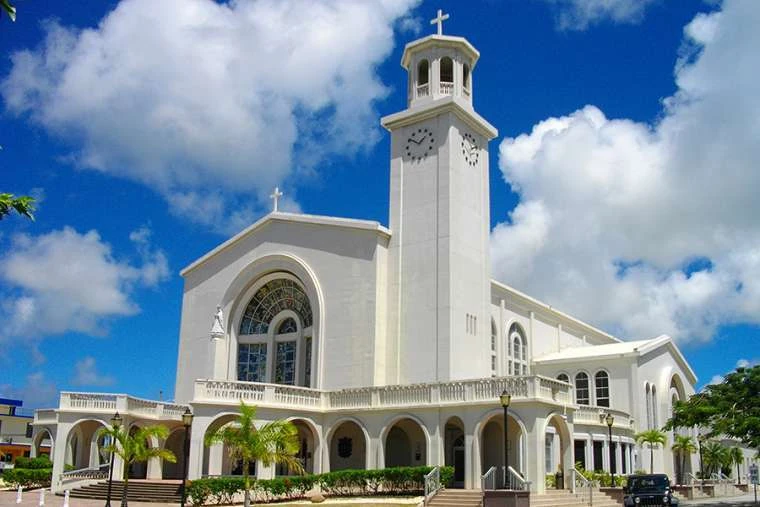
Hagatna, Guam, Jan 18, 2018 / 05:00 pm (CNA/EWTN News).- An embattled archbishop in Guam has denied an allegation that he raped his nephew nearly 20 years ago, when his accuser was a teen.

Mark Apuron, nephew of Guam’s Archbishop Anthony Apuron, filed a lawsuit Jan. 10, claiming that his uncle raped him in a Church bathroom in 1989 or 1990. This is the fifth lawsuit to accuse the archbishop of sexual abuse of minors during his time as a pastor and bishop.
 
“God is my witness: I deny all allegations of sexual abuse made against me, including this last one,” wrote Archbishop Apuron in a Jan. 18 statement, according to Guam Pacific Daily News.

“All of these allegations have been mentored and promoted by the same source and this one seems particularly timed to influence the verdict of the Vatican trial conducted by the Holy See, as a last resort out of fear that I may be exonerated,” he continued.

In addition to this claim, Apuron faces four other accusations from former altar boys, who charged the archbishop with abuse in the 1970s when he served as a parish priest in Agat. The first allegations against the archbishop were made public in May 2016.  Mark’s attorney, David Lujan, said that his client was too ashamed and embarrassed to tell his family about the alleged abuse until recently.

Pope Francis relieved Apuron of his pastoral and administrative authority in 2016 and he was replaced by Coadjutor Archbishop Michael Byrnes, formerly of Detroit. In October of that year, Apuron’s canonical trial at the Vatican began, which could dismiss him from the clerical state. Cardinal Raymond Burke, a canon lawyer, was appointed by Pope Francis as the trial’s presiding judge.

Byrnes has told reporters that the Vatican reached a decision in the case in October 2017, though no information regarding the trial’s outcome has been released.  

Byrnes, who is empowered by the Vatican to oversee the Archdiocese of Agana but has not yet formally succeeded Apuron, has since implemented new child protection policies in the archdiocese, including a safe environment program that Byrnes said will “help to instigate a change of culture in our Archdiocese.”

Byrnes adopted in February 2017 the US bishops’ conference’s Charter for the Protection of Children and Young People and its essential norms on dealing with allegations of sexual abuse of minors by clerics.

Apuron, who is currently recovering from a surgery, wrote that he hopes the truth will come out and that he will continue to pray for his accusers.

“As the Church in Guam is being destroyed by people who have only their power agenda at heart, may God have mercy on us all and save His Church from the powers of darkness,” Apuron wrote. “I pray that the truth may prevail; I pray for my accusers: fill them with what they desire; as for me, when I awake, I will be satisfied with Your face, oh Lord (Ps. 17,15)”.

The Archdiocese of Agaña is currently a defendant in 96 sexual abuse lawsuits, involving Apuron, 13 priests, a Catholic schoolteacher, a Catholic school janitor, and a Boy Scout leader. Most of the lawsuits were filed after 2016, when Guam’s territorial legislature eliminated the statute of limitations for civil lawsuits involving child sexual abuse.


[…]