Prolife Democrat laments ‘homogenization’ within parties
September 28, 2018 CNA Daily News 0

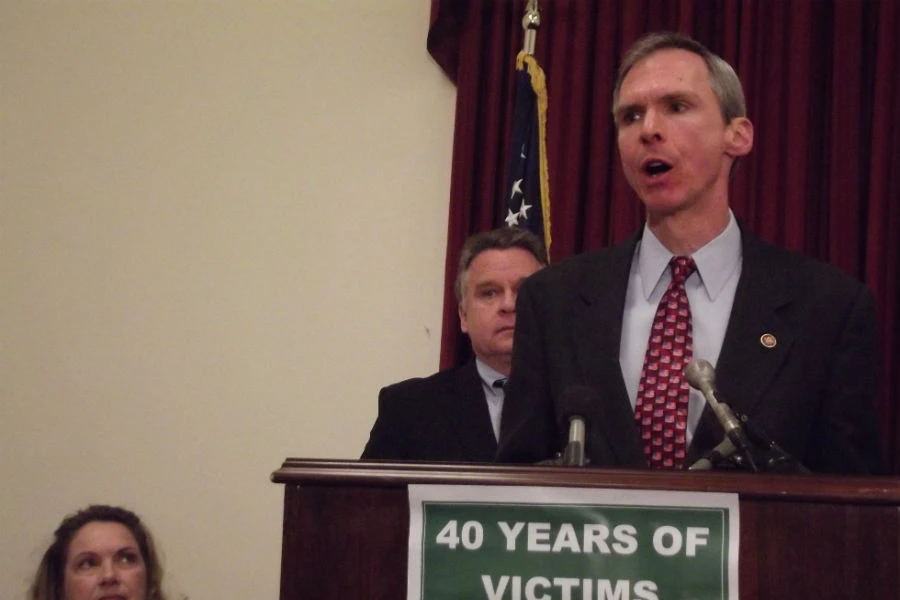
Washington D.C., Sep 28, 2018 / 03:30 pm (CNA).- Rep. Dan Lipinski (D-IL), one of the few prolife members of the Deomcratic Party with a seat in Congress, has spoken about his commitment to life issues and his concern at the increasing divide between the two major parties.

The congressman spoke at an event entitled Being a Faithful Catholic as a Public Servant on Sept. 27. The event was hosted at the Catholic University of America and sponsored by the university’s Institute for Human Ecology.

Lipinski, along with CUA Professor Joseph Capizzi, discussed what life is like in Washington for one of the last remaining Blue Dog Democrats, and how his party has shifted to the point of effectively trying to force people like him out. He has represented Illinois’ 3rd district for the last 14 years, a time in which he says divisiveness and polarization has gotten worse.

Although voting as a committed Democrat, with a 91 percent rating from the AFL-CIO and a 100 percent rating from the League of Conservation Voters— Lipinski also calls himself a strong and proud pro-life legislator, something which can leave him isolated from his party colleagues.

“The parties have really gotten more homogeneous,” he said. “It used to be that you had conservative Democrats, largely southerners but not all, and you had some more liberal Republicans. The parties have really sorted out.”

His constituents, he explained, are largely the “old-fashioned Democrats”–a phrase that he himself identifies himself with.

Over his nearly decade and a half in Congress, “things have changed. There’s less bipartisanship, but things have really gotten so much worse.”

The two major parties are generally found on opposite sides of the abortion debate. The Democratic Party’s platform has support for the public funding of abortion as one of its planks, while the Republican Party’s platform states that all Americans have an “unalienable right to life.”

In addition to being a relative rarity in his party, his pro-life views have made him something of a target.

This past March, Lipinski barely survived a primary challenge in his Illinois constituency. His challenger, Marie Newman, made abortion the central issue of that campaign, and received considerable support and money from numerous pro-abortion groups.

The Democratic Congressional Campaign Committee initially declined to endorse Lipinski, but finally endorsed the sitting congressman about two weeks before the primary election.

Lipinski said that while he is hopeful about the future of the pro-life movement, he was not comfortable with how the movement had “embraced” President Donald Trump. He explained that he pulled out of speaking at the annual March for Life when he learned that Trump would also be addressing the event.

“It very much concerns me,” said Lipinski about Trump. “I understand he’s done some very good things when it comes to protecting life, but I’m scared that getting too close is going to hurt the movement in the long run.”

Those who attended the talk were impressed with what Lipinski had to say, even if they were not necessarily on board with all of his policy positions. Many of the attendees at the Catholic University told CNA that they appreciated the stance he was taking for life.

“It’s wonderful to hear a pro-life politician who remains firm in his stance and is willing to speak out publicly in defense of life,” Sr. Mary Elizabeth, SV, told CNA.

Nick Swanson, a freshman at Catholic University who described himself as a Republican, said that he thought it was interesting how blunt Lipinski was about his time in Congress.

“It wasn’t as if he was playing to a political audience, he just wanted to be honest about the struggles he faced in making his decisions. It’s almost like he, when he approaches these decisions he takes them seriously. It’s not as if he just follows the party line,” said Swanson.

John Dashe, another freshman, told CNA that he thought it was refreshing to find ideological diversity within a party.

“Being from (Massachusetts), we have a lot of Democrats, but none of them are pro-life,” said Dashe.

“Coming from a perspective where I thought they all had a sort-of uniform view, it’s interesting to see that he was different in that way.”

[…]

Vermont AG investigates abuse allegations at Catholic institutions

September 28, 2018 CNA Daily News 1

Montpelier, Vt., Sep 28, 2018 / 02:21 pm (CNA/EWTN News).- As the attorney general of Vermont investigates allegations of abuses at Catholic institutions, the state’s bishop has announced that the diocese is waiving nondisclosure agreements for abuse victims.

Attorney General T.J. Donovan announced Sept. 11 an investigation of allegations surrounding St. Joseph’s Orphanage in Burlington.

“The allegations include murder, for which there is no statute of limitations, as well as abuse and sexual abuse,” the attorney general’s office stated. “The Burlington Catholic Diocese, which operated St. Joseph’s Orphanage, has expressed willingness to fully cooperate with the investigation.”

The orphanage, founded in the mid-1800s, was operated by the Sisters of Providence, and overseen by Vermont Catholic Charities. It closed in 1974.

The allegations were described by Christine Kenneally in an Aug. 27 article in BuzzFeed News.

“I wish to inform all survivors of abuse who entered into a Nondisclosure Agreement (NDA) with the Diocese of Burlington as part of a legal settlement that the Diocese waives that agreement and they are now free to tell the story of what happened to them as they see fit,” Bishop Christopher Coyne of Burlington said Sept. 28.

He noted that this applies only “to NDAs that were signed with the Diocese and not any other Church entity such as a religious community or school.”

“Out of respect for those who asked for an NDA so as to maintain their own personal privacy in these matters, the Diocese will continue to maintain the agreement.”

The bishop added that the Diocese of Burlington has not required nondisclosure agreements on the part of survivors since 2002.

“It is my hope that this past action as well as the present one will allow the truth of what happened to survivors and their families to be heard,” Bishop Coyne wrote. “I pledge to you, as the bishop of Burlington, that I will do everything that I can to make sure this never happens again and to work for healing and reconciliation with those who were so badly abused by clergy.”

Alleged abuses at St. Joseph’s Orphanage were the subject of lawsuits brought by former residents in the 1990s. Some of the cases were dismissed, and some reached settlements.

VTDigger reported Sept. 26 that Donovan’s investigation will include Weston Priory, a Benedictine monastery. Michael Veitch has said he was sexually abused by a visiting priest at the priory around 1970, when he was 15 years old.

Msgr. John McDermott, vicar general of the Burlington diocese, told VTDigger that the diocese will cooperate with Donovan “in any way … If the Vermont Attorney General decides to expand the investigation we will cooperate to the best of our ability.”

Veitch has said that memories of his alleged abuse were triggered by reports of sexual abuse of minors in Pennsylvania.

In August, a Pennsylvania grand jury report found more than 1,000 allegations of abuse at the hands of some 300 clergy members in six dioceses in the state. It also found a pattern of cover up by senior Church officials.

The report has prompted questions nationwide on the Church’s response to abuse claims.

Since then, numerous state attorneys general have announced investigations into abuse by clerics, including those in Michigan, Nebraska, New York, New Jersey, Missouri, New Mexico, and Illinois.

[…]

Pope Francis laicizes convicted Chilean abuser

September 28, 2018 CNA Daily News 0

Vatican City, Sep 28, 2018 / 09:30 am (CNA).- The pope has ordered the laicization of Fernando Karadima, a Chilean priest convicted in 2011 of the sexual abuse of minors. He had previously been sentenced to a life of prayer and penance.

Pope Francis m… […]

How the L.A. archdiocese is supporting separated immigrant families

September 28, 2018 CNA Daily News 0

Los Angeles, Calif., Sep 28, 2018 / 03:01 am (CNA/EWTN News).- Through Guadalupe Radio the Archdiocese of Los Angeles raised more than $90,000 last month to help reunited separated immigrant families in southern California.

“It was Archbishop [Jose] Gomez’s vision to have us be the leaders in treating immigration not as a political topic, but that it was important for the human dignity of people, first and foremost,” said Isaac Cuevas, the archdiocese’s director of immigration affairs.

A two-day campaign was held on Guadalupe Radio at the end of August, raising $92,000 in support of humanitarian efforts by Catholic Charities. Then, Archbishop Gomez of Los Angeles approved a virtual collection plate for the same efforts, which went into effect this week.

Cuevas told CNA that the money will be used to help families with a three-month transitional process and legal fees.

The families were affected by the Trump administration’s “zero tolerance” policy: immigrants found illegally crossing the border would be held in a federal jail until they go before a federal judge, who must determine whether immigrants will receive prison sentences for crossing the border illegally.

This shift lead to family separation, because children cannot be held legally in a federal jail for more than 20 days per the 1997 Flores Settlement. These children were placed in the custody of the Department of Health and Human Services while their parents’ cases were processed.

Cuevas said he received a call in August by the USCCB stating that 20 reunited families would be coming to the Los Angeles. He said these people came to the city with “literally nothing.”

“These families were arriving in the city – some didn’t have any connections, some did have connections but they were arriving with zero resources,” he said.

The radio fundraiser was a small miracle, he said, noting the money raised far exceeded the original goal. The diocese first sought to support 20 reunited families, but raised enough money to support 56 families throughout the greater Los Angeles area.

“I consider it a small miracle that even though we were modest with our $30,000-50,000 goal with the radio efforts alone we reached $92,000 in two days.”

Cuevas said the money would be used to help the families with basic necessities, including food, clothing, and school supplies. While the families find places to live and the children get placed in schools, the funds will also contribute to mental health services and proposals for self-sufficiency.

The other part of the project will aid Esperanza Legal Services, a legal non-profit underneath Catholic Charities. According to Angelus News, the money will be used to hire more legal staff for Esperanza to serve these families.

Angelus reported that a majority of the families are still undergoing deportation proceedings and require attorneys to fight their cases, which may allow them to apply for asylum status.

Cuevas gave CNA an example of one of the families the agency has been able to help – a mother and her two sons, ages 15 and 7. He said that after their detention, the eldest expressed doubts that he would see his mother again and the youngest still struggles with separation issues.

“They assumed that the two boys would be kept together, even though they were being separated from their mom. Unfortunately, that wasn’t the case and the three of them were separated individually. The eldest talks about … [that] he believed he would never get to see his mom again because he saw her go be taken away in handcuffs,” he said.

“The three were reunited. [But,] the youngest has a really hard time of even being away from his mom, like just having her be in another room makes him panic.”

Cuevas said the immigration system in United States is broken and needs to be addressed. He added that immigration policy needs to be seen foremost as a responsibility toward vulnerable persons.

“Before you get into the politics of any topic, it’s identifying with the necessities from a humanistic standpoint. The topic of immigration is exactly that – it’s people in need,” he said.

“As the Church, obviously, we believe in the country and the responsibility for us to protect its borders, but we also believe that people deserve human dignity. And that is where we would push and remind people to start with that first.”

[…]

Curtis Martin focused on ‘Making Missionary Disciples’

September 27, 2018 CNA Daily News 1

Denver, Colo., Sep 27, 2018 / 04:41 pm (CNA).- In a new book, evangelist Curtis Martin offers a plan to help equip the next “generation” of Christian disciples for evangelization.

Curtis Martin, co-founder of the Fellowship of Catholic University Students, has spent 21 years working to build an organization that brings the message of the Gospel to students on college campuses.

“Making Missionary Disciples: How to Live the Method Modeled by the Master,” offers the lessons Martin says he’s learned from Jesus Christ over those years.

“Really what we’re trying to do is to invite people to learn the art of spiritual conversations,” Martin told CNA. “We hear homilies, but we seldom, as Catholics, discuss our faith over lunch. And I don’t mean discuss scandals…I mean [discuss] the great life of Jesus Christ, the great life of the saints, the great life of the heroes of the Old Testament.”

“If we learn the art of that conversation, we will become infectious, radiant Catholics who will radiate love and joy and mercy into the culture.”

This model presented in the book, he said, is not “novel” in the Church, but rather has been duplicated over and over again throughout the years, and is especially present in religious communities. St. Paul teaches in Corinthians that people were meant to learn by imitation, Martin said, and people need a human person in front of them setting an example.

“The purpose in creating missionary disciples is the very thing we’ve been doing in FOCUS for the last 21 years; that we could share that with people in other organizations, in families, in businesses, in parishes, in diocese, et cetera, because we think it’s going to bear great fruit there, and that’s what we’re seeing already.”

“We really believe that this book, and what we’re talking about, actually applies to [parents and professionals in diocese] maybe even more than it does the college campus,” Martin said. “The alumni are actually bearing more fruit than our full-time missionaries…We’re doing a second round of research to validate that.”

Martin highlights three main habits in the book that are “simple, but hard,” because they involve changing behavior to make evangelization possible. These three habits are Divine Intimacy, Authentic Friendship, and Clarity and Conviction about Spiritual Multiplication, which Martin calls “The Method Modeled by the Master.”

The first habit, Divine Intimacy, boils down to the fact that anyone who wants to teach others about the Catholic faith should, Martin said, have experienced the love of God in a personal way. Love of others, Martin said, should stem from a total love for God, as well as a foundation of the teachings of the Church, the Sacraments, fellowship with other believers, and of course, prayer.

“If I’m cold, or just lukewarm, I’m not going to able to communicate fire, the only way I can do that is to be on fire,” he said. “So Divine Intimacy is the foundation stone for everything else.”

The second habit, Authentic Friendship, comes when we cooperate with the grace God gives us for evangelization, Martin wrote in the book.

“I am willing to love you because I’ve already been love infinitely by God,” he said. “I don’t need you to fill me up; God is already doing that.”

The third habit is Clarity and Conviction about Spiritual Multiplication.

“I’m going to work with a few people, get very intentional about knowing about Christ, following Christ, living for Christ, and then inviting them to go out and invite others to do the same,” Martin explained. “You impart not only faithfulness, as essential as faithfulness is, you impart fruitfulness, which is exactly what Jesus did.”

On the theme of investing deeply in a few close friends, Martin again drew the conversation back to the methods Jesus used to proclaim God’s Kingdom. Martin said Jesus taught his apostles, first and foremost, to love by investing deeply in them and sometimes only them.  

“The Savior of the entire world…His methodology was to find twelve guys and go camping for three years,” Martin reflected. “He invested profoundly, deeply, in twelve guys in order to reach the whole world, but he imparted not just faithfulness, He imparted fruitfulness. And those twelve men, by the power of Christ, changed the world. And we can do the same by returning to the Method Modeled by the Master.”

Jesus, Martin said, regularly rendered the extraordinary as ordinary, by performing miracles on a daily basis. However, Jesus also rendered the ordinary extraordinary by “loving beautifully” in the Holy Family, with Mary and Joseph, for the first 30 years of His life. Martin said no one since Adam and Eve have been able to love each other as much as Jesus, Mary, and Joseph did.

The Church has that capacity for love, Martin said, and saints “come in groups.”

“It’s really hard to become a saint by yourself,” he said. “To be able to walk toward Christ with others allows us to fulfill that great command to love God and love neighbor.”

Martin said his organization conducted research on FOCUS alumni, who are now no longer college students or full-time missionaries, but rather full-time parents or full-time professionals. Martin said they’re now living the “normal life,” but they’re “living the normal life extraordinarily well.”

In a certain sense, Martin said, this makes sense: college students are at the height of frivolity in their lives, distracted by such things as video games, alcohol, and even recreational drugs. As a result, as a group, college campuses are often not receptive to the Gospel.

“[College students] also happen to be at one of the most pivotal times in their lives,” Martin said. “Whereas when you move a few years down your life, and all of a sudden you’re a married [person], maybe you’ve got a few kids, and you meet someone who’s living for Christ.”

Martin argued that a father or mother, or a husband and wife, who are struggling with communication, balancing their budget, raising their children, or praying, will be more likely to seek the advice and companionship of a radiant Christian person.

For this reason, the “ground is much more fertile,” Martin said, in a parish than it is at a university.

The book, “Making Missionary Disciples: How to Live the Method Modeled by the Master” is available this week from FOCUS.org and from Amazon.


[…]

Santiago archdiocese creates lay-led commission to address abuse cases

September 27, 2018 CNA Daily News 0

Santiago, Chile, Sep 27, 2018 / 03:10 pm (ACI Prensa).- Amid the crisis facing the Church in Chile regarding sexual and other forms of abuse, the Archdiocese of Santiago has created the Bishops’ Delegated Commission for Truth and Peace.

This body will integrate  the functions carried out by the Pastoral Office for Abuse Complaints and the Department for the Promotion of Safe Environments with the goal of addressing the harm done by members of the clerics of the archdiocese, responding to current needs and establishing ways to restore trust.

Their functions include coordinating the efforts of the archdiocesan entities aimed at promoting safe and secure environments, as well as receiving and accompanying those making accusations and the victims of abuse in ecclesial contexts.

They will also monitor canonical procedures in abuse cases, provide the necessary monitoring but also pastoral care of the clergy involved and the pastoral care for the communities and persons affected. They will inform the communities “in a duly and timely manner” and collaborate with civil institutions.

The Bishops’ Delegated Commission for Truth and Peace will be presided over by Andrea Idalsoaga Montoya, a lawyer from the Pontifical Catholic University of Chile, and will be comprised of the vicar general, the judicial vicar, the vicar for the clergy, the chancellor, the diocesan delegate from the Pastoral Office for Abuse Complaints, and the director of the Department for the Promotion of Safe Environments.

The Diocesan Advisory Council for the prevention of abuse will continue to collaborate with the new commission.

Idalsoaga is the first woman and layperson to head up the tasks related to abuse complaints and abuse prevention training in the archdiocese. She will report directly to the Archbishop of Santiago.

She is also a member of the board of the Chilean Association of Canon Law. She was the judge of the National Ecclesiastical Appeals Tribunal for more than 14 years and worked as a professor of canon law at the Pontifical Catholic University’s School of Law between 2008 and 2012.


This article was originally published by our sister agency, ACI Prensa. It has been translated and adapted by CNA.

[…]

Nicaraguan bishop laments death of teen during anti-government protests

September 27, 2018 CNA Daily News 0

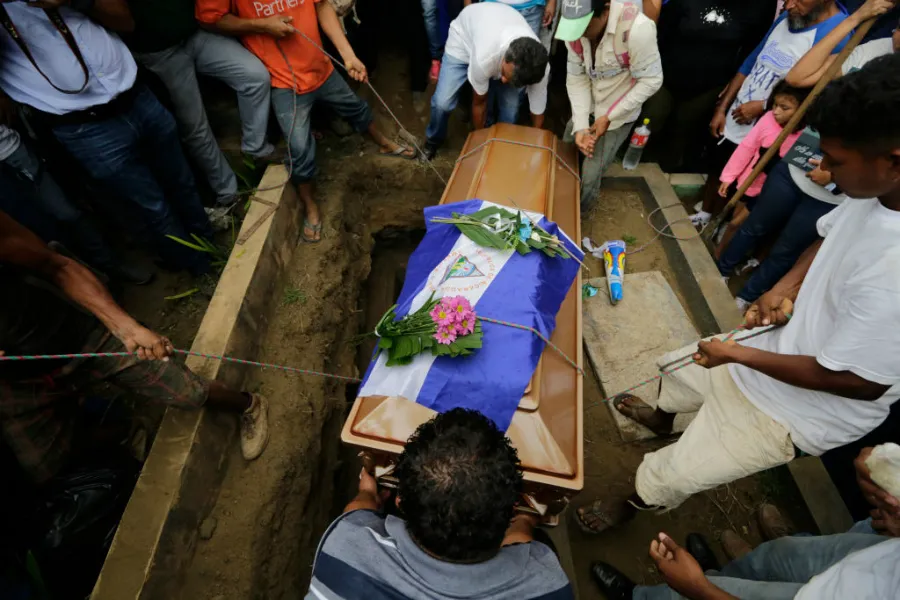
Matagalpa, Nicaragua, Sep 27, 2018 / 02:13 pm (ACI Prensa).- Bishop Rolando José Álvarez Lagos of Matagalpa has called for an end to the deaths in the country occurring during protests against the government of Daniel Ortega after the death of 16-year-old Matt Andrés Romero, who died Sept. 23 during an anti-government demonstration.

“We mourn the death. We mourn one more death. It grieves our soul, the death of the young man, of the boy, Matt Andrés Romero. Our prayers for his family. Our love and solidarity with them. We continue to insist: not one more death, please,” Bishop Álvarez wrote on Twitter Sept. 25.

<blockquote class=”twitter-tweet” data-lang=”en”><p lang=”es” dir=”ltr”>&quot;Nos duele la muerte. Nos duele un muerto más. Nos duele hasta el alma, la muerte del jovencito, del niño, Matt Andrés Romero. Nuestras oraciones por su familia. Nuestro cariño y solidaridad con ellos. Seguimos insistiendo: ni un muerto más por favor&quot;. Mons. Rolando José.</p>&mdash; Monseñor Rolando José Alvarez L. (@DiocesisdeMat) <a href=”https://twitter.com/DiocesisdeMat/status/1044814230996873217?ref_src=twsrc%5Etfw”>September 26, 2018</a></blockquote>
<script async src=”https://platform.twitter.com/widgets.js” charset=”utf-8″></script>

Romero died during the “We are all the voice of the political prisoners” march in Managua, where he was mortally wounded by a gunshot.

His family and friends affirm he was shot by paramilitaries supportive of Ortega. According to the authorities it occurred during a crossfire, which the organizers of the march refute.

With Romero’s decease, the number of deaths has risen to 323 since the protests began April 18 and include 23 children and adolescents, according to the Inter-American Commission on Human Rights.

However, according to the Nicaraguan Association for Human Rights, there have been more than 510 deaths. In addition there may be another 1,300 disappeared persons.

Nicaragua’s crisis began after Ortega announced social security and pension reforms. The changes were soon abandoned in the face of widespread, vocal opposition, but protests only intensified after more than 40 protestors were killed by security forces initially.

The country’s bishops have mediated on-again, off-again peace talks between the government and opposition groups.

Bishops and priests across the country have worked to separate protesters and security forces, and have been threatened and shot.

Anti-government protestors have been attacked by “combined forces” made up of regular police, riot police, paramilitaries, and pro-government vigilantes.

The Nicaraguan government has suggested that protestors are killing their own supporters so as to destabilize Ortega’s administration.

The Church in Nicaragua was quick to acknowledge the protestors’ complaints.

The pension reforms which triggered the unrest were modest, but protests quickly turned to Ortega’s authoritarian bent.

Ortega has been president of Nicaragua since 2007, and oversaw the abolition of presidential term limits in 2014.

The Church has suggested that elections, which are not scheduled until 2021, be held in 2019, but Ortega has ruled this out.

Ortega was a leader in the Sandinista National Liberation Front, which had ousted the Somoza dictatorship in 1979 and fought US-backed right-wing counterrevolutionaries during the 1980s. Ortega was also leader of Nicaragua from 1979 to 1990.


This article was originally published CNA’s Spanish-language sister agency, ACI Prensa. It has been translated and adapted by CNA.

[…]