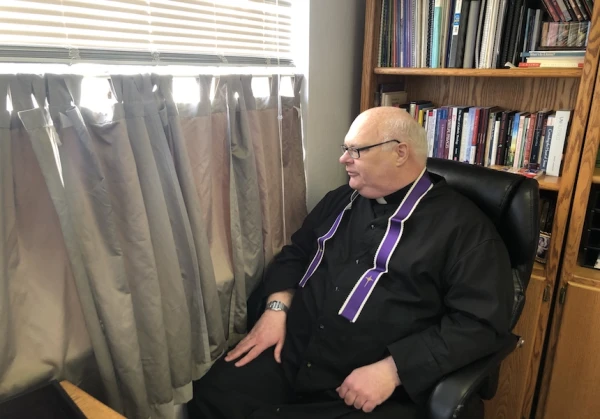
Lincoln, Neb., Mar 18, 2020 / 04:00 am (CNA).- Demand for confessions at St. Mary’s in downtown Lincoln, Nebraska, has always been high: it’s a centrally-located church with convenient, daily confession times and often multiple confessors.
During the parish’s normal 11:30-noon weekday confession times, penitents on their lunch breaks line up, often 20 people or more deep, for absolution and sacramental grace, before returning to work, or before attending the 12:10 p.m. Mass.
“It’s a big ministry,” Fr. Douglas Dietrich, the pastor of St. Mary’s, told CNA. “And then we have a lot of people who come by the door and call up and just want to go to confession; that’s great.”
“I always joked about how I should just put up a walk-up confessional” available outside his rectory office window, Dietrich told CNA.
These days, the usual daily confession lines would violate new state and federal coronavirus guidelines, which dictate that no more than 10 people should be gathered in any space. To further complicate matters, the Diocese of Lincoln announced on Monday that public Masses would be suspended until further notice, also in an effort to combat coronavirus.
But Fr. Dietrich is not deterred.
What started out as a joke has now become a reality, in an effort to keep the sacraments available to Nebraska’s Catholics during this uncharted time of restrictions on public gatherings.
“When we got the word that they were suspending all public liturgies and the churches were basically shut down, that was my first concern was – what about people who have to get to confession?”
Starting just one day after the new restrictions, Fr. Dietrich set up shop at his office window, and advertised the new set-up to his parishioners. The line was a little shorter than usual, but Dietrich said he heard confessions until a little past noon.
Dietrich is not the only priest getting creative at this time of unprecedented closures of liturgies and churches in the United States and beyond. Over the weekend, a photo circulated on social media of Fr. Scott Holmer of St. Edward the Confessor Catholic Church in Bowie, Md., offering drive-up confessions.
BRILLIANT! Drive-through confessions…. perfectly legal, good social-distancing. Awesome idea, Fr, way to adapt! I gotta figure how to do this at ASU … works with cars, skateboards, bikes, scooters, I s’pose. #ASUCatholic #coronapocalypse pic.twitter.com/pwgFnw29Gm
— Fr Rob Clements (@Fr_RobC) March 16, 2020
Holmer sat on a chair outside in the church parking lot, a safe six feet away from cars, which lined up behind traffic cones for the sacrament.
In a note on his parish website, Holmer said that while it was a “great sorrow” to be unable to offer public Mass, the “drive through confessional” was one way he could offer sacraments to the people at this time.
“As we go through this Coronavirus, I hope to be in daily communication with you to create a sense of being connected as a parish throughout these uncertain days,” he said.
The drive-up confessions will be available every day at varying times posted on the parish website, with an extended time of confessions from 7:30 a.m. to 12:30 p.m. on Sundays. A seminarian has been recruited to direct traffic, the priest noted, and the confessional will only be closed in cases of inclement weather, like heavy rain.
“This is turning out to be a Lent unlike any other. I believe the Lord is inviting us to an increased concern for the welfare of our neighbors and offering us the opportunity to make sacrifices for them. What a great Lenten penance for us all,” Holmer said in the letter to parishioners on the parish website.
“Be assured of my prayers for you. Please pray for the health and welfare of all in our parish and in the surrounding community. I miss you all terribly,” he added. The photo of Holmer’s creative confessional inspired Fr. Ryan Salisbury of Syracuse, Nebraska to think about what he could offer his parishioners.
“A number of parishioners kept sharing that photo with me, and it was like, yeah, this is something we need to do.”
Like Dietrich, he decided to set up a walk-up confessional through a window of the parish social hall.
“The way our social hall is designed, we have a classroom (where) the roof overhangs it. That way they’re kind of protected even if it would rain or anything like that. And it has a direct line of sight from the parking lot. So, I can open a window, be inside and be there with my back to the window to remain anonymous for confession,” Salisbury told CNA.
Salisbury said he planned on posting the new available confession times on the parishes website and social media pages, and that he planned on offering even more times than normal.
The priest said so far he has had about seven or eight parishioners ask him how they will be able to access confessions while ordinary Masses are suspended, so he knows it’s something on the mind of many Catholics. He encouraged people to use the walk-up confessional even if they just wanted to talk.
“We as priests, we are praying for (Catholics) and during this time we’re always there to offer anything that you need,” he said.
He added that he would encourage people “not to be afraid, to reach out with any concerns or questions or ideas that they might have. But most of all, (they should) know of our love for them and our prayer for them. And as difficult as this is for everyone, on our priestly hearts it’s also very difficult not being able to administer to them in the way that we’re used to. But we offer it up in every little sacrifice that we do,” he said.
Fr. Cassidy Stinson, a priest at St. Bede Catholic Church in Williamsburg, Virginia, told CNA that his parish has “really big confessionals with good ventilation”, so he is still offering confessions with or without a privacy screen, but at a safe distance of 6 feet or more.
Stinson has been promoting his still-open confessions on Twitter.
“We’re trying to be creative to stay safe,” he told CNA.
Fr. Carl Arcosa, like Fr. Holmer, is offering his parishioners at St Michael Parish in Livermore, California, a drive-up confessional, as well as “parking lot Benediction”, starting on Thursday, the feast of St. Joseph.
“Only one occupant per car. Drive up to the courtyard driveway and remain in your car. A priest will keep a 6-foot distance from your car window to hear your confession and absolve you,” say the instructions for drive-up confession, sent in an email to parishioners.
Drive-up confessions will be offered every day from March 19-April 7 at two different times, including bilingual confessions. Drive-up Benediction will be offered twice daily, at 8:30 a.m. and 6:00 p.m.
Directions for drive-up Benediction read: “Park in St Michael’s parking lot and remain in your car. Our clergy will process with Jesus present in the Eucharist and pass by all cars. While in your car pray this prayer three times: ‘O Sacrament most Holy, O Sacrament Divine, All praise and all thanksgiving, Be every moment Thine.’”
Arcosa said that the priests will use their phones in order to hear people confess their sins but maintain distance, and then will bless and absolve the penitents from a safe six-foot distance.
Arcosa told CNA that he wanted his people to be “spiritually and pastoral supported” during this time, even if he cannot offer them public Masses.
The church doors are also being kept open during the day so that people may pray in front of the Blessed Sacrament, or pray the Stations of the Cross, which is normally offered publicly every Friday during Lent.
“This a very Catholic parish, they love the Eucharist and everything,” Arcosa said. “So that’s why we’re giving the sacraments back to them, and the Blessed Sacrament, and opening the church, (it) makes them feel that the church is there for them. Their priest is there pastorally, spiritually.”
“I believe that the sacraments are really important for us Catholics,” Arcosa added.
“In the midst of all the other Christian churches locking their doors or canceling their services, we’re still doing (what we can) because we know that Jesus still walks with us and Jesus wants to be with us and support us and give us strength…in our sacraments, even in this time of crisis.”
 […]
[…]



Leave a Reply