Francis calls for ‘permanent catechumenate’ for married couples

September 27, 2018 CNA Daily News 1

Rome, Italy, Sep 27, 2018 / 10:42 am (CNA/EWTN News).- Pope Francis has stressed the need for ongoing formation for couples, before and after marriage, saying that even the basic teachings of the Church “could not be taken for granted.” The pope spoke in an address to participants in a recent course on marriage and family life held in Rome.

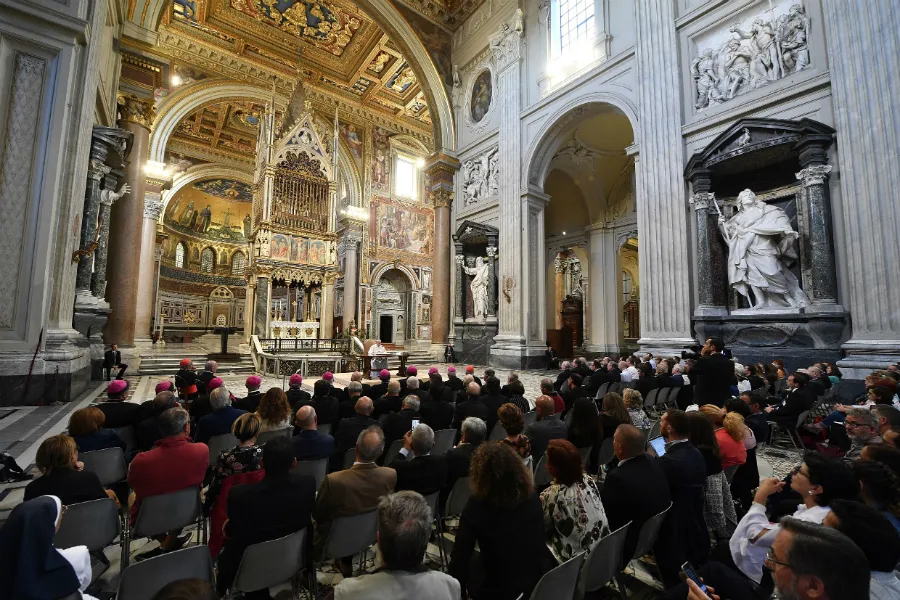
Speaking Sept. 27 in the Archbasilica of St. John Lateran to an audience of priests, deacons, and lay people, Francis renewed his call for a “permanent catechumenate for the sacrament of marriage,” saying it was essential for couples to receive ongoing formation both before and after their wedding.

The course, which ran Sept. 24-26, was sponsored by the Diocese of Rome and the Roman Rota, the Church’s highest appellate court which handles marriage nullity cases.

Francis has previously insisted on the need for better, longer, more comprehensive instruction for couples in his annual addresses to the Rota.

“The greater effectiveness of pastoral care is realized where the accompaniment does not end with the celebration of the wedding, but escorts them at least for the first years of married life” the pope said.

Francis told the attendees that marriage was “a vast, complex and delicate apostolic field” which required the full energy and enthusiasm of the Church.

Praising the “courageous” witness of St. John Paul II on the family in the modern world, Francis said he sought to build upon the legacy of his “farsighted” predecessors through his reform of canon law in marriage nullity cases and in the pastoral application of his post-synodal apostolic exhortation Amoris laetitia. The Pope said the aim of both of these efforts was to address the “urgent” need for comprehensive marriage formation.

“Marriage is not just a ‘social’ event, but a true sacrament that involves an adequate preparation and a conscious celebration,” the pope said. “The marriage bond, in fact, requires an engaged choice on the part of the engaged couple, which focuses on the will to build together something that must never be betrayed or abandoned.”

The work of marriage preparation is, according to the pope, best achieved through joint efforts by priests and married couples, though he stressed the importance and pre-eminence of the role of the parish priest.

“Priests, especially parish priests, are the first interlocutors of young people who wish to form a new family and get married in the sacrament of marriage. The accompaniment of the ordained minister will help the newlyweds to understand that marriage between a man and a woman is a sign of the spousal union between Christ and the Church, making them aware of the profound meaning of the step they are about to make.”

The pope’s comments were heard by some as a corrective to recent remarks by Cardinal Kevin Farrell, prefect of the Dicastery for Laity, Family and Life. In July, Cardinal Farrell said that “priests are not the best people to train others for marriage” and that “they have no credibility.”

Pope Francis emphasised that the work of preparing couples for marriage needed to include basic formation in the faith, noting that in many cases marriages broke down not because of any inherent problem with the couple, but simply because they lacked the depth of faith needed to live the sacrament fully.

“So many times the ultimate root of the problems that come to light after the celebration of the sacrament of marriage is to be found not only in a hidden and remote immaturity suddenly exploded, but above all in the weakness of the Christian faith” Francis told the attendees.

“The more the journey of preparation is deepened and extended in time, the sooner the couples will learn to correspond to the grace and strength of God and will also develop the “antibodies” to face the inevitable moments of difficulty and fatigue of married and family life.”

The pope noted that those preparing couples for marriage could make no assumptions about the level of formation in the faith couples might have. Many, he said, “have remained stuck to some elementary notion of the catechism of the first Communion and, if all goes well, of Confirmation.” Because of this “it is essential to resume the catechesis of Christian initiation to the faith, whose contents are not to be taken for granted or as if they were already acquired by the engaged couple.”

Addressing these common gaps in couples’ understanding of the faith would, Francis explained, both help them understand the faith and instil “a filial sense of the Church.”

Above all, the pope stressed, priests and lay formators alike should welcome the opportunity to form couples over a period of years, not weeks, calling it an essential expression of the Church’s maternal concern.

“It is an experience of joyful motherhood, when newlyweds are the object of the attentive care of the Church which, in the footsteps of her Master, is a caring mother who does not abandon, does not discard, but approaches with tenderness, embraces and encourages.”

The pope also discussed the difficulties faced by couples whose unions did break down, noting that the first priority should be to revive their faith and help them “rediscover the grace of the sacrament,” though in some cases the Church needed offer equal support through the nullity process which was also pointed toward the salus animarum.

Francis finished by noting that he was pleased to see that his reforms of the nullity process had been widely adopted into practice. These, he said, were meant as an aid to bishops and judicial vicars in dioceses whose work in tribunals is to seek the truth and “to comfort the peace of consciences, especially the poorest and far from our ecclesial communities.”

[…]

Toronto cardinal exhorts priests to ‘become fire’

September 27, 2018 CNA Daily News 1

Phoenix, Ariz., Sep 27, 2018 / 03:01 am (CNA/EWTN News).- A Canadian cardinal has a provocative message for priests, bishops, and seminarians struggling to attain holiness: “You must become fire.”

“If the flame entrusted to us at Baptism, Confirmation, and Ordination flickers and dies, or is abruptly extinguished, and the darkness of evil envelops the priest or bishop, then havoc is wrought upon the most vulnerable, and the splendor of the Holy Priesthood is sullied,” Cardinal Thomas Collins said Sept. 18.

The Archbishop of Toronto delivered the keynote address at the 55th Annual National Conference of Diocesan Vocation Directors, which took place Sept. 17-21 in Scottsdale, Arizona. The theme of fire, in many forms, was integral to his talk.

“If we who are bishops and priests do not become fire, and if those preparing for the priesthood do not, but instead become trapped in the dark and cold embrace of the world, the flesh, and the devil, then we are bound for destruction…and we fail those entrusted to our pastoral care,” Cardinal Collins said.

Cardinal Collins proposed four facets of the scriptural theme of fire and applied them to the priestly life and the ministry of guiding men to the priesthood.

First, the Fire of Sacrificial Love. In the same way that a sacrificial offering is totally consumed by fire, so too should a priest be consumed by his mission, giving his life fully to Christ and his people, and not merely giving his “leftovers.”

“When the sacrificial fire goes out in a priest or bishop, then he begins to put first his own wants – not his needs, but his wants. He wants control, or adulation, or a comfortable life, or worldly success, or popularity, or satisfaction of his lusts. Outwardly going through the motions of priestly or episcopal service, and saying all the right things, his actual conviction is that Christ must decrease, but I must increase.”

“If priests or bishops lead self-indulgent lives, then we should not be surprised if shocking instances of abuse occur. Self-indulgence is the culture in which both sexual and financial corruption flourish,” Cardinal Collins said.

Rather than think himself a “narcissistic star” around whom the parish revolves, a priest should engage in selfless ministry, always hoping at the end of his life to hear the Lord’s words: “Well done, good and faithful servant.”

Cardinal Collins recommended that vocation directors “watch out for signs of self-indulgence and narcissim” in seminarians, and for “positive signs of humble service, concern for others, and unassuming hard work.”

He said the process of discernment and formation to cultivate this attitude takes many years, and the process ought not be “sped up.”

“Because it takes time for signs both positive and negative to become evident, it is good to have a lengthy period of discernment and formation, to allow hidden problems to surface before ordination …  in my own diocese and seminary I have lengthened the process: more time before entry into the formation community: a year or two in the associates program, four years of College Seminary for some, plus a propaedeutic year, and four years of theology, and a parish internship too.”

Collins’ second facet, Purification by Fire, is a frequent theme in both the Old and New Testaments. Cardinal Collins tied this theme back to the various ongoing sexual abuse scandals in the Church, and emphasized that the revelation of hidden evils is a “great and life-giving purification in the Church.”

“Disastrously, a toxic sentimentality, in which both the call to repentance and the vision of judgment are obscured, has entered into the Church, and never more so than in the few decades following Vatican II, from the seventies to the mid-nineties,” the cardinal reflected.

“There was a blurring of the clear lines of morality, and the creation of a distorted and highly subjective concept of conscience. It is no coincidence at all that this was the very period, we now clearly realize, in which most of the devastating incidents of priestly and episcopal abuse that are now in the news took place.”

He said that policies to deal with abuse are “surely necessary,” but added, “we surely do not need a policy to stop us from engaging in self-indulgent evil that leads to the Lake of Fire. All Christians, but especially bishops and priests, need to listen to and act on these simple words of Jesus: Repent, for the Kingdom of God is near at hand.”

“It is also true that when the moral and spiritual demands of Christianity, or of the priesthood, become no more than an ideal, much to be praised in honeyed words, but with no practical relevance, and held to be impossible to actually live, then individually and as a Church we have become gnostics,” Cardinal Collins stated.

“But neither Christianity nor the priesthood is an abstract ideal; God does not play with us, holding out to us an ideal that it is impossible for us to live. By God’s grace, and only by God’s grace, every single one of us can actually become a saint. Vatican II spoke of the universal call to holiness, not the universal call to mediocrity. With a vision of the purifying refiner’s fire to keep us honest, we are challenged every day to be happy, healthy, holy priests. Nothing less than that. That is the reality of the priesthood.”

Collins emphasized the need for repentance, and suggested that priests recite quietly  the “Jesus Prayer”  during the elevation of the Host and Chalice at Mass, as well as frequently making use of the sacrament of confession.

“If we are to serve the Lord, and to invite others to do so, we must experience constant purification, and live in a spirit of repentance. Let the weeds and chaff within our hearts be thrown into the fire,” he said.

Third, the fire of Pentecostal Zeal is a boldness granted to the apostles that inspired them to be “on fire” for the Gospel, which Collins said all disciples of Christ should be.

This zeal is different, Collins said, from how “lively” or “quiet” a seminarian or priest’s personality might be, but rather, deep within, “profoundly committed to the life of holiness, that the fire will burn steadily and quietly throughout their priestly life.”

“There are two times when a priest or bishop is horizontal in Church: face down at his ordination and face up at his funeral,” Collins said. “In every moment between those two points, he must be on fire with sacrificial love and priestly zeal.”

Finally, the fire of “Majesty and Mystery” is the spirit of the Burning Bush found in the Book of Exodus; a captivating and personal call that comes when a person experiences the presence of God, and ultimately discerns their “glorious” vocation.

“Priests are not branch managers, and bishops are not CEOs,” Collins warned. “Woe to those who think in those terms, or who think of a priestly or episcopal career. We are unworthy servants and messengers of the living God.”

The priesthood is a tremendous privilege that most be treated with reverence, he said, and reminded the audience that the priesthood has always been and always will be “entrusted to frail and sinful men.”

He noted that “the priesthood, not the priest … must be treated with reverence.”

“Clericalism is not too high an estimation of the priesthood, but too low an estimation: it is using the holy priesthood to advance one’s personal desires,” the cardinal said. “If bishops or priests use their sacred office to dominate others, to take advantage of people’s quite appropriate reverence for the priestly office, or to manipulate that reverence to satisfy the cleric’s self-indulgent desires, then that is not simply evil; it is sacrilegious evil.  

“Profound awareness of the majesty of the Lord who calls us must penetrate to the depths of our souls,” Cardinal Collins said. “If it does not, then priesthood and episcopate can become worldly, and can be corrupted.”

[…]

Parish of priest who denounced drug traffickers attacked in Argentina

September 26, 2018 CNA Daily News 0

Rosario, Argentina, Sep 26, 2018 / 07:01 pm (ACI Prensa).- Mary Our Queen Parish in the city of Rosario, Argentina was the target of a violent attack Sept. 23, which the church’s pastor said was a threat made in response to his recent denunciation of area gangs and drug traffickers.

Gunmen fired on the church and school, which face each other. Seven shots struck the church facade, one of which went through the front door. Another five bullets hit the door of the school. 

The Rosario Regional Prosecutor’s Office opened an investigation to find those responsible. However, the church’s pastor, Fr. Juan Pablo Núñez, blamed the shooting on drug traffickers. A few weeks ago, he began to speak about the drugs problem, and he said he had already received threats.

“The neighborhood was a no man’s land, many incidents of robberies, shootings, the people came to talk to me because they didn’t know whom to talk to, so then I started airing their concerns about that situation,” Fr. Núñez told the news portal Todos Para Uno.

The priest explained that he has been working in the neighborhood for four and a half years. He had opened a center to help young people on drugs, but he had to close it soon afterwards because of threats from the parents themselves, some of whom were also involved in the drug trade.

Four weeks before the attack, Fr. Núñez  began to ask the local authorities to take the necessary steps “to put an end the drama of the lack of public safety.”

“When people ask me if I’m afraid, for myself no, but I do fear for the people because these gangs  don’t respect anyone,” the pastor of Mary Our Queen said.

The vicar general of the Archdiocese of Rosario, Msgr. Emilio Cardarelli, expressed his solidarity with Fr. Núñez and the parish and school community.

Msgr. Cardarelli asked prayers of all the faithful “so that the grace of letting themselves be encountered by Jesus Christ, the Way, the Truth and the Life, may come to those who were the authors of this deed.”

Finally, he asked the authorities “to not just work on the weakest link, the small time drug dealers on the streets, but also on the financial circuit that sustains drug trafficking and the massive distribution of arms, which cause so many deaths in our city.”

“With the start of the novena coming soon which prepares us for the feast of Our Lady of the Rosary, the patroness of our city and archdiocese, we commend to her heart this situation which is harming our young people and deteriorating the social fabric,” Msgr. Cardarelli concluded.


This article was originally published CNA’s Spanish-language sister agency, ACI Prensa. It has been translated and adapted by CNA.

[…]

More than 20,000 attend episcopal consecration in Indonesia

September 26, 2018 CNA Daily News 0

Maumere, Indonesia, Sep 26, 2018 / 06:01 pm (CNA/EWTN News).- At least 20,000 people were present Wednesday for the episcopal consecration of Bishop Ewaldus Martinus Sedu of Maumere, UCA News has reported.

The Sept. 26 Mass was said at Samador da Cunha Sport Center in Maumere, on Indonesia’s Flores island.

All schools in Maumere were reportedly closed so students could attend the ceremony.

His principal consecrator was his immediate predecessor, Bishop Gerulfus Kherubim Pareira; the principal co-consecrators were Archbishop Vincentius Sensi Potokota of Ende and Bishop Franciscus Kopong Kung of Larantuka.

Bishop Sedu, 55, was born in Bajawa, and was ordained a priest of the Archdioese of Ende in 1991. He incardinated into the Diocese of Maumere when it was established out of the Ende archdiocese in 2005, and has served as vicar general.

He was appointed Bishop of Maumere July 14.

The Diocese of Maumere has approximately 302,000 Catholics, 54 diocesan priests, 102 religious priests, and 36 parishes. Its area is less than 700 square miles.

Though Indonesia is a heavily majority-Muslim country, the island of Flores is largely Catholic. Flores was colonized by Portugal, and more than 87 percent of the population of the Maumere diocese is Catholic.

[…]

Millennials staying married at a higher rate

September 26, 2018 CNA Daily News 0

Washington D.C., Sep 26, 2018 / 04:30 pm (CNA).- A recent study from the University of Maryland has shown that members of the generation born in and after the mid 1980s are divorcing at a lower rate than older cohorts.

Philip Cohen, a sociology professor at the University of Maryland, released an analysis Sept. 15 which drew on census data to show that the divorce rate in the United States had dropped by 18 percent between the years 2008 and 2016. The drop was credited in large part to millennials staying married–even if they are marrying at lower rates than previous generations did at the same age.

Dr. John Grabowski, associate professor of moral theology and ethics at the Catholic University of America, told CNA that he believes the report is “kind of good news and bad news.”

“The good news is: the divorce rate is falling, particularly among millennials. The bad news is less people are getting married, especially poorer people. Many people are just choosing to cohabit.”

While it had been thought that a drop in the divorce rate could be credited to an aging population less likely to divorce, the study showed that even when controlling for age the divorce rate still dropped by 8 percent, and that the millennials who do marry tend to stay married more than older demographics.

Slightly more than 10 percent of people between the ages of 18 and 34 are divorced, a number which has stayed relatively stable since 1980. In contrast, over a quarter of people over the age of 44 are divorced, a 10 percent rise since 1980.

According to a separate study from Bowling Green’s National Center for Family and Marriage Research, the divorce rate for people aged 55 to 64 almost doubled between 1990 and 2015.

In calculating the divorce rate, Cohen compared the number of divorces to the number of married women so that the divorce rate would not be positively impacted by fewer marriages overall.

Grabowski hypothesized that the lower divorce rates among millennials could be partly explained by marriage no longer being considered a social an expectation or requirement among their generation.

This means that those who do marry are being “much more intentional” about the process, he said. “In some ways they’re swimming against the tide a bit culturally by doing that.”

Additionally, Grabowski suggested that the sexual revolution of the 1960s and 70s had led to an increased exposure to the negative effects of divorce on men, women, and children.

“People are more aware now of the resources and practices that they need to have a healthy marriage–in other words, to keep a marriage working,” he explained. It also helps, he said, that people are better informed about what it takes to keep a marriage working, and that there are more resources available to aid a troubled marriage. 

While the news that millennials are increasingly shunning divorce can be read as a positive development, the decreasing number of millennials who marry at all may indicate cause for concern, Grabowski said.

Cohabiting couples often cite disincentives to marry–such as the high cost of a “fairytale wedding”–but Grabowski told CNA that he believes the benefits of married life clearly outweigh any cost. 

“We have decades of social scientific research that shows that people who do get married do better economically, health-wise, and emotionally than people who remain unmarried or who simply cohabit or serially cohabit with different people,” he said.

The largest group of people living in poverty in the United States are single-parent households with children, “usually headed by women,” Grabowski added.

“People who remain unmarried but have children are at a huge economic disadvantage compared to their married counterparts.”

Many millennials, Grabowski theorized, may be afraid of entering a marriage after watching their parents or relatives divorce. Still, he said that the analysis showed “a little bit of good news” about marriage as a whole.

“And if the millennials kill divorce, or kill the divorce rate, well, that’s a good thing. If only we could convince maybe more of them to enter into marriage, we’d be doing really well.”

[…]