Researchers find ‘evidence of genocide’ against Rohingya

December 6, 2018 CNA Daily News 0

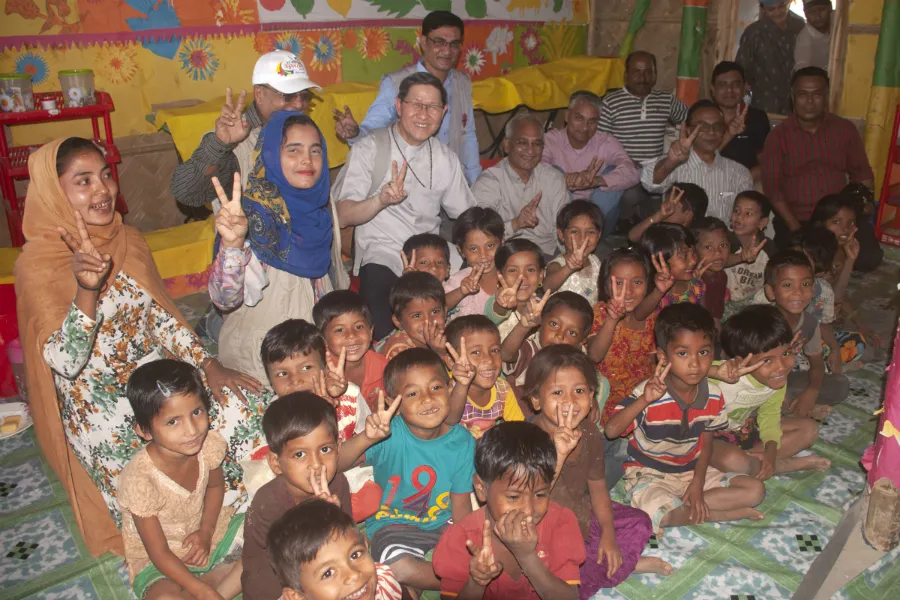
Chittagong, Bangladesh, Dec 6, 2018 / 10:50 am (CNA/EWTN News).- As new evidence emerges of atrocities committed in Burma’s Rakhine state, the president of Caritas International visited Monday a Rohingya refugee camp in Bangladesh.

In 2017 the Rohingya, a Muslim minority group,  faced a sharp increase in state-sponsored violence in Burma, also known as Myanmar. The violence reached levels that led the United Nations to declare the crisis “a textbook example of ethnic cleansing.”

More than 700,000 Rohingya have fled across the border to Bangladesh, and are living in refugee camps, many of which are located in a swampy sort of “buffer zone” along the border between the two countries.

Researchers with the Public International Law and Policy Group, contracted by the U.S. State Department to investigate Burma’s treatment of the Rohingya, found “reasonable grounds to believe that genocide was committed against the Rohingya,” in a report published Dec. 3.

The researchers interviewed more than 1,000 refugees, who shared their experiences of “mass shootings, aerial bombardments, gang rapes and severe beatings, torture and burning” by Burma’s armed forces.

Seventy percent of the Rohingya interviewed had witnessed their homes or villages being destroyed and 80 percent witnessed the killing of a family member, friend, or personal acquaintance.
f
Cardinal Luis Tagle of Manila visited Kutupalong refugee camp, more than 100 miles south of Chittagong, Dec. 3, describing it as “a cry to the whole world for a better politics based on compassion and solidarity.”

“When will we learn our lessons and be able to stop a crisis of this magnitude happening again? How as an international community and a human family can we get back to the basics of dignity, care and compassion?” continued Tagle.

The Filipino cardinal is the president of Caritas International, a group that has served the Rohingya refugee population since the crisis began.

Caritas has helped nearly 500,000 refugees by providing shelter, water, sanitation, hygiene, and living supplies.

“The situation of refugees from Myanmar was heartbreaking for me when I came first, but I’m seeing things improve,” Tagle said. “We wish for a permanent solution for these people who are stateless and helpless. It is our responsibility to be with them. We want them to have a happy life.”

Tagle found particular hope in seeing the efforts of the Caritas Bangladesh volunteers and staff to help the refugees during the Advent season.

“Here I am this first week of Advent with a people waiting for a future,” Tagle said. “For us Advent is waiting not for something but for someone. Jesus, who was born poor, who became a refugee but who never stops loving. I hope this message coming from this camp will encourage all of us never to get tired of loving.”

Bangladesh and Burma have agreed to a repatriation program which began last month, but few if any Rohingya have chosen to return to their homeland.

The Burmese government refused to use the term Rohingya, and considers them illegal immigrants from Bangladesh. They have been denied citizenship and numerous other rights since a controversial law was enacted in 1982.

[…]

Small Irish community seeks help to save a saint’s iconic cross

December 6, 2018 CNA Daily News 0

Dublin, Ireland, Dec 6, 2018 / 03:01 am (CNA/EWTN News).- A unique Irish cross marking the 1,400-year-old grave of a Catholic saint is in danger of destruction due to erosion, and the local community is seeking help to restore the “icon of Ireland’s early Christian heritage.”

St Mura’s Cross is carved into a slab nearly seven feet tall that marks the grave of St. Mura, the first abbot of a sixth-century monastery in the far north of Ireland in what is now County Donegal. The monastery, one of Ireland’s earliest, was founded by St. Colmcille less than a century after the death of St. Patrick. It became a center of religion and scholarship and its surrounding settlements gave birth to the town of Fahan, where nearly 600 people live today.

A nearby gable wall must be repaired before preservation efforts on St. Mura’s Cross must begin.

“Cracks have appeared on the wall and if we don’t stabilize that it could fall. If it does, it will fall on the cross and it will be destroyed forever,” Colm Toland of the Fahan Heritage Group told The Irish News in November.

St. Mura, said to be a descendant of the Irish king Niall of the Nine Hostages, died in 645 at the age of 94. He became the patron saint of the O’Neil Clan, whose leaders were among the High Kings of Ireland. His feast day is observed March 12.

Both a Catholic church and a Church of Ireland church in the Fahan area are named for the saint.

The cross is the only one of its kind to bear an inscription in Greek: “Glory and honor to the Father, the Son and Holy Spirit”. It is considered a unique inspiration of the Irish High Cross artistic tradition of massive and ornately carved stone crosses.

The saint’s cross was carved sometime from the sixth to the tenth century. The gable wall was built in 1608, using stones from the original monastery, the Irish state broadcaster RTE News reports. It is surrounded by a graveyard that includes St. Mura’s tomb.

The monastery and village were sacked by the Vikings twice in the middle ages, though the site’s current ruins date to the 17th century. Some monastery artifacts are now in museums in Dublin and London.

Fahan’s heritage group is seeking support to protect the cross and the nearby church gable ruins. The gable is one of the distinctive landmarks of the village and a favorite stop for tourists and wedding parties, Fahan Heritage Group said in its YouTube video “Save St. Mura’s Cross.”

<iframe width=”560″ height=”315″ src=”https://www.youtube.com/embed/vr-R-yP7Bto” frameborder=”0″ allow=”accelerometer; autoplay; encrypted-media; gyroscope; picture-in-picture” allowfullscreen></iframe>

The stone-carved cross was distinctive for centuries, but now it has faded due to severe erosion attributed to acid rain or other environmental factors. The carving and Greek inscription are almost illegible.

“One thing we might have to consider is moving the cross to an indoor location and replacing it with a replica outside,” Toland said. “That way we could protect if from whatever environmental or pollution influences which are eroding it.”

Backers of the restoration include individuals from local community heritage and church societies, including historians, archaeologists, and architects.

They have launched an online fundraiser seeking an additional 15,000 Euro, about $17,000, to add to a startup grant from the Heritage Council of Ireland and funds from other sources.

“If left unprotected we will have lost an icon of Ireland’s earliest Christian period,” said the backers of the “Save Saint Mura’s Cross” project on the group fundraiser site fundit.ie. The fundraiser will close in mid-January.

They and the wider community are “determined to conserve the local history and heritage of Saint Mura’s monastic settlement from which the village itself grew.”

[…]

How one diocese is inviting people back to the Church this Christmas

December 5, 2018 CNA Daily News 1

Detroit, Mich., Dec 6, 2018 / 12:54 am (CNA/EWTN News).- As part of a recent evangelization outreach, the Archdiocese of Detroit is launching a Christmas campaign to welcome Catholics who may have been away from the Church.

“This is the way that we are responding to the invitation to share the Gospel with others. This is part of the transformation of being a mission-oriented diocese,” Edmundo Reyes, the archdiocese’s communication director, told CNA.

The campaign is called “Part of the Family.”  Its goal is to create a welcoming environment at Mass and encourage evangelization among the parishioners through virtual tools.

Reyes said these efforts are an extension of the pastoral letter “Unleash the Gospel” released at Pentecost last year. The letter followed several years of preparation, including a year of prayer in 2014 and a synod meeting in 2016.

He said the campaign includes three parts: evangelization training, videos, and a newly published website, specifically focused on Christmas Mass times.

“Our hope is that, with these combined efforts, people that attend Mass once a year or are there for the first time, they experience what we are calling radical hospitality,” he said.

“We target at Christmas knowing there are people who come there for the first time or they haven’t been with us for a while,” he said. “One of the things is we want to be unusually gracious and hospitable for people that come to our churches.”

The first component of the campaign was a day-long evangelization event that included discussions, training, and resource material. More than 800 people from over 120 parishes in the archdiocese attended.

According to the Detroit Catholic, one of the speakers broke down the Gospel into four essential parts. Fr. John Riccardo, pastor of Our Lady of Good Counsel Parish in Plymouth, said the Gospel’s message is on the goodness of God found in his creation, sin and its repercussions, God’s response to sin, and mankind’s response to God.

Hospitality was another major focus of the event, which was held Nov. 16. Regular Mass-goers were presented with simple steps to make people feel welcome, like greeting strangers and sitting in the middle of the pews to allow room on the outsides.

The second element of the campaign is a series of Christmas videos, focusing on the universal Catholic family and God’s incarnation, Reyes said.

“We are all part of the same family, and it’s hard to imagine, but we are celebrating God becoming part of our family. So let’s do it together,” says the narrator in the video. “This Christmas, we are thankful that you are one of us, a Catholic, part of the family.”

The first video was released on Saturday, Reyes said, and it has already received roughly 30,000 views. He said more videos will be released weekly.

In addition, paid ads will be run on spotify, youtube, and social media, inviting people to attend Christmas Mass and bring their friends and family. The ads will use geoparameters to reach people in areas near churches in the archdiocese.

The third aspect of the campaign, Reyes said, is a new website, massfinder.org, to help people navigate Christmas Mass times in the Archdiocese of Detroit. He said the website is accessible, giving people an easy way to discover Mass times and invite friends and family.

“If we want to be truly hospitable, the first encounter the people have with us is going to be trying to find out what time Christmas Mass happens.”

The website includes “share buttons” for people to send links of a specific Mass time via social media, email, or text. When it is shared, the user has access to a virtual reminder of that Mass and a map to the parish.

Especially during this season of giving, Reyes said, the most important gift that can be given is the Gospel of Jesus Christ and the love of the Father.

“This is a time we celebrate the Nativity of the Lord, God becoming part of the family. And that’s the theme – Part of the Family. We want make sure that people feel welcome and invited in the celebration of Jesus’ birth.”


[…]

First livebirth after womb transplant from deceased donor

December 5, 2018 CNA Daily News 0

Sao Paulo, Brazil, Dec 5, 2018 / 05:01 pm (CNA/EWTN News).- Researchers from Brazil announced Tuesday that a baby had been born to a mother who had received a transplanted uterus from a deceased woman.

While uterine transplant is ethical, the use of in-vitro fertilization to produce a child, as was done in this case, is morally illicit.

Though 11 babies have been born worldwide to mothers who received a transplanted uterus from a living donor, this is thought to be the first baby born alive from a uterus taken from a deceased woman.

This follows at least 10 other attempted uterus transplants from deceased donors in the United States, Turkey, and the Czech Republic.

The 32-year-old mother, who has a condition called Mayer-Rokitansky-Küster-Hauser syndrome, was born without a uterus. In September 2016, she underwent uterine transplantation at the Hospital das Clínicas at the University of São Paulo in Brazil.

The deceased donor of the uterus, a 45-year-old mother of three, had died of bleeding in her brain.

The mother’s doctors gave her drugs to suppress her immune system so her body would not reject the new uterus. She began to menstruate 37 days after the operation, and after seven months her doctors implanted a single embryo. The doctors had previously removed the mother’s eggs and fertilized them artificially.

The healthy baby girl was born by cesarean section Dec. 15, 2017, near gestational week 36. In the same procedure, the doctors removed the woman’s uterus.

“The results establish proof-of-concept for treating uterine infertility by transplantation from a deceased donor, opening a path to healthy pregnancy for all women with uterine factor infertility, without need of living donors or live donor surgery,” the researchers wrote.

The first successful womb transplant from a living donor raised questions among Catholic bioethicists when it took place in 2014.

Fr. Tadeusz Pacholczyk, Ph.D., director of education for the National Catholic Bioethics Center, told CNA in 2014 that the transplantation of a healthy womb to a woman who lacks a womb because of birth defects or disease can be licit, and “would be analogous to a situation where a kidney fails to function” and a donor provides a healthy organ to someone in need.

Transplanting the uterus alone could be morally acceptable, he said, as long as the transplant of ovaries and sex cells were not also done, respecting the uniqueness of each person’s genetic information.

For such a womb transplant to be completely licit, Pacholczyk said, in-vitro fertilization could not be used, and children would need to be conceived naturally, “through the marital act.”

The use of IVF, as was done in the case of the mother who received the deceased donor’s uterus, violates Catholic teaching because it separates the creation of life from the marital act, Pacholczyk explained.

Despite this, he said the transplant itself opens the possibility for a new morally acceptable therapy, especially since the use of uteri from deceased women does not prevent the donor from being able to bear life while she is still biologically capable of doing so.

[…]

National Institutes of Health to not renew contract over fetal tissue use

December 5, 2018 CNA Daily News 0

Washington D.C., Dec 5, 2018 / 03:00 pm (CNA).- The National Institutes of Health will not renew a contract with the University of California San Francisco over concerns about the project’s use of fetal tissue.


The National Institutes of Health informed UCSF it will not renew a contract to conduct research into therapies for various ailments, including AIDS and Parkinson’s disease, over concerns about the project’s use of fetal tissue.


According to the Orlando Sentinel, the decision was communicated to UCSF last week following instruction from the “highest levels.” The contract was worth approximately $2 million per year.


As recently as October, the expectation had been that the seven-year project would be extended for a further year. The contract, which expires Dec. 5, will now continue for a further 90 days, with not clear indication of its future beyond that point.


The work in the UCSF lab involves testing on what are known as “humanized mice” that have been implanted with tissues from fetal remains. This causes the mouse to develop an immune system that is similar to that of a humans.


The fetal tissues used in these experiments and research is obtained through abortions.


The decision not to renew the contract follows what the federal government called in a September statement a “comprehensive review” over the funding of research involving the use of fetal tissue. At that time, HHS said that it was seeking “adequate alternatives” to the use of fetal tissue altogether.


In the September statement, HHS wrote that they will work to “ensure that efforts to develop such alternatives are funded and accelerated.”


In November, HHS Assistant Secretary for Health Brett Giror characterized the Trump administration as being “pro-life, (and) pro-science” in a letter to Rep. Mark Meadows (R-NC). Meadows chairs the House’s Freedom Caucus and is outspoken in his pro-life views.


The non-renewal of the UCSF contract comes just over two months after the government canceled a significantly smaller contract between Food and Drug Administration and Advanced Bioscience Resources, Inc. that also involved the creation of humanized mice.


Following media scrutiny of the existing contract between the FDA and Advanced Bioscience Resources, which has admitted to the “upselling” of some fetal parts obtained through abortion, the contract was canceled and HHS announced that they would review all similar programs.

[…]