No Picture
News Briefs

Doctrine remains problem in relations, SSPX affirms after Vatican meeting

November 26, 2018 CNA Daily News 0

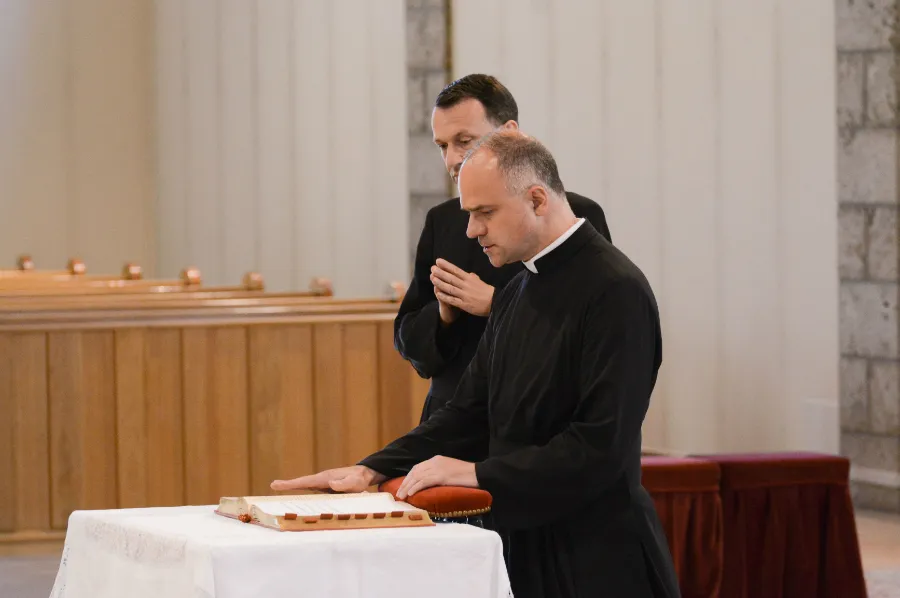
Solothurn, Switzerland, Nov 26, 2018 / 12:11 pm (CNA/EWTN News).- After a meeting between the superior general of the Society of St. Pius X and the prefect of the Congregation for the Doctrine of the Faith, the canonically irregular priestly society said the problem in its relations with the Holy See is fundamentally doctrinal.

Fr. Davide Pagliarani, superior general of the SSPX, met for two hours Nov. 22 with Cardinal Luis Francisco Ladaria Ferrer, the CDF prefect, at the Vatican.

Cardinal Ladaria was accompanied by Archbishop Guido Pozzo, secretary of the Pontifical Commission Ecclesia Dei, and Fr. Pagliarani by Fr. Emmanuel du Chalard.

In a Nov. 23 statement, the Society said Fr. Pagliarani had been invited by Cardinal Ladaria “to meet for the first time and together to take stock of the relations between the Holy See and the Society of Saint Pius X” since Fr. Pagliarani’s July election as superior general.

During the meeting “it was recalled that the fundamental problem is actually doctrinal … Because of this irreducible doctrinal divergence, for the past seven years no attempt to compose a draft of a doctrinal statement acceptable to both parties has succeeded. This is why the doctrinal question remains absolutely essential.”

According to the SSPX, “The Holy See says the same when it solemnly declares that no canonical status can be established for the Society until after the signing of a doctrinal document.”

“Therefore, everything impels the Society to resume theological discussions with the awareness that the Good Lord does not necessarily ask the Society to convince its interlocutors, but rather to bear unconditional witness to the faith in the sight of the Church.”

The priestly society said its future “is in the hands of Providence and the Most Blessed Virgin Mary,” and that its members “want nothing else but to serve the Church and to cooperate effectively in her regeneration … but they can choose neither the manner, nor the terms, nor the moment of what belongs to God alone.”

The SSPX was founded by Archbishop Marcel Lefebvre in 1970 to form priests, as a response to what he described as errors that had crept into the Church after the Second Vatican Council.

Its relations with the Holy See became particularly strained in 1988 when Archbishop Lefebvre and Bishop Antonio de Castro Mayer consecrated four bishops without the permission of St. John Paul II.

The illicit episcopal consecrations resulted in the excommunication of the bishops involved. The excommunications of the surviving bishops were lifted in 2009 by Benedict XVI, and since then negotiations “to rediscover full communion with the Church” have continued between the SSPX and the Vatican.

When he remitted the excommunications, Benedict noted that “doctrinal questions obviously remain and until they are clarified the Society has no canonical status in the Church and its ministers cannot legitimately exercise any ministry.”

The biggest obstacles for the SSPX’s reconciliation have been the statements on religious liberty in Vatican II’s declaration Dignitatis humanae as well as the declaration Nostra aetate, which it claims contradict previous Catholic teaching.

There were indications in recent years of movement towards regularization of the priestly society, which has some 600 priest-members.

In March 2017, Pope Francis gave diocesan bishops or other local ordinaries the authorization to grant priests of the SSPX the ability to celebrate licitly and validly the marriages of the faithful who follow the Society’s pastoral activity.

Archbishop Pozzo spoke about interactions with the SSPX in an April 2016 interview with La Croix. The archbishop, whose commission is responsible for discussions with the SSPX, said that discussions over the last few years have led to “an important clarification” that the Second Vatican Council “can be adequately understood only in the context of the full Tradition of the Church and her constant Magisterium.”

And in September 2015, the Pope announced that the faithful would be able to validly and licitly receive absolution from priests of the SSPX during the Jubilee Year of Mercy. This ability was later extended indefinitely by Francis in his 2016 apostolic letter Misericordia et misera.

[…]

No Picture
News Briefs

Duterte: Catholics should pray at home, not pay Church ‘idiots’

November 26, 2018 CNA Daily News 1

Manila, Philippines, Nov 26, 2018 / 10:45 am (CNA).- The president of the Philippines encouraged on Monday Catholics to build their own chapels, rather than attending Catholic churches.

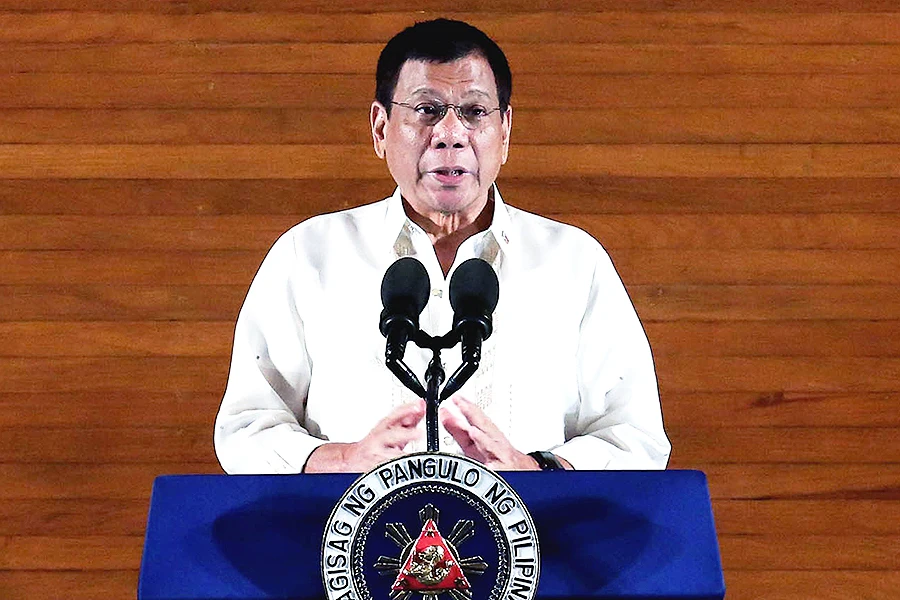
“When someone is baptized, you have to pay…when someone dies, you have to pay,” President Rodrigo Duterte said in a speech Nov. 26.

“Build your own chapel in your own house and pray there. You don’t have to go to church to pay for these idiots,” he added, according to Rappler.

Though president of predominantly Catholic country, Duterte has a record of criticizing the Catholic Church.

On All Saints’ Day, Nov. 1, the president said, apparently joking, the Christians should display his picture on Church altars instead of depictions of “drunkard” saints.

“Who are those stupid saints? They’re just drunkards,” Duterte said, according to The Philippine Star.

“Just stay with me. I’ll give you one patron saint so you can stop searching for one. Get hold of a picture of mine and put it on the altar — Santo Rodrigo,” he said.

In August, Duterte called the Church a “hypocritical institution” and before asking at a meeting of business leaders ““Is there any bishop here? I want to kick your a**.” In June, the president said that God is “stupid,” and a “son of a b-tch.” The president’s spokespersons have frequently mentioned that the context for his statements is the abuse he apparently suffered while a student at a Catholic school.

Duterte has said he was molested by Fr. Mark Falvey, SJ, who has been accused posthumously of serially sexually abusing children. In May 2007, the California province of the Society of Jesus reached a $16 million settlement with at least some of his victims.

Duterte, who is accused of human rights abuses amid a brutal crackdown on drug trafficking in the Philippines, ordered this year that Sr. Patricia Fox, a long time activist in the country, be deported, in response to her criticisms of government tactics. After a legal battle, Fox returned to her native Australia, but says she will appeal her immigration case in the Philippines.

In August Fr. Amado Picardal, a priest who criticized Duterte went into hiding, saying that “death squads” had targeted him for assassination. 


[…]

No Picture
News Briefs

Pope Francis says priests, bishops should keep an open dialogue

November 26, 2018 CNA Daily News 1

Vatican City, Nov 26, 2018 / 10:14 am (CNA/EWTN News).- In a meeting with seminarians Saturday, Pope Francis said it is necessary for priests to maintain an open and filial discussion with their bishop, since he is the unifying figure of the diocese.

“You cannot be a good priest without a filial dialogue with the bishop. This is something non-negotiable,” the pope said in the Vatican’s Consistory Hall.

“As someone likes to say, ‘No, I am an employee of the Church.’ You are wrong,” he continued. “Here there is a bishop, there is not an assembly where the position is negotiated. There is a father who unifies: like Jesus wanted things. A father who unifies.”

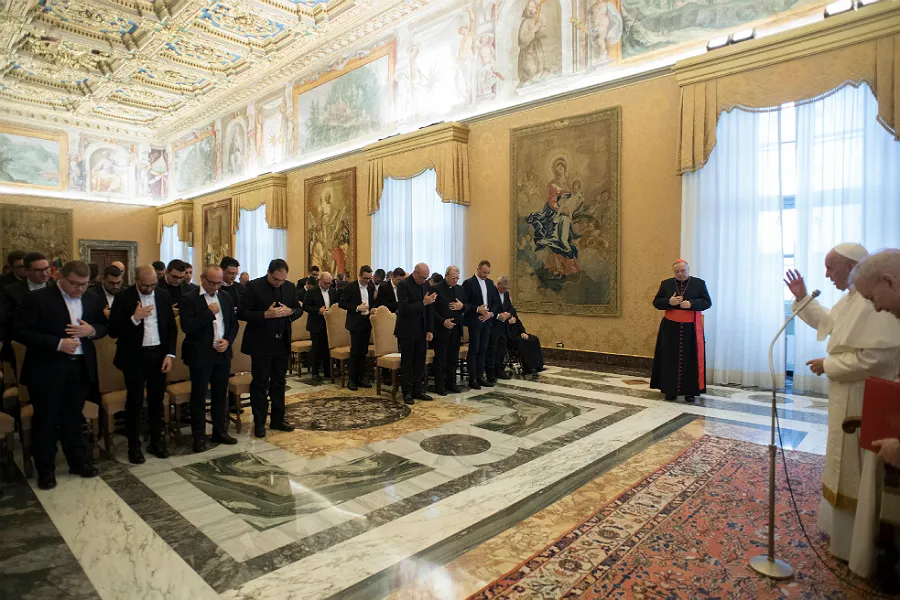
Pope Francis set aside his prepared speech during a Nov. 24 meeting with seminarians of the Diocese of Agrigento, in order to, he said, “speak a little spontaneously,” on the relationship between a diocesan priest and his bishop.

The bishop “is not the owner of a company;” he is not “the one who commands” while some obey, others pretend to obey, and still others do nothing, Francis said. “No, the bishop is the father, he is fruitful, he is the one who generates the mission.”

He noted that the term “mission” is a loaded one, signifying the will of God and the work of the Holy Spirit, advising seminarians to “learn to see in the bishop the father who was there to help you grow, to move forward and to accompany you in the moments of your apostolate.”

Whether the bishop is there “in beautiful moments, in bad moments,” he said, “but to accompany you always; in moments of success, in the moments of defeat you always have in life… This is something very, very important.”

The pope said the only way this accompaniment can happen, is if priests have a relationship with their bishop; that he knows them as they are, with their own virtues and faults, personalities, and ways of feeling and thinking.

Since it is the bishop who gives the priests of his diocese their parish or other assignment, Pope Francis emphasized the importance of the bishop knowing his priests, so he can make the right choice in the mission he assigns.

But do not meddle in the bishop’s decision, he warned. “Leave the bishop to sort it out: to organize [things] in the Spirit.”

He emphasized that this is not the same as arranging things into an “organizational chart,” though sometimes the Church may use organizational tools for functionality. “But the Church goes beyond the organizational chart, it is another thing: it is life, life ‘sorted’ in the Holy Spirit.”

The pope also made an analogy between the men in formation for the priesthood and the clay pot, which if not right, the potter can reshape or remake – but only before the clay has been baked.

The seminary is a time of training, he explained, and if they have a disagreement about something or do not understand, they should express it appropriately to the rector. “This is important, to say what you feel,” he advised.

This is so that they each can be truly become “a vessel full of grace,” he said, warning that if they “stay silent and do not talk, do not say your difficulties, do not tell your apostolic anxieties and all you want, a silent man, once ‘baked,’ cannot be changed.”

“And all life is like this,” he continued. “It is true that sometimes it is not pleasant for the potter to intervene decisively, but it is for your own good. Let yourself be trained, let yourself be formed.”

[…]

No Picture
News Briefs

Pope: The power of the Kingdom of God is love

November 25, 2018 CNA Daily News 0

Vatican City, Nov 25, 2018 / 06:45 am (CNA/EWTN News).- The Kingdom of God takes its power from the strength of Christ’s love, not the strength of the sword, Pope Francis said Sunday, on the feast of Christ the King.

History shows that kingdoms … […]

No Picture
News Briefs

What is it like to be an underground Chinese seminarian?

November 24, 2018 CNA Daily News 2

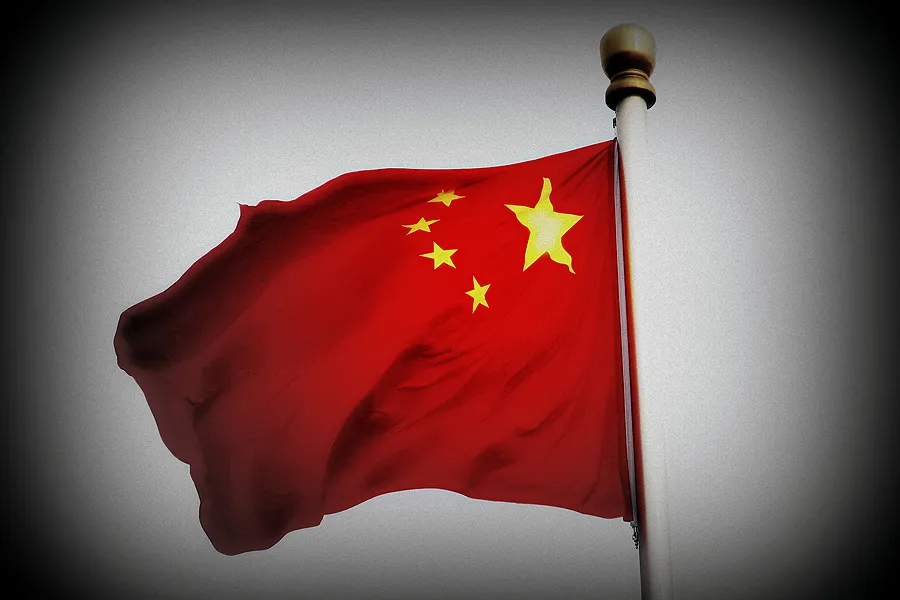
Beijing, China, Nov 24, 2018 / 04:43 pm (ACI Prensa).- Wang Jie (a fictional name) is a deacon belonging to the Chinese underground Church. He has spent several years studying in Europe, and for security reasons cannot use his real name, since Chinese authorities may not let him reenter his country if they knew he is preparing to become a priest.

The seminarian shared his story recently with media. He was born in China “in an area where most of the people are pagan.” None of his family members were Catholic, and in fact his parents “had never even heard the word ‘Christianity.’”

But one day his mother fell ill. They found what they believed to be a medical center with a cross on it. It was actually a church, where a nun received them.

After his mother recovered, Wang’s parents returned to thank the woman for caring for her.

“Then the nun began to gradually speak to them about faith, about Christ. My parents were very interested and after some time they converted,” he said. “We see it as a miracle so we would know the faith. God guided us to his house.”

In a sense, the conversion was natural, because his parents were already practicing charity and trying to help others in any way they could. Wang’s entire family was baptized when he was eight years old.

His family joined the underground Catholic Church. They could not openly practice their faith, as the government only recognized the “Patriotic Church” controlled by the Communist Party.

When Wang’s mother became pregnant again, they faced a challenge. The one-child policy, which was in effect at the time, prohibited families from having a second child. But as Catholics, his parents refused to abort. They looked for a way to avoid the heavy penalties imposed by the Communist government on families with more than one child.

“When my sister was born, we found a family that had just had another child, and we registered them as if they were twins. In fact, my sister doesn’t have my same last name [as I do] but that of the other family because according to those documents they are siblings,” he said.

Eventually, his parents befriended a priest who was a rector of the seminary. The rector explained that the seminarians had to move every three or four months to avoid being discovered by the authorities.

“My parents offered them our house, they could live on the ground floor and we on the top floor,” he said.

For the next 10 years, seminarians were living intermittently on the ground floor of the house. Touched by their example, Wang felt a call to the seminary.

He made the final decision after accompanying one of the seminarians to give some catechism lessons.

“When I returned home, it was as if something had set my heart on fire, I told my parents I wanted to be a priest. I had that seed of a vocation in my heart,” he said. “Now I’m a deacon and no words can express the very profound joy I have in my heart.”

The seminarian said that even though he is studying in Europe, his desire is to return to China as soon as possible to preach the Gospel there.

Life as a Chinese Catholic is difficult. Mass is celebrated in family homes, and people must be careful not to talk about their faith explicitly, because the authorities could be listening. However, living with the risk of arrest is worth it, Wang said, because “we want to have the Truth, it’s what you have to do despite the cost.”

One of the worst moments he faces, he said, is when he has to enter China without the authorities discovering that he is a seminarian.

“When I’m in line to enter and I have the passport in my hands, I start praying to the Virgin: ‘My mother, help me. My mother, help me.’ And everything has always gone well even though the dangers are real. God always helps me,” he said.

Regarding the recent accord between the Holy See and the Chinese government which initiates the integration of the underground Church with the Patriotic Church, the seminarian stressed the importance of unity.

“There are some who say the accord is good, and others who don’t think so. But above all we have to pray a lot and follow what the Church says, because the Devil wants to divide the Church and knows how to do it,” he said.

“God gave the key to the papacy to Saint Peter and that’s part of our faith, and either we unite ourselves to Peter or we’re not going anywhere.”

Wang Jie is currently studying and receiving formation as a priest in Europe thanks to the Fundación Centro Académico Romano de Formación (Academic Formation Center Foundation of Rome).

This foundation grants scholarships to seminarians and priests from dioceses in need from all over the world so they can receive formation at the University of Navarre, Spain, of the Pontifical University of the Holy Cross in Rome, Italy, to later return to their dioceses.

[…]