Winnowing Weasel Words

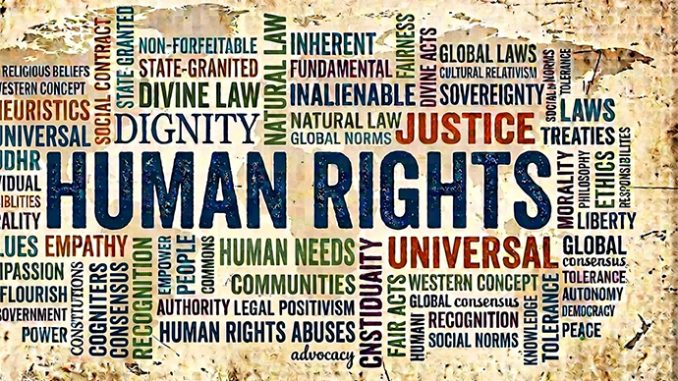
Rights mean little if they are not operating within a culture that respects human dignity.

(Image: "What We Need Now" site / whatweneednow.substack.com)

Popes have long been political players on the world stage. In recent times, John Paul II worked with Margaret Thatcher and Ronald Reagan to bring down the Berlin Wall. Benedict XVI addressed a joint sitting of the House of Lords and House of Commons, as well as the Bundestag, reminding politicians that they are not gods or social engineers. Francis will be remembered as the pope who gave the Chinese Communist Party influence over the choice of bishops. The world has been waiting to see what Leo’s contribution to the geo-political situation might be.

The first whiff of papal political smoke appeared with Leo’s address to diplomats, delivered at the Vatican on January 9, 2026. It included an endorsement of the two-state option for Gaza and a recognition that “war is back in vogue and a zeal for war is spreading” and that this mentality threatens the rule of law. It legitimizes the practice of states violating the borders of others for no other reason than to promote their own strategic objectives.

In addition to this, at the core of the address, as an unexpected element, was a broadside against the ideological debasement of language. Leo warned the diplomats that “a new Orwellian-style language is developing which, in an attempt to be increasingly inclusive, ends up excluding those who do not conform to the ideologies that are fueling it.” This, he noted, leads to other consequences that restrict human rights, especially the right of freedom of conscience. He suggested that we are dealing with a “short-circuit” problem in the rights discourse, since rights are becoming “disconnected from reality, nature and truth.”

The solution, he believes, is to rediscover “the meaning of words.”

Quite simply, Leo recognizes that no real agreements can be achieved if people mean different things when using the same concepts, or if they deliberately use concepts whose meaning is so fuzzy you can give them whatever content you like.

This is the hallmark of the weasel word. It can change its shape and content to appeal to its interlocutor. The concept takes its name from the fact that weasels are notoriously skilled at changing their body shapes to get inside places like chicken coops. They have an extraordinarily flexible skeletal structure that includes an elongated spine with extra lumbar vertebrae, very thin spinal processes, and no collarbone. The expression “to weasel one’s way out of something” means to duck and weave and side-step questions so as not to be placed into a position of having to answer a straight question with a straight Yes or No answer. Typically, when placed on the spot under cross-examination, someone wanting to weasel their way out of giving a straight and truthful answer will try to redefine one of the key concepts in the question. President Clinton, for example, tried to redefine the meaning of sexual relations when questioned about his relationship with Monica Lewinsky. He attempted to narrow the concept to sexual intercourse.

In contrast to the practice of using weasel words and ducking and weaving one’s way around answering questions truthfully, in his address to diplomats, Pope Leo declared that there must be certainty about the meaning of concepts and that words need to be “anchored in the truth.” Dialogue partners need to be able to define their terms, even if this allows entry for a Judeo-Christian worldview.

The reason this is remarkable is that the Vatican has spent the last century doing intellectual battle on the territory of competing conceptions of human rights without showing much understanding of why it keeps losing the battles. Pope Leo XIII began the process of assimilating the language of natural rights to Catholic social teaching in his encyclical Rerum Novarum (1891), and this adoption was affirmed by the Vatican’s strong endorsement of the Universal Declaration of Human Rights in 1948.

At the time of the drafting of the Universal Declaration, an issue was how to account for the foundation of rights. Where do they come from? On what are they based? Delegates from Communist countries had very different answers to these questions from those representing the Catholic countries of Latin America. In the end, the Declaration was signed, but the lack of agreement on the foundations gave rise to different interpretations of the substantive rights. In 1999, in a similar address to Italian jurists, John Paul II argued that without “a widespread, universal consensus on their foundation,” the use of rights language “runs the risk of obtaining modest results or of confusing authentic rights with subjective and selfish demands.” Pope Benedict also insisted that the foundations matter and recognized that different foundations give rise to different interpretations.

Leo clearly recognizes the problem and associates it with an ideological use of language. Meanings, he says, have become fluid, ambiguous concepts, and “in the contortions of semantic ambiguity,” language has become an ideological weapon.

Bravo Leo! Bring an end to the ideological shadowboxing! There is no point in Vatican diplomats entering into dialogue with people who use weasel words to avoid talking about what is really at stake or to paper over a policy that might be contentious. Avoiding the use of the word “abortion” by calling it “reproductive health” does not fool anyone. Leo wants to clear the air with intellectual honesty. He is open to having dialogue about different conceptions of human dignity and their foundations, but not a phony dialogue.

If we agree not to use weasel words, the positions people take on social practices like abortion and surrogacy and euthanasia—all condemned by Leo in the latter half of his address—can be understood as different understandings of the meaning and value of human life. The dialogue can begin to include discussions about why Jews and Christians and people from many of the Asian wisdom traditions think that human life is sacred. This approach to human life can then be contrasted with the materialist view, which fosters the treatment of human lives as commodities.

While all Catholic scholars agree with what the Church means when she speaks about human rights, quite a growing list of Catholic scholars, in addition to Anglican scholars, are of the view that the Church’s valiant attempts to defend human dignity using the idiom of rights is not a good idea, strategically speaking. It has meant that Catholic leaders keep running up against the short-circuit problem.

Alasdair MacIntyre argued that certain idioms exist that have been designed to thwart intellectual appeals to first principles and thereby obscure or paper over the fault lines between different moral traditions. He thought the idiom of rights was the prime example of this. Another common example is the use of the word “partner” to denote any array of relationships rather than “spouse,” a word that implies that there is a sacramental dimension to the relationship.

Some of the leading Catholic names who have been critical of the employment of the rights idiom include the late and great James V. Schall, SJ who was a professor of political philosophy at both the Gregorian and Georgetown Universities, the late David L. Schindler, who was the Dean of the St. John Paul II Institute in Washington DC, the late Fr. Ernest Fortin, AA who taught political philosophy at Boston College, and Robert P. Kraynak, professor of political science and director of the Center for Free Western Civilization at Colgate University. Some of the leading Anglican names include John Milbank, Adrian Pabst, Oliver O’Donovan, and Joan Lockwood O’Donovan. Their criticisms, along with the recent remarks from Pope Leo, suggest that maybe what we need now is an “audit” on the success or otherwise of the Church’s employment of the idiom of rights to defend human dignity.

A recent work by Professor John Loughlin titled Human Dignity: Its Roots and Challenges in Western Thought (London: Bloomsbury, 2026), provides a panoramic account of the treatment of the concept of human dignity from the Book of Genesis, through the books of the New Testament, the teaching of the early Church Fathers, the medieval scholastics, the scholars of the Renaissance, the Reformation, the Eighteenth Century “Enlightenment” and the nineteenth-century Romantic movement, right up to the personalist philosophy of the twentieth century and the human rights framework. It offers an exposition of what the various competing philosophical traditions have to say about human dignity, including an identification of the fault lines between the traditions.

There is no attempt to paper over or evade the fault lines by recourse to weasel words. The book ends with an appendix offered by the author titled “A Proposed Declaration of Human Dignity According to the Catholic Church.” Arguably, it is such a declaration focused on a Catholic understanding of human dignity that we most need now, not more time wasted on intellectual battles where the game plan is rigged against us from the beginning. As Michael Ignatieff argued in his book Human Rights as Politics and Idolatry (Princeton University Press, 2001), “secularism has become the lingua franca of global human rights as English has become the lingua franca of the global economy.”

Rather than getting bogged down in a battle between rival rights, such as the right to life versus the right of a woman to control her own fertility, it may be more evangelically fruitful if we reframed the debate entirely, leaving out references to rights. For example, we could speak of a conception of life as a sacred gift versus a conception of life as a commodity. This would at least steer the public discussion onto the issue of whether human life is anything more than a cluster of biological parts. In the context of the abortion debate, we could also use the slogan promoted by the Irish pro-life movement, “love them both.” “Love them both” de-demonizes the mother cast in the role of a murderer and de-demonizes the child cast in the role of an unwanted invader. It reframes the issue as a human problem, requiring a human solution, not a mere biological problem requiring a technological solution.

As a component of any such “audit” on the adoption of the rights rhetoric, it should be noted that numerous tyrannical governments in the twentieth century had bills of rights or recognized rights in their written constitutions, including the Soviet Union and the People’s Republic of China. Even Uganda had a bill of rights written into its 1967 Constitution that Idi Amin’s military dictatorship proceeded to ignore throughout the 1970s.

Rights themselves mean little if they are not operating within a culture that respects human dignity, and human dignity is most respected in cultures that contain some understanding that human beings are made in the image of God or, at least, that human life is in some sense sacred. Politics and culture are always downstream of theology.

Worldwide, there are now some 1.4 billion Catholics, so when Leo says that public leaders need to speak clearly and not short-circuit discussions by recourse to ideological jargon, he has the weight of quite a large team behind him. It will be interesting to see whether his words of advice to diplomats filter down to the level of diocesan chanceries and Catholic agencies. These institutions often produce documents infamous for their own “contortions of semantic ambiguity,” making them incomprehensible for many faithful Catholics.

(Editor’s note: This essay was posted first on the “What We Need Now” site and is published here with kind permission.)


If you value the news and views Catholic World Report provides, please consider donating to support our efforts. Your contribution will help us continue to make CWR available to all readers worldwide for free, without a subscription. Thank you for your generosity!

Click here for more information on donating to CWR. Click here to sign up for our newsletter.


About Tracey Rowland 28 Articles
Tracey Rowland holds the St. John Paul II Chair of Theology at the University of Notre Dame (Australia) and is a past Member of the International Theological Commission and a current member of the Pontifical Academy of the Social Sciences. She earned her doctorate in philosophy from Cambridge University and her Licentiate and Doctorate in Sacred Theology from the Pontifical Lateran University in Rome. She is the author of several books, including Ratzinger’s Faith: The Theology of Pope Benedict XVI (2008), Benedict XVI: A Guide for the Perplexed (2010), Catholic Theology (2017), The Culture of the Incarnation: Essays in Catholic Theology (2017), Portraits of Spiritual Nobility (Angelico Press, 2019), Beyond Kant and Nietzsche: The Munich Defence of Christian Humanism (T&T Clark, 2021), and Unconformed to the Age: Essays in Ecclesiology (Emmaus Academic, 2024).

67 Comments

    • Thank you Tracey for your article, I enjoyed reading it.

      The weasels are a big problem for sure but even bigger is the hypocrisy that our so called leaders demonstrate.

      If Pope Leo wants to really make a difference he should start refining the Church, and not with words but actions.

      Our bishops continuously allow those who commit grave sin to receive communion in violation of the code of cannon law and then pretend to reinterpret cannon law and the pope and Vatican turn a blind eye. When our bishops create policies that go against church teaching such as the most recent events in the German church when a German bishop created a new policy for inclusion of same sex couples that goes against church teaching and the pope and the Vatican allow it. There are other examples that go on without correction.

      So when the pope wants to tell the world what’s right and wrong while the church is falling apart it reminds me of the hypocrisy of the Pharisees. Today’s readings for August 21, 2026 Jesus tells us “For they preach but they do not practice” (Mt 23:3).

      Let the pope and the Vatican and all the world leaders practice what they preach and with the grace of God Truth will prevail.

      God’s Blessings

  1. Perhaps it should be remembered that in the Gospel, Christ tells us to “Yes”, when we mean yes and, “No” when we mean no and that all else comes from the “evil one”…

    The Buddha also pointed out that three things cannot be hidden for long, the sun, the moon and the Truth.

    When we lie to others, we are really lying to and about ourselves as others often see us as what we are by what we do just as a tree is known by the fruit it bears.

    This applies not only to politicians but also to many in the hierarchy, the ruling and administrating bodies of all faiths built up on such. Those in governments supposedly serving the citizens of their nation who live in splendor and material wealth while ignoring the poverty, hunger, homelessness and the need for health care among those same citizens are not serving the citizenry just as religious leaders who live in comfort with all their material wants well met are not being honest in their life style and have abandoned the poor whom Christ called “blessed” and said that the kingdom of heaven belonged to them.

    Words are important especially when they are used to trying to hide the reality of our selves and the incorrectness of our self chosen actions.

    Yours in Christ.

  2. Apparently Leo has forgotten the insightful phrase “The pot calling the kettle black”!
    Tracey writes with a seemingly praiseworthy and supportive intent: “…In contrast to the practice of using weasel words and ducking and weaving one’s way around answering questions truthfully, in his address to diplomats, Pope Leo declared that there must be certainty about the meaning of concepts and that words need to be “anchored in the truth…”.
    And yet Leo in his own sphere of authority is strongly pushing perhaps the #1 current “weasel word” in the Catholic Church – SYNODALITY!!!

    • Bravo, Harrry! You hit the nail on the head! SYNODALITY is indeed the #1 “weasel word” in the Catholic Church today, and it’s being used to obscure the assault on Catholic doctrine and morals.

    • Synodality is quite the weasel word. The abuse of “pastoral”, “ecumenical”, “mercy”, “welcoming”, “authority”, “accompany”, “listen”, and many others has virtually destroyed the ability for anyone to use them correctly and be understood correctly.

      We don’t just get fed a lot of drivel, we also are starved of what is good.

  3. Humpty Dumpty Relativism….The article has a more than passing resemblance to the logic of the characters in Alice Through the Looking Glass: “”When I use a word,” Humpty Dumpty said, in rather a scornful tone, “it means just what I choose it to mean—neither more nor less.”

    “The question is,” said Alice, “whether you can make words mean so many different things.”
    “The question is,” said Humpty Dumpty, “which is to be master—that’s all.”

  4. “Love them both” de-demonizes the mother cast in the role of a murderer and de-demonizes the child cast in the role of an unwanted invader. It reframes the issue as a human problem, requiring a human solution, not a mere biological problem requiring a technological solution.”
    This is a beautiful and truly Christian message.

    • It is possible to love the murderer without denying that she or he is a murderer, That is what we are called to do as Christians, as we do with those imprisoned for murder. The truth that “life is a gift” does not remove the reality that the infant in the womb does in fact have the right to its God-gifted life, and that the woman who was jointly responsible for that life coming into existence does not have the right to pay someone to end it, and if she does so, she does indeed engage in murder-for-hire. I’m afraid that the effort to avoid that truth is just another version of weasel words, as well as it may be intended.

      That the woman is under stress and/or confusion is indeed another reality to be acknowledged, but the act is objectively murder, no different than the woman on trial.in New England for strangling her three young children, whose defense is basically a mumbo jumbo of secular weasel concepts and psychobabble.

  5. Better than “human dignity,” JP II stayed with “transcendent (!) dignity of the human person(!).” Meaning a personal and eternal destiny higher than any transitory and terrestrial construction within history.

    About the Asian wisdom traditions….When asked what he would do to save his nation, the Chinese emperor replied: “I would restore the meaning of words.”

    But then came the secular redefinition of “marriage” and then the ecclesial redefinition of a “synod [of bishops]”.

  6. “Rights themselves mean little if they are not operating within a culture that respects human dignity, and human dignity is most respected in cultures that contain some understanding that human beings are made in the image of God or, at least, that human life is in some sense sacred.”

    Yes, so how do we create such a culture? Straight talk is still just talk. Lots of talking, lots of writing, lots of lecturing, lots of name dropping, and things continue to go on as they always have. How then do we change the culture?

    • We speak as we believe, and we act as we believe. Nothing less than purity of heart, in many individual souls, is required. As with all virtues, we receive it by God’s gift and our efforts.

    • We each act so as to change the world and the culture of our immediate community by actively living the changes we want to see in the world, the changes we want to have come into a lived reality.

      Until I change myself so as to live compassion, caring, loving kindness towards all others by treating them as I would want them to so treat me even and especially if they do not respond as I might wish they would so that I am loving my enemies, no change will ever happen and the old status quo will be maintained.

      Until we each live the call of Christ in our daily lives, seeking to always follow his teachings and lived example, nothing will change for the better.

      Doing the “little” daily and necessary things in the spirit of love without seeking validation, recognition or reward so as to serve all others by making ourselves a servant, which is our duty and the onus we bear by being Christian, is the way that leads to the renewal of the world and established the kingdom of God here on earth.

      Yours in Christ.

  7. Would using the word “inadmissible” in the Catechism regarding the Death Penalty be considered a weasel word? Pope Francis wanted to say it was immoral, and was reported to say it was immoral in private conversations, but somehow realized he could not say so in a catechism since the the Church had taught for over 1900 years that it was moral.

    One of the items in the last USCCB voting guide said that, “We must stand with newcomers, authorized and unauthorized.” Is that a weasel phrase?

  8. “Their criticisms, along with the recent remarks from Pope Leo, suggest that maybe what we need now is an “audit” on the success or otherwise of the Church’s employment of the idiom of rights to defend human dignity.”

    I agree with sentiment, but the word audit, (even in quotes) here should be replaced by assessment. An audit is conducted by qualified individuals using established standards promulgated by a body with either a right or invitation to perform an examination.

    The Vatican would see this as injurious to

    Can. 1404: The First See is judged by no one.

    Now, while the First See may be immune to judgment, it is not and in fact is in desperate need of criticism and critics could borrow a tool of operational/governmental auditing to structure their arguments-the “finding”.

    A finding is a succinct statement of the auditor’s evaluation of some aspect of an entity or a program. It has five elements:

    Condition: A statement of what condition exists or occurred. (We paid fraudulent Somali day cares)

    Criteria: A statement that defines a standard or expectation (Taxpayers have a right to expect their money to be expended on legitimate programs and to legitimate entities)

    Cause: Why there’s a difference between the condition and the criteria (recipients were not properly evaluated/governmental disbursements were not properly controlled and monitored-typically auditors don’t attempt to infer whether such failures are malfeasant or misfeasant, but the real cause is usually that the fox is in charge of the henhouse and the farmer is drunk or asleep)

    Effect: Why the difference matters (Poor fiscal controls over expenditures result in waste, fraud and abuse, misdirect moneys from legitimate programs, etc)

    Recommendation: Proposed corrective actions to be taken by the responsible parties to eliminate or mitigate the differences between the condition and criteria. (establishing proper fiscal controls to establish the authenticity of the recipient, it’s mission and the nature and extent of its use of government funds).

  9. “Benedict XVI addressed a joint sitting of the House of Lords and House of Commons, as well as the Bundestag, reminding politicians that they are not gods or social engineers.”

    Can we address this injunction to the Episcopacy?

    When I think of recent Popes, I think of cars. John Paul II was a nice Oldsmobile with a little slop in the steering. Benedict XVI was a Buick with an ignition misfire that ruined drivability.

    Francis? A Chevy Vega, a poorly designed, uncomfortable, unpleasant economy car designed to have an offering that would compete with new offerings.

    with a myriad of design flaws, including aluminum heads that warped when they became hot.

    Leo? Early indications are a Ford Pinto, whose makers who thought the legal and reputational damages of the explosive fuel system that incinerated passengers would less costly than a proper (re)design.

    • TPR: I think your assessment of Popes was on target – with one exception. My take on the reign of Francis I Bergoglio is that he is better compared to the car that made Ralph Nader famous – the Chevy Corvair. In fact, we could say that Francis’ pontificate was very much “Unsafe At Any Speed.” It was a prime example of a negligent pastorate and, like the Covair, was prone to dangerous rollovers and loss of control.

    • Clever. Probably because of his bulk, I saw Frank as a Mack Truck with more than a few cracked or missing wheels and few cylinders. I don’t know how those influenced drivability, but with his limp and his missing lung, he didn’t move well and suffered oxygen deprivation throughout his pontificate. IAE, he was totaled at death.

  10. Christ said it first: “Let your ‘Yes’ mean ‘Yes,’ and your ‘No’ mean ‘No.’ Anything more is from the evil one.”

  11. “Migrant” is the most frequently abused weasel-word used by our bishops. That must have been inserted somewhere be in the words of consecration for all bishops.

    • And just like that, “migrant” is being replaced with “newcomer”.

      I think somebody was binge watching the short-lived 1989 TV show “Alien Nation” and said, “newcomer”, that’s the ticket. Fortunately for the left, NPC’s are always eager to show their command of the new narrative.

    • Migrants come in different varieties. Some enter legally, some not.
      Some stay on, others return home.
      I think “migrant” is legit but so is clarifying the immigration status.

  12. Ah, more popesplaining by Americans under Leo. Rowland should have called out leo for failing to practice what he preaches. Leo and co. are exemplars of the abuse of language, stemming from their ideological/marxist motivations: all the synodal doublespeak, while they constantly use the fluffy, nebulous buzz words of listening, inclusion, fraternity, etc., and do so in place of matters of Faith. Human dignity is also used as an umbrella concept to sometimes cover for heterodoxy, illegal activity, and ideological-political agendas e.g., the push for lgbt nonsense, mass illegal immigration, climate change. Likewise, the word pastoral is regularly abused to pit it against doctrine and individual rights to also invoke challenges to doctrine. This contrast between words and deeds is also part of the confirmation of ideological motivation, as leftists just about always accuse others of what they themselves do.

      • By nationality yes, but she has heavy american ties, such as with the circles of ignatius press and the “communio” crowd here, and the piece is being published by two american outlets. To put it more bluntly, she’s a darling of american neo-cons. Surely you’re not trying to make the adjective “american” a point of rebuttal(?)

    • David, you hit the nail on the head so many times:

      “Leo and co. are exemplars of the abuse of language…”

      “all the synodal doublespeak…buzz words of listening, inclusion, fraternity, etc., and do so in place of matters of Faith.”

      “’Human dignity’ is also used as an umbrella concept to sometimes cover for heterodoxy, illegal activity, and ideological-political agendas…the push for lgbt nonsense, mass illegal immigration, (nutty) climate change…”

      The list of “weasel words” used in these last 2 pontificates could go on ad infinitum.

      • Yes! “human dignity” stands as the secularly acceptable euphemism for “soul,” or “The image and likeness of God.” The secular square tends to reject the latter two phrases as without value or venue. Affronts to human dignity, IOW.

  13. Recently, I found myself engaged in a war of words and their meaning. I quoted Pope Leo XIV on war, summarized here by Google AI [source Vatican News]:
    “Pope Leo XIV strongly rejects war, declaring it a ‘painful defeat’ of dialogue and calling the traditional ‘just war’ theory completely outdated. He stated the framework is outdated due to the development of advanced weaponry, autonomous weapons, and artificial intelligence”.
    I said that war is evil. I was challenged to respond to whether that applies to our troops storming the beaches at Normandy during WWII. When I answered No, I was accused of using the word war in a weaselly manner, now making it what I did not initially say.
    Words have meaning in their given context. For example, when Leo XIV announces war is evil, he suggests that under all and every condition war is a physical evil. That condition doesn’t make Leo’s statement a weaselly comment. In other conditions such as self defense, our obligation to protect the weak, war becomes a necessary evil.
    War becomes a moral evil when its purpose is other than self defense, protection of the weak.

      • Most welcome mrscracker. My purpose on this site has been to contribute to the understanding of moral issues, to inspire holiness.

          • Yes it is mrscracker. It’s walking a tightrope. I’ve learned that appeal to my priesthood doesn’t work very well when there’s sharp disagreement, unseemly language in this setting.
            More productive is to present myself as an equal among equals. When there’s a moral issue that deserves being addressed, I do my best to make my case on its merits rather than suggest superiority. And at that to be selective.
            I can’t deny my priesthood, although presenting myself within the mindset of the commenters removes distance.

    • It could be that everyone here is simply misunderstanding you. That is possible but statistically improbable. Maybe you need to be a bit more clear and discerning in your choice of words and the structure of your arguments. You have a tendency to make assertions and then backpedal when people challenge you.

    • How is one to tell which war is merely a physical evil and which is a moral evil to join in the fighting, if the theory of just war is outdated?

      Very few people are so stupid as to imagine war is not a physical evil. While I still think it is good to take the time to correct them, wars are fought when many people agree that it is morally good or neutral, and probably worth the physical evil. Perhaps the world’s moral teacher could explain when that is, given that he thinks the traditional way of figuring it out is outdated?

      Otherwise, he can hardly object to people going by their best assessment, or by the old “outdated” theory. Given that (at least in the old “outdated” theory) just/unjust war is a prudential judgement, heavily dependent on circumstances, we can hardly refer each question of war to the Pope prior to waging it. He really can’t know and assess all of the relevant information.

      Explanation makes a person a teacher. Assertions make a person opinionated, and opinions are a dime a dozen, even adjusted for inflation.

      Weasel words are those that sound nice, but do not actually give a yes, no, or distinguo regarding the point of contention. The issue is not so much that the statement is false, but that it is useless, and pretends to be profound.

      I don’t think the accusation of “weasel words” applies much to a conversation, or a comment section where clarification can be requested and received (particularly if it generally is). But the Pope has yet to clarify, and my general experience at this point is that Popes do not do so.

  14. Is this (seemingly becoming more common) personal defense of past posts at other OPs really necessary??? What purpose does it serve?

  15. I am not having the troubles “all of you” are said to be having with Fr. Morello’s posts or style of post etc.

    When he alters some position he stated earlier, he corrects himself. When he reiterates a position he is seeking to add clarity.

    If he posts anonymously I can’t tell but the posts in his name are very helpful on the one hand and on the other they challenge thought or bring insight.

    As a matter of fact he fits in with the group of priests willing to share intellectually in broad discussion not restricting tips to “specific momentary allusions”.

    God bless me and God bless him. Not every priest gives up with stuff just like that.

  16. Just yesterday Leo gave a good example why he is not to be praised as Rowland has us believe, but that he himself engages in manipulation and abuse of language that should have us concerned. In his angelus address- no less on the gospel about Peter’s primacy- Leo continued what has become a recent uptick of using language that Francis had started, of being aware of doctrinal rigidity and what has always been done and taught: he cautioned us against holding “religious certainties,” and against being content with “what we have heard” and “with what has been handed down to us,” and to “continue doing things as we have always done them.” He also said that “Faith is not something given to us once and for all.” He then said that as individuals and as a Church we must be open to “unfamiliar paths,” and be prepared for a change in “our pastoral choices.”

    People will be tempted to Leosplain, but this is now an emerging pattern and a script we saw under Francis, so it can’t be chalked up to a one-time thing. There is also what he could have said, but didn’t, in order to possibly clarify what his remarks insinuate. He starts with accepted language- what has been handed down to us, Faith which was once for all given to us, and tells us to be wary of it or tweeks it- Faith is now not given to us once and for all. (It’s possible he could mean by the latter the personal expression of Faith, that always needs renewal, but for one, he does not say something like that, while it is again linked with the other ideas.) What also confirms something odd here is the link to then accepting new things, new pastoral approaches. It’s also telling he does this with the gospel on papal authority and otherwise it’s odd to make such remarks over this gospel.

    So, we’re told to be on guard against contentment with what has been handed down to us, what the Church has always done, and be open to new approaches. Where have we heard that before? One wonders if this is in preparation for the october meeting over amoris laetitia, at which we’ve already been told there will be discussions about “what forms of resistance continue to emerge” to the divorced and remarried and other peoples receiving communion. We can be pretty sure something is on the horizon and we’re being prepared for it.

    • Playing the devil’s advocate, here (so to speak!), an alternative reading of “Let us seek not to retreat into our own convictions and […] what has been handed down to us” is that the accent is on “retreat.” Meaning, instead, that we should ADVANCE (notice, engage and respond) because of “what has been handed down to us”(?). No idea what “common assumptions” might refer to (pre-conciliar fortress Church?).

      Maybe just unwitting wording? But, yes, a second look at Amoris Laetitia could well be a veery serious problem.

      Things to watch for in the near future also include new appointments this year, and further references to the Documents of Vatican II (not the synodal replacements), and the eventual pecking order between consistories of cardinals alongside national and continental “ecclesial assemblies” leading up/down to a biggie in Rome in 2028.

      Also, the November session of der Synodal Weg is cancelled because the proposal is slowly making the rounds through the various dicasteries. Likewise, the 2026 review of the “provisional agreement” with China seems on hold since the action date (four-year review since 2022) seems to have been postponed until 2028.

      Pope Leo has inherited a minefield not of his making, and might be just pragmatically picking his way through it. Without acting too precipitously and then being permanently painted by the termites as a bigoted, conservative reactionary—for the rest of his pontificate.

      From the back row of the bleachers, trying here to be discerning and upbeat. We should pray for Pope Leo IV during these “interesting times.”

      • You’re likely aware I wrote two comments on the 21st Sunday Angelus that I was made aware of by John. Both suggested an either or interpretation as you do. Although I suggested in the latter that the momentum seemed in favor of a Francis I trajectory.
        Veteran Vatican journalist Andrea Gagliarducci argues that the choices Pope Leo XIV makes regarding his first batch of cardinals will define the true trajectory of his pontificate (NCReg). Gagliarducci hints that Leo XIV could create as many as 16 new cardinals in an upcoming consistory to put his own stamp on the College of Cardinals (The Pillar).
        Time will tell. Otherwise, despite my doubts my hope is that he is working his way carefully toward a return to doctrinal coherence with revelation.

        • And then, is there also the Augustinian Factor in Pope Leo XIV? About St. Augustine:

          “Augustine often uses the word ‘progress’ during his old age. But we have seen that for him it did NOT mean the prospect of unrestricted change and adaptation: rather, it implies a consciousness of having left behind the superfluous, and of having become increasingly certain of the essential. He felt that he was on a steady course, carried by the momentum of 20 years of unremitting intellectual labour as a Catholic bishop [….] To him, a bishop’s duties were NOT only ‘pastoral’; they had also become ‘medicinal. [….] Augustine provided the Catholic church with what, in future centuries [!], it would need so much: an oasis of absolute certainty in a troubled world: here was the library of a man, whose life could be regarded as a steady progression towards ‘the ecclesiastical norm of Catholic orthodoxy[!]” (Peter Brown, “Augustine of Hippo,” 1969).

          So much for “expert” Study Group #9 (etc.) and the roundtable compost heap from which it hath sprungeth!

  17. Vatican News reported what “Pope Leo XIV said in his Angelus message on Sunday, August 23, in St. Peter’s Square:

    ‘Let us seek not to retreat into our own convictions and religious certainties, but to remain open to an authentic relationship with Christ,’ he highlighted, addressing the many people gathered in the sunny square.

    ‘At times, when it comes to the Christian faith, we may be content with what we have merely “heard,” with common assumptions or with what has been handed down to us, perhaps even with the best of intentions,’ he said.

    ‘Yet Jesus calls us to give a personal response, to know him more closely and to allow ourselves to be shaped by friendship with him through an ever new encounter.’

    Granting Leo the benefit of the doubt. He seems to say that we should ‘advance’ in our relationship with Jesus, regardless of what we may have “heard” about Jesus.

    Leo’s address to the people is ambiguous—weaselly. What or who is the SOURCE of what we hear? Surely Leo would not have us disregard or retreat to what we have heard from the Church or from scripture! If we have heard from a pope or popes, should we not retreat into his/their words?

    Should we disregard what we’ve heard when it comes from false teachers? What good reason does Leo gives us to listen to Leo??

    What ‘religious certainties’ does Leo suggest we disregard in order to experience the authentic Jesus?? Leo jests, misspeaks, is confused, or purposefully misleads or obfuscates. None of the explanations stand him in good stead as an authentic teacher or knower of Christ.

  18. I can’t disagree with something that is devoid of meaning.

    You agreeing with the dead Pope does not make his words true.

    There’s a woman facing the maximum sentence of life in prison who shot her 11 month old son IN THE FACE and pled guilty. This unjust and in ideal world executed and in the same manner that she employed to commit her heinous crime. Of course that would simply make mess for somebody to clean up, so time for Reddy Kilowatt.

2 Trackbacks / Pingbacks

  1. Human Dignity Before Human Rights – Palæo-American Perennialist
  2. Winnowing Weasel Words – Tracey Rowland – seamasodalaigh

Leave a Reply

Your email address will not be published.

All comments posted at Catholic World Report are moderated. While vigorous debate is welcome and encouraged, please note that in the interest of maintaining a civilized and helpful level of discussion, comments containing obscene language or personal attacks—or those that are deemed by the editors to be needlessly combative or inflammatory—will not be published. Thank you.


*