No Picture
News Briefs

Alasdair MacIntyre: True friendships are rare, but possible

November 17, 2019 CNA Daily News 1

South Bend, Ind., Nov 17, 2019 / 03:01 pm (CNA).- For Aristotle, the definition of perfect friendship was so narrow that precious few could achieve it.

In order to have a perfect friendship between two people, Aristotle said that both must be models of goodness and virtue, willing the good of the other and loving each other for their own sake.

He also thought these levels of virtue and goodness could only be achieved by a narrow slice of the population: namely, the Greek male elite. Women, non-Greeks, productive workers, and slaves were, in Aristotle’s mind, unable to achieve the levels of virtue and goodness necessary for such friendships.

Such people could have other kinds of friendships, Aristotle said – friendships of utility or pleasure – but they could never have perfect friendship.

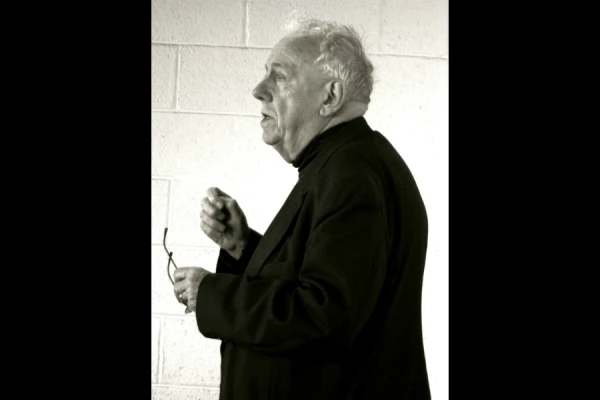
It was this view of friendship with which moral philosopher Alasdair MacIntyre took issue in his Nov. 8 address at the di Nicola Center for Ethics and Culture’s 20th annual conference, which this year had the theme of friendship.

“For (perfect) friendships, so Aristotle tells us, we have to be good in ways and to a degree that…if we’re honest, many of us know that we’re not,” MacIntyre said.

“Aristotle allows that…we can, without being good, participate in friendships of mutual utility or of shared pleasure, but even this should be depressing for many of us,” he added, “for what we need on the most important occasions when we need friendship…are friendships sustained by a good deal more than the possibility of mutual utility or of shared pleasure.”

MacIntyre pointed to other still unsatisfactory definitions of friendship, such as that from Dale Carnegie, who wrote the 1936 book “How to Win Friends and Influence People.”

But what Carnegie suggests will not help one have real friends, MacIntyre said, but will manufacture “a certain kind of superficial sociability, a sociability which no one of integrity could confuse with friendship.” Such friendships, he added, might be compared to someone who is a Facebook friend and nothing more.

Friedrich Nietzsche, on the other hand, concludes that “yes there are friends, but it’s error and deception regarding yourself that led them to you, and they must have learned how to keep silent in order to remain your friend.”

With these different definitions and ideas of friendship, what then does it mean to truly be a friend? While hoping to broaden the scope of friendship beyond that which is available to the Greek male elite, MacIntyre said there are still many types of relationships that, while friendly, are not true friendships.

Such relationships include, for example, those between coworkers, where a certain amount of friendliness is helpful in achieving common goals and completing tasks together, or relationships between parents and children, between siblings, or between members of groups such as rock climbers, people in a choir, or members of a surgical team, MacIntyre said.

Those in such relationships “only care for each other because they are collaborators in some particular role. They do not care for each other as she or he is in themselves, apart from whatever role they happen to be playing at any particular time. This alone is sufficient to distinguish such relationships from friendships,” he added.

With such relationships being so prolific in our lives, MacIntyre said some may be tempted to wonder what the use is of another kind of friendship after all.

In his response to this question, MacIntyre said that because human beings are dependent rational animals who need to be able to make good judgements about themselves and the world in order to flourish, a key element of true friendship then is the ability to tell one another the truth.

“Insofar as our minds are not so informed, we’re liable to go astray in a variety of ways, to be victims of ignorance, arrogance, deception and self-deception. We become unable to flourish and we become unable to recognize that we are unable to flourish. We make bad decisions, for we can hope to avoid bad decision making only by deliberating in the company of a certain kind of other,” he said.

This other – a true friend – must not only be a “perceptive inquirer” and “scrupulously truthful,” they must “care enough about us and about our flourishing as human agents to insist on us, too, being truthful, so with their help, we may become able to correct our mistakes and to free ourselves from our illusions.”

True friendships must also be uncalculating of the costs and benefits of the relationship, and must be relationships in which “each friend genuinely cares both for the other and for the good of the other and finds in this caring a sufficient reason for acting as she or he does,” MacIntyre added.

St. Thomas Aquinas, MacIntyre noted, was also able to “correct” some of Aristotle’s deficiencies in his definition of friendship by recognizing that people possess various virtues in varying degrees, and that grace and charity can account for some of the ways baptized persons act that go beyond either their natural inclinations towards virtue or their moral education in the virtues, which allows for a broader understanding of friendship.

“So a more recognizable portrait of humanity emerges – and one sometimes wonders how many people Aristotle had actually met,” MacIntyre said.

This more recognizable view of humanity is “one in which moral education has become the work of a lifetime, and moral failure in this or that respect is a recurrent and characteristic feature of our lives. It matters, of course, that Aquinas writes as a Christian theologian and therefore is someone for whom their sinfulness is one of the key facts about human beings,” he added.

This more flexible view of humanity also allows that good friendships can be schools of virtue, rather than just something that occurs between two people who have already achieved perfect virtue, because these friendships are “a means to self-knowledge. Friendships survive and flourish…only if each friend can rely on the other’s truthfulness. And without the self-knowledge that is one result of such truthfulness we’re all of us apt to become victims of our own self-indulgent fantasies,” he said.

An additional key element of a true friendship is that it is a gift, MacIntyre said. A gift is freely given, and must be received. This means that one must be open to the possibility of friendship with others, and recognize the opportunity of friendship when it occurs.

This requires a responsiveness to others, as well as a willingness to be surprised or disappointed along the way, he noted. It means letting go of pride, or of greed or an unnecessary competitiveness with others, he added.

“Yet what above all else stands in the way of openness to friendship is insincerity,” MacIntyre said. An insincere person is an actor of sorts, he noted. An insincere person is not necessarily a liar, but they have convinced others and sometimes themselves that they are something or someone that they are not.

“An insincere person invites others to respond not to their reality, but the sometimes impressive fiction that they have constructed. So the other is put at a disadvantage and when the invitation extended to the other is or includes an offer a friendship, what is offered cannot, in fact, be friendship. For one is being invited to care for a fiction, not for a real human being,” he said.

A final characteristic of a true friend is that they care not only for their friend, but for all that their friend cares about, MacIntyre said, quoting Aquinas: “When the man has friendship for someone for his sake, he loves all belonging to it, whether children, servants or related to him in any way.”

“Indeed, so much do we love our friends, but for their sake we love all who belonged to them,” MacIntyre said.

And so with these defining characteristics of a good friendship, they still may be difficult to find in today’s world, MacIntyre said, but they are possible and necessary for human flourishing.

“Each of us needs such others if we are able to deliberate well and to make good choices. Each of us needs such others if we are to achieve the self-knowledge without which we can’t flourish.”

[…]

No Picture
News Briefs

Pope Francis: The poor, unborn, and elderly are neglected in the frenzy of modern life

November 17, 2019 CNA Daily News 1

Vatican City, Nov 17, 2019 / 04:30 am (CNA).- On the World Day of the Poor, Pope Francis said that the poor and most vulnerable can be left behind in the frenetic haste and self-centeredness of the modern world.

“How beautiful it would be if the poor could occupy in our hearts the place they have in the heart of God,” Pope Francis said in his homily Nov. 17.

“In the frenzy of running, of achieving everything right now, anyone left behind is viewed as a nuisance. And considered disposable. How many elderly, unborn, disabled and poor persons are considered useless,” he said in St. Peter’s Basilica.

Pope Francis celebrated Mass for the 3rd annual World Day of the Poor with the theme “the hope of the poor will never be disappointed.”

“Amid so many penultimate and passing realities, the Lord wants to remind us today of what is ultimate, what will remain forever. It is love, for ‘God is love,’” he said.

Pope Francis warned that there is a great temptation in today’s world to try to know and to do everything “right now” that can cause one to lose sight of what is most important: “We no longer find time for God or for our brother and sister living next door.”

“How often do we let ourselves be seduced by a frantic desire to know everything right now, by the itch of curiosity, by the latest sensational or scandalous news, by lurid stories, by the screaming those who shout loudest and angriest, by those who tell us it is ‘now or never,’” Pope Francis said.

“To us, these are front page news, but the Lord puts them on the second page,” he said. “That which will never pass away remains on the front page: the living God, infinitely greater than any temple we build for him, and the human person, our neighbor, who is worth more than all the news reports of the world.”

The pope explained that the antidote to frantic haste is the Christian virtue of perseverance.

“Perseverance entails moving forward each day with our eyes fixed on what does not pass away: the Lord and our neighbor,” he said. “Let us ask that each of us, and all of us as Church, may persevere in the good and not lose sight of what really counts.”

Following the Mass and Angelus prayer, Pope Francis will share a free lunch with nearly 1,500 poor people invited to dine in the Paul VI Hall and nearby colleges. A medical clinic set up in St. Peter’s Square also offered free medical services to those in need in the week preceding the World Day of the Poor.

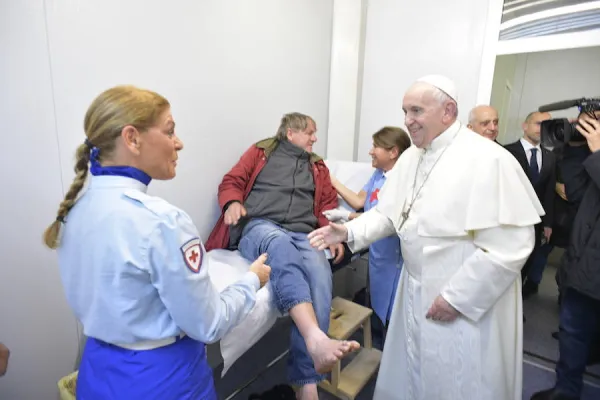
Pope Francis made a surprise visit to the medical clinic Nov. 15 and announced the creation of a new 4-story homeless shelter right off the St. Peter’s Square colonnade, which he called “the Palace of the Poor.”

The homeless shelter, staffed by the Sant’Egidio community, will have two floors of dormitories that can sleep 50 men and women, a kitchen to provide breakfast and dinner, and a recreation area for fellowship, educational programs, and psychological counseling.

“The poor person who begs for my love leads me straight to God,” Pope Francis said.

In his Angelus address, the pope thanked Catholics in dioceses and parishes around the world for their work in solidarity with the poor, which he said gives hope to the most disadvantaged.

“The Lord calls us to collaborate in the construction of history, becoming, together with Him, peacemakers and witnesses of hope in a future of salvation and resurrection,” he said.

Pope Francis established  the World Day of the Poor at the end of the Jubilee Year of Mercy in 2016. It is celebrated each year on the 33rd Sunday of Ordinary Time, one week before the Feast of Christ the King.

“The poor facilitate our access to heaven: this is why the sense of the faith of God’s People has viewed them as the gatekeepers of heaven,” Pope Francis said in his homily.

“Even now, they are our treasure, the treasure of the Church,” he said. “For the poor reveal to us the riches that never grow old, that unite heaven and earth, the riches for which life is truly worth living: the riches of love.”

[…]

No Picture
News Briefs

Development of prison catechesis program draws strong support

November 17, 2019 CNA Daily News 1

Houston, Texas, Nov 17, 2019 / 03:05 am (CNA).- It took a Catholic evangelist just three days to raise the funds online for an apologetics and faith formation curriculum to distribute to prisons— a place where he says Biblical apologetics are sorely needed.

Michael Gormley, host of the podcast “Catching Foxes” and adult faith formation director for St. Anthony of Padua Catholic Church in the Houston area, told CNA that the goal of the curriculum is to weave the Gospel message with apologetics and Catechesis.

“There’s such a need for Biblical apologetics [in prison],” he said.

“The majority of people are leaving the Catholic faith either for an anti-Catholic fundamentalist Christian faith, or for Islam. Islam is mostly big in the jails…and we have almost zero presence in jails. And it’s shocking, it’s just shocking.”

Gormley said the goal is to adapt a faith formation series that he originally created for Ascension Press.

He said he hopes to adapt the series to be more relevant to men and women in prison, offering instruction for those who want to learn more about Catholicism about how to frame their lives around Christian discipleship. He said he hopes to reach inmates who have already been inspired by prison ministry volunteers to say, “I’m interested in this Catholic thing, what’s next?”

“My hope is to be able to pull out a coherent curriculum from beginning to end, chopping the videos up and maybe adding new things into the mix as we go,” he said.

Gormley said the opportunity recently came “out of nowhere” to buy the rights to the series from Ascension, so he launched a GoFundMe page to raise the $10,000 necessary— and it took him only three days to reach the initial goal.

In fact, it only took one minute of the fundraiser being live for one donor to offer $5,000— half the funds needed.

Gormley stressed that although the campaign had reached its initial funding goal, the GoFundMe is still accepting donations because more is still needed to allow the project to continue.

Any additional funds beyond those used to buy the rights to the series, he said, will go directly to printing DVDs— Internet-based videos aren’t an option for prisons— as well as for workbooks and other production costs.

“On top of your donation dollars to all your different nonprofits, and churches, and charities, really keep an eye to prison ministries,” he said.

He said there are around 110 prison units in Texas, but only one full-time Catholic chaplain.

Gormley said he goes with a group to a prison every Monday, offering a few hours of instruction and Catechesis as well as a Communion service for the Catholic inmates. He said working with inmates has changed the way that he, an educator in the faith and an evangelist, goes about sharing his faith.

“It totally changed how I do everything in my life. From being a dad, to teaching my faith, living as a witness, evangelization, it turbocharged everything, because you see grace working right in front of your eyes.”

Gormley told CNA last month that the first time he went on a retreat at a prison, through a group called Kolbe Prison Ministries, he went to a maximum security unit in Texas.

The Jim Ferguson Unit, located in Midway, Texas, has a maximum capacity of 2,100 men and mainly houses violent and gang-affiliated prisoners.

Gormley said he remembers showing up for his first retreat at 5:00 in the morning, and he and his fellow participants prayed the prayer to St. Michael before going inside because they had heard that a group of “Satanist” inmates were cursing them and their ministry.

“When you walk into these prisons, you realize you’re going in to serve, at least in my case, violent offenders, many of whom are of the population where there’s a high recidivism rate,” he said.

“The beautiful thing about prison ministry, at least from my limited experience, is that 2 hours into the actual retreat, I was shocked at how mundane everything was,” he continued.

“There were guys that were super talkative, guys that were disengaged, guys who were listening and quiet, guys that were dominating the conversation, and everything in between, just like a normal men’s retreat. And it was that…the men quickly became very normal in my eyes from the labels that they were beforehand.”

The vast majority of the inmates participating in the retreats, he said, are non-Catholic, and he said a significant majority of those non-Catholics are “fiercely anti-Catholic.”

A large number of Latino inmates that Gormley has encountered, who may have grown up Catholic, are now “extremely anti-Catholic,” he said.

The retreats are based on testimonies that are tied to larger themes, he said. In his role as a table facilitator at the retreats, Gormley leads discussions and often fields questions and challenges from inmates about aspects of the Catholic faith.

“Every single story is insane, amazing, sad, heartrending,” he commented.

Every single man he met in the unit, with one exception, had inadequate fathers, whether by neglect, abandonment, abuse, or a combination. Almost every one of the men joined gangs, because “if they didn’t have fathers, they needed brothers.” Most of the men were abandoned by the gangs they joined, too, he said.

Gormley related the story of a man in the Ferguson Unit who had joined a white supremacist gang before being locked up.

At one of the prison retreats, the inmate stood up and told the other men at the prison that he was sorry for getting into fights with his black and Latino prison mates, because he realized on a prison retreat a year ago that he didn’t hate people of different races— he hated his father, who had abandoned him years earlier.

He said he forgave his father a year ago, and then asked the other prisoners to forgive him. An African-American inmate then stood up and gave the man a hug, amid tears and applause from the other inmates.

“The whole rest of the retreat was like that, stories like that,” Gormley said.


[…]

No Picture
News Briefs

Vatican Museums opens exhibit with newly restored Renaissance Marian paintings

November 16, 2019 CNA Daily News 0

Vatican City, Nov 16, 2019 / 06:01 am (CNA).- The Vatican Museums opened Thursday an exhibit of recently restored paintings of the Virgin Mary by early Renaissance painter Carlo Crivelli.

“The Vatican painting gallery has the privilege of having three large scale paintings by Crivelli,” Vatican Museums’ Curator Guido Cornini told CNA.

“Crivelli is a relatively rare artist, so not many collections in the world may claim the presence of a nucleus of more paintings together,” he said.

The restorations were made possible by members of the Patrons of the Arts in the Vatican Museums, the fundraising branch of the Vatican Museums that started in the United States in 1983.

The U.S. Embassy to the Holy See co-hosted the exhibition opening at the Vatican museums in celebration of the 35 years of formal diplomatic relations between the U.S. and the Holy See.

“U.S. Patrons fund approximately 80 percent of all restoration projects at the Vatican Museums,” U.S. Ambassador to the Holy See Callista Gingrich said at the exhibit opening Nov. 13.

“Through their work, the Patrons ensure that the unique spiritual and cultural mission of the Vatican Museums continues to flourish, and that these works of art endure and inspire millions each year and for generations to come,” she said.

Each year the Vatican Museums curators put together a “wish book” of art pieces in the museums that most urgently need restorations. This is then sent to donors, who can commit to funding the restoration of a particular work of art.

For the Crivelli pieces, the restoration process consisted of many stages, Cornini explained.

“It is more than presenting the painting with a superficial cleaning,” he said. The restorer, diagnostic laboratory, art historian, and/or archeologist must work together to determine the best means of restoration and then execute it in meticulous process that can take over a year.

“You have to get through a long … phase in which more historical information is being gathered both through the archives and compare this with a careful reading of the literature existing on that particular panel painting and then you prepare the proposal of a ‘therapy’ to follow, much like you would do with a medicine,” Cornini said.

The restoration of the Crivelli paintings involved removing the “over-painting” from previous restorations to recover the original vibrant colors under the surface.

Carlo Crivelli (1463-1494) was an early Renaissance painter from Venice, known for his use of gold in the late Gothic style.

Crivelli used many of the latest innovations in painting at the time, but on the other hand, his style displays a nostalgia for medieval art, Cornini explained.

Perhaps his best known pieces are “The Annunciation, with Saint Emidius” (1486) and “Saint Thomas Aquinas” (1476).

The three newly restored pieces of art on display in the exhibit are a five-panel polyptych, “Madonna and Child with Saints” (1481), “Madonna and Child” (1482), and a “Pieta” (1488-1489).

“We are blessed with having these three important pictures, which were restored in past months, and we are now able to present them … with the different histories behind each of them,” Cornini said.

The curator added that the three paintings mark the different stages in the development in Crivelli’s style.

The exhibit, “Crivelli’s gold,” is on display in the Vatican’s Pinacoteca Museum Nov. 14 until Jan. 21, 2020.

Rachel Lanz contributed to this report.

[…]

No Picture
News Briefs

Pope Francis braves rain to visit homeless in St. Peter’s Square

November 15, 2019 CNA Daily News 1

Vatican City, Nov 15, 2019 / 04:06 pm (CNA).- On a rainy Friday in Rome, Pope Francis popped over to St. Peter’s Square to greet the poor and homeless receiving treatment at a mobile medical clinic this week.

A now-annual tradition leading up to the World Day of the Poor, the mobile clinic offers free visits with specialists to Rome’s poor and homeless population.

During his brief “Mercy Friday” visit to the clinic Nov. 15, which took place around 4:40 p.m., Pope Francis also greeted and thanked the health care workers and doctors who donated their time to the clinic this week.

According to a Vatican press release Nov. 15, the health clinic has been seeing hundreds of patients each day, most of whom hear about it through word of mouth.

During his visit, Pope Francis was greeted with applause from the patients in the lobby and medical offices.

“The Holy Father spoke with everyone; a smile and a word of support for each,” the press release states.

He also said a short prayer during the encounter.

The services offered include general medicine, cardiology, infectious diseases, gynecology, obstetrics, podiatry, dermatology, rheumatology, and ophthalmology. A laboratory for clinical analysis is also present.

Afterward the pope stopped for a few minutes at a new location of the Apostolic charity office, located just outside St. Peter’s Square on extra-territorial Vatican property.

<blockquote class=”twitter-tweet”><p lang=”en” dir=”ltr”>Brand new location for the papal charity office, now outside Vatican walls. <a href=”https://twitter.com/hashtag/PopeFrancis?src=hash&amp;ref_src=twsrc%5Etfw”>#PopeFrancis</a> made a surprise stop there just minutes ago. <a href=”https://t.co/a18UdV6eqE”>pic.twitter.com/a18UdV6eqE</a></p>&mdash; Hannah Brockhaus (@HannahBrockhaus) <a href=”https://twitter.com/HannahBrockhaus/status/1195386785511157760?ref_src=twsrc%5Etfw”>November 15, 2019</a></blockquote> <script async src=”https://platform.twitter.com/widgets.js” charset=”utf-8″></script>

Pope Francis established the annual World Day of the Poor at the end of the Jubilee Year of Mercy in 2016.

This year, the pope will celebrate the third World Day of the Poor with a Mass in St. Peter’s Basilica on Nov. 17, followed by a lunch at the Vatican with over 1,000 poor and homeless people invited as guests.

The theme is taken from Psalm 9: “The hope of the poor shall not perish forever.”

[…]