No Picture
News Briefs

Saintly superhero: When Marvel Comics told the life story of John Paul II

May 5, 2020 CNA Daily News 2

Denver Newsroom, May 5, 2020 / 02:52 am (CNA).- Pope St. John Paul II, who led the Catholic Church from 1978 until his death in 2005, is perhaps one of the most compelling figures of the 20th century.

Born nearly 100 years ago on May 18, 1920 in Wadowice, Poland, Karol Woytila— the future pope— endured the loss of most of his family, clandestinely studied for the priesthood while his country was under Nazi rule, and rose through the Church hierarchy while never ceasing to encourage his Polish countrymen to keep the faith while resisting Communist pressure.

He participated in the Second Vatican Council and, upon his election as pope, became the most widely-traveled pontiff ever and likely the most-seen person in the history of the world. He was an academic, and widely regarded as a genius, but also a man of simplicity and humility.

He survived a brutal assassination attempt in 1981, crediting Mary’s intercession for his survival and extending forgiveness to his attacker.

“He’s the exemplar of the fact that a life wholly dedicated to Jesus Christ and the Gospel is the most exciting human life possible,” George Weigel, John Paul II’s biographer, told CNA.

“This man lived a life of such extraordinary drama that no Hollywood scriptwriter would dare come up with such a storyline. It would just be regarded as absurd.”

His compelling life story has been told and retold many times, including on the big screen.

But did you know that John Paul II’s life story was once the subject of a Marvel comic book?

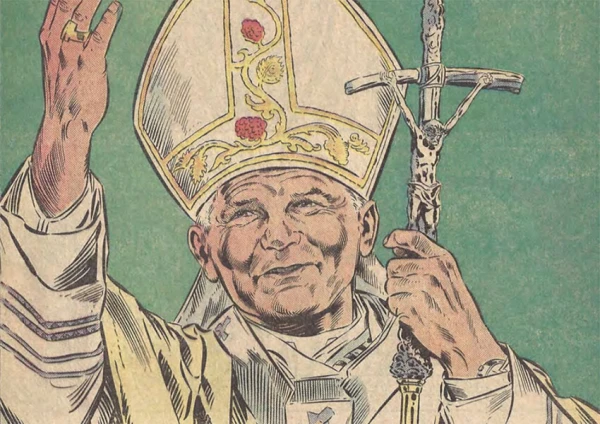
Printed in full color and featuring dramatic, stylish visuals, the 1982 comic chronicles the pope’s life, from his childhood in Poland all the way up to the attempt on his life by a would-be assassin.

Marvel, which Disney purchased in a multi-billion dollar acquisition in 2009, is one of the largest entertainment companies in the world, and the purveyor of such iconic characters as Iron Man, Spider-Man, and Captain America.

So what persuaded the Marvel executives to green-light a comic book about the then newly-elected pope?

‘Marvel’s Man in Japan’

It all started with Gene Pelc— a New Yorker and Marvel representative living in Japan.

Pelc— whose wife is Japanese— had moved to Japan in the 1970s in order to report back to Marvel on how the comic book company could adapt its products for a Japanese audience.

Pelc was tasked with licensing Spider-Man to play on Japanese television, and was largely successful at what he did, earning the moniker “Marvel’s Man in Japan.”

Pelc told CNA that he and his family went— and still go— to Mass at the Franciscan Chapel Center, a community of English-speaking priests in Tokyo.

Japan was then— and remains today— a very non-Christian country, with Catholics comprising less than half of 1% of the population.

One day, a priest named Father Campion Lally approached Pelc at the Franciscan Chapel Center with an unusual proposition. The eight-hundredth anniversary of St. Francis’ birth was coming up in 1982, Fr. Lally said…what if, to commemorate it, Marvel produced a comic book about the life of St. Francis?

Pelc liked the idea, and wondered whether it would prove popular amongst Catholics in the US. Fr. Lally was adamant, however, that the comic be marketed to non-Catholics as well.

“The real reason I want this done is to reach an audience the Church doesn’t normally reach,” Pelc remembers Fr. Lally saying.

“’I want to take St. Francis out of the birdbath’ was his exact comment.”

Pelc called up Stan Lee— a legendary Marvel comic book publisher— who apparently liked the idea. But when Pelc pitched the idea to the higher-ups at Marvel, they weren’t quite so supportive at first.

“They all said: Gene, you’ve been in Japan too long. No one wants to hear about that. They want to hear about superheroes,” Pelc remembers the executives telling him.

Pelc was able to appeal to the financial sensibilities of the executives to help his case, however— the Paulist Press, a U.S.-based Catholic publisher, had expressed interest in purchasing some 250,000 copies of the comic upon its release.

Needless to say, the prospect of a minimum of 250,000 copies sold— when a popular comic at the time could be expected to sell around 150,000 copies— was enough to sway the executives to approve the project.

Father Roy Gasnick, a Franciscan priest and director of communications based in New York, helped Marvel writer Mary Jo Duffy to write the story of St. Francis’ life for the comic. Fr. Gasnik was, by all accounts, a massive comic book fan himself.

Then the artists at Marvel did their magic, and produced the comic entitled “Francis: Brother of the Universe,” which hit stores in 1980.

Helped by the Paulist Press’ large order, “Brother of the Universe” proved to be a hit, both critically and commercially.

A new project

“The next step was pretty obvious to me, being Catholic and being Polish,” Pelc said.

“Pope John Paul II was extremely popular in the world at the time; he was traveling much more than the old popes did previously. And he was actually coming to Japan.”

John Paul II was the first pontiff to visit the country. The pope arrived in Japan in February 1981, to a small but enthusiastic welcome.

The pope’s visit galvanized Pelc, who was still riding high on the success of the St. Francis comic. He began looking into the possibility of producing another religious-themed comic for Marvel.

A friend of Gene’s introduced him to Father Mieczyslaw Malinski, who was a friend of the pope’s back in Poland during the war. Fr. Malinski apparently consulted with the pope himself about what he thought about the idea of turning his story into a comic.

According to Pelc, John Paul II was supportive of the idea, as long as Fr. Malinski himself worked with the comic book team on the project.

So, the Marvel team was off to the races yet again. The first step? Research. And a lot of it.

Most of the information came from Fr. Malinski, but the story still had to be adapted to fit into the panels and speech bubbles.

That task fell to Steven Grant, a young freelance comic book artist who at the time was living in New York and working for Marvel. He had heard that Marvel was producing a second religious-themed comic, but he didn’t think much of it— he assumed that Mary Jo Duffy would be tasked with writing this one, too.

Instead, Marvel’s editor-in-chief called Grant into his office and asked him to take on the task of writing the John Paul II comic book.

“I got involved because I was expendable at the time,” Grant told CNA.

“I wasn’t one of the artists they particularly wanted writing the Fantastic Four that month,” he laughed.

“And they knew I was Catholic— that was my big credential.”

For Grant, working on a comic book about John Paul II— which the team always referred to as “the Pope Book”— was both ordinary, in the sense that the writing process was not markedly different than other comic books; and extraordinary, given that the subject matter was not only a living person, but also the leader of a 1-billion strong worldwide religion.

“No one was worried about offending him, but there was a lot of room to offend a lot of people if we did a bad job with it,” he said.

Bumps in the road

The project experienced two major roadblocks the year before it was released, the first of which was the attempt on John Paul’s life in May 1981, in the midst of the comic’s production.

Instead of dropping the project, the Marvel team wrote the events of the assassination into the book itself.

In addition, communicating with Fr. Malinski would prove more difficult than the team at Marvel had expected.

On Dec. 13, 1981, a general named Wojciech Jaruzelski appeared on television sets throughout Poland. In a video message repeated over and over again, the general declared martial law, and ordered troops to suppress the Solidarity movement, a trade union rooted in Catholic principles that opposed Communism.

Many striking Solidarity workers would die in the next few days, as Polish troops fired into groups of them.

After John Paul’s visit to his native Poland in 1979, it would be another decade before the Solidarity Party in Poland, with the pope’s encouragement, would finally gain a majority in Parliament, and, largely peacefully, the country would shrug off the shackles of Communism.

To make matters worse, the turmoil in Poland was taking place in the middle of the comic book’s production schedule, and the Marvel team needed Fr. Malinski’s insights in order to get the comic book written.

The Communists restricted much of the communications in and out of Poland during that time. Pelc said he remembers receiving smuggled communications from Fr. Malinski, which he brought to his father in New York to have translated from Polish to English.

Apart from Fr. Malinski’s contributions, Grant says he simply put his nose to the grindstone and read up on as much as he could about the pope’s life.

“It was a little pre-internet,” Grant chuckled.

“I figured anything I found three or four references to was probably accurate.”

His total research spanned about two months, he says, but the actual writing process was only a couple of weeks long, spurred on by Marvel’s tight production schedules.

Legacy

Finally, in 1982, the comic book hit the shelves. Thanks in large part to Catholic agencies buying up the edition, somewhere in the neighborhood of 1 million copies made their way into the world.

For a young comic book artist, it was quite the windfall. Grant said he was able to pay off his student loans when he received the royalties for the comic the following year.

So, did the pope himself ever get a chance to see himself as a Marvel hero? According to Pelc, he did. A Marvel executive flew to Rome and presented the pope with a leatherbound edition.

The success of the first two religious-themed comic books led to a third, this time about another future saint— and friend of John Paul’s— Mother Teresa of Calcutta.

Although Pelc was not able to assist with that project, that comic also proved successful, though it was the last of the major religious-themed comics that Marvel produced. That comic even won a Catholic Press Association award in 1984.

In the four decades since the John Paul II comic book’s release, several members of the team that worked on it, including the artist who created the drawings, have died.

Pelc and Grant have gone their separate ways. Grant is still a freelance comic writer, and does writing work for Marvel “once in a blue moon” when they call him up.

Though the “Pope book” remains just one of the hundreds of projects that Grant has worked on over the years, he said he remembers walking into his local laundromat in New York a few months after the comic’s release, and being surprised to see the comic’s cover framed and hung proudly on the wall.

Though Grant never told the owners of the laundromat— clearly devout Catholics— that he was the author of the comic, he said it brought him pride that they valued it so highly.

Pelc, who still lives in Tokyo, owns a company that sells merchandise for musical artists. He said he still gets asked to this day— mostly by parishioners at the Franciscan Chapel Center— about Marvel’s religious comics, he says.

On the side, Pelc still has a passion for telling compelling Catholic stories. He is currently working on a book about the late 16th-century 26 Christian martyrs of Japan, and hopes eventually to adapt the story into a screenplay.

For his part, Pelc says he thinks it unlikely that a company like Marvel would produce something like this again. But he’s glad that by means of the “Pope book,” he and Grant and the entire team were able to tell a good story, in a world inundated by bad stories.

“That man deserved to be known by more than just people who go to church. He was an everyman pope, and I, being Polish, loved him,” he reflected.

Note: This story was adapted from an episode of Catholic News Agency’s podcast, CNA Newsroom. Click here to listen to the full story.


[…]

No Picture
News Briefs

Irish commission: Catholic school discriminated against atheist student

May 4, 2020 CNA Daily News 3

CNA Staff, May 4, 2020 / 05:01 pm (CNA).- The Republic of Ireland’s Workplace Relations Commission has decided that an atheist child was discriminated against by his Catholic school when students were rewarded for attending a religious ceremony.

The commission, an independent, quasi-judicial forum, ruled that the Yellow Furze National School in County Meath had discriminated against an atheist student.

Early in the 2019 school year, the students had been promised a homework pass if they took part in the choir during a First Communion ceremony

The boy’s mother complained, but the school defended its policy.

“Any student, regardless of his/her religion in our school who opted not to participate in this extracurricular event was not ‘rewarded,'” the school said, according to the Irish Post last year.

The school added that children of any religion were able to participate in the choir, and that the claim of discrimination was thus “wholly unfounded.”

The commission said the school “does not appreciate this action had an adverse effect on students who are not of a Catholic faith,” the Irish Times reported.

His mother said that “on that day my son was the only child in the class who was not participating. He was also the only non-Catholic child in the class.” She added that “he came out of school crying.”

“We are atheist and this is not a choice that is open to him,” she said.

The Irish Post reported in 2019 that the boy was one of two pupils in his class of 33 to receive homework instead of attending the choir ceremony.

According to the commission the boy’s parents were “deeply hurt and upset” by the school.

“We felt that the school had disregarded the fact that we have a different set of beliefs,” the mother told RTE News. “We felt that our child had been singled out and punished for not being a Catholic,” and she added that she hoped the ruling would “change things for children here who are not Catholic”.

The mother has since enrolled her son in a different school.

The commission ordered the school to pay €5,000 and demanded the school review its policies so it complies with the Equal Status Acts. The school will also have to post a memo of its compliance in a noticeable location within the school.

The mother told RTE News she will return the €5,000 to the school, “because it will be our friends and our neighbours who will be funding it, through school fundraising. We have been vindicated, but we feel that it would be wrong to accept this money.”

Catholic schools in Ireland make up 90% of all primary schools in the country, the Irish Times reported. The ruling is likely to affect how other schools promote and organize religious events.

[…]

No Picture
News Briefs

Priest in Costa Rica bakes bread to help families in need

May 4, 2020 CNA Daily News 1

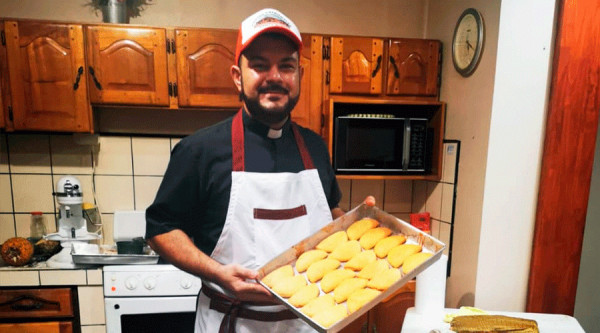
CNA Staff, May 4, 2020 / 03:53 pm (CNA).- When he was just 15 years old, Fr. Geison Gerardo Ortiz Marín had to quit school and find a job to help support his family.

Faced with a difficult economy, Ortiz’s family was struggling financially. He quit school and found a job opportunity at a neighboring family’s bakery, where he worked for five years.

The priest told ACI Prensa, CNA’s Spanish language news partner, that he learned important life skills from the job, such as “knowing what it is to meet a schedule, getting up at dawn and working overtime. In short, it was an enriching experience.”

He took those life skills with him when he entered seminary at age 21. He has now been a priest for 10 years and serves as pastor of Saint Rose of Lima parish in Ciudad Queseda in northern Costa Rica.

Recently, however, Ortiz has returned to his roots as a baker to raise funds for the needy in his parish during the coronavirus pandemic.

Public Masses were suspended a month ago in Costa Rica due to the pandemic. As the lockdown continued, the priest could see the financial strain mounting on members of the community.

“A lot of people starting knocking on the rectory door asking for help, while the parish and local charitable groups weren’t getting any income from the collection,” he explained.

So Ortiz began baking. He uses around 55 lbs. of flour each workday to bake different kinds of bread, rolls and other items. A bag of baked goods sells for 1500 colones, or about $2.65.

“With 1500 colones here we can buy perhaps a 5-pound package of rice,” he said, adding that he has been able to help about 60 families so far.

In addition, a local bake sale was able to raise extra funds, he said, which have ensured that anyone who has knocked on the rectory door has left with a package of rice, sugar or beans.

No one has been sent away empty handed, the priest said.

“I work all day long baking bread, selling it, and in the evenings I celebrate the Eucharist. I always tell the Lord, ‘Thank you for the true bread that gives eternal life, which is the greatest of riches and is what I want our people to have, receive, taste and feel’,” he said.

Ortiz encouraged other priests to find creative ways to help serve those in need during the challenging times presented by the pandemic.

“I believe that this is a special moment,” he said. “God has allowed me to return to my origins. God has allowed me to help meet the needs of our brothers. This is a moment in which the Lord is allowing us to live in solidarity and to reach out in a very special way.”

[…]

No Picture
News Briefs

Abortion bans prompt legal battles amid coronavirus pandemic

May 4, 2020 CNA Daily News 1

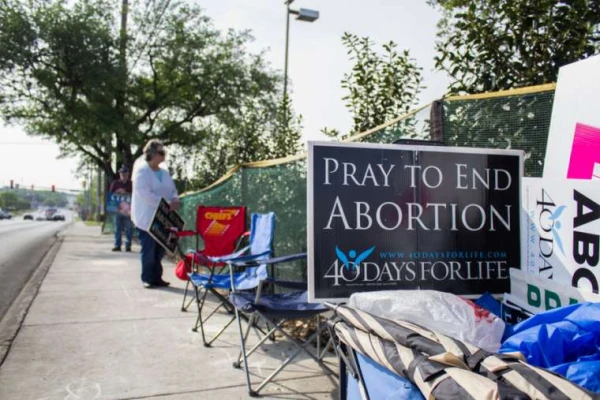
CNA Staff, May 4, 2020 / 03:00 pm (CNA).- Arkansas’ only remaining abortion clinic is suing over a state rule that patients must test negative for COVID-19 within 48 hours of any elective surgery, claiming that a lack of testing is preventing women from availing themselves of abortions before the state’s 20-week limit.

Arkansas Governor Asa Hutchinson had on April 3 suspended all elective surgeries throughout the state, with “non-medically necessary surgical abortions” included in that prohibition. Arkansas already has a 72 hour waiting period for abortions.

On April 27, the state modified the order to allow asymptomatic patients to have elective surgeries if they have had a negative COVID-19 NAAT (Nucleic Acid Amplification) test within 48 hours prior to the beginning of the procedure.

The requirement for COVID-19 testing applies across the board to all elective surgeries, Hutchinson has said.

The American Civil Liberties Union of Arkansas claims that the abortion clinic has contacted more than 15 testing locations but has been “unable” to find one that will test asymptomatic people and have results within 48 hours.

Despite the initial state order halting abortions, Arkansas health department inspectors on April 9 arrived at Little Rock Family Planning Services unannounced and found that the clinic was still performing surgical abortions.

The next day, the health department sent the clinic a cease-and-desist letter ordering a stop to surgical abortions “except where immediately necessary to protect the life or health of the patient.”

The Diocese of Little Rock’s Respect Life Office told CNA on April 16 of a “particularly troubling” increase in abortions at the clinic, especially by women traveling from neighboring Texas and Louisiana, states which have halted elective abortions.

Though a federal district court had on April 14 put a temporary restraining order on the state order stopping abortions, a federal appeals court on April 22 allowed the state order to go into effect.

Amid national lockdowns and stay-at-home orders, abortion has become a subject of national debate.

Pennsylvania governor Tom Wolf on May 2 vetoed a bill promoting the use of telemedicine during the pandemic because it did not include provisions for at-home abortions.

An amendment to SB 857 banned the use of telemedicine for procedures that are not approved under the Food and Drug Administration’s Risk Evaluation and Mitigation Strategy (REMS).

The abortion pill is not approved under REMS and thus would not be allowed via telemedicine under the new bill. At-home medical abortions are already banned under Pennsylvania law.

At least eight states have enacted temporary bans on abortion during the coronavirus pandemic and are subsequently contending with legal challenges. Judges have prevented many of the temporary bans from coming into effect, and some of the temporary orders simply have expired.

Last month in Texas, the US Court of Appeals for the Fifth Circuit ruled that the state’s ban on elective abortions, including medical abortions, could be reinstated, though the order lasted only until April 22.

In Alaska, there was a move by state officials in early April to “delay” abortions until June, but Governor Mike Dunleavy on April 14 allowed elective procedures to resume in the state.

On April 12, a federal judge ruled that the state of Alabama cannot move to limit abortion procedures through measures intended to focus medical resources on fighting coronavirus. Governor Kay Ivey had issued a statewide order March 19 which stopped all medical procedures except for emergencies or those needed to “avoid serious harm from an underlying condition or disease, or necessary as part of a patient’s ongoing and active treatment.”

On April 17, a federal judge ruled that despite Tennessee’s temporary ban on nonessential medical procedures, the state must allow abortions to continue.

Governor Kevin Stitt of Oklahoma issued an executive order halting non-essential surgeries and minor medical procedures in the state during the COVID-19 pandemic, though that order only lasted until April 30.

In Ohio and Iowa, most surgical abortions are currently allowed despite state efforts to restrict them.

The Louisiana Department of Health on March 21 ordered all medical and surgical procedures be postponed until further notice, with exceptions for emergencies. Abortion clinics in the state have sued to block the measure.

Mississippi Governor Tate Reeves issued an executive order April 10 banning all “elective” medical procedures, including abortions, with the order expiring April 27.

[…]

No Picture
News Briefs

Buffalo diocese seeks permanent injunction of abuse lawsuits

May 4, 2020 CNA Daily News 0

Washington, D.C. Newsroom, May 4, 2020 / 01:35 pm (CNA).- The diocese of Buffalo is asking a federal court to halt all outstanding clergy sex abuse litigation against it as it navigates bankruptcy proceedings.

In a motion filed in federal bankruptcy court on Saturday, the diocese is seeking an injunction on the progress of all child sex abuse lawsuits filed under the Child Victims Act (CVA). The diocese has been named in more than 250 such lawsuits.

Once the diocese filed for bankruptcy, all the CVA lawsuits in which it was named a defendant were moved into bankruptcy court and permanently stopped from moving forward. 

However, its bankruptcy proceedings have only temporarily halted the CVA lawsuits against smaller entities named as co-respondents, such as parishes and parochial schools, which have not themselves declared bankruptcy. Such cases could be moved back into the state supreme court against the co-defendants at the end of bankruptcy proceedings, and the diocese is seeking a permanent injunction on litigating these cases in order to reach a “global resolution” for all cases.

Greg Tucker, a spokesman for the diocese, told CNA on Monday that the diocese is looking “to provide the same ‘breathing spell’ for parishes, schools and other Catholic entities in the hopes of achieving a global resolution” for all the cases, rather than “piecemeal litigation.”

Tucker added that continued litigation would deplete the diocese’s shared insurance reserves, affecting future settlements available to survivors.

Steve Boyd, an attorney representing abuse survivors in some of the CVA cases against the diocese, said on Sunday that by filing for an injunction on all cases, the diocese was trying to prevent survivors having their day in court.

“This is another legal financial maneuver by the diocese designed to keep juries from hearing what the priests and bishops did, and what they failed to do to protect kids,” Boyd said in a video posted on Facebook on Sunday.

The diocese has been named in more than 250 lawsuits under the Child Victims Act which created a one-year “lookback” window for child sex abuse lawsuits.

The window, which began in August of 2019, allows a year-long period for lawsuits to be filed in cases of alleged child sex abuse where the statute of limitations had already expired.

In February, already facing hundreds of sex abuse lawsuits, the diocese filed for bankruptcy.

As part of its bankruptcy proceedings, the diocese cut off around two dozen accused priests from financial assistance and health benefits on May 1; the priests had “substantiated” allegations of the sexual abuse of children and had been removed from active ministry, but had not been laicized, leaving the diocese with a canonical obligation to provide for their basic sustenance.

In its filing for a stay, the diocese argued that it would not be regarded as distinct from the parishes and schools in court, and that it “is the real target defendant in the CVA cases.”

The “core allegations” in the lawsuits that were filed against parishes or schools “make no distinction” between their actions and those of the diocese, the motion stated. Furthermore, “moving forward” with the cases “would force the Diocese to participate in each CVA Case to the detriment of its estate’s assets and the reorganization process.”

“Continuing the CVA Cases during the pendency of this Chapter 11 Case will be burdensome on the Diocese and will disrupt the administration and expeditious reorganization of the Diocese’s estate to the detriment of all creditors,” the motion stated.

[…]

No Picture
News Briefs

CDF: Belgian Brothers of Charity hospitals must drop Catholic identity over euthanasia

May 4, 2020 CNA Daily News 0

CNA Staff, May 4, 2020 / 12:01 pm (CNA).- The Congregation for the Doctrine of the Faith has ordered 15 psychiatric hospitals in Belgium which belong to the Brothers of Charity to cease identifying as Catholic institutions after they allowed the euthanization of patients in 2017.

The hospitals are managed by a civil non-profit corporation with the same name as the Brothers of Charity religious congregation which owns them.

The CDF decision was communicated in a letter dated March 30, stating that “with deep sadness” the “psychiatric hospitals managed by the Provincialate of the Brothers of Charity association in Belgium will no longer be able to consider themselves Catholic institutions.”

In a statement responding to the CDF’s decision, the superior general of the Brothers of Charity, Br. René Stockman, said that “with a heavy heart” the religious congregation “must let go of its psychiatric centers in Belgium.”

Br. Stockman pointed out that it is “painful” that the psychiatric centers of the Brothers of Charity in Belgium have lost their Catholic status, considering also that the brothers “were among the pioneers in the field of mental health care in Belgium.”

At the same time, Stockman said he recognizes that “the congregation [the Brothers of Charity] has no choice but to remain faithful to the charism of charity, which cannot be reconciled with the practice of euthanasia on psychiatric patients.”

The decision by the Vatican’s doctrinal office ends three years of disputes between the Brothers of Charity and the corporation which manages their hospitals in Belgium.

In 2017, the board decided to allow euthanasia to be carried out in its hospitals in Belgium, where the euthanasia law is among the most broad.

At the time of the decision, the board of the corporation was composed of 15 members, with only three of them religious brothers of the congregation. The chairman is former Belgian prime minister Hermann van Rompuy.

Two of the three religious brothers among the board members, Luc Lemmens, 61, and Veron Raes, 57, supported the euthanasia decision. Their terms on the board ended at the end of September 2018 and were not renewed.

The religious congregation, especially Stockman, protested the decision, reiterating the Brothers of Charity’s rejection of euthanasia in their hospitals.

The brothers appealed to the Vatican, which asked the psychiatric hospitals to change their protocol allowing euthanasia as “a medical act” under certain conditions.

The hospital management responded with a long statement in September 2017, in which it contested a lack of dialogue and maintained the hospital was “perfectly consistent” with Christian doctrine.

The CDF’s direction that the hospitals must no longer identify as Catholic was communicated in a letter signed by CDF prefect Cardinal Luis Francisco Ladaria Ferrer and secretary Archbishop Giacomo Morandi.

The letter retraced the developments of the story, recalling that the document allowing euthanasia in the brothers’ hospitals “refers neither to God, nor to Holy Scripture, nor to the Christian vision of Man.”

According to the letter, the CDF had spoken with the Brothers of Charity and had also informed Pope Francis of the gravity of the situation.

Other audiences had also taken place beginning June 2017, including with the Congregation for Institutes of Consecrated Life and Societies of Apostolic Life, the Secretariat of State, the representatives of the Brothers of Charity and the managing corporation, as well as representatives of the Belgian bishops’ conference.

The Holy See also sent Bishop Jan Hendriks, auxiliary of Amsterdam, as an apostolic visitor, but he did not register any steps forward nor a desire to find “a viable solution that avoids any form of responsibility of the institution for euthanasia.”

The request of the CDF to the Brothers of Charity and to the managing corporation was clear: “affirm in writing and in an unequivocal way their adherence to the principles of the sacredness of human life and the unacceptability of euthanasia, and, as a consequence, the absolute refusal to carry it out in the institutions they depend on.”

The corporation “did not give assurance on these points.”

The CDF therefore reiterated that “euthanasia remains an inadmissible act, even in extreme cases,” and strengthened the statement by citing St. John Paul II’s 1995 encyclical Evangelium vitae, and a Jan. 30 speech by Pope Francis to the CDF.

The CDF stressed that “Catholic teaching affirms the sacred value of human life,” the “importance of caring for and accompanying the sick and disabled,” as well as “the Christian value of suffering, the moral unacceptability of euthanasia” and “the impossibility of introducing this practice in Catholic hospitals, not even in extreme cases, as well as of collaborating in this regard with civil institutions.”

The Brothers of Charity is a religious congregation of lay brothers founded in 1807 in Belgium, whose specialization is care for the sick and those with psychiatric diseases.

At the congregation’s July 2018 general chapter the group stressed that the Brothers of Charity “believes in sacredness and absolute respect for every human life, from conception to natural death. The general chapter requires that each brother, associate member and others associated with the mission of the congregation adhere to the doctrine of the Catholic Church on ethical issues.”

[…]