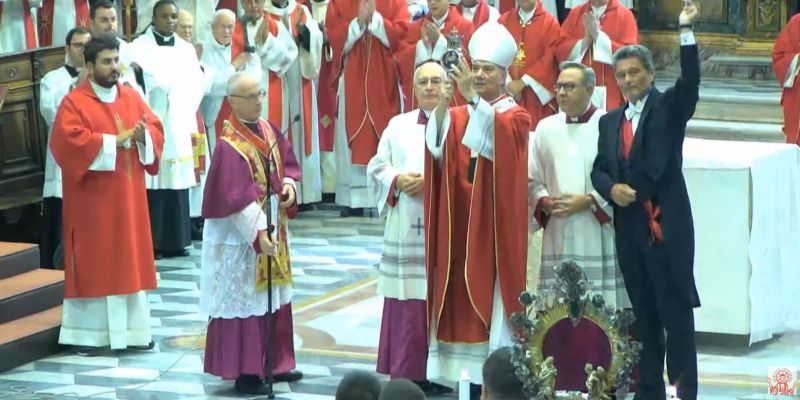
Santiago de Compostela, Spain, Jul 14, 2017 / 04:38 pm (CNA/EWTN News).- The bishops of Spain and France have published a new letter emphasizing the importance of hospitality for people who host pilgrims on the Camino de Santiago, offering guidelines for how they can welcome and care for the spiritual needs of those making the long trek.
In the letter the bishops noted that hospitality is a tradition that has been practiced in all ages and civilizations, and “is not to question or to prosecute, but only to welcome, to give food and drink, a bed and money for the trip, words of esteem and direction.”
It is the same kindness that Abraham showed to the strangers who came to his door in Mambre, and is “the mercy that the Samaritan showed to the wounded man, carrying him to an inn and leaving money so that he could be healed and recovered during the necessary time,” they said.
Published July 12, the letter is titled “Welcome and Hospitality on the Camino,” and is directed at those who host pilgrims that walk the historic “Camino de Santiago,” or “the Way of St. James.”
Often referred to simply as “the Camino,” it is an ancient pilgrimage consisting of a network of trails across Europe all leading to the tomb of the saint in Santiago, Spain.
Pilgrims have been making the journey for well over a thousand years to commemorate the life and sacrifice of the apostle. Although it is traditionally a religious pilgrimage, many non-believers also make the trek for a variety of motivating reasons.
The requirement to be a certified pilgrim of the Camino states that walkers must complete at least 100 kilometers, or about 62 miles.
Hundreds of thousands of pilgrims, individual or in groups, make the Camino each year, staying at hostels, low-cost hotels, with families or in religious communities along the way.
In the 20-page long letter, published in Spanish, the bishops of Spain and France pointed to the fact that hospitality “has a long tradition along the Camino de Santiago.”
This history, they noted, “was not always the most desirable,” and at times was marked by greed, deceit and a lack of compassion for the poor and sick. However, in recent decades the Camino has again taken up and multiplied hospitable initiatives and gestures.
“The presence of Christians on the Camino is essential to maintain the religious tradition of the great pilgrimage to Santiago de Compostela and to be active witnesses of faith in Christ,” they said, insisting that there be “visible signs” of the faith in places where pilgrims stay, but “without being exaggerated.”
As part of showing specifically “Christian” hospitality, the bishops asked that there be a crucifix at the entrance of the house or institution as well as one in each room. They also asked that there be an image of St. James, and accompanying brochures that explain his life.
They requested that an image of Mary also be hung somewhere in the building, and if possible, that it be a representation of a local Madonna. They also encouraged hosts to provide bibles in different languages and recent writings of the Popes.
Pamphlets and fliers with guides to nearby monuments and announcements of feasts and activities in Santiago, the final destination of the pilgrimage also ought to be provided, as well as information on prayers and different novenas, and papers with information on liturgies, hostels, museums and office hours for the Pilgrim Office in Santiago.
If there is a church near to the location of where the pilgrim is staying, the host, with the help of local parishioners, is encouraged to speak with the priest to arrange the opening hours so their guests can have the opportunity to “contemplate and meditate” about their experience.
The bishops also urged these parishes to offer Vespers, Mass and a special blessing for pilgrims before they start their journey again. If there is a priest among the group of pilgrims, they are asked to officiate the celebrations and announce them so that others may also participate.
Christian hosts are also asked by the bishops to advise other, non-Christian hosts of the church and office opening hours in case pilgrims staying with them are interested.
For religious houses and monasteries that host pilgrims, the bishops noted that many pilgrims “look for them and appreciate” staying with them. As such, the institutions “must be expanded” and offered “targeted support” to help them provide for pilgrims’ needs.
They are asked by the bishops to invite guests to respect the rules of the order and to keep silence, and to pray with members of the order when possible.
Members of the order, depending on their specific rule, may also eat with pilgrims at meal times. When opportunities arise, they are encouraged to speak with pilgrims, to listen to them and to explain their vocation.
In order to ensure that there is always someone available for this specific task, the bishops asked that all monasteries designate a specific monk or sister fill the role, “so that at whatever time of the day they reach the monastery they can be welcomed as Christ himself.”
As in regular hostels and hotels, the bishops requested that monasteries and convents also provide information on the Santiago pilgrimage and what they will find at the end, as well as on the history of their order, their specific monastery and those who inhabit it. In the case of parishes, they are requested to have information available on the priesthood.
For individuals who decide to host pilgrims, the bishops stressed the importance of being well-formed in the faith, saying “the mere act of being baptized and a practicing Catholic is not enough to be a Christian host.”
“A formation is needed which allows one to deepen in their own faith,” they said, noting that hosts will inevitably have to respond to a variety of different questions on the faith, including deeply reflective questions on the Nicene Creed, the Our Father prayer, religion, morals and the Church itself – her history, administration, role and how it differs from other denominations.
The bishops emphasized the importance of listening to pilgrims without asking jarring or probing questions, saying “the Christian host is not a journalist nor a psychologist.”
“Journalists need immediate answers, opinions on progress; that the interviewee provides, without reflection, their feelings about the event that has just occurred,” they said.
“Neither is the Christian host a psychologist or social assistant who, eager to put maieutics into practice, will try to get the other to speak about themselves and so formulate notions that the interlocutor doesn’t know or had never expressed.”
“Maieutics” refers to the method used by Socrates when he attempted to elicit knowledge from a person through interrogation and an insistence on close and logical reasoning.
“Not everyone is Socrates,” the bishops said, stressing that to impose dialogue on someone that begins with questions such as “what is your impression?” or “is the Camino giving you what you hoped for at the beginning?” will only prompt immediate and superficial answers, such as “there are too many people,” or “I met a nice couple.”
Rather, a Christian host, they said, “must give testimony of their faith in at least two ways. In first place, by example.”
This example doesn’t lie in the mere fact of being a “Christian” hotel or hostel, but the welcome pilgrims receive “must be open, fraternal and joyful for all and whoever arrives, without distinction, even if the pilgrim is in a bad mood, has a bad temper, smells bad or is even aggressive.”
“In every pilgrim that appears, the host will see Christ, will see the work of the Creator, and will welcome him into their home,” the bishops said, urging hosts to receive pilgrims “with joy, because the faith should not be sad, sulky or depressed.”
The bishops also stressed the importance of conveying the pilgrimage as a journey toward hope in which each step brings the pilgrim closer to their goal.
“Each host is a testimony of this hope, of the love of God, of the forgiveness of sin, of redeemed humanity,” the bishops said, adding that “their way of being, their method of welcome, the deep joy that they must radiate, are testimonies of the faith.”
“The host will also give testimony to their faith by listening to the pilgrim if they want to talk,” however, “they will not at any time force that desire to express oneself.”
In order to help pilgrims on along their journey, the bishops requested that specifically Christian hostels operate on donations, or at “a very affordable price.” They also encouraged those who have completed the Camino to volunteer, so they can “give back what they have received during their pilgrimage.”
The bishops closed the letter noting that, according to Pope Francis, to be a pilgrim means primarily “to be in movement, to be uninstalled, to go out from stillness, which becomes a comfort that paralyzes and waits – inactive, routine, formalistic – and to advance free of conditions, to read with realism the events of existence.”
“The experience of the pilgrimage is seen by the Pope as a great symbol of human and Christian life,” they said, and entrusted all who give hospitality to the protection of Mary.
Because it is through Mary, they said, that the Son of God “entered and began his pilgrimage in the world and, as a consequence, the truth of the incarnation and of redemption is linked to the truth of Mary.”
[…]
There is something I don’t understand. I mean the logic in this affair is somehow strange: this student was supposedly discriminated against because he didn’t receive the homework pass other students obtained for participating in the choir, which led his mother to feel “punished” for being atheists. But I think they took the issue from a distorted point of view: when someone is rewarded for doing something, it’s meant to congratulate and encourage this person, not to punish the others who couldn’t do the same thing. For exemple, nobody would say that rewarding children for participating in a charity cake sale is discriminatory against other children who don’t like cakes or sweets and therefore would not participate. This doesn’t mean that these children don’t have interests in other fields where they can succeed. It’s the same here. This is a Catholic school, thus it’s normal for it to promote religious events. And it’s worth mentioning that the rewarded students were not given extra grades or exam pass, they were only given a homework pass. In a normal situation, a student would have homework to do, so students who didn’t participate were pursuing a normal school life, no more no less. They weren’t “punished”, nothing was taken away from them, but I understand that a child might feel sad about this. Nevertheless, this is not a discrimination (it has become the privileged victimizing word nowadays). In addition, this child is certainly not the first atheist student in this school, and it’s clearly not the first religious event promoted by the school. If I were to be in a Muslim school, and students who fasted during Ramadan were rewarded, I wouldn’t label it discriminatory, because it’s the school’s identity. Even though maybe I would have used a different way to promote this event (like giving some little valuable Catholic gifts), what has been done here is definitely not an unfair treatment. I believe the true problem is the growing demand for secularizing Catholic schools, which is disrespectful towards their identity. This can be seen in the mother’s refusal to accept the money (for a commendable reason at first sight), hoping that the ruling itself will have an impact (hinting that her aim was not confined to this very situation). The usual tactic of aiming at people’s feelings is widely used here, when she alleges that the school does not seem to accept that they have a different set of beliefs, or that it punishes them for not being Catholics. With this, she can definitely bring the case on her side (it has shown its effectiveness in countless other cases). This is a pretty sad reality.
This shows the idiocy of the parents and at last a school that is Catholic. We now have a situation where children in Catholic families who practice and attend Mass are now subject to bullying by children like this pupil. Teachers have noticed this and was covered at a governmental inquiry. But of course it won’t come to anything except that these children are following the way of the Master and their parents should rejoice. It it was associated with the rainbow brigade you would see the bullied dealt with immediately!!! Nevertheless, to those who suffer, rejoice your names are in theBook of Life👼