Vatican City, Jun 25, 2017 / 02:03 am (CNA/EWTN News).- If Jose Brochero doesn't sound like a Gaucho name, nothing does.
Last year, Pope Francis canonized Saint Brochero, a fellow countryman from Argentina also known as the “Gaucho priest.”
He was beatified in Sept. 2013 by Pope Francis, who said Fr. Brochero was a priest who truly “smelled of his sheep.” He was canonized Oct. 16, 2016.
Saint Brochero was born Jose Gabriel del Rosario Brochero in Argentina in 1840, the fourth of ten children to Ignacio Brochero and Petrona Davila.
St. Brochero entered seminary at the age of 16, and was ordained a priest at the age of 26 for the Archdiocese of Cordoba.
As a priest, after teaching philosophy at a seminary for a few years, Fr. Brochero was assigned to the large diocese of St. Albert – 1,675 square miles with 10,000 far-flung parishioners in the rural, Great Highlands region of Argentina.
Not deterred by altitude, distance or bad weather, Fr. Brochero was known for riding throughout the countryside of his parish on the back of a mule to bring his people the sacraments, always wearing a poncho and sombrero in the style of a gaucho, or Argentinian cowboy.
On muleback, he carried an icon of the Blessed Virgin Mary, his Mass kit and a prayer book on his travels so that he was always prepared to offer the sacraments. He established a House of Exercises where his people could participate in spiritual exercises, and helped found a school for girls.
He is also credited with building post and telegraph stations, for building nearly 125 miles of roads, and for helping plan the railroad in the area.
“Woe if the devil is going to rob a soul from me,” he is held to have said, capturing his determined spirit to be close to his people no matter what.
Fr. Brochero was known for being particularly close to the poor and the sick, and helped care for those who contracted cholera during the epidemic in 1867. Eventually, he contracted leprosy from a leper in his parish, causing him to eventually become blind and deaf and to relinquish his parish duties, spending his last few years living with his sisters at home.
Fr. Brochero died on Jan. 26, 1914. His last words were: “Now I have everything ready for the journey.”
A few days after his death, the Catholic newspaper of Cordoba wrote: “It is known that Father Brochero contracted the sickness that took him to his tomb, because he visited at length and embraced an abandoned leper of the area.”
In 2012, Pope Benedict XVI approved a healing miracle attributed to Fr. Brochero, in which 13-year-old Nicolas Flores, who was in a vegetative state after a car accident, was cured through the intercession of the gaucho priest.
An earlier version of this article was published on CNA July 14, 2016.
If you value the news and views Catholic World Report provides, please consider donating to support our efforts. Your contribution will help us continue to make CWR available to all readers worldwide for free, without a subscription. Thank you for your generosity!
Click here for more information on donating to CWR. Click here to sign up for our newsletter.
Statuary sits before imagery of the recently canonized saints in St. Peter’s Square at the Vatican, Sunday, Oct. 20, 2024 / Credit: Daniel Ibáñez/CNA
Vatican City, Oct 20, 2024 / 11:00 am (CNA).
Pope Francis canonized 14 new saints on Sunday, including a father of eight and Franciscan friars killed in Syria for refusing to renounce their faith and convert to Islam.
In a Mass in St. Peter’s Square on Oct. 20, the pope declared three nineteenth-century founders of religious orders and the eleven “Martyrs of Damascus” as saints to be venerated by the global Catholic Church, commending their lives of sacrifice, missionary zeal, and service to the Church.
“These new saints lived Jesus’ way: service,” Pope Francis said. “They made themselves servants of their brothers and sisters, creative in doing good, steadfast in difficulties, and generous to the end.”
Pope Francis speaks at a Mass and canonization of 14 new saints in St. Peter’s Square on Sunday, Oct. 20, 2024. Credit: Daniel Ibáñez/CNA
The newly canonized include St. Giuseppe Allamano, a diocesan priest from Italy who founded the Consolata missionary orders, and St. Marie-Léonie Paradis, a Canadian nun from Montreal known for founding an order dedicated to the service of priests.
Also among the saints are St. Elena Guerra, hailed as an “apostle of the Holy Spirit,” and St. Manuel Ruiz López and his seven Franciscan companions, all martyred in Damascus in 1860 for refusing to renounce their Christian faith.
The final three canonized are siblings, Sts. Francis, Mooti, and Raphael Massabki, lay Maronite Catholics martyred in Syria along with the Franciscans.
Thousands of pilgrims prayed the Litany of the Saints together in St. Peter’s Square before Pope Francis declared the 14 as enrolled among the saints “for the honor of the Blessed Trinity, the exaltation of the Catholic faith and the increase of the Christian life, by the authority of our Lord Jesus Christ, and of the Holy Apostles Peter and Paul.”
“We confidently ask for their intercession so that we too can follow Christ, follow him in service and become witnesses of hope for the world,” the pope said.
In his homily, Pope Francis highlighted how service embodied the lives of each of the new saints. “When we learn to serve,” he said, “our every gesture of attention and care, every expression of tenderness, every work of mercy becomes a reflection of God’s love. And so we continue Jesus’ work in the world.”
The Gospel for the Mass was chanted in Greek in addition to Latin in honor of the 11 Martyrs of Damascus.
Pilgrims gather in St. Peter’s Square for a Mass and canonization of 14 new saints on Sunday, Oct. 20, 2024. Credit: Daniel Ibáñez/CNA
Father Marwan Dadas, a Franciscan friar from Jerusalem, was among those who attended the canonization. He said that the testimony of the martyrs from the Franciscan Custody of the Holy Land is especially meaningful to people who are suffering due to the ongoing war and violence in the region today.
“This is a good message to say that even though we have challenges — and it seems we have death continuously — we still have the light of God that is helping us and guiding us through these difficult periods,” Dadas told CNA.
“It’s an important message for me, and I hope it will be the message for all the people of the Holy Land, not only the Holy Land, but for everybody. It is a message from God saying that He is always with us.”
St. Giuseppe Allamano: A missionary heart
One of the most celebrated figures among the new saints is St. Giuseppe Allamano (1851–1926), an Italian diocesan priest who founded the Consolata Missionaries and the Consolata Missionary Sisters. Allamano, though he spent his entire life in Italy, left a global legacy by training missionaries who carried the Gospel to remote corners of Africa, Asia, and South America.
Allamano told the missionaries in the order he founded in northern Italy in 1901 that they needed to be “first saints, then missionaries.”
The medical miracle that led to Allamano’s canonization involved the healing of a man who was attacked by a jaguar in the Amazon rainforest. In 1996, a man named Sorino Yanomami, a member of the indigenous Yanomami tribe in the Amazon, was mauled by a jaguar and left with life-threatening injuries.
As doctors treated his skull fractures, Consolata missionaries prayed in the hospital with a relic of Allamano, seeking his intercession. Miraculously, Yanomami recovered without any long-term damage, according to the Vatican’s Dicastery for the Causes of Saints.
Allamano, whose spiritual director was St. John Bosco, emphasized the importance of holiness in priestly life, telling his priests, “You must not only be holy, but extraordinarily holy.” His influence has endured through the orders he founded, present today in 30 countries across the globe.
St. Marie-Léonie Paradis: “Humble among the humble”
St. Marie-Léonie Paradis (1840–1912), a Canadian religious sister, also took her place among the new saints. She founded the Little Sisters of the Holy Family, an order whose spirituality and charism is the support of priests through both prayer and by taking care of the cooking, cleaning, and laundry in rectories in “humble and joyful service” in imitation of “Christ the Servant.”
During his homily, Pope Francis praised Paradis’ faith and underlined that “those who follow Christ, if they wish to be great, must serve by learning from Him” who made himself “a servant to reach everyone with his love.”
Born in the Acadian region of Quebec, Paradis also spent eight years in New York serving in the St. Vincent de Paul Orphanage in the 1860s and taught French at St. Mary’s Academy in Indiana, before founding her religious order in New Brunswick, Canada.
Paradis’ canonization was supported by the miraculous healing of a newborn in Canada, attributed to her intercession.
St. Elena Guerra: An “apostle of the Holy Spirit”
Among the canonized was St. Elena Guerra (1835–1914), known for her ardent devotion to the Holy Spirit. Guerra, who founded the Oblates of the Holy Spirit, was instrumental in promoting the first-ever novena to the Holy Spirit under Pope Leo XIII in 1895. Her writings and spiritual leadership inspired many, including St. Gemma Galgani, a mystic and saint who was her student.
For much of her 20s, Guerra was bedridden with a serious illness, a challenge that turned out to be transformational for her as she dedicated herself to meditating on Scripture and the writings of the Church Fathers. She felt the call to consecrate herself to God during a pilgrimage to Rome with her father after her recovery and went on to form the religious community dedicated to education.
During her correspondence with Pope Leo XIII, Guerra composed prayers to the Holy Spirit, including a Holy Spirit Chaplet, asking the Lord to “send forth your spirit and renew the world.
“Pentecost is not over,” Guerra wrote. “In fact, it is continually going on in every time and in every place, because the Holy Spirit desired to give himself to all men and all who want him can always receive him, so we do not have to envy the apostles and the first believers; we only have to dispose ourselves like them to receive him well, and he will come to us as he did to them.”
The Martyrs of Damascus: Courageous witnesses of faith
The solemnity of the ceremony was heightened as Pope Francis canonized the Martyrs of Damascus, a group of 11 men killed in 1860 for refusing to renounce their Christian faith and convert to Islam. The martyrs, including eight Franciscan friars and three laymen, were attacked in a church in the Christian quarter of Damascus during a wave of religious violence.
The canonized Franciscan friars include six priests and two professed religious — all missionaries from Spain except for Father Engelbert Kolland, who was from Salzburg, Austria.
Franciscan Father Manuel Ruiz, Father Carmelo Bolta, Father Nicanor Ascanio, Father Nicolás M. Alberca y Torres, Father Pedro Soler, Kolland, Brother Francisco Pinazo Peñalver, and Brother Juan S. Fernández were all declared saints.
The three laymen were brothers — Francis, Abdel Mooti, and Raphael Massabki — known for their deep piety and devotion to the Christian faith. Francis Massabki, the oldest of the brothers, was a father of eight children. Mooti was a father of five who visited the Church of St. Paul daily for prayer and to teach catechism lessons. The youngest brother, Raphael, was single and was known to spend long periods of time praying in the church and helping the friars.
According to witnesses, the brothers were offered the chance to live if they renounced their faith, but they refused. “We are Christians, and we want to live and die as Christians,” Francis Massabki reportedly said. All 11 were brutally killed that night, some beheaded, others stabbed to death.
“They remained faithful servants,” Pope Francis said. “[They] served in martyrdom and in joy.”
A global celebration
The canonization ceremony was attended by pilgrims from around the world, including Catholics from Kenya, Canada, Uganda, Spain, Italy, and the Middle East. More than 1,000 members of the Consolata order traveled to Rome to witness the canonization of their founder.
And bagpipers from Galicia in northern Spain played traditional music at the end of the Mass to honor the Spanish Franciscans canonized among the Damascus martyrs.
Bagpipers play to honor the Spanish Franciscans canonized among the Damascus martyrs at the Vatican on Sunday, Oct. 20, 2024. Credit: Courtney Mares
“I thank all of you who have come to honor the new saints,” Pope Francis said. “I greet the cardinals, the bishops, the consecrated men and women, especially the Friars Minor and the Maronite faithful, the Consolata Missionaries, the Little Sisters of the Holy Family and the Oblates of the Holy Spirit, as well as the other groups of pilgrims who have come from various places.”
Pope Francis led the crowd in the Angelus prayer at the end of the Mass and asked people to pray in particular for the gift of peace for “populations who are suffering as a result of war – tormented Palestine, Israel, Lebanon, tormented Ukraine, Sudan, Myanmar and all the others.”
The pope also greeted a group of Ugandan pilgrims who traveled from Rome to mark the 60th anniversary of the canonization of the Ugandan Martyrs and urged people to pray for missionaries on World Mission Sunday.
“Let us support, with our prayer and our aid, all the missionaries who, often at great sacrifice, bring the shining proclamation of the Gospel to every part of the world,” he said.
“May the Virgin Mary help us to be like her and like the Saints courageous and joyful witnesses of the Gospel.”
Rome, Italy, Dec 7, 2019 / 07:12 am (CNA).- Birmingham’s Bishop Robert Baker said Friday there is a hopeful spirit about the renewal of the Church in the United States at the end of the latest round of ad limina visits with Pope Francis and other… […]
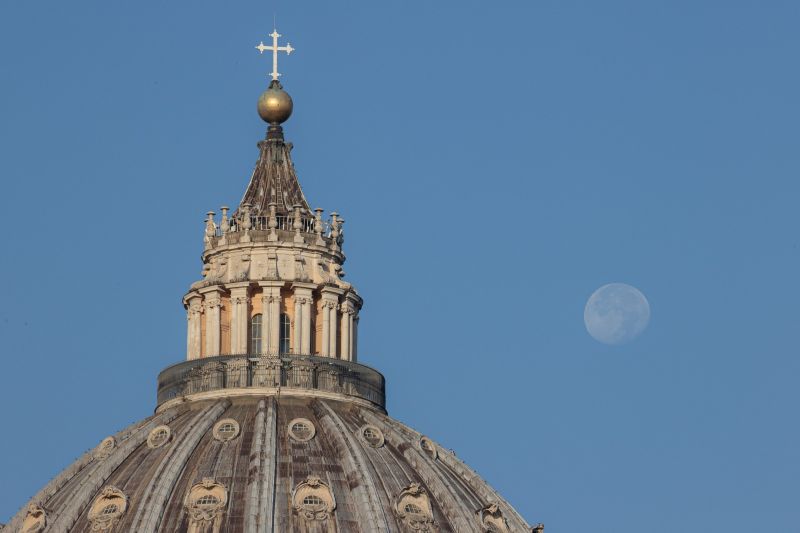
The moon was visible over St. Peter’s Basilica, Vatican, on the morning of Oct. 12. 2022. / Daniel Ibáñez / CNA
Vatican City, Jun 22, 2023 / 04:10 am (CNA).
Vatican City’s chief prosecutor, who is investigating the 40-year-old case of a missing teenage girl, has shared information deemed “worthy of further investigation” with Rome prosecutors.
Vatican prosecutor Alessandro Diddi said June 22, the anniversary of 15-year-old Emanuela Orlandi’s disappearance, that his office “has collected all the evidence available” in the case of the so-called “Vatican girl.”
Diddi reopened investigations in January after Pope Francis gave him “maximum freedom of action to investigate [Orlandi’s case] on a broad scale without conditions of any kind.”
Emanuela Orlandi was the teenage daughter of Ercole Orlandi, an envoy of the Prefecture of the Pontifical House and a citizen of Vatican City State. Her disappearance on June 22, 1983, after leaving for a music lesson in Rome, has dominated headlines and been the subject of speculation for decades.
Diddi said Thursday he has interviewed people in charge of certain offices at the time of Orlandi’s disappearance 40 years ago, and the office of the Promoter of Justice has examined the material, “confirming some investigative leads worthy of further investigation.”
Relevant documentation was sent this month to the prosecutor’s office in Rome, he noted, “so that the latter can take a look at it and proceed in the direction it deems most appropriate.”
The chief prosecutor said his office will continue its investigation over the next few months, adding that they are “close to the grief of Emanuela’s family and aware of the suffering one feels at the disappearance of a relative.”
Diddi met with Orlandi’s brother, Piero, and the family’s lawyer, in April. According to Vatican spokesman Matteo Bruni, the meeting, requested by Orlandi, served as an occasion for Orlandi to “make his own statements and to offer any information in his possession to the file opened by the Vatican promoter of justice in January.”
Diddi clarified in an interview in April that his investigation is limited to the confines of Vatican City State. He said: “I enjoy broad autonomy, but for investigations on Italian soil I necessarily have to interface with the public prosecutor’s office of Rome and with the new prosecutor Francesco Lo Voi.”
The Vatican said in January the Emanuela Orlandi case was being reopened at the request of the family.
Public interest in the case was also rekindled last fall after the release of “Vatican Girl: The Disappearance of Emanuela Orlandi” on Netflix.
The true-crime docuseries, which premiered on the streaming service in October 2022, featured interviews with subjects who proffer numerous theories about Orlandi’s disappearance, none of which have been substantiated.
In the final episode, the docuseries presents a theory that the Vatican was involved in some way in Orlandi’s disappearance, based on a new interview with a childhood friend of the missing girl. The Vatican denies having any role in her disappearance.
In 2019, the Vatican agreed to open two tombs in the cemetery of the Teutonic College, which sits on Vatican-owned property adjacent to the city-state, on the strength of a tip received by the Orlandi family that the missing girl’s remains would be found there.
The graves were found to be completely empty, and in an unexpected twist, Vatican officials discovered “thousands” of human bones — not Orlandi’s — in a previously unknown ossuary nearby.





Leave a Reply