


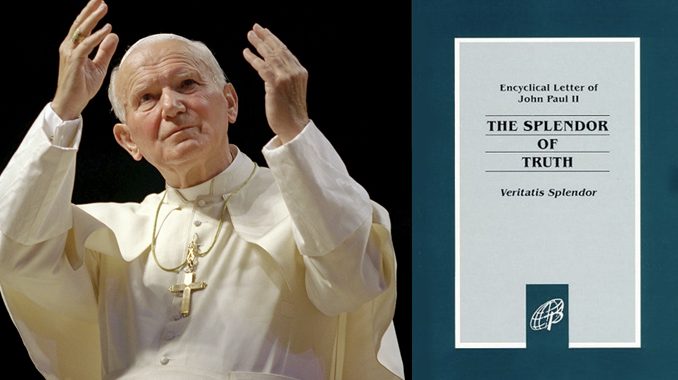
After watching “White Christmas” with the family for the umpteenth time last December, I was moved, perhaps by a demon, to scribble a spoof of the song, “Choreography.” There, Danny Kaye laments “the theater, the theater, what’s happened to the theater/especially where dancing is concerned”—dancing having been replaced by choreography.
With deepest apologies to Irving Berlin, I offer my little burlesque here before getting down to some serious business:
The doctrine, the doctrine, what’s happened to the doctrine?
Especially where “context” is concerned.
Profs who taught truths
Aren’t teachin’ truths no more, they do contextuality.
Censors who caught goofs
Aren’t catchin’ goofs no more, they love contextuality.
Prefects who were brilliant
Would stop the show in days that used to be.
But now the show is o’er, the old truths ain’t no more,
Instead of truth it’s all con-text-u-al-i-ty!
Enough.
The moral theology method known as “proportionalism” holds that the morality of an act is determined by a sort of calculus involving the nature of the act, the intentions of the actor, and the consequences of the action. Moral judgment, in other words, is a matter of “context,” in which the subjective counts as much or more than the objective. Central to this theory is the notion that there are no “intrinsically evil” acts—things that are always and everywhere wrong, irrespective of the context (intentions and consequences). Rebutting that and reaffirming the settled view of the Catholic Church that some things are morally off the board, period, was one aim of Pope John Paul II’s 1993 encyclical, Veritatis Splendor.
John Paul’s teaching sent the establishment theologians’ guild into a tizzy. The full absurdity of their claim that there are no intrinsically evil acts (or, if there are, we really can’t know them to be such) was only brought home to me, however, during a National Public Radio discussion of the encyclical.
My fellow guest, a woman appalled by the encyclical, insisted—I am not making this up—that Einstein’s theory of relativity applied to morality, and then tried to slam dunk on me by challenging me to name one intrinsically evil act. To which I responded, quietly, “What combination of intentions and consequence would justify your being raped in the parking lot outside this building after our discussion?”
We moved on to other points.
While explaining the importance of understanding that some things are wrong, full stop, John Paul II made two interesting, subsidiary points in Veritatis Splendor.
First, it drains the moral life of its drama, and thereby diminishes our humanity, to deny that intrinsically evil acts, known to be such and willfully committed, are grave sins. Second, in a world where we’re surrounded by human inequality (of intelligence, beauty, ability to throw a 105-m.p.h. fastball, play Hummel’s Third Piano Concerto, or perform “Classical Gas”), the fact that everyone is obliged to avoid intrinsically evil acts is a sturdy foundation for defending the claim, basic to democracy, that we are all created equal. Someday, someone should write a book of democratic theory based on that insight.
For the moment, though, and I finally come to the main point, what will the proportionalist theological guild offer the Artificial Intelligence titans who candidly admit, “I don’t think there is anything objectively more or less ethical,” or who blithely allow that “I don’t believe morality is objective”? Anthropic’s large language model “Claude” now has a “constitution” stating that “our collective moral knowledge is still evolving,” a view that is seemingly compatible with an app built with “Claude” sending a 17-year-old to a “sex-positive clinic” that offers “queer, polyamory, and kink-informed therapy for teens.”
I very much doubt that the AI titans have ever heard of proportionalist moral theology. That’s the good news. The bad news is that these brilliant people live in a culture that, while perhaps grudgingly acknowledging “your truth” and “my truth,” cannot conceive of the reality of the truth: a culture in which proposing that some things are wrong, period, is “insensitive,” “intolerant,” “undemocratic,” “misogynistic,” “transphobic,” “homophobic,” or all of the above.
If religious ethicists and moral theologians, stuck in the quicksand of “contextuality,” cannot identify the moral boundaries that revelation, reason and 5,000 years of human experience have taught us are essential to personal happiness and social solidarity, they’re not going to help the masters of the AI universe develop this extraordinary technology in ways that do not further degrade our culture, society, and politics.
Only those with a firm grip on the reality of immutable moral truths will be able to shape an intelligent AI conversation and offer the needed ethical counsel — and perhaps even invite the techies to conversion.
If you value the news and views Catholic World Report provides, please consider donating to support our efforts. Your contribution will help us continue to make CWR available to all readers worldwide for free, without a subscription. Thank you for your generosity!
Click here for more information on donating to CWR. Click here to sign up for our newsletter.




Do you remember “situational ethics”? It was big in its time. There’s nothing new under the sun.
Well, AI is new. And Wiegel’s concerns are on point. Since AI learns from us, if our ethics are fluid, why should we be surprised when AI “contextualizes” every moral question put to it?
Our collective moral knowledge is indeed still evolving. There are certainly intrinsically evil acts, but circumstances can change the nature of an action (the moral object), and that’s what makes moral science a bit more complicated than what the typical absolutist seems to believe. It took centuries to discover that the ethics of killing is far more complex than once thought–I’m referring to the introduction of the principle of double effect. And moral science has not stopped developing. The vast majority of moral issues can become very difficult, the more variables we bring into the picture. This is especially true with regard to issues surrounding gender. The trick is to avoid the “know it all dogmatist” (moral absolutist) on the one hand, who thinks morality is as simple as abortion and “raping someone in a parking lot”, and the absolute relativist on the other.
Are you suggesting that the moral absolute might evolve if the singular event in a parking lot setting were changed to, say, a smorgasbord of options on an island in the Bahamas? Our “collective moral knowledge?” The “double effect” that all those plane tickets boost the GNP?
“the typical absolutist”
Thanks for telling us your bias. We can now be saved the time reading what you write.
Thomas James: Congratulations on your descent into atheism if this is your goal. Morality does not evolve. It is eternal, transcendent, and absolute because the mind of God cannot be one of idiocy.
There are only two philosophies, everything else is derivative. Either God is a fool or we are. Were it the first, truth would always be in flux and creation would not exist. Since it actually is the latter, it is for this reason that our sinfulness causes us to n fail to see that God did not abandon us to our vanities. There are principles of how we ought to order our lives together that are true not because they receive acceptance by “intellectual” movements, popular acceptance, or enshrinement in statutory law, but are true because they are inherent to the nature of being a decent human being, a decency not deluded through sinfulness.
Rearticulating immutable moral precepts over time, with a hope for improved understanding of what has always been true prior to contemporary expressions, does not create a different or “new” morality or an altered understanding from what has always been evident to an honest soul.
As far as the article goes, this is George Weigel at his best. I’ve expressed disappointment in him in recent years because of his unwillingness to criticize bad popes directly, but when George is at his best, he is brilliant.
“There are certainly intrinsically evil acts, but circumstances can change the nature of an action (the moral object)”
Horse Pucky. Circumstances can change the culpability of the act, but not the nature of it.
A developing human life is stuck in the fallopian tubes. The mother will hemorrhage to death. The doctor goes in and clamps down on the fallopian tubes, to the left and right side of the fetus, killing the child as a result of lack of oxygen. He removes the fetus. This is an act of a completely different nature (moral object) than the action of abortion, as a result of the circumstances. Two women are taking the birth control pill. The one woman has low estrogen and so the pill was prescribed in order to raise the estrogen level (leaving her infertile), but the other has different circumstances–she does not have low estrogen. She is taking the pill to prevent a possible child from being conceived. The consequences are the same, namely infertility, but the moral object of the acts are completely different. One is contraception, the other is not. Finally, I am a person who keeps my promises. That’s justice. I promise to come over for supper next Friday, like I promised I would. However, circumstances changed. I got the flu. I can still come over, but I think I’m going to have to break my promise. But doing so is not a violation of justice. I’m not violating a moral principle is failing to keep my promise.
Your reasoning is both confused and patronizing. Everyone knows different circumstances create different moral objects. We don’t need you to explain an understanding that God has built into the human nature of everyone He ever created.
What you get constantly wrong is believing that a change of moral object due to changing circumstances proves the absolute is not an absolute. What anyone with an honest mind can understand is that a change of moral object simply means a change occurs in which moral absolute applies.
Let me explain this so even you can understand. I call up my neighbor to return my ladder that he borrowed. He apologizes for not having returned it when he said he would but told me I can retrieve it myself since he knows I know he leaves his garage unlocked. I have a moral right to the return of my ladder. The next day I go to his house to retrieve my ladder but I find him up on the ladder cleaning his gutter. Now the sophist non-absolutist would say this illustrates that the belief in rightful return was not absolute. Sanity says otherwise. The moral object of the return of my ladder can not be applied at that moment. I do not desire to injure my friend by grabbing the ladder with him on it. But the moral absolute did not exactly evaporate. It simply could not be applied at that moment. A different moral absolute did, which was not to harm my friend and neighbor by pulling the ladder out from under him. Circumstances that change which moral absolute applies does not invalidate any moral absolute. Got it?
“I do not desire to injure my friend by grabbing the ladder with him on it.”
Depends on how long the thieving wretch has kept the ladder! 😉
You’re kind of careless in your reading, Edward. In my first post above, I made it clear that there certainly are intrinsically evil acts. I quote: “There are certainly intrinsically evil acts…” In terms of our collective moral knowledge as something that evolves, that means precisely what it says, our moral knowledge, our understanding of the moral law. That evolves. That is not to suggest that God changes, or what was immoral 1000 year ago is okay now. Moral principles are unchanging and are universal. But circumstances can change the moral object of an action, such that it is a completely different kind of act. We didn’t always know that, but with greater precision and further distinction, that becomes evident. It is certainly true that some circumstances do not change the nature of the act and only change the culpability (a young girl gets an abortion because she feels she is too young to be a mother and is afraid her parents will kill her if they find out she’s pregnant), but some circumstances change the nature of it (such as the ectopic pregnancy or some other unique circumstance). This Pitchfork guy denies the latter. And you should stop reading into my posts things that I did not say. That is patronizing. Got it?
Thanks Leslie. My blood pressure always eases up with a laugh.
Consequences are idiomatic and relate to effects. The effect of a human act should result in a good, although the effect of the act doesn’t necessarily determine its moral good or evil.
John Paul II isolates the object of the act, what the act actually does that determines morality. A good act is consequently ultimately ordered toward God. Intentions and effect are correctly cited by Weigel as the mistake of proportionalists. Although a good act may not, due to unforeseen conditions have an intended good effect.
Context may be understood as the ‘ground level’ conditions of the act. It’s here that the error of context comes to play, wherein idioms lived experience, concrete situations are considered realities that alter the moral content of an act. What is considered an act that is adultery might become simply an act of passion. It’s conceivable that intense passion may reduce culpability as admitted by Aquinas. Although that exception doesn’t render an evil act good.
That is the issue that underlies Amoris Laeitia, that the exception vanquishes the revealed rule and literally provides a new rule or new paradigm. Consequences and contexts are a bit more complex than proportionalists would have it.
Maybe the announced 2028 “synod” (now correctly framed as an “ecclesial assembly”) can address why the 2024 Instrumentum Laboris for the navel gazing “Synod on Synodality” (say what?) used the term synod/synodal/synodality some 228 times while noticing Veritatis Splendor not even once.
“What combination of intentions and consequence would justify your being raped in the parking lot outside this building after our discussion?”
Really disturbing that you would choose rape as an example. And in debate with a female theologian. Yikes. If she wasn’t as shocked as I am, she might have proposed a much more apt example; can you not see the relative difference between raping a stranger and sex without consent due to intoxication? Both are legally rape and morally wrong, but few would argue to the same degree. Circumstances matter.
Weigel’s point is disturbing precisely because it’s correct.
You’re making too much of a perfect point he made with the woman at the NPR seminar. He could have said homicide if she was stabbed or gunned down but that’s too easy as an obvious evil.
NPR broadcast an abortion sounds to help pass prop 3 in Mi, if that gives you any clue as to their belief and tolerance system.
Circumstances affect mitigation of sinful intent. Circumstances never alter the reality of intrinsic right and wrong. Got it?
The Catholic emphasis on mitigation created the basis for Western statutes the distinguish such things as first, second, or third degree murder.
Thank you for repeating exactly what I previously said, Ed. It’s such a rare treat to agree with you!
Feigned indignity?
It’s amazing how the woke so easily get their panties all twisted.
It’s not that Weigel is incorrect, it’s that it is just not that simple. Very few absolute relativists around today, so there’s a bit of a straw man employed here. Of course the caller is going to agree that rape is absolutely unjustified. But in the vast majority of cases, circumstances do indeed change the nature of the act, i.e., keeping promises. It’s similar to the difference between science and calculus. Because the latter takes place on a higher level of abstraction, it is easy to arrive at absolute certainty, but biology is a lot more difficult to achieve certainty, because it is less abstract. Moral science becomes increasingly difficult as issues become less abstract.
Your invocation of the ideological notion of “moral science” belies your contention that there are few moral relativists remaining. The moral exoneration industry is demonic. Every time a human creature sins, it is from the self-imposed lie of relativism.
Absent inebriation of both parties, let’s say they split a bottle of Wild Turkey, the act of intentional rape is fairly clear cut, is it not? Other than the under the influence you also have to drop some of the clothing. Then there’s the oral communication to consider.
If someone had shot Trump on 5th Ave is that still an evil act if you hate him?
Seems like there’s some hair splitting here or am I missing the big picture?
Curious wording to say that “rape is absolutely unjustified.” Only “unjustified”? The accurate term is “intrinsically evil.”
And what is this middle-ground zone called “moral science”? The accurate term is “moral theology.” The comparison with science and calculus also limps.
Moral absolutes are concrete, not abstract, and sometimes have been explained this way: “There’s no compelling argument not to slit anybody’s throat except the Commandments given on Mount Sinai.”