


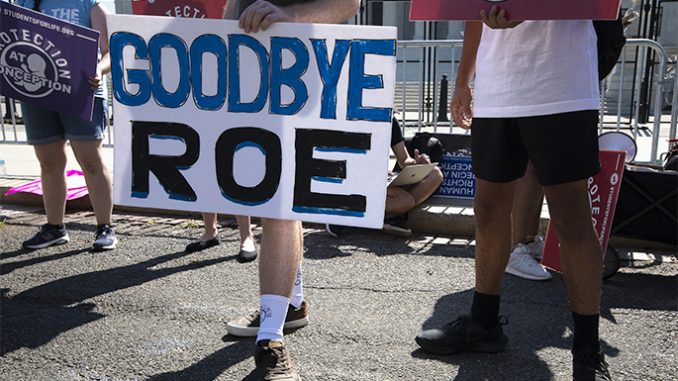
There is no doubt that Dobbs v. Jackson Women’s Health Organization, decided four years ago this month, was a legal triumph. In overturning Roe v. Wade, it eliminated the constitutional right to abortion that the Supreme Court curiously discovered hiding in the 14th Amendment. Authority for regulating abortion thus departed from the judicial branch and returned to the people and their elected representatives.
In subsequent months, many states held ballot referenda and state legislatures passed laws that, depending on the state, either banned abortion outright, limited it within a certain gestational period, or enshrined abortion as a state constitutional right. Four years later, the abortion landscape resembles the U.S. electoral map: some red, some blue, and some purple. The people have spoken.
Or so Dobbs expected. Despite near-total bans on abortion in thirteen states and another six with bans inside of twelve weeks gestation that took effect these past four years, the number of abortions nationwide has risen an astounding 21% since 2020, according to the Alan Guttmacher Institute. One cause of this counterintuitive post-Dobbs rise is that women in the thirteen states with near-total bans—72,000 women in 2024 and 91,000 in 2025—have used telehealth provisions to receive abortion pills prescribed by doctors who reside in blue states and are protected from prosecution by shield laws.
How can the laws of one state, decided according to the legislative process, be so easily trampled? The abortion pill mifepristone, which, again according to Guttmacher, induced 65% of clinician-provided abortions in 2023, is regulated by the Food and Drug Administration (FDA). States cannot outlaw a federally sanctioned drug. Not only does the FDA approve mifepristone, but the Biden administration also removed the physician visit requirement to receive a prescription. By the stroke of a pen, the federal bureaucracy has sidelined Dobbs’s states’ rights provision and rendered state abortion bans almost meaningless.
The Biden administration shifted the primary battlefield for culture war issues from the courts to the federal administrative bureaucracy, and the Trump administration has followed suit. Education, religious freedom, DEI, and transgender concerns all turn on the White House’s preferred views that are imposed by threats of lawsuits or by cuts in federal aid. It should not come as a surprise that abortion, the preeminent culture war issue, would also be subsumed by the federal administrative state once it was severed from Roe’s leash. Dobbs did not anticipate this. Formerly, after Roe, pro-life conservatives complained for decades about the judicial usurpation of politics. Today, after Dobbs, pro-life conservatives are now complaining that their agenda has been usurped by the executive branch’s bureaucracy.
Of course, this bureaucracy operates at the will of the president, who, unlike federal judges, is directly elected by the people. Yet President Donald Trump, the self-proclaimed most pro-life president in history, has repeatedly rebuffed pressure from his pro-life constituency to at least repeal the telemedicine exception for mifepristone, if not remove it from the market entirely. He has grounds for the latter, either by enforcing the Comstock Act that bans the shipping of abortion drugs or by the FDA finding the drug unsafe. He has done neither, and he has shown no interest in taking any such action.
The majority ruling in Dobbs did not foresee that the president, not the states, would set the agenda for subsequent abortion litigation—just as the president does for every other pressing issue. Biden and Trump have now established the post-Dobbs approach for their respective parties. Democratic presidents will utilize the administrative state to keep mifepristone a telehealth appointment away, to undermine state abortion restrictions at every turn, and to limit religious and conscience exemptions for abortion refusers.
Republicans, fearful that a strong stance against abortion will hurt their electoral prospects, will ironically adopt practices once championed and now abandoned by Democrats. They will proclaim that they are “personally opposed to abortion” to attract primary voters but will add that they “will not impose their views on others.” They will declare that abortion should be “safe, legal, and rare.” They will duck controversy by claiming abortion belongs to the states, though they know that is not true. When in office, they will adopt a “don’t ask, don’t tell” policy to cover their functionally pro-choice administrations.
Dobbs could have avoided this situation in two ways. First, it could have stated explicitly that the unborn child is a person and therefore entitled to equal protection under the law. Instead, it imitated Roe by claiming the “Court has neither the authority nor the expertise to adjudicate” disputes “about the status of the fetus.” Legal scholar Gerard Bradley has argued that Dobbs’s proper interpretation assumes the humanity of the unborn child. Even if this were true, because this point is effectively consigned to the decision’s penumbras, the unborn child will continue to lack legal standing indefinitely. If the Roberts court, with its six conservative justices, could not muster the courage to extend equal protection to the unborn explicitly, it’s very difficult to imagine a future court that will.
Second, Dobbs could have ruled that abortion should again be illegal, as it was for most of America’s history, on moral or procedural grounds. Instead, it chose agnosticism, which was best expressed by Justice Kavanaugh in his concurrence: “The Constitution does not take sides on the issue of abortion.”
In this regard, Dobbs, like other Roberts court rulings on culture war issues such as religious freedom and race, suffers from its unwillingness to push too hard in reversing a prior court decision. Though it resoundingly rejects Roe, Dobbs’s circumspection about the unborn child and about abortion itself has nullified its aspirations and left the abortion issue to be swallowed by the federal government.
Had Roe been overturned in 1982, abortion might well have again become a states-only issue. But in 2022, when the executive branch controls so much of American jurisdiction, abortion remains a federal issue. By failing to read the signs of the times, Dobbs has unwittingly maintained the situation it had sought to undo: future abortion policy disputes, as federal issues, will still require the Supreme Court to be resolved.
If you value the news and views Catholic World Report provides, please consider donating to support our efforts. Your contribution will help us continue to make CWR available to all readers worldwide for free, without a subscription. Thank you for your generosity!
Click here for more information on donating to CWR. Click here to sign up for our newsletter.

“Republicans, fearful that a strong stance against abortion will hurt their electoral prospects, will ironically adopt practices once championed and now abandoned by Democrats.”
.
Bingo. Pro-lifers have been focusing on the wrong thing–banning abortion–without the attacking (converting people from) the lifestyle that makes it “necessary.” Even the Christians among us are incredibly unchaste.
.
This is not a problem to be solved legally at this point. Not in a democracy. The Church must preach chastity and make it attractive. Catholic physicians (ob/gyns most of all), especially, must turn away from their support for contraception/sterilization procedures.
“The Church must preach chastity and make it attractive.”
What part of the Church? We are ruled by a ecclesial, civil and economic elite that not only doesn’t preach it actively undermines it. Do the names Cupich, McElroy and Martin ring a bell?
I am well aware of that. I am just stating what must happen, not what is too likely to happen.
.
I seem to remember Hadley Arkes arguing along this line at the time of the Dobbs decision.
Dobbs overturned Roe returning to the pre 1973 state of confusion . Hindsight is 20/20 but I do recall some voices warning of the consequences we are now experiencing.
Every son or daughter of a Human person, can only be, in essence, a Human person, regardless of one’s location, including if that particular person is residing in their Mother’s Womb. You have been you since the moment of your creation at conception and you, being you, a human person have been endowed with your unalienable Right to Life, the securing and protection upon which securing and protecting your Right to Liberty and The Pursuit of Happiness depend.
So true David…my heart breaks at the state of our government…..the only good to come out of Dobbs was that the states at least have rights. And we the people can still make a difference…..I hnow of a few women who had their babies because of the restrictions and so I rejoice in those precious lives saved…
Births have increased in states that have stricter laws to protect mothers & their developing children.
World Population hopeful forecast:
2050 – 10,000,000,000 ; 2150 – 1,000,000,000
Source UN
“The world population is projected to peak slightly earlier than in previous projections
The United Nations doesn’t only publish historical estimates of how population and demographic trends have changed in the past; it also makes projections for what the future might look like. To be clear, these are projections, not predictions of changes in the future.
In its 2022 publication, the UN estimated that, in its medium scenario, the global population would peak in 2086 at around 10.4 billion people.
This year’s edition brings this peak forward slightly to 2084, with the population topping at just under 10.3 billion…
This isn’t the first time the projected peak has been pulled earlier. According to its 2019 edition, the global population would reach 10.9 billion by 2100 and keep growing. The 2022 revision was the first to project a peak in the 21st century.”
******
There’s a demographic projection paper written for the UN in the 1970’s available online. It’s interesting to read what people were thinking back then & how that’s changed.
Unfortunately the Church lacks the courage & fortitude to define support for abortions in accordance with the 7-Stages of Sin…
State laws or judges decisions have little to do with the reality and causes of what is happening with abortion.. Too many people indulge in an “|anything goes” sexuality. That means sex anytime, with anyone. Recently in a “conservative” big city newspaper, a woman wrote a columnist asking how she could preserve her marriage when both she and her husband wished to indulge in “threesomes”! What sort of marriage exactly is she trying to preserve?? In an unrelated article in the same paper, an actress being interviewed about her life seemed to feel herself inexperienced because she had slept with “only” eight men. THIS in what is purported to be a family newspaper!!! Society has jumped into the mud and lost it’s collective mind.
I personally am horrified reading stuff like this. Printing it for all the world to see only seems like an attempt to normalize such behaviors. I believe such behavior is not at all normal or good for either society or the individual. Behavior such as this leads inevitably to a pregnancy viewed as a problem to be disposed of. It cant escape anyone’s attention that if they had not had illicit sex to begin with, a pregnancy would not have occurred. Sin begins and then it grows.
THIS is where the work of the church should begin again in earnest. My parish has several very fine priests. I will say however that issues of morality, sex outside of marriage, the need for chastity, etc, is NEVER about spoken from the pulpit. Likely they are concerned about complaints to the higher ups. But the reality is they are derelict in their duty if all they do is preach about God’s love and forgiveness but never talk about the sins which makes such gifts of God necessary.
Recently I have had two experiences of Catholic women say they never go to confession because they “dont know what to say”. Seriously?? Nice people, but saints? I think not. What is wrong with this picture? The church has to stop turning a blind eye to the fact that people no longer have a sense of sin, or right and wrong, even at the most basic level. The question is does the church have the spine to address it?? Unknown. But address it they must, and soon.
Agreed that the normalization of un chaste behavior has moved the Overton window so far that even Catholics can vote for a twice divorced thrice married man who speaks crassly of women without shame. I haven’t heard any preaching on that from the pulpit.
And what about the Baptized Catholic who no longer desires to fulfill his Baptismal Promise to be “A Temple of The Holy Ghost” who not only denies Christ’s teaching on respect for the Sanctity and Dignity of the marital act within The Sacrament of Holy Matrimony and thus God’s Will that we respect The Sanctity and Dignity of Human Life from the moment of conception while attempting to force Faithful Catholics to abandon The Catholic Faith by claiming that the desire to not affirm or accommodate the engaging in of demeaning sexual acts that no person should be engaging in because they deny the Sanctity and Dignity of all human life and are thus devoid of Love, are acts of hate, which every Faithful Catholic knows is Mr. Biden’s feeble attempt to substitute a lie for God’s Truth and a total misrepresentation of The Word Of God, our Savior, Jesus The Christ, and The Deposit of Faith Christ Has Entrusted to His One, Holy, Catholic,And Apostolic Church, In The Unity Of The Holy Ghost, Existing for The Salvation of Souls?
Selective outrage much? Whatever the litany of Trump’s faults, he was never raised in or accepted the Church. Compare that with the fake Scrantonian sanctimoniously fumbling his Rosary beads while serving as the trial balloon for same sex pseudonogamy, running the most pro-abortion and marrying a divorcee.
I have not reached the point where I consider divorce and remarriage on the same level as the murder which is abortion. I also have not yet met any democrats who are candidates for sainthood, so why bring up Trump at all?. It is arguable that Mr. Clinton’s scandalous sex in the oval office romp with a female subordinate much younger than himself, is much worse than simply “speaking crassly” of women.
There is plenty of sin to go around and its neither productive nor fair to simply pillory public figures we personally dislike. Indeed, Mr Trump is not a Catholic.
My point was that the church needs to start talking turkey about contemporary issues of sexuality and providing a really catholic point of view.. And if people leave the church I say, so what?
“Republicans, fearful that a strong stance against abortion will hurt their electoral prospects, will ironically adopt practices once championed and now abandoned by Democrats.”
This makes all the more critical the total abandonment of the failed “lesser evil” approach to voting, because that is in large part what got us to this point. It only gets worse the more we double down on utter failure. Politicians are either with us or against us, and if they refuse to act, they are against us and must not receive our vote for any office under any circumstances.
Michigan had some decent protections for the unborn. At one point, MI RTL was praised for doing excellent work (given the circumstances under Roe V Wade).
.
And then Roe v Wade happened and now abortion is enshrined in our Consitution. This happned under covid and the petition drive was like nothing I had ever seen. It hit hard and fast, and was approved with a solid majority.
.
The GOP condidate who ran against Whitmer said she was totally pro-life, no exceptions. She was soundly defeated.
.
Abortion ends when people are chaste, not because of legislation. We are a long, long way from that point.
So, what are the odds on this: Would the actual protection of the pre-born be more likely in our amoral democracy, or say, in the conversion of some future autocratic Constantine? Which would you think might be most easily accomplished: convincing one man, or convincing tens of millions?
We have seen, as the article discusses, that the judicial regime of child murder has been replaced by the executive/bureaucratic regime of child murder, and, not emphasized enough by the article, by the actual popular support for child murder expressed in the pure democracy of referendums, even in supposedly “pro-life” states like Ohio and Missouri.
And then there’s Alabama, where with the exception of Tommy Tuberville, the entire Republican establishment, executive, legislative and judicial, “pro-life” all, caved in almost literally overnight concerning the millions of children who will be discarded through IVF, all for the sake of bowing down before the idol of electoral politics.
Why does anyone at this point think that democracy will ever turn back in a better direction? Might our idolatry towards democracy ever be set aside even momentarily to consider that our whole view of government might be deeply flawed? I note that the one man in Europe’s governments who currently seems to actually care about the lives of the pre-born is the Crown Prince of Liechtenstein. I also note that through the decades the mostly powerless royalty of Europe has more often taken pro-life stands than the majority of the masses. But for this fact to penetrate, one would need to set aside if only for a moment the worship of democracy. Might it be that someone who doesn’t have to answer to elections, who has a position of authority that is stable, might be more able to protect the vulnerable?
Don’t panic folks, its not going to happen anytime soon, your opportunity to vote, which is the bait the idol uses to keep us all as worshippers, is not going to be taken from you. You can continue to use it even as millions upon millions are robbed of ever having the breath of life, and as our civilization becomes ever more monstrous and pagan. But consider this thought: what prince do those amoral voting masses serve? Who actually rules?
Mr. Saucci, I agree with you on the lesser of two evils argument. But what to do when the choice for governor is between Edwin W. Edwards who was a known crook who would end up serving a 10 year term in federal prison for crimes committed during his fourth term as governor, or David Duke? Those are your choices.
I cannot think of a better reason for why “None of the above” should be a mandatory “candidate” on every ballot from dog catcher to president.
I’m very grateful for Dobbs. In our state feticide has been abolished . Before Dobbs, that would have been impossible. Every single piece of prolife legislation signed by our governors before Dobbs would inevitably be overruled by a federal court.
Abortifacient drugs are illegal & treated as controlled substances. We have both GOP & Democrat support for that in the state legislature.
It’s not a perfect world & even in a state where abortifacients are illegal people will find ways to smuggle them in. Drug dealing & smuggling are troubles you can find everywhere.
The USA is not ready for a national abolition, so state by state is as good as it’s going to get for now. Praise God we at least have that option thanks to Dobbs.
To repeat: I seem to remember Hadley Arkes arguing against the inadequacy of the Dobbs decision at the time.
The Wages of Dobbs
By Hadley Arkes
Bill Martz above (7:11 p.m.)
Thanks.
Bill Mertz again.
Sobering.
Will have to check out Mollie Hemingway’s Alito.