


There are many newsworthy dimensions to Pope Leo XIV’s first encyclical, Magnifica Humanitas. If you’ve followed the Holy Father’s homilies, catecheses, and public addresses, the broad direction of the document is not surprising. Even so, I found myself genuinely astonished by the theological depth and architectural coherence of the text. What follows is not an attempt at a comprehensive survey of the document—I’ve had to set aside many fascinating threads to keep this essay readable—but a reflection on themes in the encyclical that I find especially noteworthy in light of my professional expertise and particular life experience.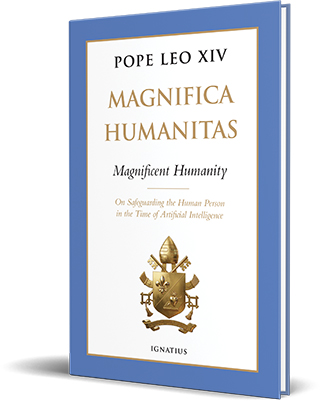
My approach here springs from an inconspicuous phrase near the end of the document, where Leo describes the human person as fulfilled only in embracing a “covenant between glory and fragility” (§239). As someone who devotes his life to the study of God’s “two books”—Scripture and creation—the encyclical’s one explicit use of the word covenant particularly caught my attention. It may seem rather eccentric to do this when the pope’s native language is English, but out of scholarly habit, I checked the Italian as well, and it indeed reads alleanza tra gloria e fragilità—the biblical term for “covenant.”
From the moment I encountered the phrase, the way Leo deploys the term here struck me as both unusual and deeply evocative. In fact, as I’ve reflected on the document over the course of the last twenty-four hours, this phrase increasingly stands out to me as a kind of punctuation mark for the entire message that precedes it.
“Little Less Than God”
One of the major contributions of Magnifica Humanitas is the way it unites glory and fragility—two realities so often torn apart—within a single vision of the human person. On the one hand, Leo speaks of glory: the unrivaled dignity of the Christian, whose body is a temple of the Holy Spirit and whose vocation to divine communion is described breathtakingly by the Christian tradition as nothing less than divinization—“becoming God” by grace. Yet Leo stresses that this glory is inseparable from fragility: from the fact that we are embodied and dependent creatures. In this vision, limitations, vulnerability, and suffering are all integral.
I am still trying to nail down the precise force and rationale behind Leo’s use of covenant here, but it seems to me that the term signals something far deeper than a mere balance or tension between opposites. In Scripture, God’s covenant with man (and indeed with all creation) is an undying bond of love. Thus, Leo presents glory and fragility as realities that essentially belong together within the very structure of authentic humanity.
As a consequence, he can say that human greatness is not discovered by escaping creaturely limits, but through receiving them as gifts that deepen our communion with God. The humble human body is neither raw material for technological self-reinvention nor a prison from which technology can liberate us, but the very place where the glory of God becomes manifest.
The paradox that man is glorious precisely in his fragility is already inscribed in the biblical vision of the human person. From Scripture’s opening chapters, man appears simultaneously as insignificant dust from the ground and as a creature singularly vivified by the breath of the divine, bearing God’s image and entrusted with directing all things within the created order to his glory.
Perhaps nowhere is this “covenantal” dynamic more beautifully presented than in Psalm 8. Gazing upon the heavens, the psalmist marvels at the lowliness of man: “What is man that you are mindful of him, and the son of man that you care for him?” Yet the movement of the psalm doesn’t end there. It ascends almost immediately into astonishment at man’s exalted vocation: “Yet you have made him little less…”
The biblical scholar in me cannot help but note that it gets interesting at this point from a translation perspective. Depending on the rendering you consult, you might find man described as “little less than a god” (NABRE), or “than the angels” (RSV2CE). The original Hebrew text reads mēʾĕlōhîm—literally, “than God” or “than the gods”—both readings are possible since there’s no verb present—while the ancient Greek Septuagint renders the phrase par’ angelous, “than the angels.” The Latin Vulgate (of which there’s more than one version) presents multiple possibilities here: ab angelis (“than the angels”) or a Deo (“than God”).
However one translates the line, the point is unmistakable: the human person occupies a uniquely elevated place within creation.
I raise this not merely as a scholarly curiosity, but because the tension reflected in these translations mirrors a debate within the Christian tradition itself: how exactly should we speak about man’s participation in divine life?
The Fathers at times employed language so daring that modern readers often recoil from it, but the Catechism of the Catholic Church embraces it without embarrassment. Beginning with St. Peter’s teaching that the Word became flesh to make us “partakers of the divine nature” (2 Pet 1:4), the catechism cites St. Athanasius’ celebrated formulation of the Christian mystery: “The Son of God became man so that we might become God.” Highlighting a few prominent expressions of this ancient tradition of theosis, it goes on to reference Irenaeus’ teaching that the Son of God became the Son of man so that man “might become a son of God.” It then recalls Aquinas’s formulation: “The only-begotten Son of God, wanting to make us sharers in his divinity, assumed our nature, so that he, made man, might make men gods” (CCC 460).
However you slice it, this is an astonishing—perhaps even scandalous—claim. Aren’t we constantly warned against “playing God”? What, then, are we to make of this ancient language about becoming “god” by grace? It turns out this is precisely where Leo’s phrase “covenant between glory and fragility” becomes so illuminating. The Christian tradition’s exalted vision of man never abolishes our creatureliness, dependence, or inherent limitations. Man’s greatness lies not in escaping his fragility through technological self-transcendence, but in receiving his creaturely nature as the very locus of communion with God.
None of this means that technology is inherently opposed to human flourishing. On the contrary, Leo repeatedly emphasizes that artificial intelligence, like other forms of technological development, can serve authentic human goods. AI can indeed be received as a genuine gift, even as it also poses a number of serious threats to mankind. The deeper question is how to employ it in ways that uphold rather than erode human dignity.
Thus, the encyclical’s basic test for AI is: Does this technology help human beings become more fully human before God and one another? That’s the question Leo wants the Church, governments, businesses, developers, schools, families, and the faithful to be asking. And here Leo’s formulation concerning glory and fragility becomes directly relevant to what the encyclical identifies as its central task: “safeguarding the human person in the time of artificial intelligence.”
Two Cities, Two Human Futures
One of my favorite aspects of the document is precisely its effort to let the study of Scripture become “the soul of theology,” as Vatican II urged.
Leo himself foregrounds the encyclical with a spiritual reading of two biblical images that frame the entire document and serve as lenses through which to discern the promises and perils of AI: the construction of the Tower of Babel (Gen 11:1–9), “where collective effort follows a plan that dominates and ultimately dehumanizes,” and the rebuilding of Jerusalem’s ruined walls after the Babylonian Exile (Neh 2–6), “which under Nehemiah’s direction are rebuilt piece by piece as a project of shared responsibility.”
At the present moment, Leo writes, “Humanity, created by God in all its grandeur, is today facing a pivotal choice: either to construct a new Tower of Babel or to build the city in which God and humanity dwell together” (MH, §1).
In Leo’s creative appropriation of these biblical narratives, Babel represents a technological project “conceived without reference to God, supported by a uniformity that eliminated diversity and that chose homogenization over communion” (MH, §7). When a city is built on pride and the illusion of self-sufficiency—whether in primordial Babel or in our own technological age, where unprecedented capacities for communication often generate only greater fragmentation and confusion—Leo observes that the result is confusion: “not unity, but dispersion.”
What Leo refers to as “Babel syndrome,” then, expresses the idolatry that underlies every technological project that, “however grandiose, arises from self-affirmation, sacrifices human dignity for efficiency and aspires to reach heaven without God’s blessing” (MH, §§7, 10).
Today, we can communicate instantaneously with people across the globe, even translating languages in real time. Yet the danger, Leo warns, is that this technological uniformity can foster “the pretense that a single language — even a digital one — can translate everything, including the mystery of the person, into data and performance.” In this way, we can see that “The risk of dehumanization—of building a future that excludes God and reduces the other to a means—is an ancient and ever-new temptation that today takes on a technical guise” (MH, §10).
The technocratic paradigm is therefore simply a renewed expression of the primordial temptation faced by our first parents in the garden: to transcend all creaturely limits and “become as gods” (Gen 3:5) by their own steam.
Meanwhile, amid the many unknowns accompanying the rapid development of technology in our age, Leo urges us to choose the “way of Nehemiah,” a path centered on “the importance of working together to make the City of God a safe place for returning exiles.” The restored Jerusalem was united by a common language, but “not one of uniformity, but one of communion, namely the harmony that arises when all persons assume their own role and recognize that their strength comes from the Lord” (MH, §10).
By invoking Nehemiah’s example, Leo neither resigns himself to AI nor rejects it outright. “Technology should not be considered, in itself, as a force antagonistic to humanity,” he writes, adding that it “is not a solution to humanity’s problems, just as it is not inherently evil” (MH, §§4, 9). Rather than simply lamenting the rapid technological developments of our age, the pope calls for prudent discernment regarding their use. As with previous technologies, he insists that “the key issue is not the use of technology as such, but the vision that underlies it” (MH, §117).
On the one hand, the pontiff notes, “Technology has the power to heal, connect, educate and protect our common home” (MH, §9). In this, he echoes the teaching of his predecessors like Benedict XVI, who went so far as to identify technology as “a response to God’s command to till and to keep the land,” adding that human innovation can even “serve to reinforce the covenant between man and creation, a covenant that should mirror God’s creative love (Caritas in Veritate, §69).
Having lived through medical conditions that would almost certainly have killed me not very long ago—from kidney failure requiring transplant to open-heart valve replacements, to cancer treatment—I, for one, can only regard many recent technological advances with profound gratitude.
On the other hand, Leo cautions that what we are witnessing in today’s digital revolution “can also divide, exclude and generate new forms of injustice,” reminding us, “In practice, however, technology is never neutral, because it takes on the characteristics of those who devise, finance, regulate and use it” (MH, §9). The danger, moreover, extends beyond misuse by bad actors. While not condemning AI as such, Leo cautions that it “threatens to normalize an anti-human vision” in which “the fullness of life is equated with having more, reducing weakness, eliminating uncertainty and exerting total control.”
In such a framework, “efficiency becomes the ultimate measure of value,” with the result that “human beings are tempted to see themselves as a project to be optimized rather than as persons called to relationship and communion” (MH, §112). For this reason, he insists on the need for a clear distinction: “It is one thing to integrate technology within a human-centered, relational vision; it is quite another to be guided by an outlook that devalues human limits and promises a purely technical form of ‘salvation’” (MH, §117).
Two Rival Paths to Becoming “More Than Human”
This mention of a technical form of “salvation” opens up another important contrast running throughout Leo’s encyclical—one that also appears in the Vatican ITC document I recently wrote about in this column. At stake is the distinction between an authentic and illusory quest for transcendent fullness of life, embodied in the antithesis between the authentically Christian pursuit of theosis, or divinization, and the attempt to become our own gods that we witness in transhumanism and posthumanism.
Importantly, Leo notes that the endeavor we witness in these movements masks a deeper and authentically human yearning for the fullness of life that is ultimately fulfilled only in God. Yet, as the Holy Father underscores, their futuristic vision of enhanced human capacities or even human-machine hybrids conceives “progress as surpassing the human condition” through an “almost disembodied” vision of transcendence that, when all is said and done, proves inhuman (MH, §§115, 232).
Whatever its precise form, Leo laments that today “the human desire for fullness of life is at risk of being misled by deceitful goals”—specifically, technologies that promise unlimited “upgrades” capable of freeing us from all weakness. Yet the pope warns that such hopes often create more problems than they solve, exacerbating inequalities as some pursue the illusion of limitless self-assertion, while many others are deprived of basic necessities. More fundamentally, he insists that technical solutions alone are incapable of healing the deepest human wounds and that “true fulfilment is not achieved by eliminating weakness but through harmonious growth” (MH, §12).
One of the encyclical’s most powerful sections comes when Leo examines the modern “crisis” surrounding humanity’s acceptance of creaturely limits. Frailties such as “incapacity, illness, old age, suffering, vulnerability,” he observes, increasingly “tend to be seen primarily as a defect to be corrected, rather than as a reality through which our humanity matures and opens itself to relationship.”
Here, the Pope places his finger on the inseparable union of glory and fragility in the human person, insisting that “humanity flourishes not despite limitations, but often through them” (MH, §118). Indeed, he argues, it is precisely our limitations that give rise to compassion, generosity, sincere concern for others, and openness to God (MH, §119).
Echoing themes emphasized by John Paul II and Benedict XVI that I explore in chapters 9–10 of this book, Leo even goes so far as to say: “To eliminate suffering would mean, in the end, extinguishing love and desire as well” (MH, §120). As C.S. Lewis famously observed, “To love at all is to be vulnerable. Love anything, and your heart will certainly be wrung and possibly broken.” In Leo’s view, anyone who truly loves must inevitably pass through suffering and trial, such that he can say, “To renounce this adventure, both tragic and splendid, in the name of a presumed transcendence of all limits, could mean many things, but it would no longer be human” (MH, §120).
But again, holding together the ‘covenantal’ balance of human fragility and glory, Leo is not suggesting that we simply resign ourselves to suffering without ever seeking to alleviate it. His criterion for proceeding is straightforward—and one all of us ought to keep in mind as an examination of conscience whenever we’re faced with the decision to adopt or continue our use of a given technology:
We can embrace the technological progress that alleviates suffering and unlocks new possibilities, provided that we do not abandon the very essence of our humanity, namely the capacity for relationship and love. (MH, §126)
The Mystery of the Incarnation
Yet Leo doesn’t stop there. He immediately raises a deeper question—and the final one I want to consider in this brief space: if Christianity affirms both the possibility of genuinely beneficial technological progress and a true path beyond our creaturely limits that technology itself cannot provide, then where is authentic transcendence to be found?
The pontiff’s answer cuts to the heart of the encyclical. The authentic “more than human,” he teaches, is “a fulfilment that does not arise from a technological divinization, but through God’s grace received in Christ” (MH, §126). Here Leo places before us two rival paths to becoming “more than human”: the presumptuous attempt to transcend our humanity through self-divinization—a path that ironically results in the loss of the human person—and the true path of divinization through grace and self-sacrifice, of theosis through kenosis, where, as Leo recalls from Vatican II, man discovers himself through a sincere gift of self (Gaudium et Spes, §24).
In the pontiff’s own words, “[Human beings] are called to self-transcendence, not through an escape from reality or a contempt for their limitations, but through their fulfillment in love” (MH, §127). Thus, he contends, “Herein lies the radical departure from Promethean dreams: what saves humanity is not enhanced self-sufficiency, but a relationship that liberates, a communion that transforms.”
In contrast to the futile “Babylonian” pursuit of transcendence through power and self-assertion, Leo stresses that true transformation—“the re-creation of the human person”—is ultimately the work of the Holy Spirit drawing man into ever deeper conformity with Christ, the incarnate Son of God (MH, §128; 2 Cor 5:17).
In the final analysis, everything comes down to conformity with Christ. A truly Christian anthropology is necessarily a Christological anthropology, for in Jesus Christ—the new Adam—we “behold the man” who reveals humanity to itself. In this light, it’s clear that the Holy Father says nothing novel when he insists that Jesus himself is humanity in all its grandeur and that it is “only in the mystery of the Word made flesh that the mystery of humanity truly becomes clear” (MH, §1; Gaudium et Spes, §22). This is the message sounded at both the beginning and end of his remarkable first encyclical: At the heart of everything is the mystery of the Incarnation.
The future of mankind, he suggests, will be determined based on whether we’re willing to embrace the divine pattern revealed in Christ’s descent into human history—our “ability to welcome this divine way of drawing near, of sharing the burden of the world, of transforming relationships from within” (MH, §232). This, he explains, is the logic of Eucharistic and Paschal existence: finding fulfillment not through an escape from the body and the created world, but through bonds of loving communion within this providential order. It means learning to receive reality again as a gift—to find holiness in ordinary things, to do little things with great love, and to rediscover the abundant graces in the persons, places, and things God has placed in our lives.
Conclusion: Recovering Contact with the Real
Because authentic transcendence comes not from fleeing our embodied condition but from rightly inhabiting it, perhaps one of the most urgent spiritual tasks of our age is to do what we can to restore contact with the real in simple, everyday ways. If constant immersion in today’s digital technologies leaves you unsatisfied, the solution is likely not another technological upgrade.
It’s a deeper immersion in realities fashioned by God rather than merely by man. And it can begin as simply as stepping outside to take in the world around you, creating something with your own hands, showing up personally for someone in need, or rejoicing in the physical presence of friends.
If you value the news and views Catholic World Report provides, please consider donating to support our efforts. Your contribution will help us continue to make CWR available to all readers worldwide for free, without a subscription. Thank you for your generosity!
Click here for more information on donating to CWR. Click here to sign up for our newsletter.


We read: “…the catechism cites St. Athanasius’ celebrated formulation of the Christian mystery: ‘The Son of God became man so that we might become God’.”
The contemporary Muslim writer, Mahmoud Ayoub, admirably summarizes this contact point, this sign of contradiction between Trinitarian Christianity and Islam. He explains that the Muslim view is to “let God be God and Man be Man,” and that natural Humanity is fulfilled by the prophet and friends.
Ayoub then adds: “Christianity has insisted, and with equally uncompromising seriousness, on ‘letting God be man” in order for “man to be divine.’ The gap between an extreme Islamic view and an extreme Christian position on this point is admittedly vast” (Mahmoud Ayoub in Irfan A Omar (ed.), “A Muslim View of Christianity,” Orbis, 2007, p.177).
Clearly, the data-dump answer offered by AI to this data gap—as with many consensual synodalists—is some sort of data-based/consensual Esperanto theology.
Yet Leo stresses that this glory is inseparable from fragility: from the fact that we are embodied and dependent creatures. In this vision, limitations, vulnerability, and suffering are all integral (Ramage).
Literally covenant is a binding contract, whereas the Italian translation in the document alleanza tra gloria e fragilità speaks to an alliance. An alliance is considered transient depending on conditions. Ramage is correct in settling for the English covenant since in our relations to God there are few if any transient agreements.
It comes down to the difference between covenants, that with God and that with creation inclusive of technology and AI. The former, to assume the glory of becoming like God, is binding. That glory is Man’s eschatological end. Our commitment to Creation and technology is conditional to the exigency of practice of the virtues, including suffering for a greater good, temperance, faithful fortitude, charity, and justice.
Justice is considered by Aquinas to be essentially the Love of others. Leo XIV underscores Man’s inadequacy to do justice to our fellow man, or to any planning or technical project absent of grace is not possible:
“This transformation is a work of the Holy Spirit. As Saint Thomas Aquinas taught, this process of elevation and transformation surpasses every capability of created nature 134 for an infinite disparity separates our finite nature from the life of God 135.” (Leo XIV Magnifica Humanitas).
Thank you very much, Dr. Ramage, for this profound theological reflection on Magnifica Humanitas. Your emphasis on the “covenant between glory and fragility” is especially illuminating. It moves the discussion away from mere technological alarmism and roots it once again in sacramental realism and the mystery of the Incarnation.Yet your insight also points toward an even deeper anthropological question. The most significant disruption introduced by Artificial Intelligence is not simply the possibility of immoral uses or deceptive goals. Increasingly, AI functions not merely as a tool, but as a pervasive environment that shapes human attention, expectations, and cognitive habits.By recognizing how technological mediation quietly structures human experience, the encyclical reveals a deeper anthropological risk. When digital systems constantly classify, predict, optimize, and exclude, reality itself is increasingly filtered before we encounter it directly. The danger is that the human person may gradually interiorize this algorithmic logic. When frictionless efficiency becomes the baseline of our digital habitat, contemplative doubt, the discipline of waiting, and even the vulnerability of suffering begin to appear as inefficiencies to be corrected.This becomes particularly evident in the realm of language. As you rightly note, human speech is inherently relational and incarnational. When generative systems simulate dialogue and care without personal presence or accountability, they risk separating language from embodied communion. Here, the encyclical implicitly confronts a contemporary form of Gnosticism: a technocratic drive toward a disembodied transcendence that views our physical, biological, and fragile nature as a mere defect to be optimized or bypassed.Furthermore, by anchoring human rights in human nature itself, Pope Leo XIV recovers the framework of natural law against utilitarianism. While the text largely distinguishes humans from AI using phenomenological categories—such as the capacity for emotion, empathy, or relational growth—the underlying metaphysical truth remains clear. The ontological chasm between the human persona and the machine exists because the machine lacks a spiritual, rational soul, which is the intrinsic principle of true understanding and free will. AI can mimic the outputs of reason, but it cannot possess the ontological nature that makes a human being a subject.I think the decisive question raised by Pope Leo XIV is not merely: “How do we regulate this technology?” but rather: “Will human beings gradually conform themselves to the logic of machinic mediation?” MH reminds us that one of our central tasks today is to recover spaces of productive inefficiency—silence, memory, contemplation, and embodied community—where human dignity may once again be recognized not as a project to be optimized, but as a mystery to be loved (cf Gabriel Marcel).
“On the one hand, Leo speaks of glory: the unrivaled dignity of the Christian, whose body is a Temple of the Holy Spirit …”, and on the other hand, Leo condones the erroneous teaching of Jorge Bergoglio and promotes those who promote these erroneous teachings, that deny God’s Divine Law regarding Lust and the sin of adultery, which is part of The Covenant God Has Made with man in regards to Salvation.
“If there is a union of a private nature there is neither a third party ( No Holy Ghost), nor is Society affected”, Jorge Bergoglio, as a cardinal, ipso facto denying Our Universal Call To Holiness Is A Call To Be Temples Of The Holy Ghost, in all our relationships, for sin done in private, even if it is consensual, is still sin, in order to justify same-sex sexual relationships and the engaging in of sexual acts that regardless of the actors or the actors desires/inclinations, demean the inherent Sanctity and Dignity of the human person and are thus devoid of Love.
We can only be Temples For The Holy Ghost if we Abide In The One Word Of God, thus we can only be One Body of Christ, In The Unity Of The One Holy Ghost.
Christ’s One, Holy, Catholic, And Apostolic Church Is One, Holy, Catholic, And Apostolic, In The Unity Of The Holy Ghost, The Spirit Of Perfect Divine Eternal Infinite Love Between The Father And His Only Begotten Son , Jesus The Christ, Who Proceeds From The Father And His Only Begotten Son, Jesus The Christ, thus outside The One Body Of Christ There Is No Salvation, although we must Pray that at the hour of death , their will be a multitude of persons, who will recognize Christ In All His Glory, and come late to The Fold. This is known as The Baptism Of Desire.
“Hail The Cross, Our Only Hope!”
At the heart of Liberty Is Christ, “4For it is impossible for those who were once illuminated, have tasted also the heavenly gift and were made partakers of the Holy Ghost, 5Have moreover tasted the good word of God and the powers of the world to come…”, to not believe that Christ’s Sacrifice On The Cross will lead us to Salvation, but we must desire forgiveness for our sins, and accept Salvational Love, God’s Gift Of Grace And Mercy; believe in The Power And The Glory Of Salvation Love, and rejoice in the fact that No Greater Love Is There Than This, To Desire Salvation For One’s Beloved.
Blessed are they who are Called to The Marriage Supper Of The Lamb.”
“For where your treasure is there will your heart be also.”
“Penance, Penance, Penance.”
Pray that Our Blessed Mother’s Immaculate Heart will Triumph Soon for the sake of The Salvation Of Souls; for “where your treasure is, there will your heart also be”.
As you say, the pope provides helpful biblical insights. But I wish we would have seen a clear description of the Tower of Babel which we now see in place, namely, the AI structure (“the machine”) where people live. They go to AI for 24/7 love, friendship and advice. The machine takes the place of spouse, family and friend. Read Paul Kingsnorth.