Vatican City, Dec 5, 2017 / 05:19 pm (CNA).- Despite the recent inclusion of Pope Francis’ 2016 letter to the Buenos Aires bishops on Amoris laetitia in the Holy See’s official text of record, neither the Church’s discipline nor its doctrine have changed.
The move is the latest in the debate over the admission of the divorced-and-remarried to Communion. The Second Vatican Council, St. John Paul II, and Benedict XVI – as well as the Congregation for the Doctrine of the Faith and the Pontifical Council for Legislative Texts under them – all firmly opposed proposals to admit to eucharistic communion the divorced-and-remarried who do not observe continence.
The debate has received renewed impetus under Pope Francis. His 2016 apostolic exhortation on love in the family, Amoris laetitia, has been met with varied reception and interpretation within the Church. Its eighth chapter, entitled “Accompanying, Discerning, and Integrating Weakness,” deals with, among other things, the pastoral care of the divorced-and-remarried, those who may not be admitted to Communion unless they have committed to living in continence, eschewing the acts proper to married couples.
Yet, for many Church leaders and theologians, ambiguous language in that chapter has led to uncertainties about this practice, and about the nature and status of the apostolic exhortation itself. Some have maintained that it is incompatible with Church teaching, and others that it has not changed the Church’s discipline. Still others read Amoris laetitia as opening the way to a new pastoral practice, or even as a development in continuity with St. John Paul II.
Some Church leaders have noted that Amoris laetitia has led to the disorientation and great confusion of many of the faithful, and at least one respected theologian has argued that Francis’ pontificate has fostered confusion, diminished the importance of doctrine in the Church’s life, and cause faithful Catholics to lose confidence in the papacy.
Pope Francis has been understood to encourage those who interpret Amoris laetitia as opening the way to a new pastoral practice – as he seemed to do in a letter to the bishops of the Buenos Aires region, which is the subject of the latest furor.
His letter approves those bishops’ pastoral response to the divorced-and-remarried, based on Amoris laetitia. The response had said that ministry to the divorced-and-remarried must never create confusion about Church teaching and the indissolubility of marriage, but may also allow access to the sacraments under specific limits. These might include specific situations when a penitent in an irregular union is under attenuated culpability, as when leaving such a union could cause harm to his children, although the circumstances envisioned are not precisely delineated, which, some theologians say, has contributed to the confusion.
The Pope’s Sept. 5, 2016 letter addressed to Bishop Sergio Alfredo Fenoy of San Miguel said, “The text is very good and makes fully explicit the meaning of the eighth chapter of ‘Amoris Laetitia’. There are no other interpretations. And I am sure it will do a lot of good. May the Lord reward you for this effort of pastoral charity.”
It was reported this weekend that Pope Francis’ letter, as well as the pastoral response of the Buenos Aires bishops, were promulgated in the October 2016 issue of the Acta Apostolicae Sedis, a Vatican publication in which official documents of the Pope and the Roman Curia are published, and through which universal ecclesiastical laws are promulgated.
Dr. Edward Peters, a professor of canon law at Sacred Heart Major Seminary in Detroit, wrote Dec. 4 that the Buenos Aires document contains assertions “running the gamut from obviously true, through true-but-oddly-or-incompletely phrased, to a few that, while capable of being understood in an orthodox sense, are formulated in ways that lend themselves to heterodox understandings.”
He noted that what prevents the admission of the divorced-and-remarried to eucharistic communion is canon 915 “and the universal, unanimous interpretation which that legislative text, rooted as it is in divine law, has always received.” The canon states that those “obstinately persevering in manifest grave sin are not to be admitted to holy communion.”
In an August 2017 post anticipating the possible publication in AAS of the Buenos Aires letter or the Pope’s commendation of it, Peters had written that “many, nay most, papal documents appearing in the Acta carry no canonical or disciplinary force.”
He wrote that “Unless canon 915 itself is directly revoked, gutted, or neutered, it binds ministers of holy Communion to withhold that most august sacrament from, among others, divorced-and-remarried Catholics except where such couples live as brother-sister and without scandal to the community.”
“Nothing I have seen to date, including the appearance of the pope’s and Argentine bishops’ letters in the Acta Apostolicae Sedis, makes me think that Canon 915 has suffered such a fate.”
He added: “Neither the pope’s letter to the Argentines, nor the Argentine bishops’ document, nor even Amoris laetitia so much as mentions Canon 915, let alone do these documents abrogate, obrogate, or authentically interpret this norm out of the Code of Canon Law.”
While the Pope’s letter and the Buenos Aires bishops’ pastoral response do contain ambiguous “disciplinary assertions”, they are insufficient “to revoke, modify, or otherwise obviate” canon 915, Peters wrote.
Aside from the canonical problems with the admission of the divorced-and-remarried to eucharistic communion is the question of what it means that the Buenos Aires document and the Pope’s letter in support of it are intended to be a part of the Church’s Magisterium.
A rescript from Cardinal Pietro Parolin, Vatican Secretary of State, in the AAS notes that their promulgation was intended “as authentic Magisterium.”
The Magisterium is a part of teaching office of bishops, by which they are charged with interpreting and preserving the deposit of faith. In its 1990 declaration Donum veritatis, the Congregation for the Doctrine of the Faith noted that the Magisterium “has the task of discerning, by means of judgments normative for the consciences of believers, those acts which in themselves conform to the demands of faith and foster their expression in life and those which, on the contrary, because intrinsically evil, are incompatible with such demands.”
Catholics are bound to assent to divinely revealed teachings with faith; to firmly embrace and retain those things which are required to safeguard reverently and to expound faithfully the deposit of faith; and to give religious submission of intellect and will to doctrines on faith or morals given through the authentic Magisterium.
The critical question regarding Amoris laetitia is what, precisely, it teaches with regard to faith and morals, and what it doesn’t, or even, can’t, teach. On the latter question, especially, the Church’s existent doctrine is helpful.
Even while some bishops, such as those of the Buenos Aires region and those of Malta, have interpreted the apostolic exhortation as allowing a new pastoral practice, many others have maintained that it changes nothing of doctrine or discipline.
For example, while prefect of the Congregation for the Doctrine of the Faith, Cardinal Gerhard Müller said that Amoris laetitia has not eliminated Church discipline on marriage, nor has it has permitted in some cases the divorced-and-remarried “to receive the Eucharist without the need to change their way of life.”
“This is a matter of a consolidated magisterial teaching, supported by scripture and founded on a doctrinal reason: the salvific harmony of the sacrament, the heart of the ‘culture of the bond’ that the Church lives.”
The prefect of the CDF said that if Pope Francis’ exhortation “had wanted to eliminate such a deeply rooted and significant discipline, it would have said so clearly and presented supporting reasons.”
“There is however no affirmation in this sense; nor does the Pope bring into question, at any time, the arguments presented by his predecessors, which are not based on the subjective culpability of our brothers, but rather on their visible, objective way of life, contrary to the words of Christ,” Cardinal Müller stated.
It has been the constant teaching of the Church that marriage is indissoluble, that people not married to each other may not legitimately engage in acts of sexual intimacy, that the Eucharist may not be received by those conscious of grave sin, and that absolution requires the purpose of amending one’s life, even with a diminished or limited capacity to exercise the will.
And the Catechism of the Catholic Church teaches that “If the divorced are remarried civilly, they find themselves in a situation that objectively contravenes God’s law. Consequently, they cannot receive Eucharistic communion as long as this situation persists … Reconciliation through the sacrament of Penance can be granted only to those who have repented for having violated the sign of the covenant and of fidelity to Christ, and who are committed to living in complete continence.”
St. John Paul II promulgated the Catechism in 1992 by the apostolic constitution Fidei depositum, in which he wrote that it “is a statement of the Church’s faith and of Catholic doctrine, attested to or illumined by Sacred Scripture, Apostolic Tradition and the Church’s Magisterium. I declare it to be a valid and legitimate instrument for ecclesial communion and a sure norm for teaching the faith.”
“The approval and publication of the Catechism of the Catholic Church represents a service which the Successor of Peter wishes to offer to the Holy Catholic Church … of supporting and confirming the faith of all the Lord Jesus’ disciples, as well as of strengthening the bonds of unity in the same apostolic faith. Therefore, I ask the Church’s Pastors and the Christian faithful to receive this catechism in a spirit of communion and to use it assiduously in fulfilling their mission of proclaiming the faith and calling people to the Gospel life. This catechism is given to them that it may be a sure and authentic reference text for teaching Catholic doctrine.”
Critical to understanding the character of the Church’s teaching on these issues is a declaration the Pontifical Council for Legislative Texts wrote in 2000 that canon 915’s prohibition on admitting to Holy Communion those who obstinately persist in manifest grave sin is applicable to the divorced-and-remarried.
“Any interpretation of can. 915 that would set itself against the canon’s substantial content, as declared uninterruptedly by the Magisterium and by the discipline of the Church throughout the centuries, is clearly misleading,” it said.
This prohibition, the pontifical council continued, is “by its nature derived from divine law and transcends the domain of positive ecclesiastical laws: the latter cannot introduce legislative changes which would oppose the doctrine of the Church.”
This declaration defines a kind of a limit on how the Magisterium can develop; by invoking divine law, the council says that no pastoral approach can transgress the norms of Sacred Scripture and Sacred Tradition. While considering questions of subjective culpability do not exceed those norms, the council’s directive explains that the Church can not, and will not, redefine the deposit of faith.
The deposit of faith has not been changed, and nor has canon law. Despite a great deal of anxiety and media attention, truth remains unchanged, and unchanging.
While some find the Pope’s writing to be ambiguous, truth is not. Amoris laetitia must be interpreted in a way that does not contravene truth.
Even when such an interpretation is not readily apparent.
 […]
[…]




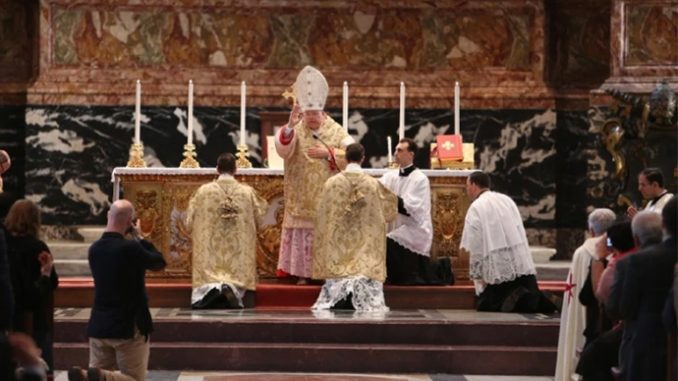



These small blessings bring gratitude for the opportunity to celebrate the Latin Mass once again at St. Peter’s. However, it is disheartening that such a thing should be viewed as an event for which we must feel so grateful — a return to a tradition upheld for nearly 1800 years.
Michael, you forget that tradition now means whatever has been believed and practiced only for the last 50 years.
Michael, you forget that tradition now means whatever has been believed and practiced only for the last 50 years.
This permission should not have been granted. The aim ought to be to completely phase out the use of the preconciliar liturgy, not to prolong its use and certainly not to encourage its growth.
The Roman Church is liturgically and ecclesiologically incoherent in its practice.
Ergo, Seabass, also sprach Zarathustra.
Pronouncing such judgment on the church, you make yourself a heathen and a slave like Onesimus, thinking you know more than the Church by defrauding your Christian master. May you find yourself an apostle like Paul. He can reset your thoughts to True.
The Church is universal & catholic, within which there are many Rites & liturgies.
It’s all good.
This is a good sign.
Habemus Papam
While I do not participate in Mass in Latin, I want it available for those who love this liturgy. As Catholics we have room for all.
As Catholics, we should accept the liturgical reform mandated by the bishops at Vatican II. That entails putting the 1962 Missal behind us and only celebrating the reformed Mass. If the reformed Mass were celebrated more in accord with tradition — including the Latin language and Gregorian chant — I believe well over 90% of the tiny subset of Catholics who say they prefer the TLM would accept that way of celebrating the reformed Mass and attend it. For the vast majority of TLMers, they are seeking a traditional, reverent liturgical aesthetic at Mass, not the 1962 Missal itself. That’s how the reformed Mass ought to be celebrated anyway: in accord with liturgical tradition.
So is the Mass celebrated by most Catholics today actually in conformity with what the conciliar documents (SC, etc) really say? This is a double-edge sword, but the fixation is always on those who prefer the “traditional” form. Once again, I’m quite thankful that I’ve been in an Eastern Catholic parish for most of my Catholic life.
To your question, the way the reformed Mass is celebrated in the typical American parish is inept, in my judgment, and does not conform to the Church’s liturgical norms nor does it accord with liturgical tradition.
I understand why the trads want the TLM: because the celebration of the reformed Mass is so embarrassingly awful in 99% of Catholic parishes. The solution is to correct the liturgical abuses and poor celebrations of the reformed Mass in parishes, not to retreat into the preconciliar form of the Mass in liturgical enclaves of traditionalism.
By maintaining the use of the 1962 Missal alongside the reformed Mass, the Roman Church is liturgically schizophrenic.
Preferring and attending the TLM is not a retreat into a preconciliar form or enclave. The TLM reverently and ritually commemorates the sacrifice of Christ’s passion without room for liturgical novelty or debased experimentation.
The Church is not liturgically schizophrenic in allowing use of both forms. Based as it is upon the TLM, the NO’s precursor, foundation, history, meaning, and rubrical model is the TLM.
Seeing the Church’s use of both forms as schizophrenic reflects a want of wisdom and a rigidity in want of charity.
Sebastian: I have the opportunity to celebrate the Holy Mass in churches frequently in three different states and in no way are they “embarrassing awful “ in any of these churches. How much have you been around, and where do you come up with your 99 %?
Carl, two of my cousins and their families recently started attending the Eastern Orthodox Church. I believe Pope Francis was a step too far for them, so they decided to leave. While I understood their choice, it still made me sad. When they explained their reasons for leaving, I found myself without a response.
Mr Olson, I totally agree with you. I too am grateful to be part of a Byzantine Rite parish. Just pure old-world style liturgical services without wars.
Will that Mass at St. Peter’s by Cardinal Burke be with or without James Martin’s parade of homosexual activists?
The Pope met with BOTH Burke and Martin. A good sign I would think.
Br. Jaques, we have come to expect your foolish sentimentality here. You seem to struggle with discriminating between good and evil.
May the Lord forgive disdain against LGBT. Our Lord died for all of his children. Arrogance, like it’s cousin pride. Does nothing to build the body of Christ. It is a poverty to show contempt to brothers and sisters in Christ. So that you might live as you wish.
Pray for the unity of Christendom.
It’s not a disdain against individuals but about Church teaching regarding acting on disordered attractions.
Joe, you seem to have a perverse notion of the moral good; you confuse/invert evil for the good. Come to your senses, man.
If I thought the TLM would bring peace to our world, I would kneel during the whole Mass. As it is, I settle for making my heart kneel before God.
Love God more than Rubrics; Burke is power hungary;
Please explain, Sister, how celebrating Mass at the Vatican is evidence of being “power hungary”. I await your cogent presentation of the matter.
Doubtful she’ll respond to you Carl if she’s one of those “nuns out of uniform.”
Clearly the holy nun (or is it “none”?) is referring to Hungary’s Cardinal Erdo and the future day when he gains further influence in the perennial Catholic Church, as when he introduced the second session of the Synod on the Family, offering this self-evident insight: “There are absolutely no grounds for considering homosexual unions to be in any way similar or even remotely analogous to God’s plan for marriage and family.” (Section III:3, below).
https://www.catholicnewsagency.com/news/32772/full-text-of-cardinal-erdos-introductory-report-for-the-synod-on-the-family
Respectfully Sister, Cardinal Burke has always struck me as a very humble & lovely man.
Hungry, not Hungary.
Typical ‘Nun on the Bus’ sort of comment.
To James Connor above who wrote: “Sebastian: I have the opportunity to celebrate the Holy Mass in churches frequently in three different states and in no way are they “embarrassing awful “ in any of these churches. How much have you been around, and where do you come up with your 99 %?”
Father O’Connor, when you celebrate Mass, do you ONLY say the Black and DO the Red, with no deviations whatsoever? Let’s hope so.