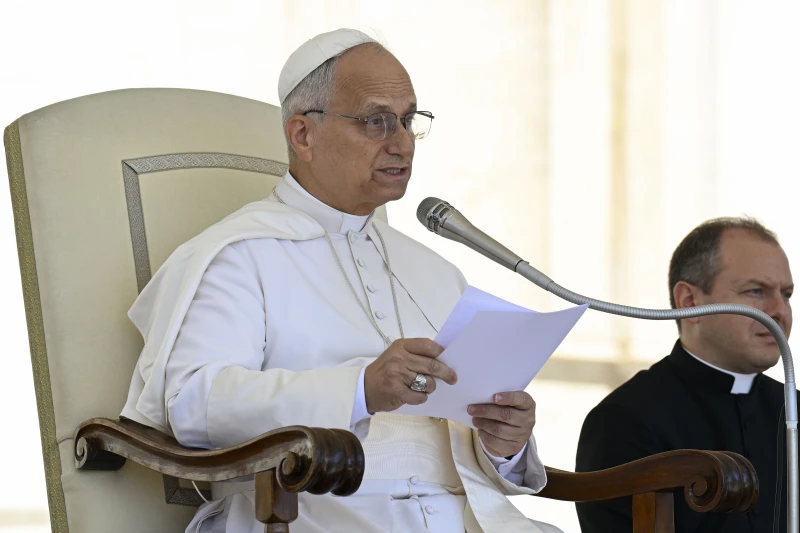
Pope Leo XIV addresses pilgrims during his general audience on July 30, 2025, in St. Peter’s Square at the Vatican. / Credit: Vatican Media
ACI Prensa Staff, Aug 26, 2025 / 12:53 pm (CNA).
“Peace Be With You All: Towards an Unarmed and Disarming Peace” will be the theme for the 2026 World Day of Peace, the Vatican Dicastery for Promoting Integral Human Development announced Aug. 26.
This theme, according to a statement from the Vatican Press Office, “invites humanity to reject the logic of violence and war, to embrace an authentic peace, based on love and justice.”
The statement continues: “It is a peace that is unarmed — that is, not based on fear, threats, or weapons; and disarming, because it is capable of dissolving conflicts, opening hearts, and generating trust, empathy, and hope. It is not enough to invoke peace; it must be embodied in a lifestyle that rejects all forms of violence, visible or structural.”
“The greeting of the risen Christ, ‘Peace be with you’ (cf. Jn 20:19), is an invitation to all — believers, nonbelievers, political leaders, and citizens — to build the kingdom of God and to construct together a humane and peaceful future,” the statement concludes.
The World Day of Peace was instituted by Pope Paul VI, who proposed it on Dec. 8, 1967, the solemnity of the Immaculate Conception. The Church first celebrated it on Jan. 1, 1968, the solemnity of Mary, Mother of God.
The observance came amid the Cold War, the Vietnam War, and other conflicts.
This story was first published by ACI Prensa, CNA’s Spanish-language news partner. It has been translated and adapted by CNA.
If you value the news and views Catholic World Report provides, please consider donating to support our efforts. Your contribution will help us continue to make CWR available to all readers worldwide for free, without a subscription. Thank you for your generosity!
Click here for more information on donating to CWR. Click here to sign up for our newsletter.
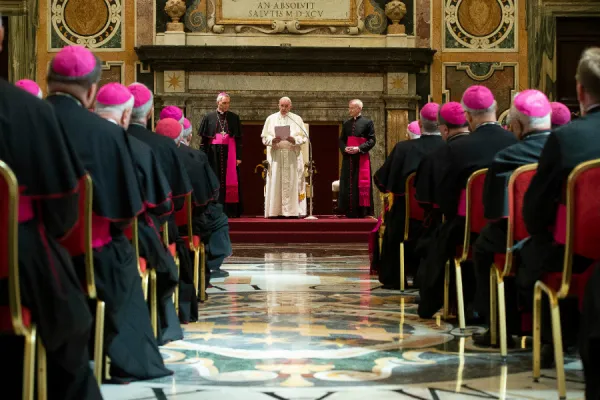
Vatican City, Jun 13, 2019 / 02:04 pm (CNA).- Pope Francis sent a message to apostolic nuncios Thursday informing his ambassadors that they have a responsibility as papal representatives not to criticize the pope or to join groups hostile to the Roman curia.
“It is therefore irreconcilable to be a pontifical representative criticizing the pope behind his back, having blogs or even joining groups hostile to him, to the curia and to the Church of Rome,” Pope Francis said June 13 in remarks distributed to more than 100 nuncios meeting in the Vatican’s Apostolic Palace.
Pope Francis said that he desired to share some simple precepts to help the papal diplomats live out their mission, calling the 4,000 word document a “Ten Commandments” of sorts for nuncios and their co-workers throughout the world.
One of the ten precepts outlined in the document is titled, “The Nuncio is a man of the Pope.” The section states that “certainly every person could have reservations, likes and dislikes, but a good nuncio cannot be hypocritical.”
“As a Pontifical Representative, the nuncio does not represent himself but the Successor of Peter and acts on his behalf at the Church … the Representative is a link, or better, a bridge of connection between the Vicar of Christ and the people to whom he was sent, in a certain area, for which he was appointed and sent by the Roman Pontiff himself,” Pope Francis said.
Other exhortations included in the document are to be merciful, obiendent, prayerful, charitable, humble, and to have initiative and apostolic zeal.
“The man of God does not deceive nor deceive his neighbor; he does not let himself go into gossip and slander; it preserves the pure mind and heart, preserving eyes and ears from the filth of the world. He does not let himself be deceived by worldly values, but looks to the Word of God to judge what is wise and good,” he said.
“The Nuncio who forgets that he is a man of God ruins himself and others; he goes off the track and also damages the Church, to which he has dedicated his life,” Francis warned.
Current papal nuncios have been caught in scandal. The apostolic nuncio to France, Archbishop Luigi Ventura has been accused of sexual misconduct against an adult male while he was nuncio in Canada. The Vatican diplomat is already under investigation for alleged sexual assault in Paris.
Archbishop Francis Chullikatt, apostolic nuncio to Kazakhstan, Tajikistan, and Kyrgyzstan has recently been accused of financial and personal misconduct during his time of service as the Vatican’s chief diplomat at the United Nations.
Some have pointed to Pope Francis’ comments about “having a blog” as alluding to the apostolic nuncio to Switzerland and Liechtenstein, Archbishop Thomas Gullickson, because he has a blog, which was linked to a Twitter account in which he shared articles critical of some of Pope Francis’ comments.
In 2015, the nuncio tweeted a National Review article entitled, “The Pope Got It Completely and Utterly Wrong,” which called Pope Francis’ comments in an in-flight press conference “imprecise, poorly judged.” The nuncio’s Twitter account has since been deleted.
Former nuncio to the United States, Archbishop Carlo Vigano, set off a flurry of debate last August by penning a public letter alleging that some Vatican officials knew of Theodore McCarrick’s sexual misconduct for years yet restored McCarrick’s place as a papal advisor to Pope Francis.
The former nuncio issued additional letters calling for Pope Francis to resign and gave an extended interview to the Washington Post published this week.
Francis’ document to nuncios quotes Saints Maximilian Kolbe, Paul, Augustine, and Paul VI on living the Christian life. It concludes with the “Litany of Humility” written by Servant of God Cardinal Rafael Merry del Val, Vatican Secretary of State from 1903-1914.
“The nuncio – and all of us – without a life of prayer, risks failing to meet all the aforementioned requirements. Without prayer we become mere officials, always unhappy and frustrated. The life of prayer is that light that illuminates everything else and all the work of the nuncio and his mission,” Pope Francis said.
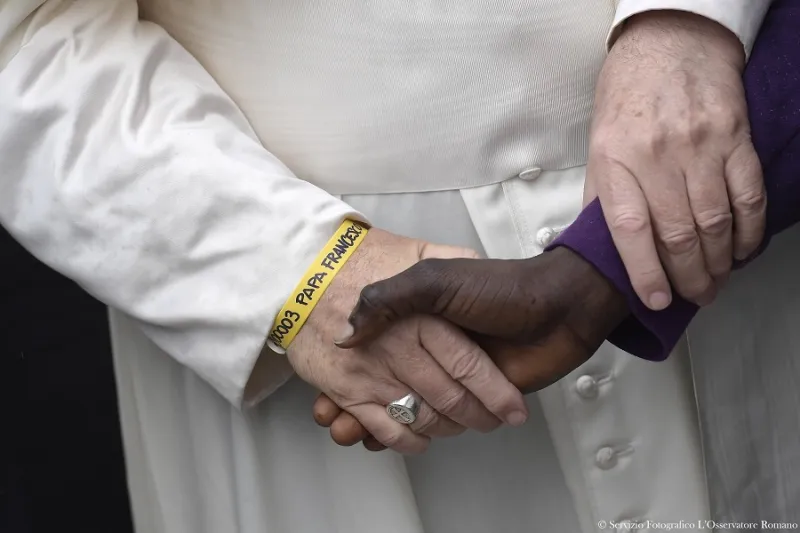
Pope Francis greets a migrant at a welcoming hub near Cesena, Italy on Oct. 1, 2017. / L’Osservatore Romano.
Vatican City, Nov 29, 2021 / 12:00 pm (CNA).
Pope Francis could reportedly help to bring up to 50 migrants to Italy as part of his trip to Cyprus and Greece this week.
Cypriot government spokesman Marios Pelekanos said that the Vatican wanted to arrange the transfer of migrants currently in Cyprus to Rome, Reuters reported on Nov. 26.
“This is a tangible expression of solidarity by the head of the Roman Catholic Church to people in need, affirming that the Vatican recognizes the problem that the Republic of Cyprus faces today because of the increased migratory flows and the need for a fair distribution among EU member states,” Pelekanos said, according to Reuters.
Pope Francis will depart for the Mediterranean island of Cyprus this Thursday for a five-day visit that will also take him to Greece. The trip is expected to highlight the plight of migrants seeking to enter Europe, mainly from the Middle East and Africa.
The last time that Pope Francis visited Greece, in 2016, he brought three Syrian refugee families from the Moria refugee camp on the island of Lesbos back with him to Rome.
Among the refugees relocated with the pope’s help was Majid Alshakarji, who escaped the Syrian civil war at the age of 15.
Five years later, Alshakarji is now studying at a university in Rome to become a dentist and volunteers with the Catholic Community of Sant’Egidio, helping to welcome new refugees to Italy.
“We have been allowed to have a new life in a new country … It is a beautiful experience,” he told CNA in 2020.
Sant’Egidio helped to organize the arrival of 70 Syrian refugees in Rome on Nov. 29.
The refugees, who had been living in refugee camps in Lebanon, came to Italy through the humanitarian corridors promoted by the Catholic movement in coordination with the Federation of Evangelical Churches in Italy and the Italian government.
Pope Francis has repeatedly urged governments not to “lose sight of the human face of migration.”
Most recently, in a message on Nov. 29 marking the 70th anniversary of the International Organization for Migration, the pope decried the “double standard” that places economic interests over “the needs and dignity of the human person.”
“On the one hand, in the markets of upper-middle-income countries, migrant labor is in high demand and welcomed as a way to compensate for the lack of it. On the other, migrants are generally rejected and subject to resentful attitudes by many of their host communities,” he said.
“This tendency was particularly evident during the COVID-19 lockdowns, when many of the ‘essential’ workers were migrants, but they were not granted the benefits of the COVID-19 economic aid programs or even access to basic health care and immunization,” the pope added.
The pope’s message to the U.N. organization was read by Cardinal Pietro Parolin in a video message.
Pope Francis underlined that “we must never forget that these are not statistics, but real people whose lives are at stake.”
“Rooted in its centuries-long experience, the Catholic Church and its institutions will continue their mission of welcoming, protecting, promoting, and integrating people on the move,” he said.
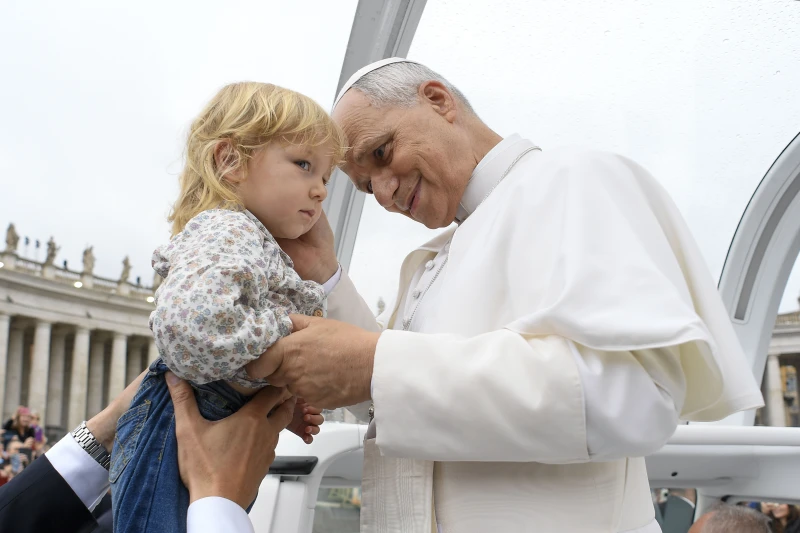
Pope Leo XIV greets a young child before his Wednesday general audience in St. Peter’s Square on Sept. 10, 2025. / Credit: Vatican Media
ACI Prensa Staff, Sep 10, 2025 / 08:00 am (CNA).
In his general audience on Wednesday, Pope Leo XIV explained that cries of pain, like those of Jesus in his final moments on the cross, instead of a sign of weakness, can express desire, surrender, and prayer.
A rainy morning in Rome prevented the Holy Father from spending much time greeting the faithful in St. Peter’s Square. Aboard the popemobile, he toured the square amid applause and cheers, stopping to give his blessing, especially to children.
The pope dedicated his catechesis at the weekly audience, which began just over five minutes late, to reflecting on the value of crying.
“At times, what we are unable to say in words, we express with the voice,” Leo said. “When the heart is full, it cries. And this is not always a sign of weakness; it can be a profound act of humanity.”
Although we are accustomed to thinking of crying as something disorderly to be repressed, the Gospel gives our cry a value, reminding us it can be “an invocation, a protest, a desire, a surrender,” the pope said.
“It can even be the extreme form of prayer, when there are no words left,” he continued.
“One cries not out of desperation, but out of desire. Jesus did not cry out against the Father, but to him. Even in silence, he was convinced that the Father was there,” the pontiff said. “And, in this way, he showed us that our hope can cry out, even when all seems lost.”
Pope Leo XIV waves at the crowds of people who braved a rainy morning for the general audience in St. Peter’s Square on Sept. 10, 2025. Credit: Vatican Media
A cry that manifests the greatest love
Addressing pilgrims huddled under umbrellas in protection against sporadic rain showers, Pope Leo meditated on the “culmination of Jesus’ life in this world: his death on the cross.”
Specifically, he highlighted an important detail worthy of faithful contemplation: That “on the cross, Jesus does not die in silence.”
The pontiff explained that after fulfilling his mission on earth, from the cross, “Jesus uttered a loud cry, and breathed his last.” For the Holy Father, “that cry contains everything: pain, abandonment, faith, offering. It is not only the voice of a body giving way, but the final sign of a life being surrendered.”
He also recalled that the cry was preceded by a question, “one of the most heart-rending that could be uttered: ‘My God, my God, why have you abandoned me?’”
Pope Leo XIV emphasized that, in that final moment, Jesus experiences silence, absence, and the abyss. However, according to the pontiff, “it is not a crisis of faith, but the final stage of a love that is given up to the very end.”
“Jesus’ cry is not desperation, but sincerity, truth taken to the limit, trust that endures even when all is silent,” he emphasized.
He added that “it is there, in that broken man, that the greatest love manifests itself. It is there that we can recognize a God who does not remain distant, but who traverses our pain to the very end.”
Pope Leo XIV spoke about the value of crying during his weekly audience with the public in St. Peter’s Square on Sept. 10, 2025. Credit: Vatican Media
Jesus teaches us not to fear crying
The pope also explained that to cry can be a “spiritual gesture,” since it is often one’s first act after birth and a way to stay alive.
“One cries when one suffers, but also when one loves, one calls, one invokes. To cry out is saying who we are, that we do not want to fade away in silence, that we still have something to offer,” he added.
Leo invited those listening not to hold back their tears, because keeping everything inside “can slowly consume us.”
The pontiff insisted that “Jesus teaches us not to be afraid to cry out, as long as it is sincere, humble, addressed to the Father. A cry is never pointless, if it is born of love.”
At the end of his message, Pope Leo XIV encouraged the faithful to learn from the Lord to give a “cry of hope when the hour of extreme trial comes.”
“Not to hurt, but to entrust ourselves. Not to shout at someone, but to open our hearts. If our cry is genuine, it can be the threshold of a new light, of a new birth,” he said.
Pope Leo XIV greets newlyweds and sick and disabled people, including a young child in a wheelchair, in the Vatican’s Paul VI Hall after the Wednesday general audience on Sept. 10, 2025. Credit: Vatican Media






Leave a Reply