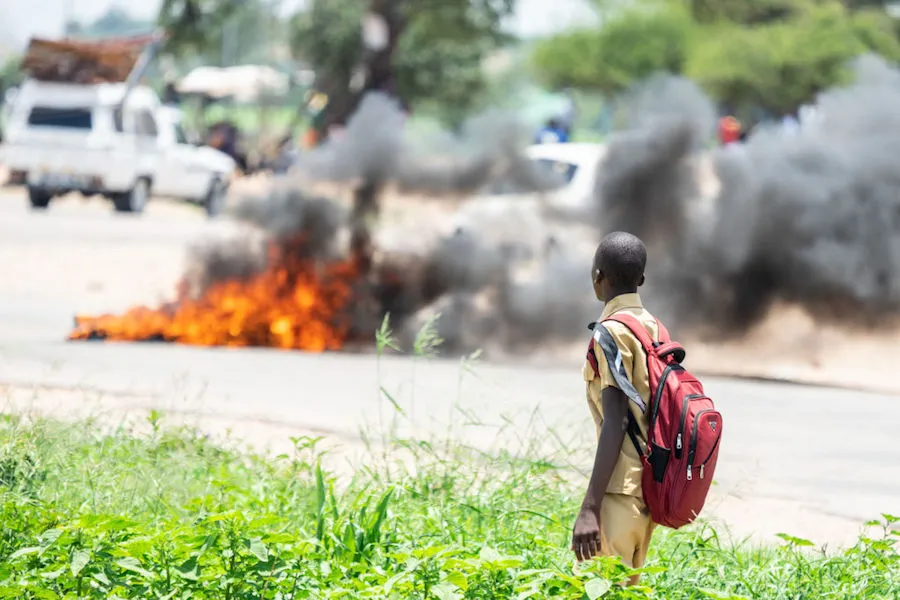
Harare, Zimbabwe, Jan 22, 2019 / 12:16 am (CNA/EWTN News).- As political protests in Zimbabwe have turned violent and even fatal, reportedly leaving at least 12 people dead, the bishops of the country have called for peaceful resolutions to the crisis.
“Zimbabwe is burning; its economy is hurting; its people are suffering. Many ordinary Zimbabweans express disappointment that hoped-for changes are yet to be felt, in access to employment, cash and broad stakeholder consultations. Our quasi currency, operating with multiple exchange rates, is fueling a national crisis,” the bishops said in a Jan. 17 letter.
“We call upon [the] Government and the Opposition to put their differences aside and work together to free Zimbabwe from economic shackles and international ostracisation.”
Last week, a sharp spike in fuel prices in Zimbabwe sparked violent protests from members of groups who oppose the current government.
According to the BBC, Presidential spokesman George Charamba told local journalists that the opposition group Movement for Democratic Change (MDC) was responsible for the violence.
“The MDC leadership has been consistently pushing out the message that they will use violent street action to overturn the results of (last year’s) ballot,” Caramba said.
However, the United Nations called on the Zimbabwe government to stop using “excessive” force to cull the protests, after reports surfaced that the government was conducting door-to-door searches and beating, torturing and using live ammunition on the protestors.
Zimbabwe President Emmerson Mnangagwa announced that he would be returning early from a foreign tour in order to help address the situation.
The clashes took place largely in the capital city, Harare, and the southern city of Bulawayo, where looting and riots have been reported and all schools have been forced to close. Reuters reported that more than 60 people were treated for gunshot wounds, following the government’s alleged use of live ammunition on the protestors.
News of the protests came despite government blocks on Facebook, Whatsapp and Twitter messaging apps. The government said the blocks were part of an attempt to quell the violence, while human rights groups have said they were attempting to mask human rights violations.
The protests come after a long period of political and economic instability, from “the military-assisted political change that took place in November 2017 to the total shutdown of Zimbabwe’s major cities and rural trading centres that began on Monday, 14 January 2019,” the bishops said.
They said that while they had hoped for good change after November 2017, they have “witnessed with sadness and concern [the] Government’s piecemeal and knee-jerk reaction to the worsening economic situation, exemplified by the unilateral imposition of 2 percent tax on the country’s major money-transfer and payment system and by the hefty increase in fuel prices on 12 January 2019, the immediate cause of the violent demonstrations and riots that brought Zimbabwe’s major cities and rural trading centres into complete lockdown.”
The bishops said that they are “saddened and concerned” by the government’s failure to stabilize the economy, which has put the livelihood of many Zimbabweans in jeopardy, as well as by the violent riots and demonstrations, the disruption of essential services, and by the government’s intolerance for people expressing opposing views, leading to their torture and even death.
“We are writing at a time when our country is going through one of the most trying periods in its history. Once more the resilience and resolve of Zimbabweans is being put to test. We thank the many Zimbabweans who continue to pray ceaselessly for our Country. We, your Shepherds, write to you at this time to help rebuild hope, trust, confidence and stability in Zimbabwe,” the bishops said.
They encouraged the government and all citizens of Zimbabwe to help build a free country, with free elections and strong, politically inclusive institutions.
“We do not need a strong man or woman but strong institutions. We need to develop a new and challenging kind of politics, a new cooperation and harmony based on reasoned argument, generous compromise and respectful toleration,” they said.
“Zimbabwe is faced with a crisis that is not just political and economic but moral and spiritual. A new Zimbabwean politics needs to be more collaborative, inclusive and based not on one or two leaders, however effective and charismatic, but rather on strong democratic institutions that embody and secure the values of our democracy, regulate our politics, build trust and administer peace, truth and justice to all.”
The bishops urged the government to work to ease the suffering of the people of Zimbabwe rather than contribute to it, and they urged all citizens towards tolerance and peaceful, nonviolent protests that are within their constitutional rights.
“We believe in a God of second chances, who is always offering us new opportunities. Even in the midst of current tensions and disturbances there are new opportunities to rebuild hope, trust, confidence and stability in our country,” they said.
“The task at hand requires our collective responsibility in upholding everything that is good and right, to promote unity, reconciliation, and national cohesion. We wish to state our firm belief that Zimbabwe would easily become one of the best countries to live in on earth if only all of us, its people, committed to living and working with each other in harmony, tolerance and peace, putting the interests of the country before selfish and political party interests.”
 […]
[…]



Quite remarkable!
Here at the conclusion of the Bergoglio imbroglio, there is still a bishop who affirms the actual teachings of the Church on sexuality!
Who could have ever predicted it?
That document ought to be preserved for historians centuries hence.
Who knew, right brineyman?
In answer to your question: Who could have ever predicted it? I have to go with the Holy Spirit. 🤓 (John 16:13).
I talked to the gazillionth priest about Franciscus a few months ago. He was French and had trouble saying all he wanted in English regarding the natural law and conscience. So instead of giving a dissertation about the heteropraxy of Amoralist Laetitia, this priest pointed at his heart and said: The faithful will always come back to Confession because of what God is saying to them within.”
Pray and stay Catholic.
Brineyman above – Yes, and he’s not alone, believe it or not.
The fact that this statement on sexuality was released a year ago and got no coverage tells you how far its going to go. Chastity? You must be kidding. That is a defunct concept these days, where so many people “sleep around.” Too many priests fail to preach about Catholic stands on sexuality from the pulpit. The lack of such preaching undercuts parents who feel nobody is helping to back them up to take a stand. Parents of course cannot control what adult children chose to do, like living together. Beyond of conveying disapproval of them doing it. But this behavior should not go unremarked at church. And when such couples come to get a church wedding (which it appears they now rarely do) why does the priest simply rubber stamp the situation and give them a wedding date at the church?? If we lose such potential church “members” because they dont like the reprimand, so what? They do not follow catholic beliefs anyway. And most do not attend church, but if they do, they sure DO go to communion. Thats also a problem which is unaddressed from the pulpit far too much.
It would have been good if something about contraception being incompatible with Christianity, but I’m guessing that is a bridge too far.
I believe it was Ryan T. Anderson (When Harry Became Sally) who said recently that until there is a renewal of chastity and marriage, there will be no success in the fight against abortion.
Ryan T. Anderson – The pro-life movement needs to pivot to promoting chastity and marriage – CWR, Sept. 13, 2024.