Moms for America President Kimberly Fletcher. / Credit: Courtesy of CPAC/Screenshot
Washington D.C., Feb 22, 2025 / 08:00 am (CNA).
Speakers at the 2025 Conservative Political Action Conference (CPAC) praised U.S. President Donald Trump’s efforts to root gender ideology out of the American public education system and expressed high hopes for the major expansion of school choice in the country.
“The public education system in America has literally failed the American people,” Erika Donalds, who serves on the boards of Moms for Liberty and the Independent Women’s Forum, said during a panel discussion at CPAC on Friday.
“It hasn’t lived up to the promise where we parents were told if you send your child to this school for eight hours a day, we’re going to teach them to read and do math and achieve their own American dream — that was a lie,” said Donalds, who is the wife of Rep. Byron Donalds, R-Florida.
Jack Brewer, a former NFL player and official in the first Trump administration, said on the same panel that the American education system was not created to “indoctrinate [children] to make them believe they could be transgender and be any gender they wanted to choose.”
He credited Trump for standing for “biblical truth” through his executive orders, adding: “God created man and woman and that’s it.”
Shortly after his inauguration on Jan. 20, Trump signed an executive order that prohibits K–12 schools that receive federal funds from helping facilitate the gender transition of a child. This includes actions like using pronouns inconsistent with his or her biological sex or permitting a child to use a restroom or locker room inconsistent with his or her sex.
Trump also signed an executive order that prohibits biological boys and men from participating in girls’ and women’s sports.
“Everything that we asked for, we’re getting,” Kimberly Fletcher, the president of Moms for America, said in a separate speech later that afternoon.
Fletcher said mothers who have religious faith should be more active in the political process “if we want to continue to win” and warned “there’s a real threat to our country and it’s not going away.”
“Do not think that the devil sleeps,” Fletcher said. “They have just gone back underground. And this is our opportunity to make sure that ground never opens up again.”
The speakers also urged stronger school choice in the country, including Brewer, who said it was important for churches to run more schools and day cares and to empower organizations that support school choice.
If you value the news and views Catholic World Report provides, please consider donating to support our efforts. Your contribution will help us continue to make CWR available to all readers worldwide for free, without a subscription. Thank you for your generosity!
Click here for more information on donating to CWR. Click here to sign up for our newsletter.
CNA Staff, Feb 16, 2021 / 04:18 pm (CNA).- President Joe Biden’s long self-presentation as a devout Catholic contradicts his strong political stands backing abortion. For Archbishop Joseph Naumann, this means Biden needs to acknowledge this, and … […]
Jay Richards, the director of the Heritage Foundation’s DeVos Center for Life, Religion, and Family, speaks at a Fidelity Month gathering on June 9, 2025, in the Longworth House Office Building on Capitol Hill. / Credit: Madalaine Elhabbal/CNA
Standing 100 feet tall, the Christmas Star overlooks the little town of Bethlehem, Pennsylvania (aka “Christmas City, USA”). / Credit: A. Strakey/Flickr
CNA Staff, Dec 25, 2023 / 07:00 am (CNA).
There are at least 18 cities and towns in the United States named Bethlehem, but one of the first and perhaps the most famous is Bethlehem, Pennsylvania, a town of 75,000 in the eastern state’s Lehigh Valley, a short drive from Allentown.
Bethlehem was founded in 1741 — prior to the establishment of the United States itself — when Protestant Christians, members of the Moravian Church, purchased land along the confluence of Monocacy Creek and the Lehigh River and cleared it of trees to begin building hewn-log structures.
According to the city’s official website, the town of Bethlehem was christened on Christmas Eve of that year. It’s not the only town in the area to be named after a biblical location — the valley also is home to towns named Egypt, Emmaus, and Nazareth.
In the intervening years since its founding, the town has sought to lean into its name by branding itself “Christmas City USA.” The town even claims to have put up the first documented Christmas tree in the (future) United States, in 1747.
The town has seen a lot throughout its lengthy history, including the deaths of about 500 of its soldiers in the Revolutionary War. One of the original buildings in the town is thought to be the largest 18th-century log structure in continuous use in the United States, the town’s website says.
The town’s status as a nexus of industry is long as well. Just six years after its founding, the town website says, some 35 crafts, trades, and industries had been established, including a butchery, clockmakers, and numerous mills of different kinds. Bethlehem’s Colonial Industrial Quarter had, the town says, the largest concentration of pre-Industrial Revolution crafts, trades, and industries in America and “can be considered America’s earliest industrial park.”
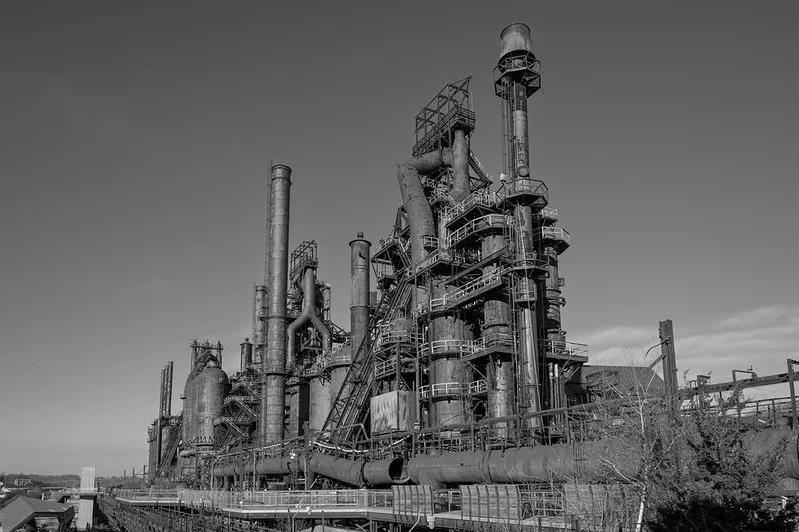
A steel plant in Bethlehem, Pennsylvania. Credit: Peter Miller/Flickr
Bethlehem Steel was once one of the most important manufacturers in the entire country, as it provided the steel for such iconic structures as the Golden Gate Bridge, the Empire State Building, and the Hoover Dam.
And according to at least one historian, the United States may not have succeeded in the two World Wars if Bethlehem Steel, with its wartime peak of some 300,000 workers, had not been able to turn out the necessary materials for the country’s military. Bethlehem Steel alone produced 1,127 ships during World War II.
The massive plant in the corporation’s hometown finally closed down for good in 2003 after the company declared bankruptcy two years earlier. Still a prominent landmark on the city’s riverfront, the rusted, dystopian steel mill towers have been preserved and incorporated into a trendy new public park and music venue.
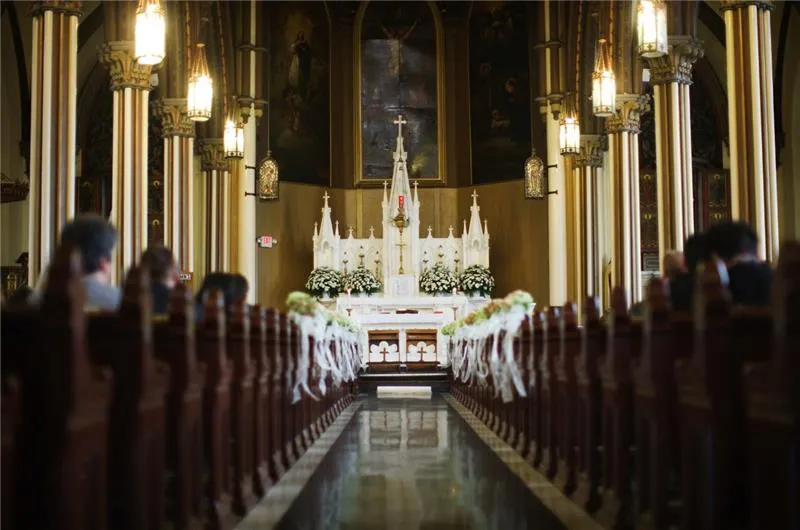
Inside Holy Infancy Catholic Church in Bethlehem, Pennsylvania, which is located on Bethlehem’s south side and founded in 1861, attracting Catholic immigrants from all over the world who came to work in the steel industry. Credit: Courtesy of Holy Infancy Catholic Church
Catholics in Bethlehem
Father Andrew Gehringer, pastor of Holy Infancy Catholic Church, told CNA that his parish, which is located on Bethlehem’s south side, was founded back in 1861 and attracted Catholic immigrants from all over the world who moved to Bethlehem to work in the steel industry. In the town’s heyday, there were six Catholic churches within 10 blocks, he said, with Holy Infancy being the first. Germans, Irish, Hungarians, Polish, Portuguese, and Brazilian people have all made Bethlehem home over the years.
Today, Mass is offered at Holy Infant in English, Spanish, and Portuguese. Gehringer said the multicultural nature of his parish lends itself to numerous fascinating Christmas traditions. For example, Portuguese-speaking parishioners participate in the “Novena de Natal” (Christmas novena), a nine-day prayerful meditation on the birth of Christ.
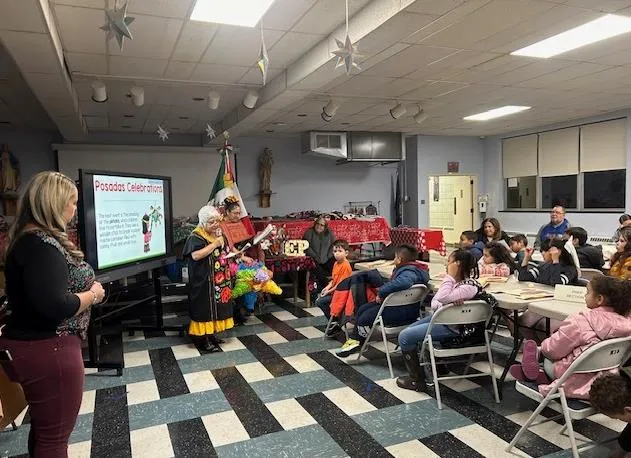
Spanish-speaking Catholics celebrate “Las Posadas” at Holy Infancy Catholic Church in Bethlehem, Pennsylvania, which is located on Bethlehem’s south side and founded in 1861. Credit: Courtesy of Holy Infancy Catholic Church
A similar devotion, “Las Posadas,” is practiced by the parish’s Spanish-speaking Catholics. The Spanish word “posada” means “inn,” and this devotion commemorates Mary and Joseph’s journey from Nazareth to Bethlehem, where they sought shelter for the birth of Jesus. Like the Portuguese Christmas novena, Las Posadas begins on Dec. 16 and involves the recitation of the rosary followed by a procession, Mass, and a celebration with a piñata on the nights leading up to Christmas.
“We really do push the multicultural flair of our parish. So we have multicultural dinners, and we have a multicultural summer festival,” Gehringer continued.
The priest said the town, as you can imagine, goes all out decorating for Christmas. Many of the decorations are religious, such as a Nativity scene in the center of the city, as well as innumerable Christmas trees. Gehringer said some of the parish’s Spanish-speakers have been asked in years past to decorate Christmas trees for the city in the manner of their culture.
The town has had a massive Christmas star set up on a nearby mountain since the late 1930s, a five-pointed star with eight rays. The structure is located at Bethlehem’s highest point — 890 feet above sea level — and the star’s LED lighting array, installed in 2010, can be seen 20 miles away. The star has become a symbol of the city, with signs throughout Bethlehem bearing an image of the star and proclaiming “Follow the Star to Bethlehem Attractions.”
Gehringer said it is special to live in a city where the religious aspects of Christmas are so widely celebrated with symbols — which, of course, include the name of the town itself.
“There’s some very Christian symbolism that’s very prominent in our city, that our city puts up,” Gehringer said. “In some towns, they don’t even allow the Nativity set.”




‘”Do not think the devil sleeps . . . They have just gone back underground.”‘
And they have a lot of clout (and money).