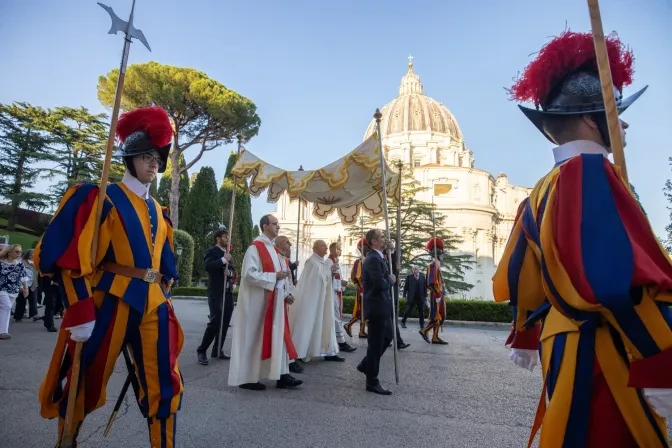
In celebration of the upcoming feast of the protomartyrs of Rome, a Eucharistic procession was held on June 27, 2024, through the streets of Vatican City. / Credit: Daniel Ibáñez/EWTN News
ACI Prensa Staff, Jun 28, 2024 / 17:10 pm (CNA).
On the occasion of the feast of the holy protomartyrs of Rome, which the Church celebrates every June 30, the traditional Mass and Eucharistic procession took place in Vatican City.
In celebration of the upcoming feast of the protomartyrs of Rome, a Eucharistic procession was held on June 27, 2024, through the streets of Vatican City. Credit: Daniel Ibáñez/EWTN News
The Pontifical Music Band plays during the Eucharistic procession in honor of the protomartyrs of Rome at the Vatican on June 27, 2024. Credit: Daniel Ibáñez/ EWTN News
The Eucharist is held in a monstrance by Cardinal Gianfranco Ravasi during a Eucharistic procession in honor of the protomartyrs of Rome on June 27, 2024, at the Vatican. Credit: Daniel Ibáñez/ EWTN NewsHoly Mass, celebrated on June 27 in the Church of Our Lady of Mercy at the Teutonic Cemetery, was offered by Cardinal Gianfranco Ravasi, president emeritus of the Pontifical Council for Culture.
Cardinal Gianfranco Ravasi presides at the Mass in honor of the holy protomartyrs of Rome on June 27, 2024, at the Church of Our Lady of Mercy of the Teutonic Cemetery in Rome. Credit: Daniel Ibáñez/EWTN News
At the end, a solemn Eucharistic procession took place, with the accompaniment of the Pontifical Musical Band along the avenues of Vatican City.
Members of the Pontifical Academy Cultorum Martyrum, numerous faithful, representatives of the Swiss Guard, and the gendarmerie as well as members of the Association of Sts. Peter and Paul participated in this traditional procession.
Lay faithful precede the Eucharist during a procession in honor of the protomartyrs of Rome on June 27, 2024. Credit: Daniel Ibáñez/EWTN News
Cardinal Gianfranco Ravasi holds the monstrance during a Eucharistic procession in honor of the protomartyrs of Rome on June 27, 2024. Credit: Daniel Ibáñez/EWTN News
The Eucharistic procession in honor of the protomartyrs of Rome goes around St. Peter’s Basilica on June 27, 2024 at the Vatican. Credit: Daniel Ibáñez/EWTN NewsCardinal Gianfranco Ravasi incenses the Eucharist during a procession in honor of the protomartyrs of Rome on June 27, 2024. Credit: Daniel Ibáñez/EWTN News
Members of the faithful follow the Eucharistic procession honoring the protomartyrs of Rome on June 27, 2024. Credit: Daniel Ibáñez/EWTN News
Swiss Guard accompany the Eucharist under the baldacchino during a Eucharistic procession in honor of the protomartyrs of Rome on June 27, 2024. Credit: Daniel Ibáñez/EWTN News
Who were the holy protomartyrs of Rome?
On June 30, the Church commemorates the holy protomartyrs of Rome, who died during the first persecution against the Catholic Church, which was unleashed in the second half of the first century.
They suffered terrible torments and gave their lives just to call themselves “Christians,” followers of Jesus of Nazareth.
Consequently, they were granted the title of “protomartyrs” — a term from ancient Greek — which means “first martyrs” or “first witnesses.”
This story was first published by ACI Prensa, CNA’s Spanish-language news partner. It has been translated and adapted by CNA.
If you value the news and views Catholic World Report provides, please consider donating to support our efforts. Your contribution will help us continue to make CWR available to all readers worldwide for free, without a subscription. Thank you for your generosity!
Click here for more information on donating to CWR. Click here to sign up for our newsletter.
Vatican City, Apr 20, 2017 / 08:00 pm (CNA/EWTN News).- Pope Francis sent a letter to the president of Brazil, apologizing for his inability to visit in 2017 and encouraging the leader’s attention to the country’s social issues.
“Since in his letter President Temer made reference to his efforts to confront the social problems of the country, the Pope underlined that aspect and encouraged him to work for the promotion of the country’s poorest people,” the Vatican press office said April 4, confirming a letter the Pope sent a few days before.
President Michael Temer invited Pope Francis to visit Brazil for the 300th anniversary of a Marian apparition known as Our Lady of Aparecida.
The story behind the apparition involves a clay statue of Mary Immaculate that was caught by three fishermen in October 1717 in preparation for a feast dedicated to royalty passing through the town.
Guarantinqueta, a small city along the Paraiba River, was expecting to receive the Count of Assumar on his travels to a gold mining site in Vila Rica.
The feast required a vast amount of fish, but it was not the season for it and weather conditions proved to be a challenge. After a night of fishing, the men caught nothing.
Having prayed to our Lady of Immaculate Conception, the fishermen first brought up the body of the statue and then the head. After the statue was brought up, the men decided to pray with faith to “Nossa Senhora da Conceição Aparecida” – which means Our Lady of the Appeared Conception. Their nets suddenly became very full, and the catch has been considered a miracle.
During an inauguration of a statue of Aparecida at the Vatican Gardens in 2016, Pope Francis said he did not know when he would be able to visit Aparecida in Brazil again “but at least I will have her very close, here.” The new statue was designed by a Brazilian artist and depicted Our Lady of Aparecida next to the three men with full nets of fish.
The Pope said Our Lady of Aparecida is close to the heart of the working class, “especially those who need work, education, those who are deprived of dignity.”
He encouraged President Temer’s for the efforts made to resolve the county’s social issues, reiterating Aparecida’s closeness to the poor.
President Michael Temer was brought into office last August when his predecessor, Dilma Rousseff, was impeached from office for an alleged abuse of power. Brazil’s economy has been in its worst recession since the 1980s; inflation increased by 10.7 percent and unemployment increased to 9 percent in 2015. Prices for Brazilian oil, iron ore, and soya also dropped.
Since his induction into office, Temer has aimed to reduce the country’s spending and the level of public debt.
Maryland state capital building, Annapolis. Via Shutterstock. / null
Washington D.C., Mar 20, 2023 / 16:30 pm (CNA).
Legislation that would end the statute of limitations for lawsuits against entities that are accused of negligence involving in… […]





Leave a Reply