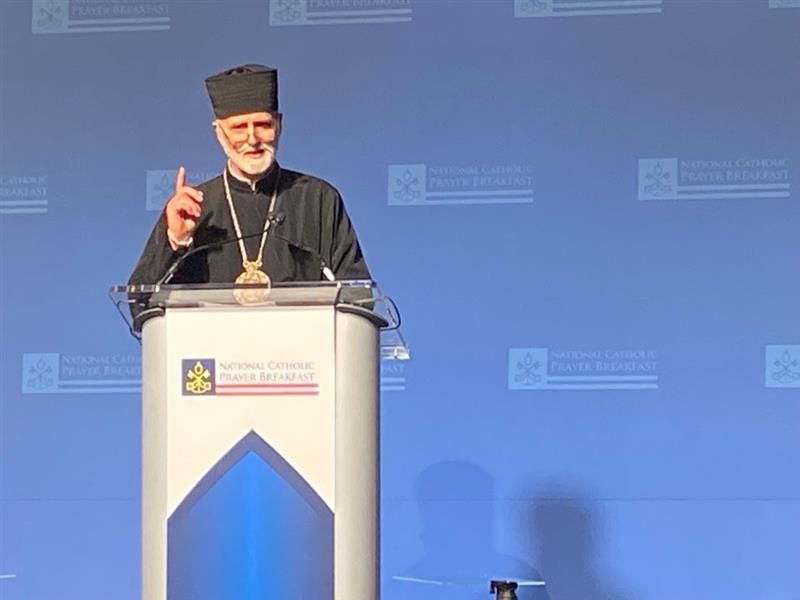
Ukrainian Greek Catholic Archbishop Borys Gudziak addresses the National Catholic Prayer Breakfast in Washington, D.C., on March 14, 2023. / Credit: Shannon Mullen/CNA
The Ukrainian Catholic Archeparchy of Philadelphia said this week that it would cover up a monument to the Nazi SS that still stands in a local cemetery in the suburbs of the city while it engages in “discussions” with the community about the controversial display.
The monument, erected roughly 30 years ago at St. Mary’s Ukrainian Catholic Cemetery, which is owned by the seat of the archeparchy, the Cathedral of the Immaculate Conception, gained national attention last week with a report in the Philadelphia Inquirer. A report on that monument, and another in Michigan, had appeared in the Jewish newspaper The Forward last month.
NEW: Two monuments to a Nazi military division with a record of war crimes have been hiding in plain sight in the suburbs of Philadelphia and Detroit.https://t.co/uUjFw2tcFW
The monument was meant to honor the 14th Waffen Grenadier Division of the SS, which was made up of ethnic Ukrainians during the Nazi occupation. The large stone cross bears the insignia of the division as well as several memorial inscriptions in English and Ukrainian.
Advocates argue the unit should be seen less as a vanguard of the Nazi Reich and more as a group of anti-communist Ukrainian patriots. Critics, meanwhile, say the group was involved in numerous war crimes and atrocities and that their behavior during the war — as well as their identification with the SS — should preclude any monuments being constructed in their honor.
Amid the controversy, the American Jewish Committee issued a statement urging the Ukrainian Catholic Church to “correct” the “historical myths” about the division and “remove this memorial stone from our community.”
Marcia Bronstein, the regional director of American Jewish Committee Philadelphia/Southern New Jersey, likewise said that the AJC was “look[ing] forward to being partners and exploring how best they can condemn this and how they can remove this statue that is so painful to the Jewish community.”
On Tuesday, Metropolitan Archbishop Borys Gudziak said in a statement that “given the current attention surrounding the monument … the Ukrainian Catholic Archeparchy of Philadelphia has decided to temporarily cover [it].”
Gudziak said the monument will remain covered “while our discussions ensue with the community in order to prevent vandalism and with the goal of conducting an objective dialogue with sensitivity to all concerned.”
In an earlier statement Gudziak had noted that the archeparchy “values its relationship with the Jewish community and intends to address the issues at hand with the depth and seriousness that they deserve.”
Reached for comment, an archeparchy spokesperson declined to offer information on how long that process would take, instead directing CNA back toward Gudziak’s original statement.
The 14th Division — also referred to as the 1st Galician for the region from which many of the volunteers were drawn — was after the war found to have participated in several war crimes including the massacre at the Polish village of Huta Pieniacka where as many as 1,200 Polish civilians were killed. The division was also reportedly responsible for the Pidkamin massacre, where several hundred to a thousand were murdered.
The Jewish news outlet Forward reported last month that another statute honoring the division resides near Detroit. Monuments to the division can also be found in Canada.
The Michigan monument sits “on the side of a Ukrainian credit union building” in the town of Warren, according to Forward. The town’s mayor, James Fouts, told the news outlet that there was “not even a minute chance that we would support anything like this.”
“We would never allow anything like that to go on public property,” Fouts told Forward, “but I don’t think we can do much for a monument on private land.”
If you value the news and views Catholic World Report provides, please consider donating to support our efforts. Your contribution will help us continue to make CWR available to all readers worldwide for free, without a subscription. Thank you for your generosity!
Click here for more information on donating to CWR. Click here to sign up for our newsletter.
Schoolchildren in Tigray, Ethiopia, eat biscuits and tea provided by Mary’s Meals. / Copyright Mary’s Meals
St. Louis, Mo., Sep 3, 2023 / 05:00 am (CNA).
A Catholic charity providing thousands of free meals daily to schoolchildren in Tigray, northern Ethiopia, recently resumed operations after a brutal civil war precluded it from its mission for almost three years.
Since 2017, Mary’s Meals has worked with the Daughters of Charity in Tigray to bring food to schoolchildren there. Pre-2020 they fed an estimated 24,000 children a day, but the effects of the COVID-19 pandemic and the subsequent commencement of the country’s devastating civil war halted the program. Mary’s Meals had every intention of reopening in the fall of 2020 following COVID, but the start of the conflict precluded those plans.
“It was really heartbreaking to see that what we were expecting to be quite a joyous occasion in terms of the resumption of school feeding, children being welcomed back into schools and being able to return to what must have felt a bit more like normal life, suddenly being decimated by this terrible conflict,” Alex Keay, director of programs at Mary’s Meals International, told CNA.
Schoolchildren in Tigray, Ethiopia, eat biscuits and tea provided by Mary’s Meals. Copyright Mary’s Meals
Today, as of late August, Mary’s Meals is able to serve high-energy biscuits and hot tea to approximately 10,000 children in 14 schools. Over the next few months, the group says, its program and menu will be expanded as cooking facilities that were destroyed or looted in the fighting are replaced.
Keay called the resumption of the food distribution a “joyous occasion.”
“We’ve been able to restart school feeding just in the last couple of weeks. And more of those schools will be reopening and we will be able to get food to those schools, and we would like to be able to reach even more schools. We know the need is there,” Keay said, speaking from Mary’s Meals’ home country of Scotland.
“These school meals that we’re providing are a critical lifeline at this time, but also they are enabling the children to return to school after more than a three-year absence.”
A refugee camp in Tigray, Ethiopia. Copyright Mary’s Meals
Widespread starvation has been reported recently in Tigray, especially since U.N. and U.S. food aid has been disrupted in recent months due to revelations of corruption. Overall, more than 20 million people in Ethiopia rely on food assistance. A persistent drought has made food scarcity even worse. According to reports from the region, many mothers giving birth at local hospitals in Tigray have been unable to breastfeed due to their own hunger, and many malnourished children “near death” have been showing up at hospitals.
It is estimated that 600,000 people have died in the conflict and there are reports of ongoing violence in various parts of Tigray. Though Ethiopia is extremely diverse overall, the Tigray region is overwhelmingly Orthodox Christian, at about 96%.
Keay said Mary’s Meals is focused on providing nourishing meals for children in areas where access to education is limited. The logistics are challenging, and the on-the-ground help of the Daughters of Charity is vital, he said.
“They would sooner give away the food in their cupboard than have people come to their door hungry with nothing,” Keay said of the religious sisters.
“Our model is a low-cost model, but I think a very efficient model whereby the community is taking a strong ownership and a really strong part in making sure that those programs operate successfully,” he added. “So they’ll be the ones that manage the local preparation of the meals, they’ll organize the volunteer cooks to come every day to cook the food and to make sure that every child that comes to that school gets fed. And then our role is that we’ll provide the food, the training, the monitoring, and the support to those communities so that that food is in the right place at the right time and that the children will all be fed.”
Schoolchildren in Tigray, Ethiopia, eat biscuits and tea provided by Mary’s Meals. Copyright Mary’s Meals
Schools provide a “beacon of hope” in an otherwise hope-starved country, and providing free meals at the schools helps to provide an incentive for students to get educated, he said. Major challenges remain, though, as many of the schools themselves have been shelled and looted amid the conflict.
“The children came with a lot of energy and a lot of passion for education, a lot of determination to really engage in their schools and to try and get the best from their education. And we certainly see that in terms of the … high attendance rates … once school feeding had started. That’s not uncommon for us to see that all of a sudden more children are encouraged to go to school,” Keay continued, drawing on his own experience visiting the country this year.
“The amazing thing is that the children were already coming back to those schools even though there was no furniture to sit on. Many of the teachers are still not back in their posts. A lot of the classrooms are actually damaged, the walls are damaged, or there’s holes in the ceiling. But the children are already coming back to those schools and are really, I guess, leading by example in their communities in terms of trying to get the schools back up and running.”
A destroyed school building in Tigray, Ethiopia. Copyright Mary’s Meals
The conflict in Tigray stemmed in part from the outsized role the Tigray People’s Liberation Front (TPLF), the primary political party representing the region, has played in recent decades in national politics in Ethiopia despite Tigrayans’ status as an ethnic minority. The political coalition that the TPLF led was dissolved in 2018 by Prime Minister Abiy Ahmed after he took office. The coalition’s ethnicity-based regional parties were merged into a single party, the Prosperity Party, which the TPLF refused to join. Tigrayan leaders have said they were unfairly targeted by political purges and allegations of corruption.
On Nov. 4, 2020, Abiy announced a military offensive in response to an alleged attack on a military base in Mekelle, the capital of Tigray. The conflict soon escalated into an all-out civil war in which mass atrocities have been reported. Eritrea, Ethiopia’s neighbor to the north and former adversary, joined the side of the Ethiopian government early in the conflict. Some have accused Abiy’s government of ethnic cleansing.
For much of the war, Tigray was under blockade by the Ethiopian government, which halted all humanitarian aid and forbade aid workers and media from entering the region. The Ethiopian government and the TPLF signed a peace deal brokered by the African Union (AU) in November 2022, bringing the war to an end on paper.
A damaged school building in Tigray, Ethiopia. Copyright Mary’s Meals
The needs in Tigray over the past few years have been largely overshadowed by other major world events, such as the war in Ukraine. Keay said it is important that people take notice of the “huge, devastating humanitarian situation” in Tigray.
“Tigray is a place that for the most part, people will be familiar with for probably quite negative reasons. There’s been terrible famines in that part of Africa, and a lot of those images, I think, have stuck in a lot of people’s minds. But it’s a very beautiful part of the world, with a real strong sense of identity and culture for the Tigrian people. They’re very distinctive in their culture, the way people dress. And there’s been a lot of work in that part of Ethiopia in recent years around development, and really a lot of progress has been made,” Keay said.
The brutal war, Keay said, has “really set back the development that’s been happening in Tigray.”
“From a state that was really blossoming and a lot of really positive things were happening in terms of sustainable food being grown for the communities … to a situation where the vast majority of Tigrayans are now dependent on food, hand out food aid to be able to survive. And it’s going to take a long time, I think, to repair that damage.”
Schoolchildren in Tigray, Ethiopia, eat biscuits and tea provided by Mary’s Meals. Copyright Mary’s Meals
The BBC reported earlier this month that at least 1,400 people have starved to death in Tigray since food assistance from the U.N.’s World Food Programme (WFP), the global humanitarian organization addressing food security, and the U.S. Agency for International Development (USAID) was suspended about four months ago. The suspension came about after it was revealed by Tigrayan authorities that nearly 500 people had been stealing the food, including government officials and nongovernmental organization staff.
Keay said that from an accountability standpoint, the Daughters of Charity have developed a very “transparent and accountable system that meant that the food was being put directly into [needy people’s] hands.”
“Other organizations were having to suspend their programs because of concerns about food not getting to those that it was intended to. But it was very clear when we were there and being on the ground, seeing the food being distributed, that it is really possible to be able to put the food directly into the hands of those that we’re trying to serve,” he noted.
Mary’s Meals now operates in 18 countries, after its founding in Malawi in 2002. Magnus MacFarlane-Barrow, a Catholic and founder and CEO of Mary’s Meals, was declared a “CNN Hero” in 2010 and has also been awarded the Order of the British Empire by Queen Elizabeth for his work. The organization says it feeds 2.4 million children every day throughout the 18 countries where it is present, with the largest share of those children in Malawi.
Pope Francis has repeatedly called for peace in Tigray. In 2021, after his weekly Angelus, the pope prayed a Hail Mary for the people of the Tigray region.
Hong Kong.Hong Kong media tycoon and founder of Apple Daily newspaper Jimmy Lai Chee Ying arrives at the West Kowloon Magistrates’ Court, May 18, 2020. / Yung Chi Wai Derek/Shutterstock
Washington D.C., Sep 14, 2021 / 16:01 pm (CNA).
A Catholic democracy advocate was honored in absentia on Tuesday at a Catholic gathering in Washington, D.C., while he remains imprisoned in Hong Kong.
Jimmy Lai, a media entrepreneur and Catholic pro-democracy advocate in Hong Kong, was given the Christifidelis Laici award on Sept. 14 by organizers of the National Catholic Prayer Breakfast. The award is named for Pope John Paul II’s 1988 exhortation on the mission of the laity in the world.
Lai “believed that we are created for truth and that it is our job to speak the truth,” said William McGurn, a member of the Wall Street Journal editorial board who accepted the award on Lai’s behalf on Tuesday. “His publications told the truth about China & Hong Kong.”
“He is a man of extraordinary means, serving ordinary men and women longing for freedom,” said Joseph Cella, a board member of the National Catholic Prayer Breakfast.
Lai has been imprisoned for 10 months in Hong Kong, having long supported the pro-democracy movement there and having cited his Catholic faith in support of his efforts.
An entrepreneur, he founded both Next magazine, a Chinese weekly publication, and Apple Daily, a pro-democracy publication critical of the Chinese mainland government. Apple Daily shut down publication earlier this summer, after its accounts were frozen and top leadership was arrested.
In 1997, he converted to Catholicism and was baptized by the now-retired bishop of Hong Kong, Joseph Cardinal Zen.
Lai’s conversion, at the time the United Kingdom handed over sovereignty of Hong Kong to the People’s Republic of China, was “like a small green shoot breaking through the concrete,” McGurn said of the time.
Hong Kong had previously maintained its own legislature and democratic form of government under the “one country, two systems” agreement, as the U.K. prepared to hand sovereignty of the region to China. However, the Chinese mainland government had sought greater control over Hong Kong in recent years before imposing a sweeping national security law on the region in 2020, bypassing the island’s legislature. The act followed months of pro-democracy protests in Hong Kong.
Under the new law, a person convicted of secession, subversion, terrorism or collusion with foreign forces would receive a minimum of 10 years in prison, with the possibility of a life sentence.
Lai was arrested in August 2020 over his support for pro-democracy protests in Hong Kong, and remained on the island to face his charges. People had urged Lai – who is also a British citizen – to leave Hong Kong before he would be arrested, McGurn noted.
“If you thought that [leaving] was ever a possibility, you don’t know Jimmy Lai,” McGurn said.
Released on bail, he was arrested again later in the year, and was charged in December with breaching the terms of a lease for his company, Next Digital Media.
Hong Kong’s Court of Final Appeal on Feb. 9 denied Lai bail, but allowed his legal team the possibility of applying again for bail. He has remained in prison for 10 months.
During his prison term, he has applied the Rule of St. Benedict – “ora et labora,” or “prayer and work,” McGurn noted.
“When he’s not reading the classics of the faith,” McGurn said of Lai, “he has a job folding paper into envelopes.” Some fellow prisoners have even been baptized during his term, McGurn said.
“While Jimmy may be stuck in prison, his soul remains free,” he said.
Pennsylvania Republican U.S. Senate candidate Dave McCormick and his wife, Nina Powell, thank supporters after declaring victory in a closely contested race with incumbent Democratic Sen. Bob Casey on Nov. 6, 2024, in Pittsburgh. / Credit: Jeff … […]
Leave a Reply
