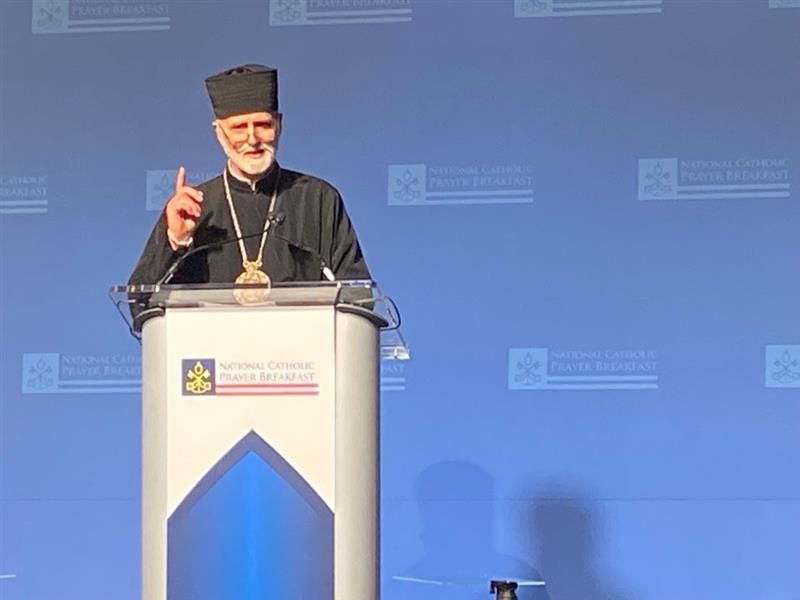
Ukrainian Greek Catholic Archbishop Borys Gudziak addresses the National Catholic Prayer Breakfast in Washington, D.C., on March 14, 2023. / Credit: Shannon Mullen/CNA
The Ukrainian Catholic Archeparchy of Philadelphia said this week that it would cover up a monument to the Nazi SS that still stands in a local cemetery in the suburbs of the city while it engages in “discussions” with the community about the controversial display.
The monument, erected roughly 30 years ago at St. Mary’s Ukrainian Catholic Cemetery, which is owned by the seat of the archeparchy, the Cathedral of the Immaculate Conception, gained national attention last week with a report in the Philadelphia Inquirer. A report on that monument, and another in Michigan, had appeared in the Jewish newspaper The Forward last month.
NEW: Two monuments to a Nazi military division with a record of war crimes have been hiding in plain sight in the suburbs of Philadelphia and Detroit.https://t.co/uUjFw2tcFW
The monument was meant to honor the 14th Waffen Grenadier Division of the SS, which was made up of ethnic Ukrainians during the Nazi occupation. The large stone cross bears the insignia of the division as well as several memorial inscriptions in English and Ukrainian.
Advocates argue the unit should be seen less as a vanguard of the Nazi Reich and more as a group of anti-communist Ukrainian patriots. Critics, meanwhile, say the group was involved in numerous war crimes and atrocities and that their behavior during the war — as well as their identification with the SS — should preclude any monuments being constructed in their honor.
Amid the controversy, the American Jewish Committee issued a statement urging the Ukrainian Catholic Church to “correct” the “historical myths” about the division and “remove this memorial stone from our community.”
Marcia Bronstein, the regional director of American Jewish Committee Philadelphia/Southern New Jersey, likewise said that the AJC was “look[ing] forward to being partners and exploring how best they can condemn this and how they can remove this statue that is so painful to the Jewish community.”
On Tuesday, Metropolitan Archbishop Borys Gudziak said in a statement that “given the current attention surrounding the monument … the Ukrainian Catholic Archeparchy of Philadelphia has decided to temporarily cover [it].”
Gudziak said the monument will remain covered “while our discussions ensue with the community in order to prevent vandalism and with the goal of conducting an objective dialogue with sensitivity to all concerned.”
In an earlier statement Gudziak had noted that the archeparchy “values its relationship with the Jewish community and intends to address the issues at hand with the depth and seriousness that they deserve.”
Reached for comment, an archeparchy spokesperson declined to offer information on how long that process would take, instead directing CNA back toward Gudziak’s original statement.
The 14th Division — also referred to as the 1st Galician for the region from which many of the volunteers were drawn — was after the war found to have participated in several war crimes including the massacre at the Polish village of Huta Pieniacka where as many as 1,200 Polish civilians were killed. The division was also reportedly responsible for the Pidkamin massacre, where several hundred to a thousand were murdered.
The Jewish news outlet Forward reported last month that another statute honoring the division resides near Detroit. Monuments to the division can also be found in Canada.
The Michigan monument sits “on the side of a Ukrainian credit union building” in the town of Warren, according to Forward. The town’s mayor, James Fouts, told the news outlet that there was “not even a minute chance that we would support anything like this.”
“We would never allow anything like that to go on public property,” Fouts told Forward, “but I don’t think we can do much for a monument on private land.”
If you value the news and views Catholic World Report provides, please consider donating to support our efforts. Your contribution will help us continue to make CWR available to all readers worldwide for free, without a subscription. Thank you for your generosity!
Click here for more information on donating to CWR. Click here to sign up for our newsletter.
Orlando, Fla., Jul 2, 2017 / 08:01 pm (CNA/EWTN News).- The rapidly changing realities of the Catholic Church in the U.S. bring a host of challenges and unknowns, but also great opportunities for evangelization and engagement, said experts at a gathering of Catholic leaders.
“The future of U.S. Catholicism is being forged in areas once not central to U.S. Catholic life,” said Dr. Hosffman Ospino, associate professor of theology and religious education at Boston College. “Are we paying attention?”
Dr. Ospino spoke at the “Convocation of Catholic Leaders: The Joy of the Gospel in America” event on July 2 in Orlando, Florida.
He explained to more than 3,500 attendees from parishes and Catholic organizations around the country how the face of the Church in the United States is rapidly changing. In particular, he pointed to the rapid growth throughout the nation, particularly in the South and West of Hispanic communities. He also noted swift growth of other faith communities, particularly Asian Catholic communities and, within some localities, communities of immigrants from Africa.
These changes have swiftly changed the face of American Catholic life. Fifty years ago, over 80 percent of American Catholics were of European descent. Today, that number is less than 50 percent, with 40 percent of all Catholics claiming Latino heritage, 5 percent of Asian or Pacific Islander descent, 4 percent African-American and 1 percent of Catholics of Native American descent.
Among Catholics under the age of 30, those numbers are even more diverse.
To address these very shifts in American Catholic life, Catholics should imagine what the future of the Church will look like, Ospino said.
“What kind of community of faith will our children and grandchildren inherit?” he asked, encouraging Catholics in attendance to consider the best stories and guidance the Church can offer.
Ospino also suggested Catholics reimagine their relationship with the public square. He warned that the ‘culture wars’ which have been a marker of American discourse in recent decades have hampered, in some cases, the Church’s ability to speak effectively to communities on the margins.
“It has become impossible to speak about anything because one is expected to take an ideological position to make a point,” he commented.
“The Gospel, my friends, is not an ideology, to be a co-opted to advance an ideological position. The Gospel is a message of life and communion,” Ospino said to applause.
Catholics should look for other means of engaging and reaching these growing segments of the Church, and participate in the U.S. Bishops’ National Encuentro program as part of this engagement, he continued.
Dr. Ospino’s talk was followed by a panel discussion, describing the different ways the Church is growing and changing in the United States.
Jesuit Father Thomas P. Gaunt, SJ, executive director of the Center for Applied Research in the Apostolate at Georgetown University, explained that demographic changes in the United States do not apply just to Latino Catholics, but to all sections of the Church in the United States. He noted that populations of U.S. Catholic life are shifting away from the historic centers in the Northeast to booming job markets in the South and West. In addition, he noted, shifts are impacting African-American and Asian communities.
Meanwhile, according to CARA’s research, nearly a third of U.S. Catholics are not connected to a local church. While this disparity is a sign for needed improvement, Fr. Gaunt suggested that this gap can also be seen as a resource.
“How do we re-invite and re-engage them once more?” he wondered.
Kerry Weber, executive editor of America magazine, also pointed to these communities on the peripheries and noted that most of these communities have been engaged in the Church for decades or even centuries. The challenge for Catholic journalists, she said, is to show the diversity of the Church that has always been here.
Helen Alvare, professor of law at the Antonin Scalia Law School at George Mason University, pointed to the great strides the Church has made both in promoting its view of the human person in the public square and improving her own witness to the living out of respect for the human person in daily life.
On one hand, she said, “there is an embracing of the role of women in the Church and in the public square,” and embracing of men’s integral role in raising children in the home. Furthermore, “there is a huge emerging consensus that the Church’s beautiful way of marriage sex and the family is freeing for all people.”
However, there have also been challenges. She noted that in the past several decades, challenges to the family have been a major contributor to social inequality. In addition, she said, the Church has experienced “profound losses of ideas” and understanding of teaching.
She urged participants not to be afraid to share the Church’s message and vision for the human person – even as it confronts the messages and priorities of the secular world.
“Since when has the Church’s message anywhere not been scandalizing to the world?” she remarked.
At the same time, however, Catholics should articulate the fullness and meaning of the faith, and not rely purely on constitutional and legal arguments. “We have to tell them what we’re going to use our religious liberty for,” she insisted.
Franciscan Father Agustino Torres, CFR, works extensively with Latino youth in New York City and explained that Latino youth – one of the largest growing populations of Catholics in the United States, “don’t want just a program,” but an example of the Church’s message. He pointed to the Church’s teaching on love and sexuality as a concrete example of doctrine that youth can apply to their lives, finding Christ in the process.
“It makes the Church relevant to young people,” Fr. Torres said.
Daniel Owens, who spoke with his wife Melanie on the powerful encounter of love provided in the Church’s message of chastity, echoed Fr. Torres’ insights, saying that he sees a “real opportunity” in sharing the message of the Gospel, and added that the Theology of the Body has the unique ability to speak to the questions many youth face today.
Outside of any specific program or message, however, Fr. Torres stressed the importance of encounter, particularly when reaching out to young people. Within many cultures, particularly Latino youth, young people feel torn between different cultures and identities asking for their attention.
“If the Church were to say ‘you belong here, this is your home,’ you’re going to get an army of missionary disciples,” he said.
A defining theme of Pope Francis’ papacy has been his urging of humanity to better care for the natural environment, which he has done most prominently in his landmark 2015 encyclical Laudato Si’ and numerous subsequent writings and speeches.
The pope’s emphasis on this topic — especially his foray into climate science via his recent encyclical Laudate Deum — has variously drawn both praise and consternation from Catholics in the United States, about half of whom do not share Pope Francis’ views on climate change, according to surveys.
In Laudate Deum, which was released in October as a continuation to Laudato Si’, Francis wrote that the effects of climate change “are here and increasingly evident,” warning of “immensely grave consequences for everyone” if drastic efforts are not made to reduce emissions. In the face of this, the Holy Father criticized those who “have chosen to deride [the] facts” about climate science, stating bluntly that it is “no longer possible to doubt the human — ‘anthropic’ — origin of climate change.”
The pope in the encyclical laid out his belief that there must be a “necessary transition towards clean energy sources, such as wind and solar energy, and the abandonment of fossil fuels.” This follows a call from Pope Francis in 2021 to the global community calling for the world to “achieve net zero carbon emissions as soon as possible.”
He further lamented what he called “certain dismissive and scarcely reasonable opinions [on climate change] that I encounter, even within the Catholic Church.”
In light of the new encyclical — which extensively cites the U.N.’s Intergovernmental Panel on Climate Change (IPCC) — Pope Francis was invited to speak at this week’s United Nations Climate Change Conference, known as COP28. Though the 86-year-old pope was forced to cancel his trip due to health issues, the Vatican has indicated that he aims to participate in COP28 this weekend in some fashion. It announced today that Vatican Secretary of State Cardinal Pietro Parolin will represent the pope at the conference.
While various Catholic groups have welcomed the pope’s latest encyclical, some Catholics have reacted with persistent doubts, questioning whether the pope’s policy prescriptions would actually produce the desired effects.
How do Americans feel about climate change?
According to a major survey conducted by Yale University, 72% of Americans believed in 2021 — the latest available data year — that “global warming is happening,” and 57% believe that global warming is caused by human activity.
More recent polling from the Pew Research Center, conducted in June, similarly suggests that two-thirds of U.S. adults overall say the country should prioritize developing renewable energy sources, such as wind and solar, over the expansion of the production of oil, coal, and natural gas. That same survey found that just 3 in 10 adults (31%) say the U.S. should completely phase out oil, coal, and natural gas. The Yale study found that 77% of U.S. adults support at least the funding of research into renewable energy sources.
Broken down by party affiliation, Pew found that a large majority of Democratic and Democratic-leaning independents — 90% — favor alternative energy sources, while just under half, 42%, of Republicans and Republican-leaning adults think the same. Within the Republican cohort, however, 67% of Republicans under age 30 prioritize the development of alternative energy sources, compared with the 75% of Republicans ages 65 and older who prioritize the expansion of oil, coal, and natural gas.
In terms of the expansion of alternative energy sources, two-thirds of Americans think the federal government should encourage domestic production of wind and solar power, Pew reported. Just 7% say the government should discourage this, while 26% think it should neither encourage nor discourage it.
How do America’s Catholics feel about climate change?
Surveys suggest that Catholics in the United States are slightly more likely than the U.S. population as a whole to be skeptical of climate change, despite the pope’s emphatic words in 2015 and since.
A separate Pew study suggests that 44% of U.S. Catholics say the Earth is warming mostly due to human activity, a view in line with Pope Francis’ stance. About 3 in 10 (29%) said the Earth is warming mostly due to natural patterns, while 13% said they believe there is no solid evidence the planet is getting warmer.
According to the same study, 71% of Hispanic Catholics see climate change as an extremely or very serious problem, compared with 49% of white, non-Hispanic Catholics. (There were not enough Black or Asian Catholics in the 2022 survey to analyze separately, Pew said.)
One 2015 study from Yale did suggest that soon after Laudato Si’ was released, U.S. Catholics were overall more likely to believe in climate change than before. That same study found no change, however, in the number of Americans overall who believe human activity is causing global warming.
Pope Francis’ climate priorities
Beyond his groundbreaking writings, Pope Francis has taken many actions during his pontificate to make his own — admittedly small — country, Vatican City, more sustainable, including the recent announcement of a large order of electric vehicles, construction of its own network of charging stations, a reforestation program, and the continued importation of energy coming exclusively from renewable sources.
Francis has often lamented what he sees as a tepid response from developed countries in implementing measures to curb climate change. In Laudate Deum, he urged that new multinational agreements on climate change — speaking in this case specifically about the COP28 conference — be “drastic, intense, and count on the commitment of all,” stating that “a broad change in the irresponsible lifestyle connected with the Western model would have a significant long-term impact.”
The pope lamented what he sees as the fact that when new projects related to green energy are proposed, the potential for economic growth, employment, and human promotion are thought of first rather than moral considerations such as the effects on the world’s poorest.
“It is often heard also that efforts to mitigate climate change by reducing the use of fossil fuels and developing cleaner energy sources will lead to a reduction in the number of jobs,” the pope noted.
“What is happening is that millions of people are losing their jobs due to different effects of climate change: rising sea levels, droughts, and other phenomena affecting the planet have left many people adrift. Conversely, the transition to renewable forms of energy, properly managed, as well as efforts to adapt to the damage caused by climate change, are capable of generating countless jobs in different sectors.”
‘Leave God’s creation better than we found it’
Dr. Kevin Roberts, president of the Washington, D.C.-based Heritage Foundation think tank, told CNA that he has noticed a theme of frustration and confusion among many Catholics regarding the Holy Father’s emphasis on climate change.
A self-described outdoorsman and former president of Wyoming Catholic College, Roberts spoke highly to CNA of certain aspects of Laudato Si’, particularly the pope’s insights into what he called “human ecology,” which refers to the acceptance of each person’s human body as a vital part of “accepting the entire world as a gift from the Father and our common home.”
Dr. Kevin Roberts, president of the Heritage Foundation. Courtesy of Heritage Foundation.
“I like to think [Pope Francis] personally wrote that, because I could see him saying that,” Roberts said of the passage, which appears in paragraph 155 of the encyclical. Roberts said he even makes a point to meditate on that “beautiful and moving” passage during a retreat that he does annually.
That portion of Laudato Si’ notwithstanding, Roberts said he strongly believes that it detracts from other important issues, such as direct ministry to the poor, when Pope Francis elevates care for God’s natural creation as “seemingly more important than other issues to us as Catholics.” He also said he disagrees with Pope Francis’ policy prescriptions, such as a complete phasing out of fossil fuels, contained in Laudate Deum.
“We of course want to pray for him. We’re open to the teaching that he is providing. But we also have to remember as Catholics that sometimes popes are wrong. And on this issue, it is a prudential matter. It is not a matter of morality, particularly when he’s getting into the scientific policy recommendations,” Roberts said.
Roberts said the Heritage Foundation’s research and advocacy has focused not on high-level, multinational agreements and conferences to tackle the issues posed by climate change but rather on smaller-scale, more community-based efforts. He said this policy position is, in part, due to the historical deference such multinational conglomerates of nations have given to China, the world’s largest emitter of greenhouse gases overall.
He said agreements within the U.S. itself, with businesses and all levels of government working together, have produced the best results so far when it comes to improving the environment. He also pointed to examples of constructive action that don’t involve billions of dollars, such as families making the choice to spend more time outdoors or engaging in local activities that contribute to environmental conservation and community life, such as anti-litter campaigns and community gardening. The overarching goal, he said, should be to “leave God’s creation better than we found it.”
Roberts — who said he personally believes humans likely have “very little effect” on the climate — said he was discouraged to read other portions of Laudato Si’, as well as Laudate Deum, that to him read as though they had come “straight out of the U.N.” Despite his criticisms, Roberts urged his fellow Catholics to continue to pray for the Holy Father and to listen to the pope’s moral insights.
“I just think that the proposed solutions are actually more anti-human and worse than the purported effects of climate change,” he added.
‘A far more complex issue’
Greg Sindelar, a Catholic who serves as CEO of the Texas Public Policy Foundation (TPPF), a conservative think tank that studies the energy industry, similarly expressed concerns to CNA about the potential impact of certain climate change mitigation policies on human flourishing.
Like Roberts, Sindelar spoke highly of certain aspects of the pope’s message while expressing reservations about some of the U.N.-esque solutions proposed in Laudate Deum.
“I think the pope is right about our duty as Catholics to be stewards and to care for the environment. But I think what we have to understand — what we have to balance this with — is that it cannot come at the expense of depriving people of affordable and reliable energy,” Sindelar said in an interview with CNA.
“There’s ways to be environmentally friendly without sacrificing the access that we all need to reliable and affordable energy.”
Greg Sindelar is CEO of the Texas Public Policy Foundation, a think tank in America’s leading energy-producing state. Courtesy of Texas Public Policy Foundation
Sindelar said TPPF primarily promotes cheap, reliable access to energy as a means of promoting human flourishing. The free-market-focused group is skeptical of top-down governmental intervention, both in the form of regulation and incentives or disincentives in certain areas of the energy sector.
When asked what he thinks his fellow Catholics largely think about the issue, Sindelar said many of the Catholics he hears from express the view that government policies and interventions rarely produce effective solutions and could potentially hinder access to energy for those in need.
“I think it’s a far more complex issue than just saying we need to cut emissions, and we need to transfer away from fossil fuels, and all these other things. What we need to do is figure out and ensure ways that we are providing affordable and reliable electricity to all citizens of the world,” he reiterated.
“When the pope speaks, when the Vatican speaks, it carries a lot of weight with Catholics around the world, [and] not just with Catholics … and I totally agree with him that we need to be thinking about the most marginalized and the poorest amongst us,” Sindelar continued.
“[But] by going down these policy prescription paths that he’s recommending, we’re actually going to reduce their ability to have access to that,” he asserted.
Sindelar, while disagreeing with Pope Francis’ call for an “abandonment of fossil fuels,” said he appreciates the fact that Pope Francis has spoken out about the issue of care for creation and has initiated so much public discussion.
“I think there is room for differing views and opinions on the right ways to do that,” he said.
Effective mitigation efforts
Susan Varlamoff, a retired biologist and parishioner at St. John Neumann Catholic Church in the Atlanta area, is among those Catholics who are committed to Pope Francis’ call to care for creation and to mitigate the effects of climate change. To that end, Varlamoff in 2016 created a peer-reviewed action plan for the Archdiocese of Atlanta to help Catholics put the principles contained in Laudato Si’ into action, mainly through smaller, more personal actions that people can take to reduce their energy usage.
Retired biologist Susan Varlamoff. Photo courtesy of Susan Varlamoff
The Atlanta Archdiocese’s efforts have since garnered recognition and praise, Varlamoff said, with at least 35 archdioceses now involved in an inter-diocesan network formed to exchange sustainability ideas based on the latest version of the plan from Atlanta.
“It’s fascinating to see what everybody is doing, and it’s basically based on their talents and imaginations,” Varlamoff said, noting that a large number of young people have gotten involved with their efforts.
As a scientist, Varlamoff told CNA it is clear to her that Pope Francis knows what he’s talking about when he lays out the dangers posed by inaction in the face of climate change.
“He understands the science, and he’s deeply concerned … he’s got remarkable influence as a moral leader,” she said.
“Part of what our religion asks us to do is to care for one another. We have to care for creation if we’re going to care for one another, because the earth is our natural resource system, our life support, and we cannot care for one another if we don’t have that life support.”
Responding to criticisms about the financial costs associated with certain green initiatives, Varlamoff noted that small-scale sustainable actions can actually save money. She offered the example of parishes in the Atlanta area that have drastically reduced their electric bills by installing solar panels.
“[But,] it’s not just about saving money. It’s also about reducing fossil fuels and greenhouse gas emissions, and protecting the natural resources for future generations,” she said.
Moreover, Varlamoff said, the moral imperative to improve the natural environment for future generations is worth the investment. “When [Catholics] give money, for example, for a social justice issue like Walking with Moms in Need or special needs, the payback is improving lives. We’re improving the environment here,” she emphasized.
Washington D.C., Apr 15, 2017 / 03:01 am (CNA/EWTN News).- Global religious persecution spiked from 2014 to 2015, the Pew Research Center noted in a new report released this week.
“Government restrictions on religion and social hostilities involving religion increased in 2015 for the first time in three years,” the latest annual Pew Research Center report on “Global Restrictions on Religion” began.
In 2015, there were “very high” or “high” levels of animosity shown towards religious groups in 40 percent of countries, the report noted, either through restrictive government laws targeting religious groups or violence or harassment toward adherents of specific religions by other members of society.
The 2015 percentage was up six points from 2014, when 34 percent of countries reported such levels of hostility to religious groups.
Pew’s report drew from various sources on global religious freedom, both from the U.S. government (annual international religious freedom reports of the State Department and the U.S. Commission on International Religious Freedom), the European Union and United Nations, and other non-governmental organizations.
The report was part of the “Pew-Templeton Global Religious Futures project,” funded by The Pew Charitable Trusts and the John Templeton Foundation.
Certain countries and regions of the world showed especially high hostility towards religious groups. Russia, Egypt, India, Pakistan, and Nigeria all showed both government harassment of and social animus toward certain religious groups.
Some of the most common instances of hostility included “mob violence” waged against people for their religious beliefs or violence conducted in the name of religion, and also “government harassment and use of force against religious groups” Pew explained.
Certain regions fared worse than others on religious tolerance. Countries in the Middle East and North Africa featured the highest median levels by far of both “government restrictions on religion” and “social hostilities involving religion,” Pew reported.
However countries in sub-Saharan Africa showed the “largest increase” in the median levels of government restrictions in 2015, Pew noted, and both Europe and sub-Saharan Africa showed marked increases in “social hostilities involving religion.”
In Europe, there were many reports of harassment or violence against Muslims and Jews, continuing a pattern of both anti-Semitism on the continent and verbal or legal harassment of Muslims as the European Union deals with an influx of refugees from Muslim-majority counties like Syria and Iraq.
For instance, Switzerland showed an increase in anti-Semitic and anti-Muslim incidents, including the desecration of a Muslim cemetery and an assault of an Orthodox Jew where one perpetrator shouted “Heil Hitler!”
Mosques and Muslims were targeted for vandalism or violence in the wake of the January, 2015 terror attacks on the offices of the satirical publication Charlie Hebdo and on a kosher market in Paris.
“France’s Interior Ministry reported that anti-Muslim incidents more than tripled in 2015, including cases of hate speech, vandalism and violence against individuals,” the report noted.
Thirty-two countries in the continent showed “social hostilities toward Muslims” in 2015, more than the 26 countries reported in 2014. Meanwhile, the number of European countries where there were social hostilities shown towards Jews remained high.
“The widespread harassment of Jews is notable because about eight-in-ten of the world’s Jews live in just two countries – the United States and Israel – but Jews continue to be harassed in a relatively large number of nations (74 in 2015),” Pew stated.
However, government officials also showed hostility to religious groups either through restrictive laws or rhetoric.
France and Russia in particular showed a spike, with over 200 “cases of government force against religious groups,” the report noted. These were mostly due to laws aimed at specific religious groups targeting the public exercise of religion, from France’s burqa ban to Russia’s treatment of some Muslims and groups like Jehovah’s Witnesses as extremists, jailing them without due process.
Some governments have been particularly restrictive of religious freedom for years, like those of China, Saudi Arabia, Iran, Egypt, and Uzbekistan, the report noted. Others have more recently shown greater hostility, like Iraq, Eritrea, Vietnam, and Singapore in 2015.
Some of the government restrictions on religion were supposedly in reaction to terrorism. For instance, Muslim women in Cameroon and Niger were barred from wearing full-face veils after militants wore those veils to conceal bombs.
Both Christians and Muslims saw a sizable increase in the number of countries where they experienced harassment in 2015. Christians “were targeted by the highest number of governments in the Asia-Pacific region, where 33 countries harassed Christians in 2015,” the report said.
Leave a Reply