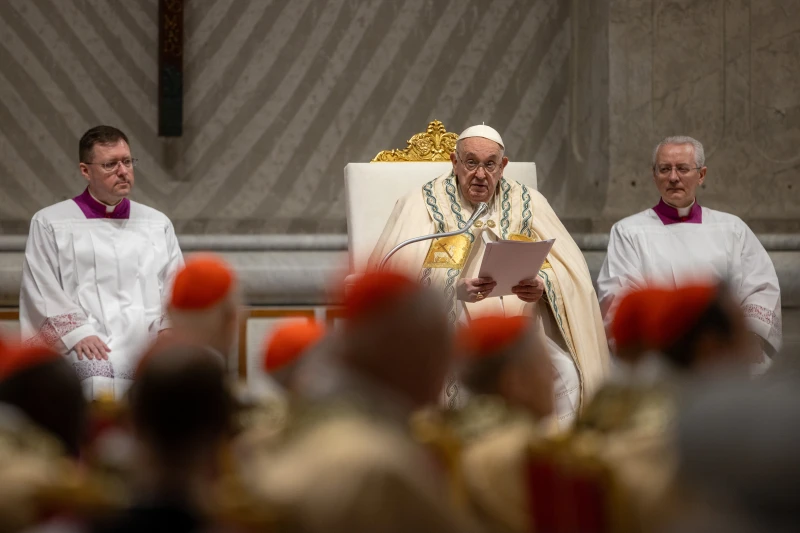
 Pope Francis speaks at the Vatican’s Easter Vigil, March 30, 2024 / Daniel Ibanez/CNA
Rome Newsroom, Mar 30, 2024 / 16:00 pm (CNA).
The following is the text of Pope Francis’ homily delivered at the Vatican’s 2024 Easter Vigil.
The women go to the tomb at daybreak, yet they still feel the darkness of night. They continue to walk, yet their hearts remain at the foot of the cross. The tears of Good Friday are not yet dried; they are grief-stricken, overwhelmed by the sense that all has been said and done. A stone has sealed the fate of Jesus. They are concerned about that stone, for they wonder: “Who will roll away the stone for us from the entrance to the tomb?” (Mk 16:3). Yet once they arrive, they are taken aback when they see the amazing power of the Easter event: “When they looked up, they saw that the stone, which was very large, had already been rolled back” (Mk 16:4).
Let us stop and reflect on these two moments, which bring us to the unexpected joy of Easter. The woman anxiously wonder: Who will roll away the stone from the tomb? Then, looking up, they see that it had already been rolled back.
First, there is the question that troubles their grieving hearts: Who will roll away the stone from the tomb? That stone marked the end of Jesus’ story, now buried in the night of death. He, the life that came into the world, had been killed. He, who proclaimed the merciful love of the Father, had met with no mercy. He, who relieved sinners of the burden of their condemnation, had been condemned to the cross. The Prince of Peace, who freed a woman caught in adultery from a vicious stoning, now lay buried behind a great stone. That stone, an overwhelming obstacle, symbolized what the women felt in their hearts. It represented the end of their hopes, now dashed by the obscure and sorrowful mystery that put an end to their dreams.
Brothers and sisters, it can also be that way with us. There are times when we may feel that a great stone blocks the door of our hearts, stifling life, extinguishing hope, imprisoning us in the tomb of our fears and regrets, and standing in the way of joy and hope. We encounter such “tombstones” on our journey through life in all the experiences and situations that rob us of enthusiasm and of the strength to persevere. We encounter them at times of sorrow: in the emptiness left by the death of our loved ones, in the failures and fears that hold us back from accomplishing the good we mean to do. We encounter them in all the forms of self-absorption that stifle our impulses to generosity and sincere love, in the rubber walls of selfishness and indifference that hold us back in the effort to build more just and humane cities and societies, in all our aspirations for peace that are shattered by cruel hatred and the brutality of war. When we experience these disappointments, do we also have the sensation that all these dreams are doomed to failure, and that we too should ask ourselves in anguish: “Who will roll away the stone from the tomb?”
Yet the same women who bore this darkness in their hearts tell us something quite extraordinary. When they looked up, they saw that the stone, which was very large, had already been rolled back. This is the Pasch of Christ, the revelation of God’s power: the victory of life over death, the triumph of light over darkness, the rebirth of hope amid the ruins of failure. It is the Lord, the God of the impossible, who rolled away the stone forever. Even now, he opens our tombs, so that hope may be born ever anew. We too, then, should “look up” to him.
Let us look up, then, to Jesus. After assuming our humanity, he descended into the depths of death and filled them with the power of his divine life, allowing an infinite ray of light to break through for each of us. Raised up by the Father in his, and our, flesh, in the power of the Holy Spirit, he turned a new page in the history of the human race. Henceforth, if we allow Jesus to take us by the hand, no experience of failure or sorrow, however painful, will have the last word on the meaning and destiny of our lives. Henceforth, if we allow ourselves to be raised up by the Risen Lord, no setback, no suffering, no death will be able to halt our progress towards the fullness of life. Henceforth, “we Christians proclaim that this history… has meaning, an all-embracing meaning… a meaning no longer tainted by absurdity and shadows… a meaning that we call God… All the waters of our transformation converge on him; they do not pour down into the depths of nothingness and absurdity… For his tomb is empty and the One who died has now been revealed as the Living One.”
Brothers and sisters, Jesus is our Pasch. He is the One who brings us from darkness into light, who is bound to us forever, who rescues us from the abyss of sin and death, and draws us into the radiant realm of forgiveness and eternal life. Let us look up to him! Let us welcome Jesus, the God of life, into our lives, and today once again say “yes” to him. Then no stone will block the way to our hearts, no tomb will suppress the joy of life, no failure will doom us to despair. Let us lift our eyes to him and ask that the power of his resurrection may roll away the heavy stones that weigh down our souls. Let us lift our eyes to him, the Risen Lord, and press forward in the certainty that, against the obscure backdrop of our failed hopes and our deaths, the eternal life that he came to bring is even now present in our midst.
Sister, brother, let your heart burst with jubilation on this holy night! Together let us sing of Jesus’ resurrection: “Sing to him, distant lands, rivers and plains, deserts and mountains … Sing to the Lord of life, risen from the tomb, more brilliant than a thousand suns. All peoples beset by evil and plagued by injustice, all peoples displaced and devastated: on this holy night cast aside your songs of sadness and despair. The Man of Sorrows is no longer in prison: he has opened a breach in the wall; he is hastening to meet you. In the darkness, let an unexpected shout of joy resound: He is alive; he is risen! And you, my brothers and sisters, small and great … you who are weary of life, who feel unworthy to sing… let a new flame be kindled in your heart, let new vitality be heard in your voice. It is the Pasch of the Lord; it is the feast of the living.”
[…]







So does this mean that Pope Francis is now going to let all Catholic Bishops and Priests, from around the world, simply govern their Catholic flock in any way that they want to?
Just disgusting on every proposal. I look forward to hearing that the Pope has excommunicated all of these Bishops from the CATHOLIC church. Should he fail to do so,and attempt to co-opt this into the larger church, I suspect the movement to the Latin Mass will be massive.There is nothing to stop them from breaking away too. If the Germans want to run a carnival side-show, let them do it with a new church name and someone else’s money. I hope the Bishops who lacked the spine to veto this know that they will have to account for their actions to God one day. Or, maybe they dont believe that anymore either.
Francis held two private meetings with James Martin and has yet to correct or condemn Cardinal McElroy’s false teachings about human sexuality. Not sure we should hold our breath waiting for Francis to grow a spine and actually do his job, sad to say.
That’s just it. It is their money. This is why it’s a big deal. The German church is the richest church in the world — by far.
Ugh. The more of the LEFTIST crazy I see in the church, the more attractive the traditional movement in the church becomes.
“Yuck” was my immediate reaction to this headline—neither a theological nor reasoned response. “Ugh” is understandable, too. I cannot envision a more chaotic—dare one say “hellish” spiritual environment than one with thousands of shrill voices spouting their self deified opinions to whole congregations. By the way, I have experienced this squeamish environment on a small scale. The devil is definitely in the details.
It’s hard to imagine that German seminaries are bursting with candidates for the priesthood, or that a move such as this will attract even a few. Anyone actually serious about the faith will head for the FSSP or some similar traditionalist order.
An open invitation to Gays to come out of the closet.
Hey! What about pedophilia? Is the big-tented, new and improved catholic church going to let calendars dictate who we love?
And what about sibling romance? Isn’t that just more ways to love?
And what about unions between humans and their beloved pets? Is the new now-a-go-go church going to turn its back on other-species-attracted persons?
Doesn’t God love *these* people too? Don’t *they* fit inside the big new catholic tent of love?
And what about people who masturbate? Shouldn’t the church recognize these special self-satisfying relationships? Shouldn’t they be allowed to marry themselves?
The evil one’s minions on the left have finally taken off their masks. And the writhing, wormy, pustulous visage beneath is not a pretty sight.
If a faithful Pontiff was manning the helm on the Barque of Peter all of the protestants masquerading as Catholic clergy in Germany – and elsewhere – would have already been dismissed from the clerical state and received Ferendae Sententiae excommunications.
Repent Jorge, while you still can.
Pope Francis said in November that he doesn’t want another Protestant Church in Germany. Well, your holiness, it’s not about what you want. It’s about what you deserve. And it certainly looks like what you’re going to get.
Christ never turned anyone away from his ministry. It is better that us sinners sit together in church and listen to the word of God than for us sinners being locked out.
“Locked out,” or, as in any and all of us (inclusivity!) not listening?
As in the “word of God”: “Then Peter continued preaching for a long time, strongly urging all his listeners, “Save yourselves from this perverse generation!” (Acts 2:40).
Or, maybe this from St. Paul: “Do you not know that the unrighteous will not inherit the kingdom of God? Do not be deceived. Neither fornicators, nor idolaters, nor adulterers, nor homosexuals, nor sodomites, nor thieves, nor covetous, nor drunkards, nor revilers, nor extortioners will inherit the kingdom of God. And such were some of you. But you were washed, but you were sanctified, but you were justified in the name of the Lord Jesus and by the Spirit of our God” (1 Cor 6:9-11).
Gerald, you’re right that Jesus never turned people away. But he absolutely let them leave if they were not inclined to live according to his teachings.
He even invited them to go.
And clearly the German Church has many, many people who have no intention of living as Catholics.
And so they are determined to destroy the faith they have rejected.
I wonder what will happen to those Germans who do intend to live as Catholics in these apostate German dioceses. We need to pray for them and the Vatican needs to proactively protect and provide authentic and faithful worship alternatives for them.
Pope Francis started his pontificate by famously urging “let’s make a mess.” He has succeeded in enabling that in Germany and is now trying to get the toothpaste back in the tube.
True, Jesus never turned anyone away. However, He always told people that they had to give up their sinful lives. He never condemned the sinners, but He always insisted that they repent and change their lives. As for myself, I have been and am a sinner, but I have repented, and with the grace of God, I am trying to live a holy life. I could not remain how I was.
Well, keep in mind the old song, And the Beat Goes On. “Do you ever wonder That to win, somebody’s got to lose”.
It’s not complex. If Germany’s Synodale Weg is permitted by the Vatican to win, then who is the loser? Or rather, to be Justifiably cynical, true to Byzantium on the Tiber long range policy is it that to win we permit the loss?
A current essay ‘Cardinals Müller, Burke rebuke German bishops over same-sex union blessings’ raises an issue of interpretation of events and response. Raymond Arroyo in an interview with both Cardinals [to which the essay was drawn] were asked the usual questions except at the end, Arroyo asked Müller what he thought about Francis’ 10 year legacy. Card Müller made no reference to Pope Francis. Whatsoever. He kind of rambled almost incoherently about German Synodale orthodoxy that if anyone listening would think his response was entirely to the second question Arroyo pinned on the tail of the first.
A weakness of our best hierarchy is the unwillingness to be more direct on the paramount issue of Francis’ pontificate [Burke was miles ahead of Müller on candor], his policies, the effects within the Church. Almost as if they have a sacred duty never to express legitimate queries that really must be addressed in line with their mission as defenders of the faith. Card Müller was among the first orthodox churchmen to denounce the four Dubia cardinals, Card Burke one of four. It seems a form of Ultramontanism.
Makes me wonder how many pieces of silver they were paid… including the 11 that abstained.