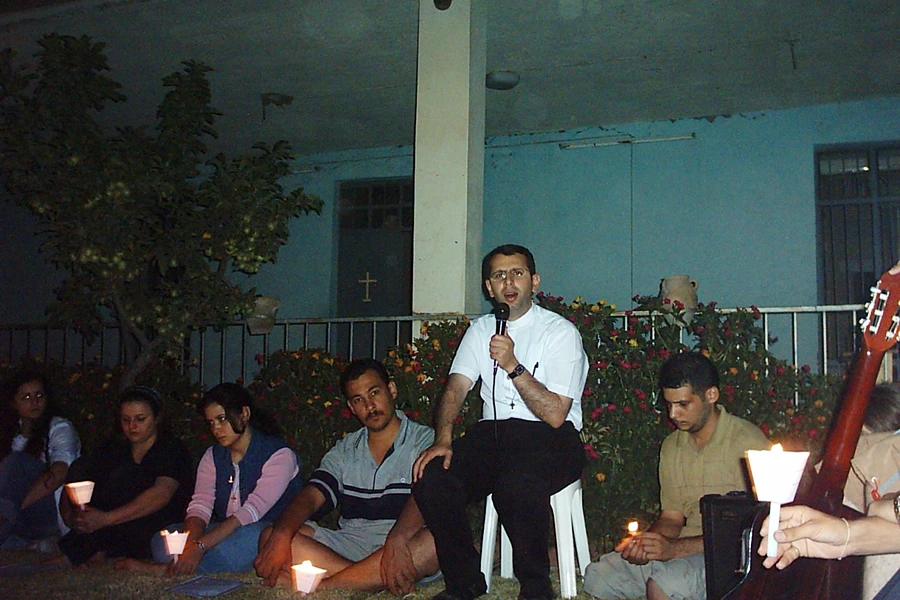
Rome, Italy, Jun 9, 2017 / 03:04 am (CNA/EWTN News).- When Fr. Ragheed Aziz Ganni was confronted by armed men after celebrating the Eucharist at his Chaldean Catholic parish in Mosul, they asked him why he was still there and why he hadn’t closed the church as they had demanded.
“How can I close the house of God?” he responded, right before they shot and killed him, alongside three friends and subdeacons at the parish: Waheed, Ghasan, and Basman.
An Iraqi priest born in 1972 in a town in the Plain of Ninevah, Fr. Ganni moved to Rome in 1996 to study at the Pontifical University of Saint Thomas Aquinas on a scholarship from the pontifical foundation Aid to the Church in Need.
In 2003 he decided to return to Iraq, despite the war following the American invasion, and the persecution of Christians that was taking place. He served at a parish in Mosul until the day of his death, June 3, 2007.
Ten years after his death, Fr. Ganni’s friend and fellow priest, Fr. Rebwar Basa, has written a book about his life and death, and about the ongoing situation of Christians in Iraq. He spoke to CNA at a presentation for A Catholic Priest in the Islamic State, published by Aid to the Church in Need.
The martyrdom and testimony of Fr. Ganni, he said, “is very important for the whole Church, but especially in Iraq.”
“He is an example for all of us to resist and to testify to the Gospel in the midst of the conflict and violence that we have in Iraq. Because we need this kind of witness to reconstruct Iraq, to be able to live together in peace and unity.”
Baian Adam Balla, the wife of Waheed Hanna Isho’a, one of those killed with Fr. Ganni, was an eyewitness to the events of the martyrdom, though her life was spared. In an interview published in the book, she described how they were attacked.
The day of the murder, Fr. Ganni was accompanied by three subdeacons of the parish, Waheed, Ghasan and Basman, as well as Waheed’s wife, Baian.
Driving home after saying Sunday evening Eucharist at Holy Spirit church in Mosul, they were approached by masked men carrying machine guns and told to get out of the car and put their hands up in the air.
“And then they fired and took the car. And I began to cry out. There was a butcher, I do not know, a butcher man. He was a Muslim. They took the car and kidnapped him. But at us Christians … they shot and they killed them,” Baian recounted.
“Certainly there is an effect. Not an effect on our faith, but an effect on us, because we are not able to go in the church … because we are not able to continue so … How are we able to continue like this? In these conditions? But what do they want from us? What have we done?”
There had been around 10 different attacks on the church before this, though with no casualties. But Fr. Ganni seemed to know that something worse might happen.
The morning of his death, after meeting with some young men for breakfast and renewing his ID, he visited his father and mother, bringing with him a recent photograph of himself, which he gave them.
In an interview recorded in Fr. Basa’s book, Fr. Ganni’s father recalled him saying to his mother that the photograph “is for my funeral, so it is not a worry to you.”
His mother remembered that he said to her, “Mamma, if I die now or I die in 10 years, there is always a death. If they cut my throat with a knife, at the beginning it will hurt badly, but then I will feel nothing more.”
She said to him, “So they have threatened you!” and he answered: “I know that they have threatened the whole Church, but have they threatened me personally?” He was laughing but he didn’t answer the question, she related.
Fr. Basa explained that Fr. Ganni himself described the situation in Iraq during his five years as a priest there as “worse than hell.”
“Now it is even worse than in that period because of the invasion of ISIS and the dramatic situation for the minorities in Iraq, including Christians,” he said.
He added that people should be very careful to distinguish between Muslims and a certain ideology which doesn’t tolerate other religions. This ideology “should be refused”, and Muslims encouraged not to become victims of this ideology themselves.
But as a Christian and a Catholic priest, he explained, he doesn’t feel it is his place to say what Islam is – it is up to Muslims themselves to show they are peaceful.
The solution to the violence, he said, is to respect human rights and human freedom, which is a product of real religion, “not the propaganda that terrorists and fundamentalists want to offer us.”
“Real religion is the religion in which we live in peace and respect each other and the freedom of others to express their ideas, their faith, as they like,” he said.
“What we need is very simple, that they (the government) recognize our human rights, the human rights of the Iraqi people in general, and especially the minorities.”
Continuing, he maintained that Islam should not be the established religion of the nation.
Iraq’s constitution establishes Islam as the country’s official religion and a foundation source of legislation. It adds that no law may contradict Islam’s established provisions, the principles of democracy, or the rights and basic freedoms stipulated in the constitution.
It also guarantees the Islamic identity of the majority of Iraqis, while also guaranteeing “the full religious rights to religious freedom of religious belief and practice of all individuals such as Christians, Yazidis, and Mandean Sabeans.”
The priest maintained that “saying that Islam is the official religion of the State, is an official invitation for the fundamentalists to feel better a superior to others. That could be the start point for terrorism!”
Fr. Basa explained that from the beginning of time, Iraq has been made up of many different religions and civilizations, and that is what should be focused on.
His hope, he noted, is that the United Nations, the United States, Europe, and the whole world will help Iraq to overcome present divisions and concentrate on the human dignity and rights of all citizens of the country.
“Because when there are these rights – religious freedom and other kinds of freedoms – I think everybody can live his or her faith as they like and we can live in peace,” he said. “This would be a great richness for Iraq, for the whole region, and for the whole world.”
 […]
[…]






So does this mean that Pope Francis is now going to let all Catholic Bishops and Priests, from around the world, simply govern their Catholic flock in any way that they want to?
Just disgusting on every proposal. I look forward to hearing that the Pope has excommunicated all of these Bishops from the CATHOLIC church. Should he fail to do so,and attempt to co-opt this into the larger church, I suspect the movement to the Latin Mass will be massive.There is nothing to stop them from breaking away too. If the Germans want to run a carnival side-show, let them do it with a new church name and someone else’s money. I hope the Bishops who lacked the spine to veto this know that they will have to account for their actions to God one day. Or, maybe they dont believe that anymore either.
Francis held two private meetings with James Martin and has yet to correct or condemn Cardinal McElroy’s false teachings about human sexuality. Not sure we should hold our breath waiting for Francis to grow a spine and actually do his job, sad to say.
That’s just it. It is their money. This is why it’s a big deal. The German church is the richest church in the world — by far.
Ugh. The more of the LEFTIST crazy I see in the church, the more attractive the traditional movement in the church becomes.
“Yuck” was my immediate reaction to this headline—neither a theological nor reasoned response. “Ugh” is understandable, too. I cannot envision a more chaotic—dare one say “hellish” spiritual environment than one with thousands of shrill voices spouting their self deified opinions to whole congregations. By the way, I have experienced this squeamish environment on a small scale. The devil is definitely in the details.
It’s hard to imagine that German seminaries are bursting with candidates for the priesthood, or that a move such as this will attract even a few. Anyone actually serious about the faith will head for the FSSP or some similar traditionalist order.
An open invitation to Gays to come out of the closet.
Hey! What about pedophilia? Is the big-tented, new and improved catholic church going to let calendars dictate who we love?
And what about sibling romance? Isn’t that just more ways to love?
And what about unions between humans and their beloved pets? Is the new now-a-go-go church going to turn its back on other-species-attracted persons?
Doesn’t God love *these* people too? Don’t *they* fit inside the big new catholic tent of love?
And what about people who masturbate? Shouldn’t the church recognize these special self-satisfying relationships? Shouldn’t they be allowed to marry themselves?
The evil one’s minions on the left have finally taken off their masks. And the writhing, wormy, pustulous visage beneath is not a pretty sight.
If a faithful Pontiff was manning the helm on the Barque of Peter all of the protestants masquerading as Catholic clergy in Germany – and elsewhere – would have already been dismissed from the clerical state and received Ferendae Sententiae excommunications.
Repent Jorge, while you still can.
Pope Francis said in November that he doesn’t want another Protestant Church in Germany. Well, your holiness, it’s not about what you want. It’s about what you deserve. And it certainly looks like what you’re going to get.
Christ never turned anyone away from his ministry. It is better that us sinners sit together in church and listen to the word of God than for us sinners being locked out.
“Locked out,” or, as in any and all of us (inclusivity!) not listening?
As in the “word of God”: “Then Peter continued preaching for a long time, strongly urging all his listeners, “Save yourselves from this perverse generation!” (Acts 2:40).
Or, maybe this from St. Paul: “Do you not know that the unrighteous will not inherit the kingdom of God? Do not be deceived. Neither fornicators, nor idolaters, nor adulterers, nor homosexuals, nor sodomites, nor thieves, nor covetous, nor drunkards, nor revilers, nor extortioners will inherit the kingdom of God. And such were some of you. But you were washed, but you were sanctified, but you were justified in the name of the Lord Jesus and by the Spirit of our God” (1 Cor 6:9-11).
Gerald, you’re right that Jesus never turned people away. But he absolutely let them leave if they were not inclined to live according to his teachings.
He even invited them to go.
And clearly the German Church has many, many people who have no intention of living as Catholics.
And so they are determined to destroy the faith they have rejected.
I wonder what will happen to those Germans who do intend to live as Catholics in these apostate German dioceses. We need to pray for them and the Vatican needs to proactively protect and provide authentic and faithful worship alternatives for them.
Pope Francis started his pontificate by famously urging “let’s make a mess.” He has succeeded in enabling that in Germany and is now trying to get the toothpaste back in the tube.
True, Jesus never turned anyone away. However, He always told people that they had to give up their sinful lives. He never condemned the sinners, but He always insisted that they repent and change their lives. As for myself, I have been and am a sinner, but I have repented, and with the grace of God, I am trying to live a holy life. I could not remain how I was.
Well, keep in mind the old song, And the Beat Goes On. “Do you ever wonder That to win, somebody’s got to lose”.
It’s not complex. If Germany’s Synodale Weg is permitted by the Vatican to win, then who is the loser? Or rather, to be Justifiably cynical, true to Byzantium on the Tiber long range policy is it that to win we permit the loss?
A current essay ‘Cardinals Müller, Burke rebuke German bishops over same-sex union blessings’ raises an issue of interpretation of events and response. Raymond Arroyo in an interview with both Cardinals [to which the essay was drawn] were asked the usual questions except at the end, Arroyo asked Müller what he thought about Francis’ 10 year legacy. Card Müller made no reference to Pope Francis. Whatsoever. He kind of rambled almost incoherently about German Synodale orthodoxy that if anyone listening would think his response was entirely to the second question Arroyo pinned on the tail of the first.
A weakness of our best hierarchy is the unwillingness to be more direct on the paramount issue of Francis’ pontificate [Burke was miles ahead of Müller on candor], his policies, the effects within the Church. Almost as if they have a sacred duty never to express legitimate queries that really must be addressed in line with their mission as defenders of the faith. Card Müller was among the first orthodox churchmen to denounce the four Dubia cardinals, Card Burke one of four. It seems a form of Ultramontanism.
Makes me wonder how many pieces of silver they were paid… including the 11 that abstained.