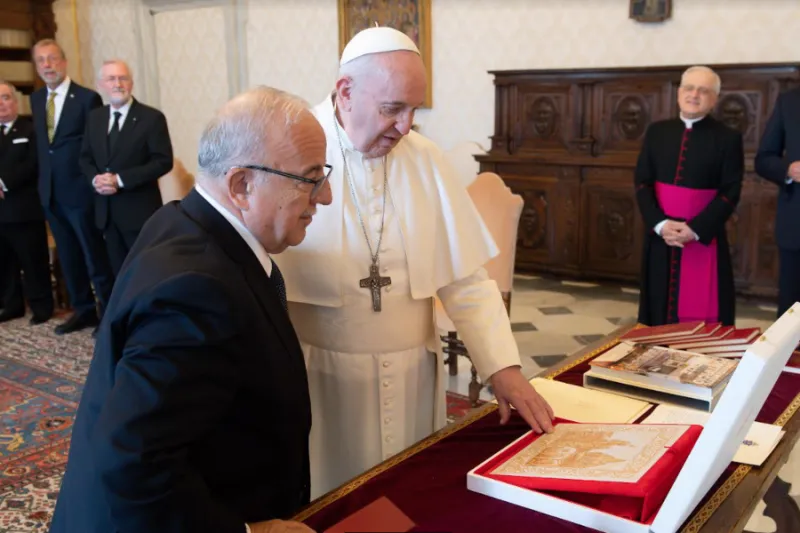
Pope Francis meets with the Order of Malta’s Fra’ Marco Luzzago on June 25, 2021. / Vatican Media
Vatican City, Jun 9, 2022 / 04:26 am (CNA).
In a condolence message on Wednesday, Pope Francis praised the “luminous Christian witness” of Order of Malta leader Fra’ Marco Luzzago.
Luzzago, who had overseen the 1,000-year-old institution since 2020, died on June 7 after a sudden illness.
The pope offered his condolences in a telegram to Cardinal Silvano Maria Tomasi, the pope’s special delegate to the Order of Malta.
The telegram said: “Spiritually sharing in the grief at the sudden passing of His Excellency Fra’ Marco Luzzago, Lieutenant of the Grand Master, I wish to offer my condolences to his family and to the entire order and, in remembering his commitment generously lavished in the performance of his high office in the service of this institution, as well as his love for the Church and luminous Christian witness, I invoke eternal peace for him and from my heart impart my blessing to you … to the interim Lieutenant Fra’ Ruy Gonçalo do Valle Peixoto de Villas-Boas, to the Grand Magistry, and to all the members of the Sovereign Military Order of Malta.”
Luzzago died at the age of 71 at Villa Ciccolini in the Italian province of Macerata.
If you value the news and views Catholic World Report provides, please consider donating to support our efforts. Your contribution will help us continue to make CWR available to all readers worldwide for free, without a subscription. Thank you for your generosity!
Click here for more information on donating to CWR. Click here to sign up for our newsletter.
Pope Leo XIV sits next to Cardinal Mario Grech, general secretary of the Vatican’s synod office, during the jubilee of synod teams and participatory bodies in the Vatican’s Paul VI Hall on Oct. 24, 2025. / Credit: Vatican Media
Vatican City, Oct 25, 2025 / 12:00 pm (CNA).
There is no single model for what synodality should look like in all countries and cultures, Pope Leo XIV said in a discussion with synod leaders from around the globe, held at the Vatican on Friday.
“We have to be very clear, we’re not looking for a uniform model. And synodality will not come with a template where everybody and every country will say this is how you do it,” the pope said in the Paul VI Hall Oct. 24.
“It is, rather, a conversion to a spirit of being Church, and being missionary, and building up, in that sense, the family of God.”
Leo spoke about synodality in unscripted remarks in English, Spanish, and Italian during the opening session of a meeting for the jubilee of synodal teams and participatory bodies, taking place in Rome Oct. 24-26, part of the Church’s wider 2025 Jubilee of Hope.
Around 2,000 people are attending the synod-focused jubilee, which includes a two-day meeting “aimed at translating the orientations of the [Synod on Synodality’s] Final Document into pastoral and structural choices consistent with the synodal nature of the Church,” according to the Vatican’s synod office.
Pope Leo XIV listens to reports from seven representatives around the world about the implementation of synodality on their continents during the jubilee of synodal teams and participatory bodies at the Vatican on Oct. 24, 2025. Credit: Vatican Media.
The pope joined part of the program on Friday evening to listen to representatives from different regions give reports on the implementation of synodality in their parts of the world, and to answer their questions about the synodal process.
Synodality, Leo said, “is to help the Church fulfill its primary role in the world, which is to be missionary, to announce the Gospel.”
He added that synodality “is not a campaign. It’s a way of being and a way of being Church. It’s a way of promoting an attitude, which begins with learning to listen to one another.”
The pope recalled the value of listening, “beginning with listening to the Word of God, listening to one another, listening to the wisdom we find in men and in women, in members of the Church, and those who are searching who might not yet be members of the Church.”
He also addressed resistance to the synodal process, such as worry by some that it is an attempt to weaken the authority of the bishop.
“I would like to invite all of you … to reflect upon what synodality is about and to invite the priests particularly, even more than the bishops, to somehow open their hearts and take part in these processes,” Leo said. “Often the resistance comes out of fear and lack of knowledge.”
He emphasized the need to prioritize formation and preparation at every educational level.
“Sometimes ready answers are given without the proper, necessary preparation to arrive at the conclusion that maybe some of us have already drawn, but others are not ready for or capable to understand,” he said.
“We have to understand that we do not all run at the same speed. And sometimes we have to be patient with one another,” Leo said. “And rather than a few people running ahead and leaving a lot behind, which could cause even a break in an ecclesial experience, we need to look for ways, very concrete ways at times, of understanding what’s happening in each place, where the resistances are or where they come from, and what we can do to encourage more and more the experience of communion in this Church which is synodal.”
Asked if groupings of churches, such as regional bishops’ conferences, will continue to grow in the life of the Church, Leo said, “the brief answer is yes, I do expect that, and I hope that the different groupings of churches can continue to grow as expressions of communion in the Church using the gifts we are all receiving through this exercise if you will, this life, this expression of synodality.”
The pontiff also weighed in on the topic of women and their participation in the Church, though he set aside the most controversial questions, which he said are being examined in a separate study group.
“So leaving aside the most difficult themes,” he said, “there are cultural obstacles, there are opportunities, but there are cultural obstacles. And this has to be recognized, because women could play a key role in the Church, but in some cultures women are considered second-class citizens and in some realities they do not enjoy the same rights as men.”
“In these cases, there is a challenge for the Church, for all of us, because we need to understand how we can promote the respect for the rights of everyone, men and women,” he encouraged.
The Church can promote a culture in which there is co-participation of every member of society, each according to their vocation, Leo continued. “We have to understand how the Church can be a strength to transform cultures according to the values of the Gospel.”
Vatican City, Mar 20, 2020 / 11:05 am (CNA).- Cardinal Mauro Piacenza, head of the Apostolic Penitentiary, has said that the coronavirus pandemic may justify the use of general absolution, in extraordinary circumstances, for Catholics unable to go to i… […]
Fr. Richard Cassidy, professor of Sacred Scripture at Sacred Heart Major Seminary, dresses in Roman prisoner garb as he holds a copy of his newest book, “A Roman Commentary on St. Paul’s Letter to the Philippians.” Fr. Cassidy’s eighth scholarly work, the book explores the subversive nature of St. Paul’s Letter to the Philippians, which the apostle wrote from behind bars in a Roman prison cell. / Valaurian Waller | Detroit Catholic
Detroit, Mich., Apr 30, 2022 / 08:00 am (CNA).
It was a tough decision for Rick Cassidy as he began graduate studies at the University of Michigan in mid-1960s. Would he take the course on Imperial Rome, because of his love of history, or the course History of Slavery, because of his deep concern for social justice?
The Dearborn native chose the course on slavery. The insights he acquired have helped to guide Fr. Richard Cassidy’s scholarly work for three decades, including his latest work, “A Roman Commentary on St. Paul’s Letter to the Philippians“ (Herder & Herder, 2020).
Paul’s letter, composed in chains and secreted out of his Roman jail cell, is intentionally “counter-slavery” argues Father Cassidy, professor of Sacred Scripture at Sacred Heart Major Seminary since 2004, as well as “counter-emperor.” At its core, Philippians is an underground epistle that subverts the Roman power structure and the “lordship pretensions of Nero.” Reviewers praise the “distinctive thesis” of Father’s groundbreaking work as “fresh and illuminating,” making for “fascinating reading.”
This is Father Cassidy’s seventh book that examines the influence of Roman rule on the writers of the New Testament, and his eighth book overall. He returned to Ann Arbor on a rainy afternoon in late June to discuss his newest work.
Dan Gallio: St. Paul’s Letter to the Philippians is most known for its soaring declaration of the divinity Christ, before whom one day “every knee must bend,” and “every tongue proclaim” his universal lordship (2:6-11).
Your new book presents a unique argument: Paul’s letter is primarily a “subversive” document of resistance against the Roman Empire—particularly against emperor worship and slavery. How did you arrive at this against-the-grain interpretation?
“A Roman Commentary on St. Paul’s Letter to the Philippians” (Herder & Herder, 2020) is Fr. Cassidy’s eighth book and a follow-up on his 2001 work, “Paul in Chains: Roman Imprisonment and the Letters of St. Paul”. Valaurian Waller | Detroit Catholic
Father Cassidy: These insights were the result of long hours with the text, spending a lot of prayer time for guidance, as to Paul’s situation.
The issue of slavery came into play strongly. I now saw that Jesus was executed as a violator of Roman sovereignty, condemned by Pilate, executed under Emperor Tiberius—and that this was the slave’s form of death. This is a crucial point.
In regards to the two topics you mention, I had the intuition that the Letter to the Philippians was “counter-emperor cult” and “counter-slavery.” First, the self emptying of Christ from on high—descending downward into human form, downward, downward to the point of the slave’s death on a Roman cross—and then you have St. Paul’s wonderful words in chapter 2, verses 9-11.
My insight was that there is going to be a redressing of what has happened. Because of the great faithfulness of Jesus Christ, the Father intervenes and begins the lifting up, the ascending of Christ, where the Father exalts Jesus and bestows upon him “the name above every other name.”
So I can now speak about this famous passage in terms of a kind of “drama”: four scenes that represent the descent of Jesus, and four scenes that represent his ascent, akin to a medieval passion play. The Father intervenes on Christ’s behalf, conferring upon him the name of “Lord.” Now all of creation, including the emperor, the governor, the imperial personnel, are all subject to Jesus. They have to prostrate themselves before the name of Jesus.
DG: So, essentially, Philippians is subversive because it makes a political statement as much as a theological one.
FC: Yes, but for some, it is a great privilege to genuflect at the name of Jesus. This includes slaves! Paul had integrated slaves into his community in Philippi. They were empowered now to proclaim the name of Jesus, standing alongside free men and women. They are standing alongside the Roman imperial power structure, all involved in the same process of bowing before Christ and proclaiming his name.
A security guard at Sacred Heart Major Seminary helps Fr. Cassidy don his “prisoner’s clothing” for a photo shoot promoting Fr. Cassidy’s latest book, “A Roman Commentary on St. Paul’s Letter to the Philippians,” which details Paul’s experience behind bars and the conditions under which he wrote his Letter to the Philippians. Valaurian Waller | Detroit Catholic
And that name is “Lord.” Jesus is being acclaimed as Lord, and not the emperor, to the glory of God the Father. This is the decisive element of Philippians 2:6-11, blended together in this one passage.
DG: You provide a forty-four-page introduction to the social situation of the Roman colony of Philippi. Why did you feel such an informative but lengthy introduction was necessary to support your thesis?
FC: I had to establish that conditions at Philippi mirror conditions at Rome. This is important. Philippi was like “Little Rome.” When Paul is speaking of conditions at Philippi, his is also experiencing the same oppressive conditions at Rome as a chained prisoner. I had to establish that emperor worship was everywhere, in Philippi’s renowned amphitheater, in the streets, in public artifacts. That is why I had to go into an extensive introduction to set the stage of what Paul is doing in his letter.
DG: Your appendices are extensive, too, like bookends to the introduction, driving the thesis home again using illustrations.
FC: There is one illustration of a monument where slaves are chained, and a slave trader is proclaiming his prowess as a slave trader. This monument to the degradation of slavery was at a city adjacent to Philippi. Paul almost certainly passed by it on his way to and from Philippi. It was discovered back in the 1930s and almost destroyed in the war by Nazi bombings.
DG: Paul is sometimes criticized by revisionist commentators for not rejecting the institution of slavery in his letters. Is your book an answer to these critics?
FC: Paul’s approach to slavery is complicated. There are some letters where he seems to envision the imminent return of Christ. Possibly he minimized the importance of slaves being freed in these letters. However, in Philippians, his final letter before his death, he addresses the issue definitively. It is very undermining of slavery.
I intended to de-establish the idea that Paul acquiesced to slavery. He did not acquiesce. The laudatory prepublication comments by scholars make me think the book will have a decisive role in re-imaging Paul.
Against a prevailing notion that St. Paul “acquiesced” to the idea of slavery in his writings, Fr. Cassidy’s book aims to counter the idea by showing how St. Paul’s Letter to the Philippians actually served a subversive purpose in a Roman empire dominated by emperor worship and tight controls. Valaurian Waller | Detroit Catholic
DG: Back to Philippians 2:6-11. Why do you maintain this passage is not a hymn or baptismal catechesis, as is customarily believed, but is an original composition of Paul? Is this position another example of your counter exegesis?
FC: This is not some other preexisting hymn. No! This is fresh imaging. Visceral imaging. This is intensity from identifying with Christ as the “slave crucified.” No one else could have composed this passage. And Paul could not have composed this passage until he was in Roman chains and could see the threat posed against Jesus by the counterfeit claims that Emperor Nero is Lord.
DG: It’s almost like the passage is “supra-inspired,” that he would get such an original insight while in such dreadful circumstances.
FC: Correct. And there is a real question as to how this letter could be transmitted from prison, with the security and censorship. In garments? In pottery? It is possible the original written letter was confiscated. So how is Paul is getting his subversive thoughts past the Roman guards?
I suggest in my book that Paul was drilling his associates, Timothy and Epaphroditus, to memorize his letter, given the role of memory in early Christian life.
DG: With your busy teaching and pastoral duties, where to you find the motivation and energy to produce such a thoroughly researched, and beautifully written, work of scholarship?
FC: It’s Spirit driven!
DG: Is the Spirit driving you to another book?
FC: I would say so. After a book comes to publication, there is always a kind of mellowing period. So right now I have not identified the next project. I am appreciating the graces I have received from this book, and trusting that the same Spirit who has shepherded me through this sequence will still stand by me, guiding me forward.
Respectful farewell to Fra’ Marco Luzzago. Eternal rest grant unto him O Lord and let your perpetual light shine upon the departed soul.