The Spanish bishops conference has said that a news report indicating priests not vaccinated against COVID-19 would be barred from ministry was a hoax.
The report appeared on a day that is observed in Spain much like April Fools’ Day.
Alerta Digital reported Dec. 28 that Cardinal Juan José Omella of Barcelona, president of the Spanish bishops’ conference, said: “The episcopal conference decrees that only priests vaccinated according to all the guidelines will be able to exercise the ministry.”
The Alerta Digital report also said that priests reluctant to be “vaccinated will have thirty days to receive the usual inoculation” and that if they do not comply “they will be severely warned and subsequently sanctioned with the suspension of their pastoral assignment and their salary.”
“If they persist in their disobedience, their dismissal from the clerical state is not ruled out. Thus, unvaccinated priests will not be able to say Mass in public, or impart the sacraments in any case,” Alerta Digital stated.
However, the Spanish bishops’ conference responded Jan. 5 on Twitter: “This news is false, very typical of December 28.”
The feast of the Holy Innocents, Dec. 28, is a day for pranks in Spain and other Hispanophone countries. The inocentes are either the victims of pranks (inocentadas), or the pranksters themselves.
If you value the news and views Catholic World Report provides, please consider donating to support our efforts. Your contribution will help us continue to make CWR available to all readers worldwide for free, without a subscription. Thank you for your generosity!
Click here for more information on donating to CWR. Click here to sign up for our newsletter.
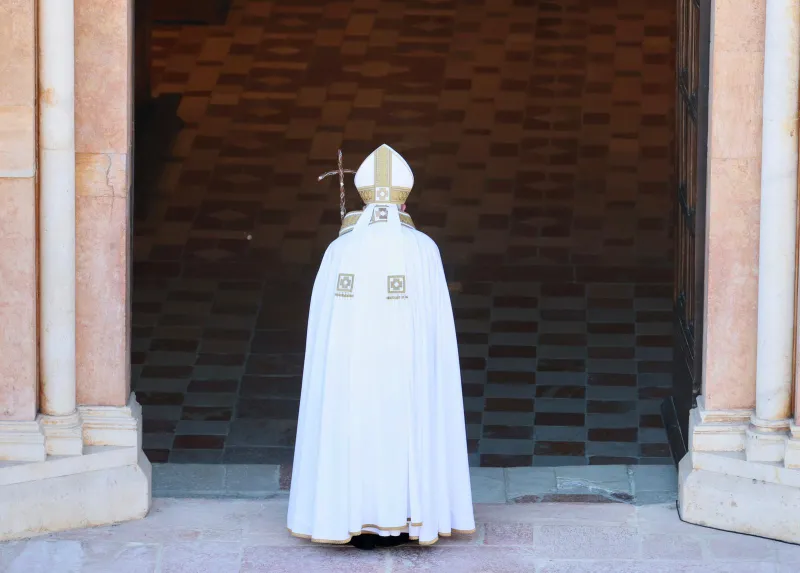
Pope Francis opens the Holy Door in L’Aquila, Italy on Aug. 28, 2022. / Daniel Ibanez/CNA
Rome Newsroom, Aug 28, 2022 / 04:15 am (CNA).
Pope Francis became the first pope in 728 years to open the Holy Door of a 13th-century basilica in L’Aquila, Italy on Sunday.
During a visit to the Italian city located about 70 miles northeast of Rome on Aug. 28, the pope participated in a centuries-old tradition, the Celestinian Forgiveness, known in Italian as the Perdonanza Celestiniana.
The opening of the Holy Door marked a key moment in the annual celebration established by Pope Celestine V in 1294.
“For centuries L’Aquila has kept alive the gift that Pope Celestine V left it. It is the privilege of reminding everyone that with mercy, and only with it, the life of every man and woman can be lived with joy,” Pope Francis said in his homily during Mass at L’Aquila’s Basilica of Santa Maria di Collemaggio.
“To be forgiven is to experience here and now what comes closest to the resurrection. Forgiveness is passing from death to life, from the experience of anguish and guilt to that of freedom and joy. May this church always be a place where we can be reconciled, and experience that grace that puts us back on our feet and gives us another chance,” he said.
Pope Francis began the day trip at 7:50 a.m. traveling by helicopter from the Vatican to L’Aquila. He visited the city’s cathedral, which is still being rebuilt after it was badly damaged during a 2019 earthquake in which more than 300 people died.
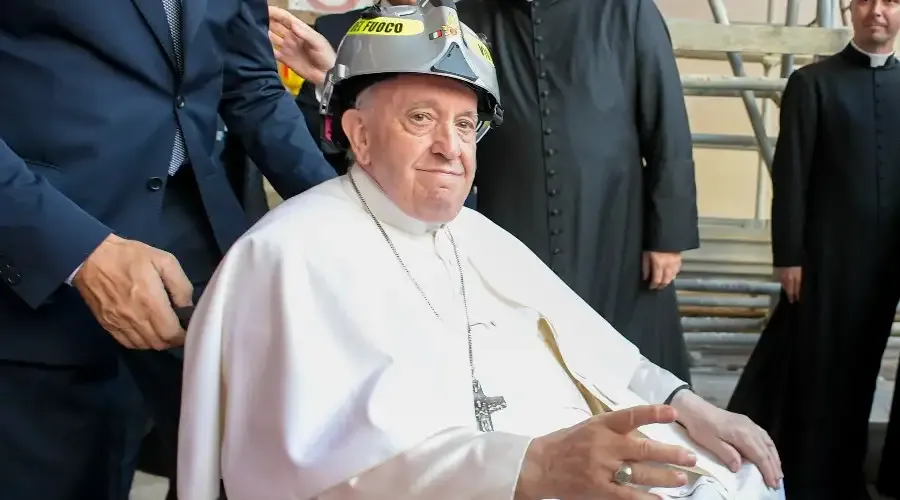
The pope wore a hard hat while touring the reconstruction area of the damaged church. He spoke to family members of earthquake victims in the town square in front of the cathedral, where local prisoners were also present in the crowd. People cheered and waved Vatican flags as Pope Francis greeted them from a wheelchair.
Pope Francis wore a hard hat while visiting the L’Aquila cathedral, which was damaged by a 2019 earthquake. Vatican Media
Pope Francis said: “First of all I thank you for your witness of faith: despite the pain and loss, which belong to our faith as pilgrims, you have fixed your gaze on Christ, crucified and risen, who with his love redeemed the nonsense of pain and death.”
“And Jesus has placed you back in the arms of the Father, who does not let a tear fall in vain, not even one, but gathers them all in his merciful heart,” he added.
After speaking to the families of the victims, Pope Francis traveled in the popemobile to L’Aquila’s Basilica of Santa Maria di Collemaggio, where he celebrated an outdoor Mass, recited the Angelus, and opened the Holy Door.
In his brief Angelus message, the pope offered a prayer for the people of Pakistan, where flash floods have killed more than 1,000 people and displaced thousands more.
Pope Francis also asked for the intercession of the Virgin Mary to obtain “forgiveness and peace for the whole world,” mentioning Ukraine and all other places suffering from war.
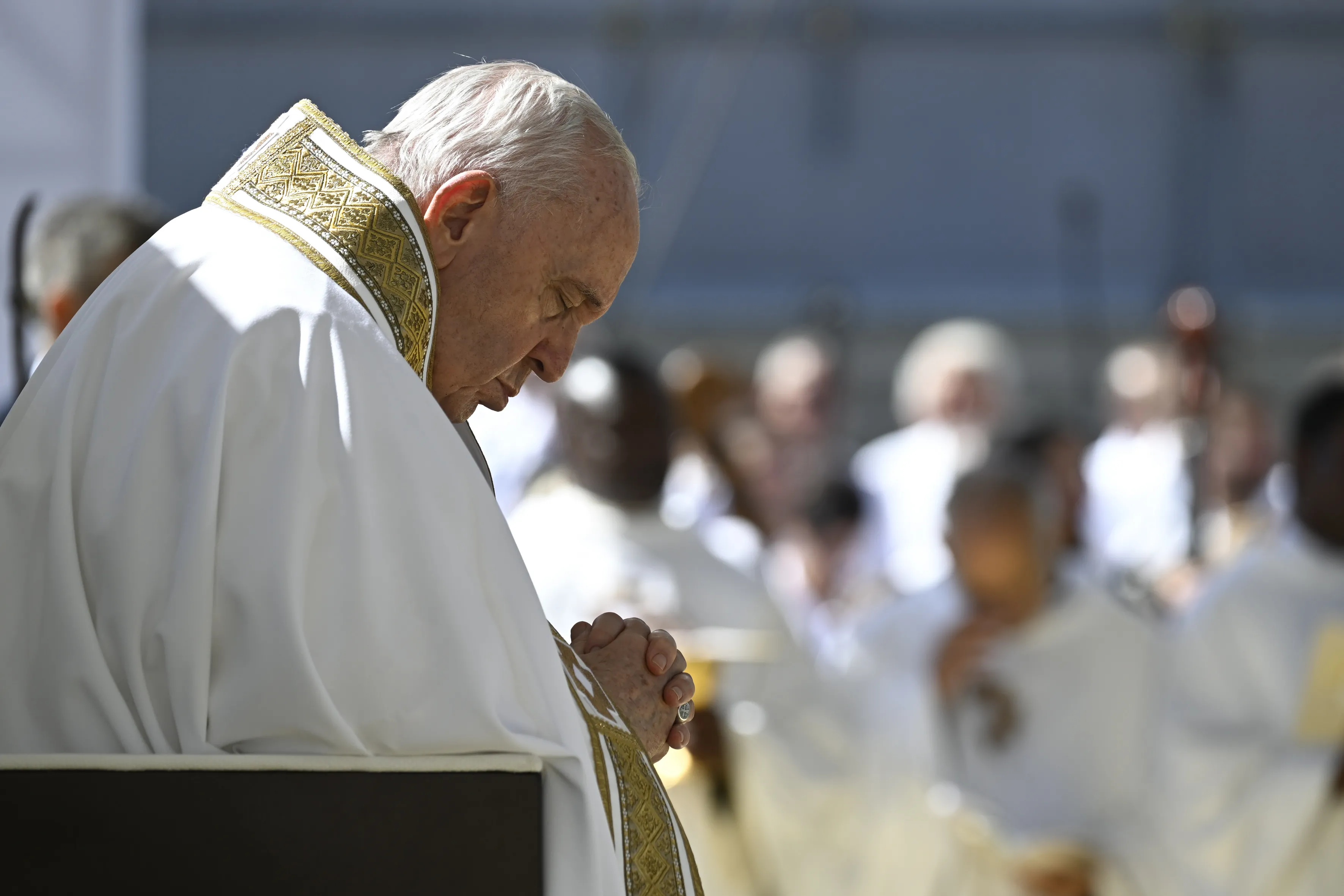
Pope Francis prayed for peace in his Angelus address following Mass in L’Aquila, Italy. Pope Francis prayed for peace in his Angelus address following Mass in L’Aquila, Italy.
During his visit to L’Aquila, the pope said that he wanted the central Italian city to become a “capital of forgiveness, peace, and reconciliation.”
“This is how peace is built through forgiveness received and given,” he said.
L’Aquila is the burial place of Pope Celestine V, who led the Catholic Church for just five months before his resignation on Dec. 13, 1294. The pope, who was canonized in 1313, is buried in L’Aquila’s Basilica of Santa Maria di Collemaggio.
In the spring, the Vatican’s announcement that Pope Francis would visit L’Aquila prompted unsourced speculation that the trip could be the prelude to the 85-year-old pope’s resignation.
When Benedict XVI became the first pope to resign in almost 600 years in 2013, Vatican-watchers recalled that he had visited the tomb of Celestine V years earlier. During his trip on April 28, 2009, he left his pallium — the white wool vestment given to metropolitan archbishops — on the tomb. In hindsight, commentators suggested that Benedict was indicating his intention to resign.
In his homily in L’Aquila, Pope Francis praised Pope Celestine V for his humility and courage.
Mentioning Dante Alighieri’s description of Celestine as the man of “the great refusal,” Pope Francis underlined that Celestine should not be remembered as a man of “no” — for resigning the papacy — but as a man of “yes.”
Pope Francis said: “Indeed, there is no other way to accomplish God’s will than by assuming the strength of the humble, there is no other way. Precisely because they are so, the humble appear weak and losers in the eyes of men, but in reality they are the true winners, for they are the only ones who trust completely in the Lord and know his will.”
At the end of the Mass, the crowd prayed the Litany of Saints and watched as Pope Francis made history when he opened the basilica’s Holy Door. According to Cardinal Giuseppe Petrocchi of L’Aquila, Pope Francis is the first pope to open the Holy Door in 728 years.
Visiting cardinals have opened the Holy Door for the Celestinian Forgiveness in past years, after a reading of the bull of forgiveness by the local mayor. Celestine donated the papal bull to L’Aquila, where it is kept in an armored chapel in the tower of the town hall.
The bull of forgiveness drawn up by Celestine V offered a plenary indulgence to all who, having confessed and repented of their sins, go to the Basilica of Santa Maria di Collemaggio from Vespers on Aug. 28 to sunset on Aug. 29. A plenary indulgence is a grace granted by the Catholic Church through the merits of Jesus Christ, Mary, and all the saints to remove the temporal punishment due to sin.
Celestine’s indulgence was exceptional at the time, given it was available to anyone, regardless of status or wealth, and cost nothing except personal repentance at a time when indulgences were often tied to almsgiving.
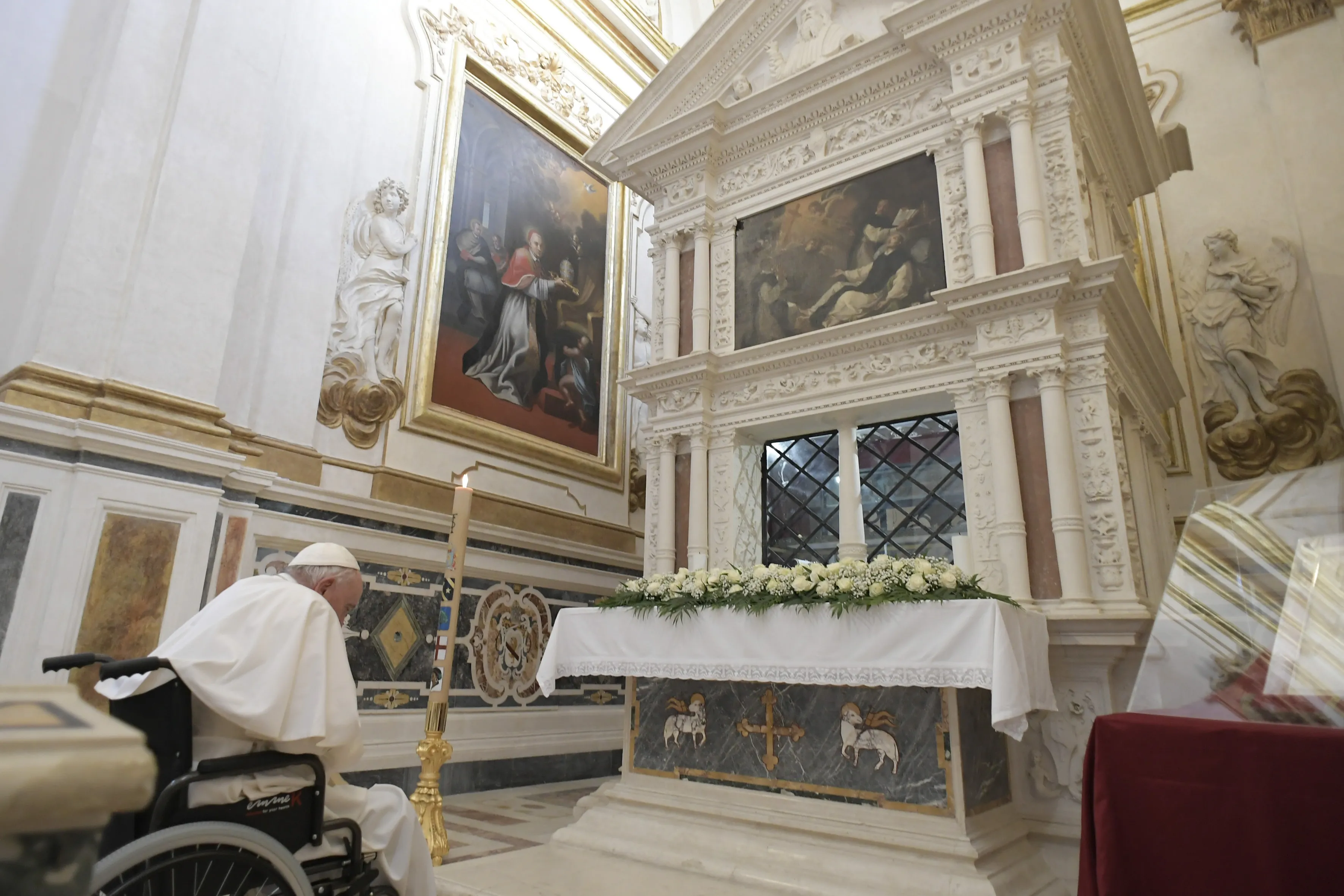
Pope Francis prays at the tomb of Pope Celestine V in L’Aquila, Italy. Vatican Media
After opening the Holy Door, Pope Francis was wheeled through the basilica to the tomb of Pope Celestine V, where he spent a moment in silent prayer before the relics of his papal predecessor who was declared a saint in 1313.
“In the spirit of the world, which is dominated by pride, today’s Word of God invites us to be humble and meek. Humility does not consist in the devaluation of self, but rather in that healthy realism that makes us recognize our potential and also our miseries,” Pope Francis said.
“Starting precisely from our miseries, humility causes us to look away from ourselves and turn our gaze to God, the One who can do everything and also obtains for us what we cannot have on our own. ‘Everything is possible for those who believe (Mark 9:23).'”
Our Lady of Lourdes shrine in the city of Alta Gracia in Córdoba province, Argentina, displays an image of Our Lady of Lourdes of Altagracia that is not there — but everyone sees it. / Credit: Facebook Virgen de Altagracia
CNA Staff, Mar 9, 2021 / 05:48 pm (CNA).- Following a nearly year-long sabbatical to attend to his mental health, Bishop James Conley of Lincoln explained his experience with depression, seeking help, and his return to his duties as a bishop.
According to Prime Matters, the bishop discussed engagement with mental health in a Zoom interview with Dr. James Link, a Catholic psychologist based in North Dakota.
Link said it is a difficult moment for a person to realize when they require external help with mental health and began the conversation asking the bishop when he decided the time was right to tackle depression.
“What was the pivotal moment where you felt, ‘This is more than I can manage?’ he asked.
Conley said the struggle did not happen all at once, and, instead, he spent about a year-and-a-half trying to soldier through this difficult time.
While his relationship with his family has always been strong and supportive, his father was a WWII veteran and a “self-made man,” he said noting that his sister and he were instilled with a can-do attitude. He said this is how he first encountered the struggle with mental health – “to pull yourself up by your bootstraps.”
As the McCarrick and the Pennsylvania Grand Jury scandals arose in 2018, he said a “sort of pall fell over the Church.” He then encountered local difficulties – having to remove some priests, undergo investigations into the diocese, close school parishes, and grieve the death of a young priest.
“Because I’m the bishop, I felt like I had to fix all these problems – I was praying, of course – but it was all wearing me down. I took all that pressure and stress upon myself,” he said.
“During the Second Vatican Council, when things were really uncertain in the Church and in the world, Pope St. John XXIII at night would pray, ‘Lord, it’s your Church, I’m going to bed!’ I would always advise people to do the same, but I wasn’t doing it myself. I wasn’t sleeping – and you can only go so long without sleeping. So I decided that I needed to find out what was going on.”
In March 2019, he was diagnosed with major depression disorder at Mayo Clinic in Rochester, Minnesota, and soon began counseling and medication. However, he said, trying to pursue help on top of his episcopal duties only further deteriorated his mental state.
Finally, Conely discussed the problems with a familiar group of bishops: Archbishop Paul Coakley of Oklahoma City, Bishop Thomas Olmsted of Phoenix, and Bishop James Wall of Gallup. He was then convicted to take a break.
“We talked about it, and they convinced me to go talk to the apostolic nuncio to the United States, Archbishop Christophe Pierre, who was present for the meeting. He was wonderful about it. I told him everything … and he said, ‘You need to take a break.’ He was very positive and supportive.”
“So it was really my closest friends – I mentioned some of them, and there was another priest I had talked to a lot – who encouraged me to seek professional help.”
Over the 11-month sabbatical, Conley attended sessions with a Catholic psychotherapist, his spiritual director, a CMA psychologist, and a medical doctor. Additionally, he said, he regularly engaged in exercise, such as golf and hikes, and social interactions with very close friends.
“[My friends] live in Phoenix, and I was at their home about three nights each week. Just sitting down at the table and having dinner with a great Catholic family was so therapeutic,” he said.
“They have great, healthy kids and are very involved at Ville de Marie, a K-through-12 Catholic school that Luke’s parents helped to found. That kept me grounded, and I always looked forward to that,” he further added.
Since Conley returned to his office Nov. 13, 2020, the bishop has continued to pursue self-care practices and make changes in his life to maintain his mental health. He said, when he returned, there was a line out the front door of people with a to-do list.
He said he has been practicing saying “no” to more things and managing his time better. He said he is trying to keep office hours from 10 am to 3 pm so as not to over exhaust himself.
“Right now, I don’t have the energy that I had a couple of years ago. I can’t take on as much as I used to, nor do I want to take on as much as I used to,” he said.
“What this experience of mental illness has taught me is that life is too short to fill every day up from morning to night, even when we’re filling the day up with good things. So, really, finding the right balance – a healthy balance – is an art. I’m still working on the exercise piece.”
The bishop said it is important to be aware of the activities that drain his energy and the roles of a bishop that are life-giving and fulfilling. He said while administrative tasks like emails are tiresome, his spiritual commitment to the community provides him with energy.
“Yesterday, for instance, was a great day. We started Catholic Schools Week, and I went down to a K-12 school in Nebraska City. We had an all-school Mass with adoration and a Eucharistic procession. They managed to fit all the students in the gym, 6 feet apart, and for the procession I took the Blessed Sacrament to the door of each classroom. The students stayed in the room, but they all got down on their knees for the Blessed Sacrament. That was a very beautiful, life-giving event for me,” he said.



Leave a Reply