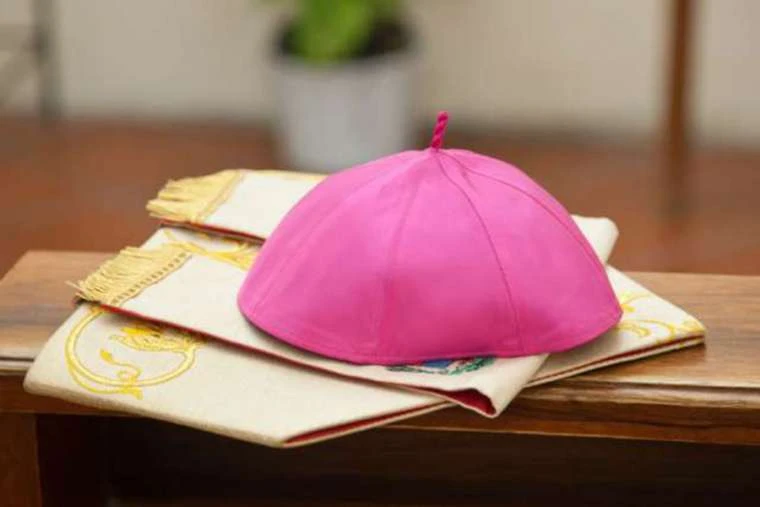
Bishop Edward Grosz, Auxiliary Bishop Emeritus of Buffalo, faces an allegation, which he denies, that he abused a then-child in 1990, the diocese announced Monday.
Bishop Grosz “has voluntarily agreed to step aside from active ministry and not to exercise any priestly or episcopal functions pending a thorough investigation. Bishop Grosz has denied ever having abused an individual, either an adult or a minor,” the Diocese of Buffalo announced July 12.
The bishop, 76, retired in March 2020, upon turning 75. Though retired, he has been performing “limited sacramental ministries.”
Bishop Michael Fisher of Buffalo has notified Timothy Cardinal Dolan of New York, the metropolitan, and the apostolic nuncio. The diocese said he is “in the process of notifying appropriate Congregations of the Holy See,” and has “instructed diocesan attorneys to notify the Erie County District Attorney.”
The allegation was made under New York’s Child Victims Act. The 2019 law opened a “lookback” window, which closes Aug. 14, allowing child sex abuse victims to file abuse lawsuits long after their statute of limitations had ended.
Grenz had been ordained a priest of the Buffalo diocese in 1971, and he was appointed its auxiliary bishop in November 1989. He was consecrated a bishop in February 1990.
Prior to the allegation of abuse on his part, Bishop Grenz faced an accusation of negligence in responding to reported sex abuse by another cleric.
In an interview with local news station WKBW, Fr. Ryszard Biernat said that in 2003 he was sexually assaulted by Fr. Art Smith at the rectory of St. Thomas Aquinas parish in Buffalo. When Fr. Biernat went to Bishop Grosz with the allegations in 2004, Bishop Grosz allegedly blamed him for not locking the door, and threatened his vocation if he did not keep silent about it, suggesting he might be deported to Poland.
Bishop Grosz has since “categorically” denied the claim by Fr. Biernat.
Fr. Smith was later removed from ministry for other credible accusations of abuse.
Bishop Grosz is among the diocesan officials facing a lawsuit from the state of New York.
In November 2020, the state’s attorney general, Letitia James, sued the diocese in the state supreme court; Bishop Emeritus Richard Malone, Bishop Grosz, and Buffalo’s then-apostolic administrator, Bishop Edward Scharfenberger of Albany, were all named in the lawsuit.
The state alleged that the diocese, Bishop Malone, and Bishop Grosz, all failed properly to investigate claims of clergy sex abuse, to monitor priests with credible abuse accusations, and to take action against priests credibly accused.
In addition, the state is seeking restitution from Bishop Malone and Bishop Grosz, and a ban on their serving “a secular fiduciary role in a nonprofit or charitable organization” in the state.
A judge ruled in February that Bishop Malone and Bishop Grosz must pay their own legal fees, but may still have the right to seek reimbursement from the diocese’s insurers for their legal costs, the Buffalo News reported.
The diocese declared bankruptcy in February 2020 after more than 250 clergy abuse lawsuits were filed against it under the Child Victims Act.
If you value the news and views Catholic World Report provides, please consider donating to support our efforts. Your contribution will help us continue to make CWR available to all readers worldwide for free, without a subscription. Thank you for your generosity!
Click here for more information on donating to CWR. Click here to sign up for our newsletter.
Bishop Rolando José Álvarez of the Diocese of Matagalpa, Nicaragua, was placed under house arrest by the police of Daniel Ortega’s regime in early August 2022. / Photo credit: Diocese of Matagalpa
Denver Newsroom, Aug 10, 2022 / 17:12 pm (CNA).
The Mexican Bishops’ Conference expressed its solidarity with the Church in Nicaragua, whose freedom of speech and religion is under attack by the dictatorship of President Daniel Ortega.
“At this time of profound suffering, the bishops of Mexico wish to convey to you our fervent prayer, closeness, and support, imploring the Prince of Peace, Jesus Christ, the much-longed-for peace, justice, and harmonious coexistence of your people,” the conference said in an Aug. 8 statement.
The recent wave of repression against the Nicaraguan Church began Aug. 1, when the Ortega dictatorship ordered the closure of eight Catholic radio stations in the Diocese of Matagalpa.
Later, the bishop of Matagalpa, Rolando José Álvarez, was placed under house arrest and threatened with prison for allegedly trying to “organize violent groups” to destabilize the government.
The cathedral in Managua was vandalized Aug. 6, cutting off electricity to it and other buildings on the grounds. From Aug. 1 through Aug. 4, riot police prevented Father Uriel Vallejos and a group of faithful from leaving the rectory of Jesus of the Divine Mercy parish in the town of Sébaco after the police forced their way into the parish to shut down the Catholic radio station that operated on the premises. Vallejos is the radio station’s director.
On Aug. 6, unidentified vandals stole the main switch to the cathedral’s electrical control system, leaving the cathedral and surrounding grounds without power.
“We express our solidarity with the bishops’ conference of Nicaragua for the deplorable events that they have been enduring and that have caused suffering and global outrage due to the suppression of individual guarantees, particularly their fundamental rights such as freedom of speech and freedom of religion,” the statement said.
The Mexican bishops also lamented “that in communities, families, consecrated life, priests, laity, children, and young people suffer from conditions that create fear, take away tranquility, and steal peace.”
“They even experience difficulty in worshiping, praying, and announcing the Gospel,” they added.
“As an ecclesial family, we join in raising awareness so that, in the face of these situations that cry out to God for social justice, there be added attitudes of dialogue and encounters that seek a healthy coexistence,” they continued.
At the end of their message, the bishops of Mexico implored “the Blessed Virgin Mary of Guadalupe, Empress of America, her maternal intercession to find paths of dialogue that lead to respect and peace.”
Other Latin American bishops stand in solidarity
The Guatemalan Bishops’ Conference issued a statement Aug. 8 to express “its closeness, support, and solidarity,” especially to the priests deprived of their liberty and to Bishop Álvarez.
“Freedom of speech is part of the rights of man. Our love and support extends to all Nicaraguan Catholics to whom we recall the promise made by our Savior: ‘I will be with you all days until the end of the world,’” the message said.
The Bolivian Bishops’ Conference published a statement Aug. 5 assuring that it “is closely following … with deep pain the situation that the Church and the Nicaraguan people are suffering.”
“We want to express our most sincere solidarity and closeness in this difficult moment that you are going through. We ask you not to give up the effort to build a dialogue that is capable of achieving unity and peace in [the] land of Nicaragua. For this, you have our prayers for you, for the people you serve, and for the political authorities,” the conference stated.
The same day, the Costa Rican Bishops’ Conference lifted up “a prayer for peace to come and [that] paths of dialogue can be opened in search of the well-being of all the inhabitants of the sister country” of Nicaragua.
This story was first published by ACI Prensa, CNA’s Spanish-language news partner. It has been translated and adapted by CNA.
Benedictine College in Atchison, Kansas. Courtesy photo. / null
CNA Staff, Mar 23, 2024 / 07:00 am (CNA).
A new Catholic, osteopathic medical school that will be housed on the campus of Benedictine College hopes to open in the fall of 2027, the… […]
At the end of the Mass of consecration on Nov. 1, 2023, María Ruiz Rodríguez shows the ring symbolizing her membership in the Ordo Virginum. That’s the only outward sign of her consecration. / Credit: Latin Patriarchate of Jerusalem
Jerusalem, Nov 12, 2023 / 07:00 am (CNA).
On the 25th day of the ongoing conflict between Israel and Hamas, the Church in Jerusalem welcomed a new consecrated member into its fold. María Ruiz Rodríguez made her consecration in the Ordo Virginum on Nov. 1, permanently rooting herself in the local ecclesiastical community.
“A thought crossed my mind, a temptation: ‘What purpose does this step serve in the midst of current events? Doesn’t the Church have more urgent matters to attend to than to stop and celebrate the consecration of a humble woman like me?’” Ruiz shared with CNA a few days later. But she said she was immediately aware of something else.
“I told myself: I cannot delay this commitment… In fact, uniting my life with the Church in a time of suffering is even more meaningful,” she said.
Cardinal Pierbattista Pizzaballa, Latin patriarch of Jerusalem, presided over the consecration of María Ruiz Rodríguez in the Ordo Virginum on Nov. 1, 2023, in the Church of the Latin Patriarchate of Jerusalem. With this consecration, Ruiz permanently rooted herself in the local Church. Credit: Marinella Bandini
Ruiz, now 42, is originally from Spain and arrived in Jerusalem in 2018 for a period of discernment. At that time, she was a member of the “Monastic Family of Bethlehem, the Assumption of the Virgin Mary and St. Bruno,” an institute of consecrated life established in France in 1950.
It was Ruiz’s first time in the Holy Land, even though the desire to visit the sacred places in the Holy Land had long been a dream in her heart.
Iconographer María Ruiz Rodríguez with the new Roman Missal in Arabic. The book is open on the page where she depicted the Crucifixion of Jesus. Credit: Marinella Bandini
“For two years, I set aside my savings to make a pilgrimage in 2000, the year of the Great Jubilee. However, in that very year, I entered the convent, so I gave up. I felt that Jesus was saying to me: ‘I am your Holy Land.’ In a way, I had already arrived in Jerusalem,” Ruiz said.
It was in the Holy Land that Ruiz first came into contact with some consecrated women of the Ordo Virginum.
“I was looking for my place and I felt called,” she said.
The Ordo Virginum, Ruiz continued, “is the oldest form of consecration in the Church”. Abandoned over the centuries in favor of the religious life, it was rediscovered with the Second Vatican Council as a form of life that, “in a radically transformed historical context” possesses “a surprising force of attraction” and is “capable of responding not only to the desires of many women to dedicate themselves totally to the Lord and to their neighbors, but also to the concurrent rediscovery by the particular Church of its own identity in communion with the one Body of Christ” (cf. Instruction “Ecclesiae Sponsae Imago” on the “Ordo Virginum”).
Iconographer María Ruiz Rodríguez at work in her studio. The image depicts Jesus walking on water and taking St. Peter’s sinking hand (Mt 14:22-33). Credit: Marinella Bandini
Consecrated women in the Ordo Virginum choose to live a life of virginity “for the sake of the kingdom of heaven” in a lay form of life. They do not wear religious habits, do not live in communities, have no common statutes or rules, or even superiors. Instead, they maintain a personal reference to the local bishop — in this case, Cardinal Pierbattista Pizzaballa — who acts as guarantor of their journey of discernment and presides over their consecration.
The sole commitment these consecrated women make is the “resolution of chastity,” which they express during the Rite of Consecration. The only symbol they wear is a ring, emphasizing the spousal character of this vocation, which reflects the mystery of the Church as “Bride of Christ.” Engraved in Ruiz’s ring is an inscription in Hebrew meaning “O my life,” referring to Christ, and the date of her consecration.
Iconographer María Ruiz Rodríguez on her terrace looking at the horizon. In the background are the walls of Jerusalem and the outline of the Basilica of the Dormition, November 2023. Credit: Marinella Bandini
Women who consecrate themselves in the Ordo Virginum support themselves through their jobs. Ruiz is an iconographer and has been working for the Latin Patriarchate of Jerusalem for about four years. She was drawn into a project aimed at renewing liturgical books — the Missal and the Evangeliary — with her artwork.
“I first approached iconographic art when I was a nun. It was first of all a spiritual journey, a path of prayer. More than an artistic expression, an icon is a profession of faith. Before beginning the work, I invoke the Holy Spirit and ask for forgiveness for my own sins and for those who will venerate these images. I was interested in this dimension of relationship,” Ruiz shared. She spent a year researching the style and colors.
“The patriarch asked me to create something that would speak to local Christians, who are Latin by tradition but Eastern by culture. A style that was uniquely mine yet rich in the entire iconographic tradition of the Church of Jerusalem. The art of Armenian manuscripts certainly had a significant influence on me.”
Iconographer María Ruiz Rodríguez at work in her studio. Currently, Ruíz is in the process of creating the images for the Gospels of Matthew and Mark. Credit: Marinella Bandini
The patriarch takes a personal interest in overseeing Ruiz’s work. “We read the Gospel together and choose which scenes to represent, taking into account the particularity of each evangelist. He particularly enjoys highlighting passages that are less frequently represented in the artistic tradition. This is a project close to his heart,” she told CNA.
Currently, Ruíz is in the process of creating images for the Gospels of Matthew and Mark.
“The process is very laborious and involves multiple stages for each page: the pencil lettering, the crafting of the icons, then the ink lettering and finally the gilding.” The plan is for a volume of about 200 pages with 250 images.
“Making this work in Jerusalem has a special value: I can visit the places where that Gospel was lived” but also “immerse myself in Jewish culture,” she said. “This has opened my eyes to the richness that Judaism brings to Christianity. There is a perfect continuity and at the same time an unprecedented newness in the person of Christ.”
The Church of the Latin Patriarchate of Jerusalem full of people on Nov. 1, 2023, for the Mass of consecration of María Ruiz Rodríguez in the Ordo Virginum. Credit: Latin Patriarchate of Jerusalem
Ruiz learned the local languages — Arabic and Hebrew. The Mass of her consecration brought together within one place all the diverse “souls” of the Jerusalem Church: priests, friars, religious, and laity, Arab Christians and Hebrew-speaking Christians, each hearing the word of God in their own language. There were migrants, foreigners, Jews, and Christians of various denominations.
The culminating moment of María Ruiz Rodríguez’s consecration in the Ordo Virginum. The celebration took place on Nov. 1, 2023, in the Church of the Latin Patriarchate of Jerusalem. Credit: Latin Patriarchate of Jerusalem
“I believe my being a foreigner is a blessing for this Church,” Ruiz said. “Why were there such different people in the church that day? Because I am neither Arab nor Jewish, and this allows me to bring both of these peoples into my heart together. In the praise of God we were one people, transcending the divisions that usually separate us. The Church in Jerusalem also needs this, to remember its universal vocation.”
Group photo at the end of the Mass of consecration of María Ruiz Rodríguez in the Ordo Virginum. With her (in the middle, with red shirt) there are other members of the Ordo Virginum, and the bishops of the Latin patriarchate of Jerusalem (from left to right: Giacinto-Boulos Marcuzzo, bishop emeritus; Monsignor William Shomali, general vicar and patriarchal vicar for Jerusalem and Palestine; Cardinal Pierbattista Pizzaballa, Latin patriarch of Jerusalem; Monsignor Rafic Nahra, patriarcal vicar for Israel). Credit: Latin Patriarchate of Jerusalem
With her consecration, Ruiz embarks on her new journey as a “living stone” of the Jerusalem Church: “I am certain that I am finally in the right place. It is not an act of heroism. I am simply where God wants me to be.”
Leave a Reply
