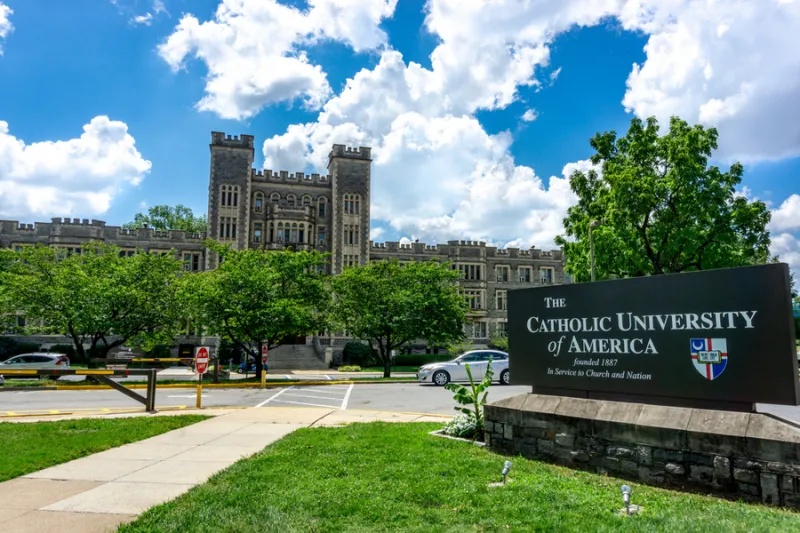
The Catholic University of America announced this week that an intervention for suicide developed by one of its psychology professors performed well in a recent meta-analysis.
Professor David Jobes of the school’s psychology department had created the Collaborative Assessment and Management of Suicidality (CAMS), “a therapeutic framework” for treating suicidal patients, the university said in a May 17 press release.
A recent meta-analysis of clinical trials determined that Jobes’ assessment was “Well Supported for reducing suicidal ideation per Centers for Disease Control criteria.” The framework outperformed alternative interventions in the trials.
Jobes said in a statement on Monday, “We are thrilled with the findings of this meta-analysis.”
“Our mission in our treatment research is to save lives through effective suicide-focused clinical care,” Jobes said.
The CAMS method “quickly reduces suicidal thoughts (in six to eight sessions) and reduces overall symptoms of distress, depression, and hopelessness,” the university said. It added that CAMS emphasizes collaboration with patients, involving them as a “co-author” in their own treatment plans.
The meta-analysis of clinical trials was performed by Joshua Swift, associate professor of clinical psychology at Idaho State University, along with his university colleagues. It was published in the peer-reviewed journal Suicide and Life-Threatening Behavior.
Swift and his team reviewed nine national and international studies with data from 749 patients; the CAMS intervention was compared to normal or alternative treatments.
“The results showed that CAMS, in comparison to alternative interventions, resulted in significantly lower suicidal ideation and general distress, considerably higher treatment acceptability, and notably higher hope/lower hopelessness,” Swift wrote.
Jobes on Monday said the analysis underlines the importance of treating suicidal ideation.
“The incredibly rigorous work of Dr. Swift and his colleagues clearly shows that CAMS provides highly effective care for the largest challenge we face in suicide prevention today: the massive population of people who struggle with serious suicidal thoughts,” he said.
Jobes said nearly 20,000 clinicians have been trained in CAMS so far, and added that he hopes “to train many more so we can help decrease suicide-related suffering and deaths around the world.”
“CAMS is patient-centric,” Jobes said. “We emphasize empathy, collaboration, honesty, and a singular focus on treating and eliminating suicidal thoughts and behaviors. CAMS creates a strong therapeutic alliance and it also invariably motivates patients to fight for their lives.”
Jobes said the final phase of care in the CAMS framework “focuses on plans, goals, and hope for the future — a life worth living with purpose and meaning.”
“We often treat relationship issues, vocational problems, and issues of self-worth that make people suicidal,” Jobes said.
If you value the news and views Catholic World Report provides, please consider donating to support our efforts. Your contribution will help us continue to make CWR available to all readers worldwide for free, without a subscription. Thank you for your generosity!
Click here for more information on donating to CWR. Click here to sign up for our newsletter.
St. Louis metropolitan police and school officials stand outside the south entrance to the Central Visual and Performing Arts High School after a shooting that left three people dead including the shooter in St Louis, Missouri on Oct. 24, 2022. … […]
Legatus President Stephen Henley is pictured here speaking at the organization’s 2025 annual conference last month in Naples, Florida. / Credit: Courtesy of Legatus
Miami, Fla., Mar 13, 2025 / 07:20 am (CNA).
In today’s culture, often hostile to expressions of faith, many Catholics struggle with how to hold true to their values within the workplace. That’s why, in 1987, Domino’s Pizza founder Tom Monaghan started the Catholic organization Legatus.
From the Latin word for “ambassador,” Legatus aims to empower Catholic presidents, CEOs, and managing partners to become what St. Paul coined “ambassadors for Christ,” explained Stephen Henley, president of Legatus.
Offering peer support groups, networking, speakers, pilgrimages, and an annual international summit, Legatus’s goal is to “inspire members to live out their faith in all aspects of their life.” There are currently about 90 Legatus chapters in North America.
Chapter meetings are held once a month, providing the opportunity for members and their spouses to participate in confession and Mass, the recitation of the rosary, a cocktail reception dinner, and a speaker’s presentation.
“All of this is to help fortify the members’ marriage, the peer support group, the networking of this group, and then embolden them to go out and live their faith,” said Henley. “Tom felt that if we can bring together these Catholic CEOs, how much more can we change society with these people that have high impact and high influence?”
In interviews with Catholic News Agency, Hawkins, Dean Abela, and Henley covered three tips for bringing the Catholic worldview into the workplace.
Commit to your priorities
Dean Andrew Abela’s Catholic faith wasn’t always as important to him as it is now. As a teenager, he even stopped practicing.
“I came back in my mid-20s, funnily enough, while I was in business school,” he recalled. As a student in 1991, he encountered Pope John Paul II’s new encyclical letter Centesimus Annus, and the pope’s reflection on economics changed the trajectory of his life.
“Just a few months after, I returned to the Church,” he said. “When I reverted to the faith, I wanted to know what my newly rediscovered Catholic faith meant for a life in business.”
Andrew Abela is dean of the Busch School of Business at The Catholic University of America. Credit: Legatus
After working for companies including Procter & Gamble, McKinsey & Company, and the Corporate Executive Board, in 2002 Dean Abela eventually began teaching at the Catholic University of America. He is also a consultant to Fortune 100 corporations.
“The reason I left business and switched to academia was that I wanted to dedicate myself full-time to studying questions about what it means to be a faithful Catholic in the workplace,” he explained.
A member of Legatus since 2000, Dean Abela mentioned that members can follow what the organization terms a “spiritual plan” to attend daily Mass, recite the rosary daily, and do monthly confession.
Known as Tres Magna, or the “Big Three,” this plan was inspired by Miami Dolphins head coach Don Shula, who “attributed the perfect season to him going to daily Mass,” explained Stephen Henley. “Tom [Monaghan] thought, well, if he can go, there’s no reason why I can’t go.”
“Daily Mass, daily rosary, and monthly confession will align your life and priorities,” added Henley.
Find a supportive community
When Kristan Hawkins first encountered Legatus, she was not a Catholic. Hawkins was raised an Evangelical. After Students for Life’s 2006 launch, she began speaking at Legatus events.
In 2014, Hawkins decided to visit the Basilica of Our Lady of Guadalupe in Mexico City, “a pilgrimage Legatus had sponsored.” “I was the only Protestant there,” she recalled. “I decided there that I was going to enter RCIA.”
She became a full-fledged member of Legatus soon after becoming Catholic.
“As a pro-life activist who starts a pro-life organization, I want to save babies, I want to end abortion, I want to help as many families and women. You don’t start a non-profit because you’re necessarily a great business leader or have all these skills. You started this non-profit, this mission, because you want to see this mission accomplished,” Hawkins said. “For me, that’s one of the powerful benefits of being in Legatus, is having friends and mentors who were successful in the for-profit world who I can call on and ask questions.”
Students for Life of America President Kristan Hawkins. Credit: Legatus
“It’s very powerful and important to have those relationships. For me, in the work I’m doing, it’s a constant spiritual attack,” she added. “One of the best things about Legatus is I can call any of my Legatus friends at any moment, and they’ll be there for you. They know the power of the work we do and the resistance we face.”
Dean Abela also finds a sense of community in Legatus and also strives to build a supportive Catholic community at the Catholic University of America.
“We share with students the principles of Catholic social doctrine, things like human dignity and solidarity, and try to embed these principles into all of our classes,” he explained. “We’re also increasingly trying to give them opportunities to practice different virtues as part of their studies and schoolwork.”
For instance, Dean Abela explained, “To teach graduate students about decision-making, we go through a couple of survivor simulations, where you crash land in the north of Canada and you have to decide what you’re going to do. We have them go through decision-making exercises explicitly practicing the virtue of prudence or practical wisdom, the habit of making wise decisions. We break apart the components of practical wisdom, which include things like alertness, preparedness, and reasoning, and we have them try to exercise those as part of the decision-making process.”
These skills built in the classroom can be applied not only in business, but also in students’ personal lives.
Model the behavior you expect from others and celebrate your co-workers’ integrity
For Henley, giving authentic witness to the Catholic faith in the workplace can start with a simple “hello.”
“First, live the golden rule,” he said. “When you’re walking down the hall, say hello to the janitor, to the executive, and to everyone in between. It matters a lot.”
He added: “Another practical thing: take the opportunity to pray before meals. If you’re going on business lunches, you’ll be surprised at how many people say, ‘Yeah of course, let’s pray.’ It’s more common than not for people to pray before meals. The fact that you’re doing it shows that you’re a bold leader and that you’re spiritual.”
Dean Abela agrees that these types of habits make all the difference, and were the subject of the presentation he made of his book Superhabits: The Universal System for a Successful Life last month during the 2025 Legatus Summit.
“The main focus of the book is understanding that things like diligence, honesty, and resilience are not genetic characteristics. They are habits that anyone can acquire through practice,” Dean Abela explained. “Companies can focus on one of the most important virtues and give employees opportunities to practice those virtues.”
For instance, Dean Abela explained the GrowVirtue App, an AI-driven app “based on the work of the book,” which organizations can use to evaluate which virtues their company has already made a habit of, which virtues they might target, and tips for how to make progress.
“The important thing is that the company would choose a virtue that they think would be directly beneficial to the company right now,” said Dean Abela. “Although personal results are private, the whole company can see what employees as a whole are weakest in. So, if you’re trying to grow in customer service, you might encourage the virtue of friendship or friendliness.”
Dean Abela discussed the value of recognizing virtue both inside and outside the company.
“See examples in action or read about examples,” he suggested. “You can have employees watch videos or you can share articles that demonstrate examples of a particular virtue in action. And you can make sure senior folks are role models for junior employees.”
“Most importantly, give the employees the opportunity to practice the virtues, and give feedback,” he added. “When companies give awards, they tend to do this more with core values. They should shift to core virtues and give it to people who are exemplars of that virtue.”
Ultimately, the goal for Catholics is to live authentic lives that draw others to Christ.
“Stay true to who you are, don’t give in,” said Hawkins. “They’ll know you by your fruits. I think that’s very important. You don’t have to work in the pro-life movement or specifically in an apostolate to be a good Catholic, a faithful Christian in the workplace. You can do that in any job, in any position you have – in McDonald’s or in a Fortune 500 company.”
Washington D.C., Jan 6, 2021 / 05:57 pm (CNA).- Catholic bishops strongly condemned pro-Donald Trump protesters’ incursion that penetrated the Capitol Building Wednesday as Congress debated the certification of the presidential election results, leading to the evacuation of lawmakers and the deadly shooting of one protester by law enforcement.
“I join people of good will in condemning the violence today at the United States Capitol,” Los Angeles Archbishop Jose Gomez, president of the U.S. Conference of Catholic Bishops, said Jan. 6. “This is not who we are as Americans. I am praying for members of Congress and Capitol staff and for the police and all those working to restore order and public safety.”
“The peaceful transition of power is one of the hallmarks of this great nation,” he added. “In this troubling moment, we must recommit ourselves to the values and principles of our democracy and come together as one nation under God.”
In his own statement, Archbishop Salvatore Cordileone of San Francisco added: “To attack the U.S. Capitol to express your fear that democracy has been denied is wrong, and also counterproductive. Doubts about free and fair elections cannot be redressed by violence against democratic institutions.”
“To the deaths from a pandemic, and destruction wreaked on people’s livelihoods, we do not need to add an attempted civil war. I called for an end to violence in the streets when it happened this summer. I call on every American of good will to denounce this violence against our nation’s Capitol now.”
“May the Prince of Peace put an end to this strife, and bring healing and constructive criticism in the place of mob rule. And may God bless America,” the archbishop said.
Gomez entrusted the country to the heart of the Blessed Virgin Mary, asking, “May she guide us in the ways of peace, and obtain for us wisdom and the grace of a true patriotism and love of country.”
The U.S. Conference of Catholic Bishops’ Twitter account said, “Lord God of peace, hear our prayer.”
It also broadcast a prayer from the National Shrine: “Let us pray for peace in our nation. Mary Immaculate, pray for us!”
Archbishop William Lori of Baltimore called the protests “shocking and unlawful.”
“We fervently pray for peace and for God’s protection over our country, our lawmakers, and all those in harm’s way this terrible day. May peace-loving Americans of good will throughout the United States come together to engender peace, reconciliation and healing in our wounded and broken nation, which remains and must always be one, under God.”
Bishop Nicholas DiMarzio of Brooklyn called for prayer for the nation “on this unprecedented day of national chaos, so that we can return to the rule of law.”
“We are better than this. We as a people have always respected our differences. The peaceful transfer of power is the hallmark of our democracy,” he said.
Please join me in praying for our Nation on this unprecedented day of national chaos, so that we can return to the rule of law. We are better than this. We as a people have always respected our differences. The peaceful transfer of power is the hallmark of our democracy.
The protests seeking to overturn the presidential election results followed various claims that the presidential ballot results in some states were fraudulent. Some protesters appeared to think there was still a path for President Donald Trump to win the presidency, despite presumptive President-Elect Joe Biden’s decisive electoral college victory.
More than 150 Republican lawmakers sought to question the legitimacy of election results in some states, but Vice President Mike Pence, who can vote to break ties in the U.S. Senate, refused any suggestion that he act to block certification of the election.
Trump himself has stoked claims that the election was stolen and has not conceded, even in the same statements in which he has told protesters to go home. Twitter has started to remove some of his posts, and Facebook has removed some of his videos.
In a Wednesday morning appearance at a rally outside the White House, Trump encouraged supporters to march to the capitol. Some protesters clashed with police, while others intimidated capitol guards into retreating without significant contact.
Some wore “Make America Great” hats or other regalia associated with Trump’s campaign. Many carried U.S. flags or Donald Trump flags and some carried Confederate flags.
Some protesters attacked news media, while dozens of others pressed forward into the Capitol Building in defiance of capitol police, breaking windows and forcing open doors.
Lawmakers took shelter, sometimes in their offices, and put on gas masks after security used gas masks in their defense, the Associated Press said. Protesters occupied the office of Speaker Nancy Pelosi and the chambers of Congress.
Critics of the president, including some Republicans, blamed him for inciting the protesters.
At least one bomb was found at the headquarters of the Republican National Committee in D.C., at least one other device was discovered on the U.S. Capitol grounds, and a suspicious package at the Democratic National Committee headquarters was under investigation, the New York Times reported.
Pence called out the national guard to support law enforcement in the capital. After the capitol building was secured, Pelosi recalled lawmakers to certify the election results.
Another bishop who spoke out against the protests was Bishop Frank Caggiano of Bridgeport.
“There are few words that can describe the shock I feel to see our Capitol Building occupied by violent rioters. As Americans, we should be deeply disturbed to see an important symbol of freedom and liberty in our nation violated in such a way. Our nation is better than that,” he said on Twitter.
There are few words that can describe the shock I feel to see our Capitol Building occupied by violent rioters. As Americans, we should be deeply disturbed to see an important symbol of freedom and liberty in our nation violated in such a way. Our nation is better than that. 1/4
“The peaceful transfer of power is one of the most important and revered aspects of our democracy,” he continued. “We must recommit ourselves to the values we hold dear as Americans: democracy, freedom, and peace.”
“As people of faith, we condemn violence in all its forms as a moral betrayal of the Gospel,” he said. “We also know that our nation needs prayer, now more than ever, so that we may always remain one nation, under God.”
The bishop asked people to join in prayer for the U.S. “during this unprecedented and frightening time in our history.”
“Let us pray for peace in our communities, in our capital, in our Country, but most of all, in our own hearts,” he said.
Bishop Joseph Strickland of Tyler invoked the feast of the Epiphany, saying, “We pray for peace and for Christ to shine in this traditional feast of the Epiphany. It is a sad day for our nation but God is with us,” he said. “We have to turn to God and really remember that we claim to be a nation under God.”
Cardinal Blase Cupich of Chicago called the event a “national disgrace”, adding, “We pray for peace at this bracing moment in U.S. history, a history that has been marked by one of democracy’s greatest virtues—the peaceful and orderly transition of power.”
The incident at the Capitol follows significant disruptions and unrest across the U.S. last year.
The death of George Floyd, a Black man, while he was being detained by Minneapolis police helped spark nationwide protests for weeks. Protesters often peacefully advocated against police brutality and for racial justice under the motto “Black Lives Matter.” Some of these protests turned violent, causing billions of dollars in damage and several deaths.
Leave a Reply