Teachers protest in Hpa-An, the capital of Karen State, Burma, on Feb. 9, 2021. Credit: Ninjastrikers (CC BY-SA 4.0).
Rome Newsroom, Feb 22, 2021 / 08:00 am (CNA).- The Catholic bishops of Burma have called for a “return to dialogue” as two protesters were killed during demonstrations over the weekend.
“The heartrending scenes of youth dying in the streets wound the conscience of a nation,” the bishops said in a Feb. 21 letter.
“This nation has a reputation of being called as a golden land. Let not its sacred ground be soaked in fraternal blood,” they said. “Sadness of parents burying their children has to stop. Mothers’ tears are never a blessing to any nation.”
The letter was signed by 10 bishops, including Cardinal Charles Bo, president of the Catholic Bishops’ Conference of Myanmar, the country’s official name.
The bishops’ appeal came after two people died and at least 20 people were injured in clashes between police and demonstrators in Mandalay.
Demonstrators are protesting against this month’s military coup and calling for the release of Aung San Suu Kyi, the country’s elected civilian leader.
She was detained along with Burma’s President Win Myint and other members of the National League for Democracy (NLD) party when the military seized power on Feb. 1, alleging fraud during last November’s elections, which the NLD won by a landslide.
Reports on Sunday said that some protesters in Mandalay threw projectiles at police, who responded with live fire and tear gas.
The bishops urged those in power to seek reconciliation and healing, beginning with the release of the detained leaders.
“Just a month ago, this nation held in her heart a great promise: dreams of enhanced peace and robust democracy,” they wrote. An election was held despite the coronavirus pandemic and “the world admired our capacity for managing our differences.”
“Today the world weeps with us, shattered by the fragmentation of this nation once again. Our youth deserve better,” the bishops wrote.
They said that if Burma does not learn to solve its problems peacefully, it could be wiped off the world map.
“Urgently, the recourse to violence has to stop. The past lessons warn us violence never wins. Seventy-two years after independence, those in power need to invest in peace,” the bishops said.
“The peace dividend will heal this nation. Give peace a chance. Peace is possible, peace is the only way.
If you value the news and views Catholic World Report provides, please consider donating to support our efforts. Your contribution will help us continue to make CWR available to all readers worldwide for free, without a subscription. Thank you for your generosity!
Click here for more information on donating to CWR. Click here to sign up for our newsletter.
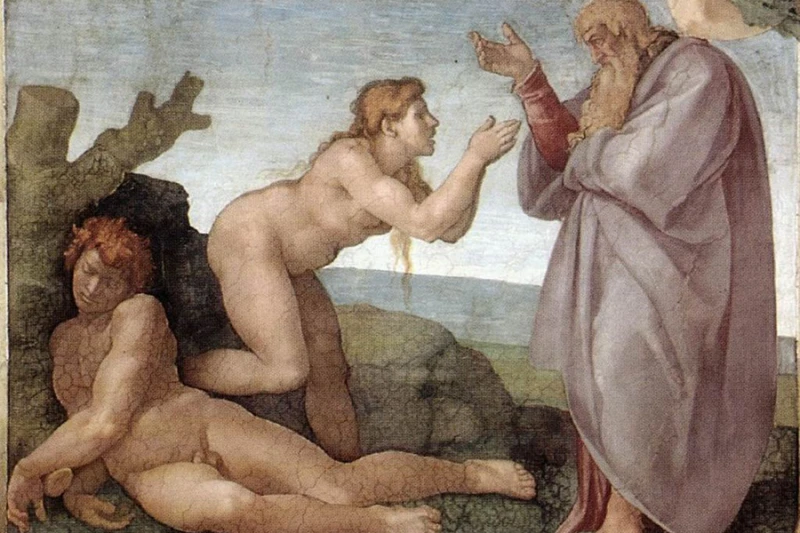
Michelangelo’s The Creation of Eve, from the Sistine Chapel ceiling, c. 1510. / null
Denver, Colo., Nov 15, 2022 / 09:00 am (CNA).
Michelangelo’s artistic masterpiece in the Sistine Chapel broke new ground in portraying the dynamic creative acts of God, but his work also depicts the combined importance of men and women through all of sacred history, art historian Elizabeth Lev has said.
“The spirit of artistic adventure led the artist to experiment with a completely new vision of creation,” Lev said Nov. 12. “He took a book that had been painted, sculpted, mosaiced, and illuminated over and over again in the history of art and created something completely new.”
She spoke at the closing keynote Saturday evening at the fall conference of the University of Notre Dame’s de Nicola Center for Ethics and Culture. Lev teaches at the Rome campus of Duquesne University and the Pontifical University of St. Thomas Aquinas. Her speech, “Creation, Complementarity, & St. John Paul II in Michelangelo’s Sistine Ceiling,” focused on one of the key artistic treasures of Vatican City.
The 16th-century Florentine artist Michelangelo was commissioned by Pope Julius II to paint the Sistine Chapel’s ceiling and the upper section of its walls. This was the artist’s focus from 1508 to 1512. He later finished the Last Judgment above the chapel altar from 1535 to 1541.
The ceiling frescoes show the creation of the heavens and the earth, the creation of Adam and Eve, their expulsion from the Garden of Eden, the great flood, and the rebirth of humankind through Noah.
Lev cited St. John Paul II’s description of Michelangelo’s work in his poem “Meditations on the Book of Genesis at the Threshold of the Sistine Chapel.”
“It is the book of the origins — Genesis,” the pope said. “Here, in this chapel, Michelangelo penned it, not with words, but with the richness of piled-up colors. We enter in order to read it again, going from wonder to wonder.”
Lev reflected on the first three panels depicting the creation of the world. These show “the mighty dynamic figure of God the Father at work.”
“It’s not what God creates, it’s that God creates,” she said. Michelangelo broke ground in portraying God as “physically engaged in creation.” For Lev, this offers “a preview of the Incarnation.”
Turning to Michelangelo’s famous depiction of the Creation of Adam, Lev noted that the artist depicts “just God and the creature formed in his likeness.” Adam is shown as “somewhat listless” in contrast with God’s energy. Adam is “sentient and awake but he has no will or strength or purpose to rise,” she said. “He looks completely passive and dependent despite that incredibly beautiful form.”
“It’s God who reaches towards man,” she continued. For Lev, the outstretched finger of God makes the viewer “almost lean forward in his seat waiting for that final Act of Creation, the divine spark, the Breath of Life that will release that latent energy and allow Adam to take his place as the greatest of creations.”
“This is the joy in humanity that permeates the Renaissance,” Lev said.
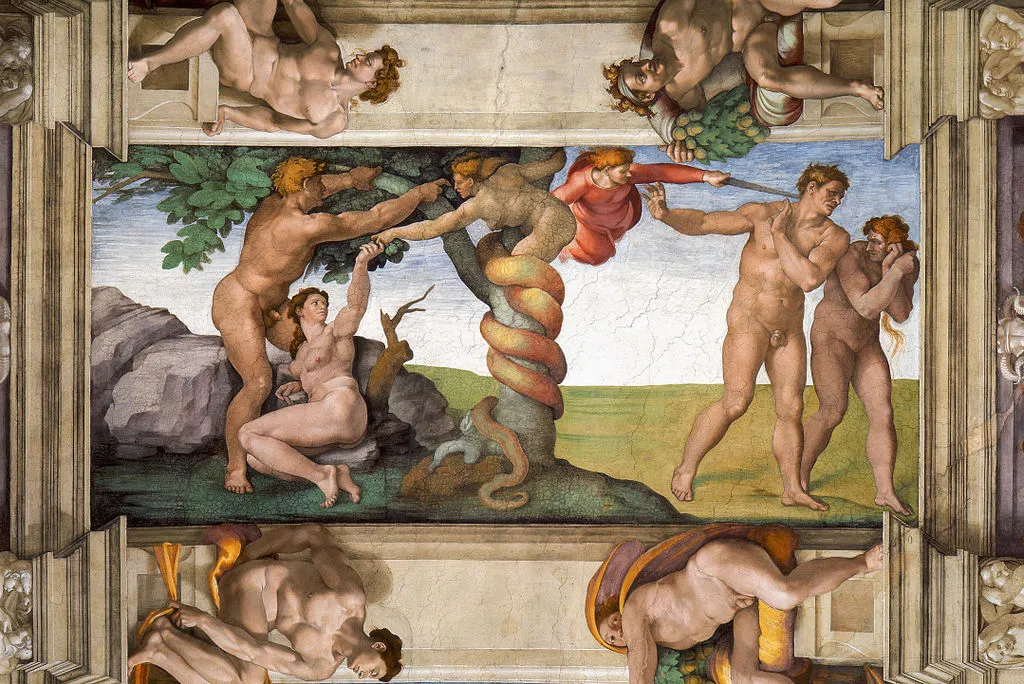
Michelangelo’s The Fall and Expulsion from Paradise from the Vatican’s Sistine Chapel (1508-12).
There is academic debate over a female figure shown in the Creation of Adam. As God the Father stretches out one arm to Adam, his other arm curls around a female figure. Some have identified this figure as Wisdom, some as Mary.
Lev suggested it is best to identify this figure as Eve, both because the figure provides visual balance to Adam and because her gaze “connects her more intimately with Adam.”
The creation of Eve from Adam, depicted next on the chapel ceiling, shows Eve emerging from Adam’s side with her hands clasped in prayer, an image of the Church and the personification of Mary, the “Second Eve.”
Lev cited St. John Paul II’s 1999 homily inaugurating the newly restored Sistine Chapel, after centuries of grime and soot were removed. The pope called the chapel the “sanctuary of the theology of the human body,” alluding to his catecheses offered from 1979 to 1984. The pope suggested that Michelangelo allowed himself to be guided by the Book of Genesis’ depiction of mankind in Eden: “the man and his wife were both naked and they felt no shame.”
Before the fall, Lev commented, Michelangelo depicted Adam and Eve in the state of grace as “two of his most beautiful figures.”
“They are filled with dynamism. They’re buoyant. They’re luminous,” Lev said, adding that their bodies “suggest immortality.” After the fall, however, both of their bodies “lose their luminosity” and appear heavier, like a burden. Adam’s shoulder seems to force Eve into the background, “subjugating her.”
For Lev, the artistic depiction of the genealogy of Jesus Christ also deserves attention. The portrayal of the ancestors of Jesus Christ shows “a genealogy of men and women struggling from generation to generation.” These figures seem “more approachable” and “much more similar to candid family photographs.” Even though 22 women in Jesus’ genealogy are not named, Michelangelo pairs them with their husbands.
Lev noted that Michelangelo broke with artistic convention both by including mothers and by showing them as busy, everyday women “tending to toddlers, toilettes, and tasks.” His style of painting them with “incredible immediacy” adds observations of human nature: Eleazar’s wife holds the purse strings and the key to the house, and her husband looks “startled” as she surveys their son. Other depictions are “tender and intimate,” like the portrayal of the wife of Manasseh, who cradles a swaddled son while rocking an infant’s cradle.
Here, Lev drew on John Paul II’s 1995 “Letter to Women.” He wrote that womanhood and manhood are complementary at the physical, psychological, and even ontological level.
“It is only through the duality of the masculine and the feminine that the human finds full recognition,” the pope said. “To this unity of the two, God has entrusted not only the work of procreation and family life but the creation of history itself.”
Lev noted that the passing of generations “necessarily emphasizes the begetting of children.” This means that the complementarity of the sexes is essential for a population to form and for creation to continue.
In Michelangelo’s portrayal of the Last Judgment, the artist still looks back to creation but also breaks new ground. He placed Mary next to Christ, as “a foil to Christ’s sternness.”
“She is the picture of mercy gazing down towards the elect, placed by the wound in Christ’s side whence the Church sprang,” Lev said. “Mary is transfigured into the Bride of Christ, for whom he gave his life and to whom he cannot say no. She is the conduit to Christ, as Eve was the link between God and man in the creation of woman.”
For Lev, the Sistine Chapel shows the “incredible gift of creation” from the beginning of the world down through the generations, “through which all of us today are a part of that continuation of creation.”
Washington, D.C. Newsroom, Jun 30, 2023 / 14:30 pm (CNA).
The Association of Catholic Colleges and Universities (ACCU) as well as numerous Catholic universities blasted the U.S. Supreme Court’s Thursday decisio… […]
The European Parliament building in Brussels, Belgium. / Ala z via Wikimedia (CC BY-SA 3.0).
Brussels, Belgium, Jun 23, 2021 / 10:00 am (CNA).
A Christian legal group said Wednesday that its inclusion in a report claiming that “religious extremi… […]




Leave a Reply