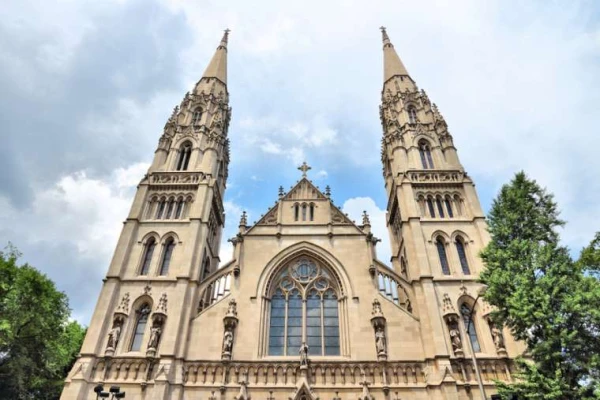
CNA Staff, May 28, 2020 / 04:17 pm (CNA).- This summer, the Diocese of Pittsburgh will initiate another round of mergers, bringing its current 152 parishes down to 106. While the consolidation is difficult, Pittsburgh Bishop David Zubik said, it will allow the Church to more effectively carry out its ministry.
“This has not been a simple task. Jesus never promised that it would be easy to carry his message of love and mercy to others. He was clear that sacrifice would be necessary,” the bishop said in a letter to affected parishioners.
“However, you are positioning your new parish for more effective ministry by addressing financial needs, sharing resources and allowing your clergy to focus on the spiritual work for which they were ordained. With your faith in Jesus and empowered by the Holy Spirit, I invite you to warmly welcome and serve each other as you become one parish family.”
This round of mergers will take place on July 1, 2020. It will consolidate over 60 parishes into 15 parishes.
The merger is the latest step in the “On Mission for The Church Alive” initiative, which is reorganizing what began as 188 parishes into what will be fewer than 60 parish groupings.
The diocese’s strategic planning initiative began in 2015 in part as a response to declining Mass attendance, the financial struggles of some parishes, and fewer priests.
The situation was exacerbated by the 2018 Pennsylvania grand jury report, which detailed sexual abuse allegations in six of Pennsylvania’s eight Latin-rite dioceses, including Pittsburgh. Earlier this year, CBS Pittsburgh reported that since the report’s release, Mass attendance had dropped 9% and offertory donations declined 11%.
“Since 2018, you have journeyed together on a road that is intended to unite you on the mission to bring the Good News of Jesus to your neighbors and to strengthen all of you in faith,” Bishop Zubik said.
“Southwestern Pennsylvania is radically different than it was 100, 50, 20, even 10 years ago, yet the work of the Church and our call from God to bring His love to everyone continues as strong as ever,” he said. “As we address the challenges we face in the Church today, the witness of working and growing together reflects the unity of the Body of Christ that is essential to our mission.”
Among other parish combinations, Holy Angels in Hays, Holy Apostles in South Pittsburgh, and Saint Sylvester in Brentwood will merge into the Blessed Trinity Parish; and two Wexford churches – Saint Alexis and Saint Alphonsus – will merge into Saint Aiden Parish.
The diocese will also reorganize the four regional vicariates into two regional vicariates – a North and South Vicariate – which will be used to assist future parish groupings. Father John Gizler III has been appointed Regional Vicar for the North Vicariate, and Father Joseph Sioli will be Regional Vicar for the South Vicariate.
Bishop Zubik expressed gratitude for the clergy and church leaders who have helped the “On Mission” project become a reality.
“Their examples of collaboration, courage and compassion have inspired me. Their collective efforts have gone beyond the practical matters related to merging parishes. They have encouraged their parishioners to deepen their relationship with Jesus and with each other,” he said in a statement.
The bishop added that as the “On Mission” plan unfolds, the Church will need to rely heavily on the inspiration of the Holy Spirit.
“[M]ay we unceasingly rely on the will and the wisdom of the Holy Spirit, the Advocate who gives us life as we come together for vibrant worship, responsive pastoral care and powerful evangelization,” he said.
 […]
[…]



““As a founding principle of our country, we have always welcomed immigrant and refugee populations, and through the social services and good works of the Church, we have accompanied our brothers and sisters in integrating to daily American life,” Bishop Mario Dorsonville, auxiliary bishop of Washington and chair of the US bishops’ Comittee on Migration, said Jan. 2.”
Someone needs to take a remedial US history class.
SOL,
Which part of US history did you think they need a remedial class on?
Who are most Americans originally if not immigrants?
I’d agree it’s not correct to say that we have always, at all times welcomed immigrants and refugees but we certainly have done that selectively. And Catholics have for the greater part been among the groups of immigrants not warmly welcomed.
We need immigration to counteract the current birth dearth but we don’t have to have open borders or risk our national security. There should be a reasonable and humane approach to immigration.
Has it occurred to you that mass immigration is a cause of the drop in birthrates? By driving up the cost of living (housing, heath care, taxes, etc.), while depressing wages, it makes family formation so much more difficult.
Tony,
Birthrates are plummeting globally with or without immigration. Even government incentives to have a replacement level birthrate have failed.
Hungary is offering tax incentives for families and hopefully they’ll have some success.
Mrscracker,
The founding American people were not immigrants but colonists/settlers. They didn’t enter into a pre-existing polity and receive citizenship or some other form of membership from another people. The whole “America is a land of immigrants” myth was created by leftist subversives even if used by 20th ce nationalists for their own purposes after the fact, more than 3 centuries after the first British colonists started settling this country. Many of the founding fathers after the revolution even explicitly wrote on the question of whether anyone non-British should be allowed to immigrate to the US.
This original Anglo-American (and Protestant Christian) heritage and identity is what the left is trying to erase and unfortunately too many Catholic bishops are assisting in this, even if the bishops seek to replace it with some vague “Catholic” identity.
This system is currently in a stage of collapse, and continued immigration will further destabilization and increase the likelihood of wide-scale violence, regardless of how necessary believers in infinite economic growth say immigrants are for that.
SOL,
Good morning!
My daddy’s side of the family has been here for 400 years. I went to the UK a few years ago and visited the parish church of a 17th century colonial ancestor. In his memorial he’s referred to as “Henry the Immigrant” because he migrated to the American Colonies.
🙂
You know, the longer your ancestors have lived in North America the more likely you are to find non Anglo Saxon ancestry or ancestors who came as convicts. The American colonies were a dumping ground for thousands of British convicts until the Revolutionary War. After that, the British had to turn to Australia and Tasmania to dump their unwanted.
Beyond chattel slavery, folks of African ancestry have been here for 400 plus years. Many were free people of color and many intermarried with white colonists.
And of course, our American Indians have their own perspectives on immigration.
History is complicated and the more you look at it, the more humble you feel. Most of us have very modest beginnings and sometimes, we find very surprising narratives along the way.
Your argument seems to be that, since we are all the descendants of immigrants (in the broadest sense of the word), there is no justification for this nation (or really, any nation) to have a restrictive immigration policy. Apparently, this Ellis Island sentimentalism must override all other political, social, cultural and economic considerations. Does a country have a right to try to maintain its ethnic and cultural balance by limiting who is allowed in?
More mindless, liberal rubbish from bishops who seem utterly incapable of, not to mention unwilling to, speak in anything other than left wing cliches. Will they ever declare solidarity with the American people?
Looked up the bishop in question.
Wikipedia: Mario Eduardo Dorsonville-Rodríguez (born October 31, 1960) is a Colombian-born bishop of the Catholic Church in the United States.
Like Jose Gomez, another immigrant who is presumptuous enough to lecture Americans about American history and identity.
Thanks for the information. I suppose the good bishop has admonished the elites in Colombia on the need to clean up the corruption and to improve the nation’s economy that has apparently created such intolerable conditions.
Wish the bishops (and the nuns!!) would show a little solidarity with the dyslexic/dyscalculaic/etc community.
.
Just because dyslexics frequently have high intelligence does not mean they all go to MIT and walk out with $75,000 starting income.
.
Many suffer socially as well as educationally and the job situation upon adulthood can look bleak. As many prisoners are dyslexic, I think it is a good bet if it was caught early in school, we’d have fewer children in trouble and fewer adults in prison.
.
I mean no ill will toward those looking for a better life, but we have plenty of hurting children/adults who were born here. Don’t they deserve the same concern?
Tony,
North Americans, with the exception of those descended from our Indian tribes, are all the product of quite diverse immigrant populations from the past 400-500 years. I dislike the term “diverse ” because it’s become a cliche, but it really does describe our immigrant history.
I don’t think race or ethnicity should even enter into a Catholic conversation regarding what to conserve in America. Color and ethnicity simply don’t signify but culture does.
A Judeo Christian culture is what conservative Christians and others should be concerned about preserving. Not Anglo Saxonism. Culture, not color is what’s critical.
And yes, I strongly believe that sovereign nations have a right to secure their borders and enforce immigration laws. And preserve their unique cultures. But you have to have enough population to ensure a functioning society to pass that culture down to. Societies that are ageing and not reproducing themselves won’t be capable of that and will eventually be replaced.
Nature abhors a vacuum.
Immigrants – they are ambassadors of the Good News.
All of them? How so? In what way?