Washington, D.C. Newsroom, Apr 25, 2020 / 12:00 pm (CNA).- Fr. Brendan Buckley, OFM. Cap., had never heard of the Zoom before this past March and the onset of the coronavirus pandemic. After his home in the Diocese of Brooklyn became a center of COVID-19 illness in the United States, he learned.
With the help of two parish employees, he has now shifted much of his parish ministry online, caring for his flock at the parish of St. Michael-St. Malachy despite the outbreak.
“They’ve got something [streaming] every day of the week,” he said. This includes fitness programming for children, meetings of the parish’s young adult group, First Communion classes, all in addition to live-streams of Masses.
The vast majority of Buckley’s parishioners are immigrants from the Dominican Republic, Mexico, and other Central American countries, he told CNA on Friday, April 24. Many of them “don’t have jobs that necessarily have unemployment insurance attached,” he said, or medical benefits. They have been especially hard-hit by the economic effects of the virus, and are his chief concern when trying to deliver practical help.
“People like that are what our main concern is here, because they don’t have anything to back them up,” he said.
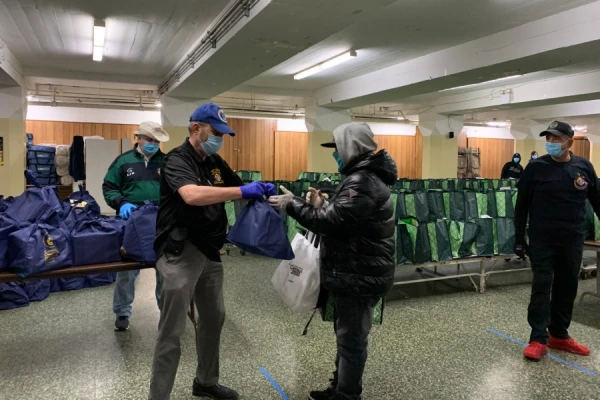
On April 24, his parish staged a pop-up food distribution with Catholic Charities of Brooklyn and Queens. Opened in addition to the existing 34 food pantries operated by Catholic Charities of Brooklyn and Queens, the parish event saw a total of 9,360 meals distributed to 1,040 families in need, with an additional $2,500 in grocery vouchers given to 100 families.
Buckley told CNA that as a Capuchin Franciscan friar, his work ministering in Brooklyn during the COVID-19 pandemic is following in the tradition of his religious order. The boroughs of Brooklyn and Queens contain about 60% of the COVID-19 cases in New York City, which has more cases than anywhere else in the country.
Several priests of the Diocese of Brooklyn have fallen ill, and died, from the coronavirus.
“From my perspective as a Capuchin Franciscan, this is exactly what we want to be doing: directly helping people in need,” he said. “Throughout the difficult times in Europe, the Capuchins were right there on the front lines. When leadership in different cities fled to the hills during plagues, the Capuchins stayed, and ministered, and died.”
Buckley heaped praise on the work of Catholic Charities, which he said have been meeting ever tougher challenges during this crisis, enabling him to more fully live out his vocation as a Capuchin.
“Catholic Charities has been such a help in allowing us to have the resources to be able to do this kind of outreach,” he said.
Buckley explained to CNA that he had two main areas of concern when it came to his parish: providing food to his parishioners, and ensuring their psychological health. Hence the pop-up event at the parish on Friday.
“Catholic Charities has been just amazing in terms of their outreach. They have provided over 1,000 families with food today,” he said. The pop-up pantry was organized with other Catholic organizations, including the Knights of Columbus and Ancient Order of Hibernians.
“They have been exceptional in their care for those in need,” he said. “I’m just so proud of them.”
Buckley has not neglected the spiritual needs of his flock, even while he is still not able to celebrate Mass publicly. He is hard-of-hearing–and without one of his hearing aids that he sent for repairs pre-pandemic–he had to work with the diocese to figure out a way for him to continue safely, and literally, hearing confessions.
While the diocese recommended a space of at least six feet between penitent and confessor, that would not work for Buckley’s situation. He is now hearing confessions twice a week, for two hours at a time, in his office with the door closed. A penitent must make an appointment for confession in order to ensure that the church would not become crowded.
Buckley said he’s “very excited” to resume hearing confessions.
“The need for the Sacraments is so important,” he said. “Especially confession and the reception of the Eucharist.”
Once Buckley is permitted to have public Masses again, he will have a backlog of at least 15 memorial Masses he promised to celebrate for parishioners who have died from COVID-19.
“We’ve had one after another of parishioners, or family members of parishioners[…] that have died. It’s been a lot,” he said. He has regularly posted prayer requests on social media, to the point where “I worried that people are going to get sick of me asking for prayers for somebody else.”
In dealing with the pandemic, Buckley said that the most challenging spiritual aspect for his parish is the inability to mourn in the standard manner.
“They can’t go to wakes and funerals. So, it’s very hard on them. They can’t say goodbye,” he said. He told CNA that he has been dealing with much of the grieving process on the phone with parishioners.
Despite everything, Buckley insists that his parish has been blessed; blessed with a small, yet smart and capable staff who moved programming online, and blessed with the outpouring of assistance from others.
“I’m very grateful that there’s so many incredible people out there that are willing to help, volunteer, sacrifice themselves to help others,” he said.
“We’re so blessed and so touched. God is good.”
 […]
[…]



““As a founding principle of our country, we have always welcomed immigrant and refugee populations, and through the social services and good works of the Church, we have accompanied our brothers and sisters in integrating to daily American life,” Bishop Mario Dorsonville, auxiliary bishop of Washington and chair of the US bishops’ Comittee on Migration, said Jan. 2.”
Someone needs to take a remedial US history class.
SOL,
Which part of US history did you think they need a remedial class on?
Who are most Americans originally if not immigrants?
I’d agree it’s not correct to say that we have always, at all times welcomed immigrants and refugees but we certainly have done that selectively. And Catholics have for the greater part been among the groups of immigrants not warmly welcomed.
We need immigration to counteract the current birth dearth but we don’t have to have open borders or risk our national security. There should be a reasonable and humane approach to immigration.
Has it occurred to you that mass immigration is a cause of the drop in birthrates? By driving up the cost of living (housing, heath care, taxes, etc.), while depressing wages, it makes family formation so much more difficult.
Tony,
Birthrates are plummeting globally with or without immigration. Even government incentives to have a replacement level birthrate have failed.
Hungary is offering tax incentives for families and hopefully they’ll have some success.
Mrscracker,
The founding American people were not immigrants but colonists/settlers. They didn’t enter into a pre-existing polity and receive citizenship or some other form of membership from another people. The whole “America is a land of immigrants” myth was created by leftist subversives even if used by 20th ce nationalists for their own purposes after the fact, more than 3 centuries after the first British colonists started settling this country. Many of the founding fathers after the revolution even explicitly wrote on the question of whether anyone non-British should be allowed to immigrate to the US.
This original Anglo-American (and Protestant Christian) heritage and identity is what the left is trying to erase and unfortunately too many Catholic bishops are assisting in this, even if the bishops seek to replace it with some vague “Catholic” identity.
This system is currently in a stage of collapse, and continued immigration will further destabilization and increase the likelihood of wide-scale violence, regardless of how necessary believers in infinite economic growth say immigrants are for that.
SOL,
Good morning!
My daddy’s side of the family has been here for 400 years. I went to the UK a few years ago and visited the parish church of a 17th century colonial ancestor. In his memorial he’s referred to as “Henry the Immigrant” because he migrated to the American Colonies.
🙂
You know, the longer your ancestors have lived in North America the more likely you are to find non Anglo Saxon ancestry or ancestors who came as convicts. The American colonies were a dumping ground for thousands of British convicts until the Revolutionary War. After that, the British had to turn to Australia and Tasmania to dump their unwanted.
Beyond chattel slavery, folks of African ancestry have been here for 400 plus years. Many were free people of color and many intermarried with white colonists.
And of course, our American Indians have their own perspectives on immigration.
History is complicated and the more you look at it, the more humble you feel. Most of us have very modest beginnings and sometimes, we find very surprising narratives along the way.
Your argument seems to be that, since we are all the descendants of immigrants (in the broadest sense of the word), there is no justification for this nation (or really, any nation) to have a restrictive immigration policy. Apparently, this Ellis Island sentimentalism must override all other political, social, cultural and economic considerations. Does a country have a right to try to maintain its ethnic and cultural balance by limiting who is allowed in?
More mindless, liberal rubbish from bishops who seem utterly incapable of, not to mention unwilling to, speak in anything other than left wing cliches. Will they ever declare solidarity with the American people?
Looked up the bishop in question.
Wikipedia: Mario Eduardo Dorsonville-Rodríguez (born October 31, 1960) is a Colombian-born bishop of the Catholic Church in the United States.
Like Jose Gomez, another immigrant who is presumptuous enough to lecture Americans about American history and identity.
Thanks for the information. I suppose the good bishop has admonished the elites in Colombia on the need to clean up the corruption and to improve the nation’s economy that has apparently created such intolerable conditions.
Wish the bishops (and the nuns!!) would show a little solidarity with the dyslexic/dyscalculaic/etc community.
.
Just because dyslexics frequently have high intelligence does not mean they all go to MIT and walk out with $75,000 starting income.
.
Many suffer socially as well as educationally and the job situation upon adulthood can look bleak. As many prisoners are dyslexic, I think it is a good bet if it was caught early in school, we’d have fewer children in trouble and fewer adults in prison.
.
I mean no ill will toward those looking for a better life, but we have plenty of hurting children/adults who were born here. Don’t they deserve the same concern?
Tony,
North Americans, with the exception of those descended from our Indian tribes, are all the product of quite diverse immigrant populations from the past 400-500 years. I dislike the term “diverse ” because it’s become a cliche, but it really does describe our immigrant history.
I don’t think race or ethnicity should even enter into a Catholic conversation regarding what to conserve in America. Color and ethnicity simply don’t signify but culture does.
A Judeo Christian culture is what conservative Christians and others should be concerned about preserving. Not Anglo Saxonism. Culture, not color is what’s critical.
And yes, I strongly believe that sovereign nations have a right to secure their borders and enforce immigration laws. And preserve their unique cultures. But you have to have enough population to ensure a functioning society to pass that culture down to. Societies that are ageing and not reproducing themselves won’t be capable of that and will eventually be replaced.
Nature abhors a vacuum.
Immigrants – they are ambassadors of the Good News.
All of them? How so? In what way?