

Today is the best of all times to be born with Down Syndrome, and the worst of all times. In the United States, some 76 percent of children diagnosed with the genetic disorder in utero are aborted—and elsewhere around the world, that number spikes to almost 100 percent.
Those who survive have opportunities like never before in history. Today, individuals with Down syndrome are excelling and advocating for themselves as never before. As triathlete Gabe Cobb told the United Nations in 2023: “I have Down syndrome and I have no limitations.”
It’s not as rare as a lightning bolt—about 6,000 of the 3.6 million babies born in the United States each year have Down syndrome. But to parents hearing the diagnosis, it can feel like one, searing through expectations and dreams.
Down syndrome comes with a lifetime of challenges and a host of health issues, including heart defects, respiratory and hearing problems, and cognitive issues. Most people with Down syndrome have Trisomy 21, an extra copy of chromosome 21 that affects every cell of their bodies and every aspect of their development.
According to the National Down Syndrome Society, “A few of the common physical traits of Down syndrome are low muscle tone, small stature, an upward slant to the eyes, and a single deep crease across the center of the palm. Individuals with Down syndrome possess varying degrees of cognitive delays, from very mild to severe.”
So what happens when lightning strikes—not twice, but over and over?
That’s what happened to one family where Down syndrome is seen, not as a curse, but as a gift to be celebrated. In a world where most babies with the diagnosis are aborted, they have said yes to Down syndrome five times over two generations.
‘The Secret’
Peter and Andrew Daub still become emotional when they think of their younger brother Paul, the first lightning strike in their big Catholic family.
Paul, who was Mary Ann and Frank Daub’s eighth child, lived just six months before a heart defect took his life, but that was long enough for him to capture hearts. Paul’s siblings remember the beauty of their short time with him: holding him, helping feed him, applauding his tentative smiles.
So when Peter and his wife Erin found out that Rose, their third child, had Down syndrome, the memory of Paul was sobering—“I knew the issues that Paul had, and that scared me a little,” Peter says.
“On the other hand,” he says, “I saw throughout my childhood how special people with Down syndrome were. They were always happy, and I saw how much they loved and were loved. I didn’t fear raising a child with DS.”
His mom was supportive. There would be hard things, she told Peter and Erin, but the good would definitely outweigh the bad.
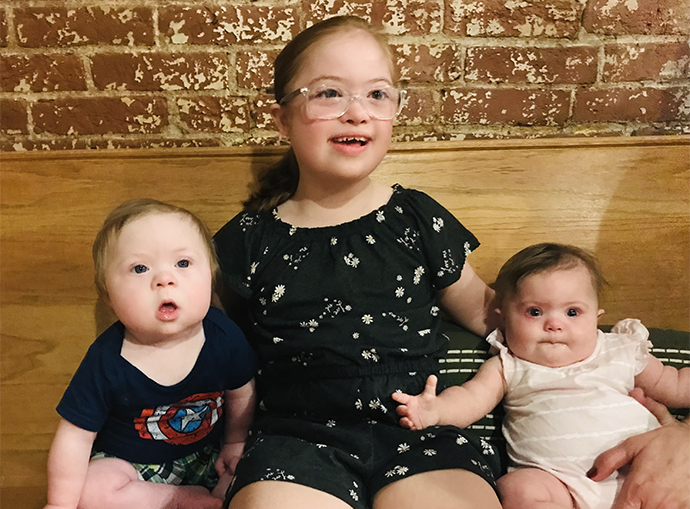
Rose was six when Andrew and Cathy Daub got the news that their 8th child had Down syndrome. Cathy cried at first, but ultimately, as she told The Epoch Times in 2022, “I was ok with this news. I really was.” Because of Rose and Paul, she said, “I knew the secret.”
Will—who quickly became known as “Iron Will”—and his cousin soon became stars among the Daub grandkids.
The Gift
One might think this story ends there, but it doesn’t.
Just a few days before Will’s birth, Meg Giovannini, Andrew and Peter’s first cousin, got the news during a busy morning at work: “Your baby has an 84 percent chance of having Trisomy 21.”
Even though “there was never a doubt I wanted this baby,” Meg said, she grieved. “I had plans for him or her,” she said. “And suddenly those plans and that life no longer felt possible.”
The tears fell until she told her mentor and former boss about the diagnosis. “His face lit up, and he said, ‘What a gift,’” she recalls.
“That was it for me. So many more tears, but looking back, I think that was the first time they were tears of joy. And I think that was really when I stopped grieving and started planning again for the gift we were being given.”
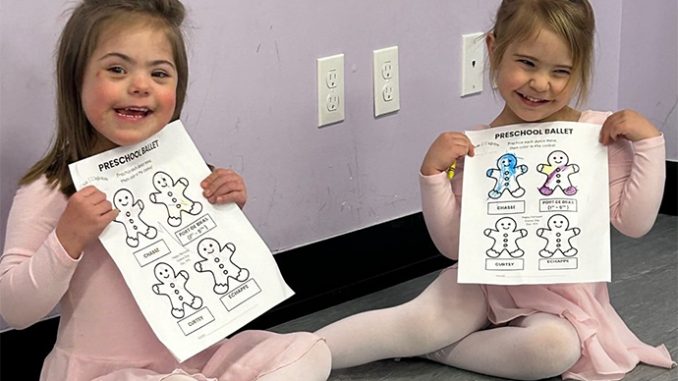
At the time, two states away from her cousins in Missouri, Meg didn’t really think about the fact that “others in the family … were also on this journey.” Today, Eden is a bouncy, dark-haired five-year-old who loves ballet and plays soccer. And her mom says she’s “so grateful” for their unique family because “hopefully she won’t ever have to feel alone.”
Two years after Meg and her husband Michael welcomed Eden, lightning struck again, as yet another cousin embraced a diagnosis of Down syndrome. This time, the story, like Paul’s, ended in heartache. That’s enough said: it’s still too raw.
An uncle and four cousins with Down syndrome: What are the chances? They’re very small indeed—less than 1 percent. Down syndrome does not usually run in families. There is a variant of Trisomy 21—Translocation Down syndrome—that can be inherited, but genetic testing has ruled that out for Rose, Will, and Eden.
The rare circumstance makes this family uniquely qualified to talk about Down syndrome.
The Daubs and their cousins have become experts and advocates as they deal with the health and learning challenges that come with the condition.
They have a priceless advantage: the support of close family members who know Down syndrome first-hand.
Unconditional Love
And the gift far outweighs the challenges, they say.
The biggest blessing of raising a child with Down syndrome, Peter says without hesitation, is unconditional love.
The list grows quickly as the parents enumerate how their children enrich the lives around them: authenticity, compassion, contagious joy, a huge capacity to love and be loved.
“I would also say the effect our kids have on others,” Erin says. At a recent mother-daughter dance, she said, Rose “danced with every mom and kid there. And every single one of them took her outstretched hand without a thought and danced their hearts out right along with her.”
For Frank Daub, the gift goes back to that first yes. In Paul’s short life, he says, he taught his other children compassion “without ever having the opportunity to communicate with them.”
“I am incredibly certain of this,” he says: “their ability to love and treasure a person with serious disabilities grew with them as they became adults.”
“Most people have no idea,” Cathy says. “When they have a child with Down syndrome, they are totally surprised by the joy and unconditional love.”
Advocacy
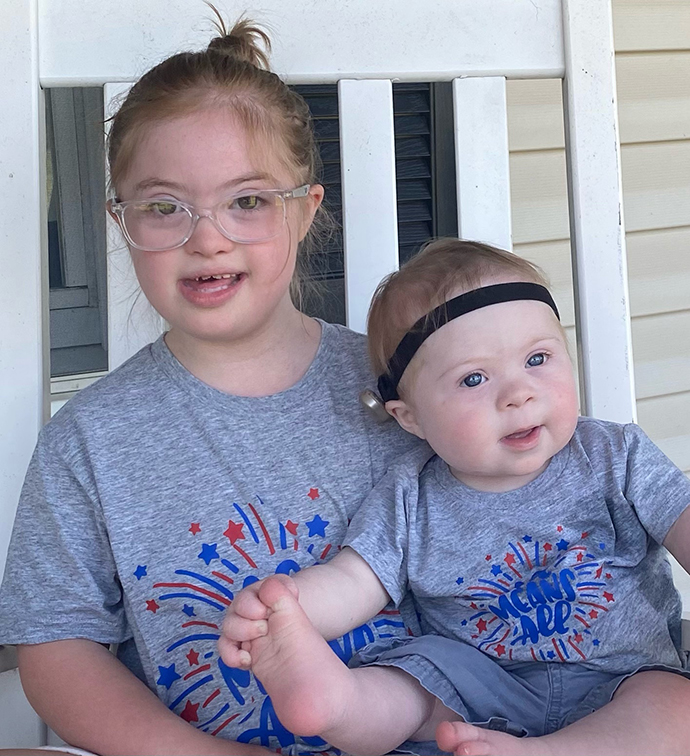
Today, Rose is thriving as a fifth grader in her Catholic grade school. She’s the only student with Down syndrome and fully mainstreamed—thanks to her parents’ advocacy. She’s “really into changing into cute outfits and making sure her hair looks good,” her dad says.
Will, five, is the face of Team Iron Will, a nonprofit that provides resources, education, and support for Down syndrome families.
Having Will, “we immediately understood—at a personal level—how much work remains in helping the rest of the world understand the blessing,” Andrew says. “We realized we had to advocate relentlessly and share a message of hope to give people with Down syndrome a chance to be fully seen and heard.”
The cousins are backed by a support network of dozens of doting aunts, uncles, and cousins who frequently turn out for Down syndrome fundraisers or Team Iron Will events.
Not to mention siblings. When Peter and Erin were told of Rose’s diagnosis, Peter says “I didn’t fear raising a child with DS,” but a big concern was what would happen once he and Erin were no longer around to care for her.
He needn’t have worried: “I am blessed to have two wonderful older daughters who have pledged and sometimes argue about who will take Rose when necessary,” he said.
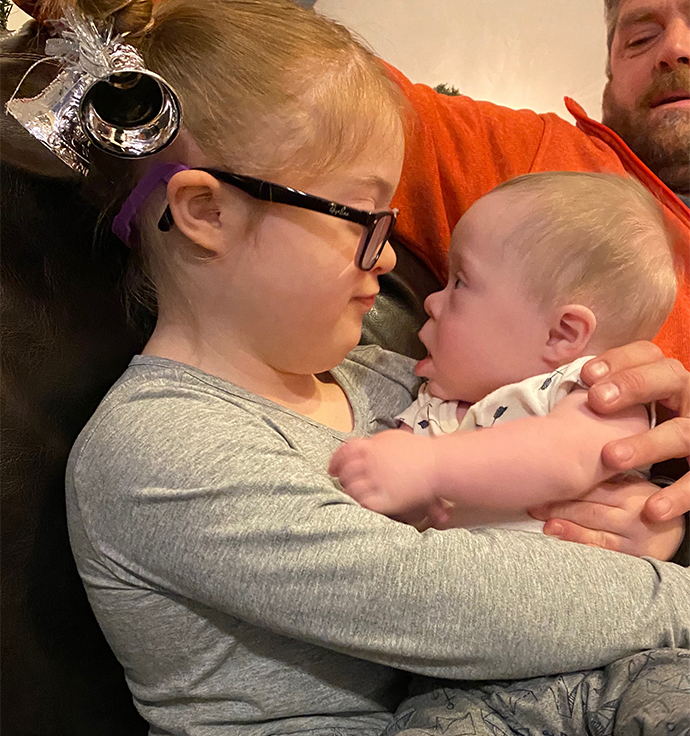
Andrew and Cathy never have to call a babysitter for Will—his six older brothers and older sister happily step in. In their creative family, that often means new videos with Will playing a starring role.
Faith
The family’s strong Catholic faith and pro-life ethic cannot be separated from this story.
Meg credits Mary with her daughter’s healthy birth during the pandemic—Eden was born on Dec. 8, 2020, the Feast of the Immaculate Conception. “Our Lady has been taking amazing care of her this whole time,” she said.
Andrew and Cathy have been deeply involved in pro-life work over the years. They feel that having Will is just another step in their pro-life journey, broadening their horizons and giving them common ground for conversations about life they would not have had otherwise. Team Iron Will is unique among Down syndrome advocacy organizations, they say, for its unswervingly pro-life focus.
Erin points out that in a world where life was always welcomed, there would be many more families like theirs. “It shows the disparity between how many folks with Down syndrome we should all have in our lives, versus how many survive the womb,” she says.
Challenges and Opportunities
Meg says her biggest challenge is not her daughter’s Down syndrome but not knowing what her future holds. “Like all parents, I want to know she is going to be ok. And I want to know she will be accepted and included and never feel less than because of her genetics,” she says, “and we just can’t know that.”
When she first got Eden’s diagnosis, Meg gave up on her daughter going to college and getting married; nonetheless, her dreams have rebounded. “Now I hope and pray daily she finds someone to love her. And she gets that college degree. And we want her to ice skate and play tennis. She could be the first professional tennis player with Down syndrome!”
Experiencing Down syndrome through two generations is less like lightning and more like “finding multiple four-leaf clovers,” Andrew says.
In this family, Down syndrome is not something to be dreaded, but celebrated. When a genetics doctor excitedly told her, “It’s not genetic, so this probably won’t happen to your children when they have kids,” Cathy says simply, “We never went back.”
As Will’s older sister, Cailin, said when Cathy asked, “What makes your brother special?” the family attitude is that Down syndrome comes with “a little extra everything.”
The next generation knows they may also someday hear “Your child has Down syndrome.” They’ll be ready for that. They’ll know the secret, just as Andrew and Cathy did when they got Will’s diagnosis.
“I knew the magic that was about to enter our lives,” Cathy says.
• March 21 is World Down Syndrome Day.
If you value the news and views Catholic World Report provides, please consider donating to support our efforts. Your contribution will help us continue to make CWR available to all readers worldwide for free, without a subscription. Thank you for your generosity!
Click here for more information on donating to CWR. Click here to sign up for our newsletter.

The title of this piece is perverse, and so is the notion of “saying yes to Down syndrome.” Down syndrome is a disease; no sane person would want another human being to have down syndrome, and if a cure for it was available we would want to pursue it. Consequently, sane people don’t “say yes to Down syndrome,” we “say yes” to the people born with this disorder and we love them, treat them with dignity, and do our best to integrate them into society. Catholics should utterly oppose the prevailing cultural fad that denies that disorders are disorders and are mere manifestations of “diversity.”
You appear to be misunderstanding what the author has written. Saying “yes” to DS is precisely saying yes to the people who are born with it. It’s not a celebration of DS, but an acceptance of the situation and the person. And, of course, if there was a cure, they would embrace it. While the parallel is not exact, St. Paul underwent something similar, and he embraced his thorn in the flesh:
Thank you, Carl,for your response. I thought also that the article was being misinterpreted. To me, it was an illustration of the great faith of this family, trusting in the Lord and and looking for the rainbow in every storm.
Oh but you are wrong. Maybe a cure would be welcome, but watching those little ones beat odds, do amazing things and grow in love and laughter, I think is probably more than worth any heartache their parents may encounter. And yes, while life for this family could be so much easier without this diagnosis, I would wager to say they wouldn’t change it for the world, they clearly state in this article, the unmeasurable joy, love, and innocence their children exude is 1,000 times worth it.
You are wrong in thinking that one does not consent to Down syndrome. Doctors in fact deliver the diagnosis at a very early stage of pregnancy. Failing to comprehend that their “product of conception” is a preborn child with a genetic anomaly yet consistent with LIFE, at least 75% of parents given the news of Down syndrome choose to abort. Why? Parents, in this day and age of technology and cultural decay, are asked to consent to the diagnosis; most parents likely know little except that the doctor often advises against bringing a person into the world with that ‘disorder.’
(So it is with little reflection or concern that a society may later turn to euthanizing the ‘disordered’ among them, no matter the age, size, or nature of the ‘disordered’ persons.)
In short, parents DO CONSENT to Down Syndrome as an inherent, ingrained, predominant, God-wise but mysterious blessing upon their unborn child, given unto themselves and the community and society in which they abide.
Your comment is repugnant, at best. My brother, Paul, and my beautiful little nieces and nephews have NEVER been looked upon as being “diseased”. We all said “yes”. Yes to giving these beautiful little ones a chance to live despite a culture that promotes abortion when this diagnosis is given. I had never looked at Paul, Rose, Will, Eden and thought “it’s too bad they can’t be cured”. God knows what is best and He has a plan that we will never understand. He knew that the little ones He sent our way would enrich our family beyond measure.
Yes, it’s not a “disease “, it’s a difference. Vive la difference.
🙂
What are your other categories of unacceptable life situations that should be treated as diseases rather than God’s call to give your heart to someone in loving care?
My wonderful wife Mary Ann, died from Alzheimer’s last Christmas morning. She gave birth to Paul, the child mentioned in the article you choose to use as a platform to advance the sorry perception that God owes you a life of perfection, without the beauties of taking another human through sorrows, struggles, life challenges. Our son, Paul, died after nine months of a life of being held, cherished, loved so deeply that today his brothers and sisters still include him in their lives. Some of my sons and daughters bring rewarding lives to their own “disordered” children. Every day I receive unconditional love from my DS grandchildren. I cannot conceive of ever seeing them as victims of disease.
Your heart, metaphorically, must be an empty and dark place, or worse, a place that is burdened with today’s societal sickness that imperfect people are unfit for love and attention.
Toto, the reward will be so wonderful for me if I am blessed enough to see my Mary Ann again, and Paul, in his perfection God planned for him.
The thing is about unconditional love, not a life without challenges and opportunities to really love others no matter their earthly conditions
Thank you so much for sharing those thoughts Mr. Daub and my sincere condolence for your loss. 🙏
You are so very welcome. Thank you for seeing life with a beautiful vision that Christ gave to you to recognize the value of every life brought in to the world to demonstrate God’s goodness.
My 48 year old daughter has Ds. I would never wish for a child with her condition, nor would I wish for a six and a half foot quarterback nor a 90 pound ballerina. That type of thinking misunderstands the role of parenting. All I have ever wished for is the grace to be the father my two children deserve. Looking back I would not change a thing. I am the luckiest father I know. The biology of Ds is that it is an anomaly. I think the theology of Ds, and other human diversity, is further proof of the greatness of the Father. Thank God we are not all the same. Happy belated World Down syndrome Day.
“I am the luckiest father I know.” Jim, I never thanked you for this beautiful comment. It meant so much. You walk the talk: https://karengaffneyfoundation.org