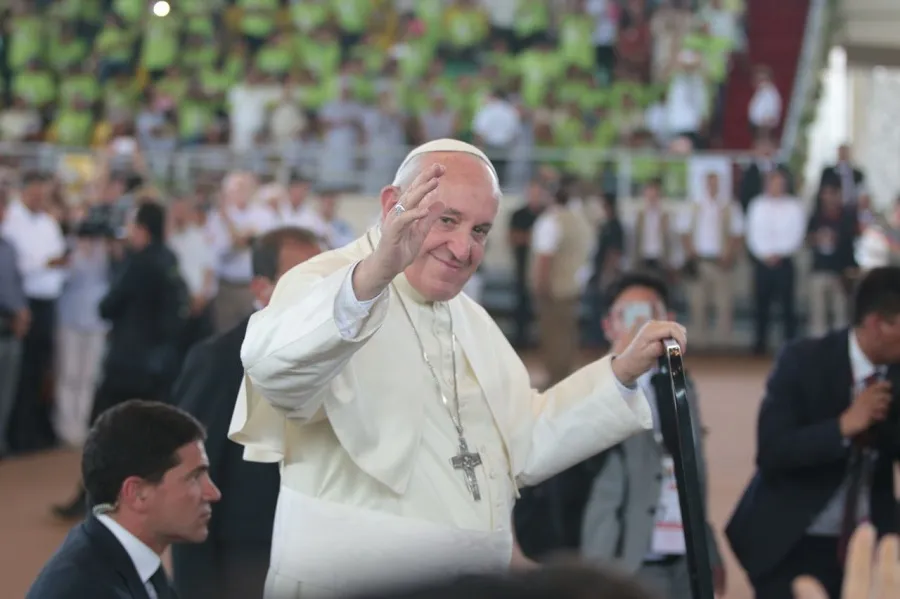
Quebec City, Canada, Apr 1, 2019 / 04:49 pm (CNA).- A bill introduced recently in Quebec would forbid future government employees from expressing their faith through religious symbols during office hours.
The bill, called “An act respecting the laicity of the state,” was introduced March 28 and is expected to pass.
“The purpose of this bill is to assert the secularity of the state and to specify the requirements that flow from it,” said Simon Jolin-Barrette, Quebec’s Minister of Immigration, Diversity and Inclusiveness and the architect of the bill, at a legislative session last week.
The legislation would ban religious symbols for government employees, including Muslim headscarves, Jewish yarmulkes, and crucifixes.
It would affect future employees hired into the public sector, including teachers, police officers, and judges. Current government employees in Quebec would be exempt from the ban.
The bill has drawn criticism from political and religious leaders, who have called it an act of discrimination and an affront to religious freedom.
“It is unthinkable to me that in a free society we would legitimize discrimination against citizens based on their religion,” Prime Minister Justin Trudeau told journalists.
“We are deeply opposed to the restriction and erosion of the freedom of religion of individuals in the name of secularism,” said Rabbi Reuben Poupko, Quebec co-chair of the Centre for Israel and Jewish Affairs.
“The commitment to secularism does not rest on the outward appearance of individuals,” he said, according to the Canadian Jewish News.
Quebec has previously sought to assert the secularity of the state and ban religious symbols. The province issued a ban in 2017 on religious full-face coverings, but it is was suspended by a judge last June.
The proposal continues a trend of increased scrutiny for religious symbols, in Canada and internationally, in recent years.
A few weeks ago, Montreal’s City Hall announced that a crucifix taken down during renovations would not be returned to its display. City councilor Laurence Lavigne-Lalonde said the religious symbol was no longer relevant.
“The crucifix was installed during an era that was completely different than the one we live in today,” Lavigne-Lalonde told the council, according to CTV News Montreal. “We now live in a society that has evolved and is represented by democratic institutions that must be secular, neutral and open to all citizens.”
The Archdiocese of Montreal issued a statement in response, saying that the crucifix represents the Christian roots of the country and does not need to be removed in a religiously pluralistic society.
“As a sign revered by Christians, the crucifix remains a living symbol. It symbolizes openness and respect toward all peoples, including toward other faith communities and religious traditions, which rightfully adhere to their own signs and symbols,” said Archbishop Christian Lépine.
Europe has also seen debate over religious symbols in recent years. In 2017, the Court of Justice of the European Union upheld a ban on religious symbols in the work place. The court ruled that it is not directly discriminatory for a workplace to ban “any political, philosophical or religious sign” if the ban is based on internal company rules requiring neutral dress.
A ban on teachers wearing religious headscarves was ruled unconstitutional in a German court in 2015. In Austria and the German state of Bavaria, full-face veils are banned in public. France banned religious symbols and veils in schools in 2004.
In 2013, four Christian British Airways employees won a legal case in the European Court of Human Rights, which ruled their employer engaged in illegal discrimination for telling them they could not wear their crosses.
If you value the news and views Catholic World Report provides, please consider donating to support our efforts. Your contribution will help us continue to make CWR available to all readers worldwide for free, without a subscription. Thank you for your generosity!
Click here for more information on donating to CWR. Click here to sign up for our newsletter.

Toronto, Canada, Aug 18, 2017 / 02:54 am (CNA/EWTN News).- Conscience protections for Catholic hospitals and other organizations could soon come under fire in the Canadian province of Ontario, with one assisted suicide group saying they may challenge this legislation in court.
Deacon Larry Worthen, executive director of the Christian Medical and Dental Society of Canada, warned that it becomes very difficult to defend objections to assisted suicide once it becomes legal.
“Of course our position would be that there should be no requirement for faith-based institutions to be involved in assisted suicide or euthanasia,” the deacon said. “It’s appropriate that not only the institution, but the individuals should be protected as well.”
“I think that conscientious objection in Canada, unfortunately, hangs by a thread,” he told CNA Aug. 17. “There are many of us fighting for this right, but the concern is that in a society where killing a patient is seen to be a compassionate and merciful act, then those who refuse to do it are by definition uncompassionate and uncharitable.”
“When you legalize euthanasia, and killing becomes moral, then that quickly becomes the norm, and those who deviate from that are seen to be outliers and unprofessional in their approach,” he added.
More than 630 people have killed themselves in Ontario under legal assisted suicide, but not at Catholic hospitals, CBC News reports. In Ontario, the law requires hospitals, hospices and long-term care centers that will not take part in assisted suicide to transfer the patient to a facility that will.
But Shanaaz Gokool, CEO of pro-assisted suicide group Dying With Dignity Canada, claims that the current Ontario law “gave an opt-out to basic and essential health care to hospitals that don’t want to provide for the dying.” She said transferring patients may not be easy for people nearing the end of life, the older, the frail, and those already in pain.
Gokool’s group presently says individual doctors or nurses should be able to choose not to take part in assisted suicide, but organizations should not be able to do so.
For Deacon Worthen, however, the rights of individuals and of facilities are linked “very closely together.”
“Doctors, nurses, and other health professionals spend their whole lives being at the beds of the sick, with the point of view of helping them, supporting, them, helping them with their pain. To ask the same individuals then to participate in the deaths of those patients strikes me as being totalitarian and inhumane,” he said.
“No individual should be forced to go against their conscience, especially in something as personal and emotional as the taking of human life.”
Similarly, Deacon Worthen backed the right of faith groups to have facilities to provide health care according to their faith, culture and tradition.
“In order for that facility to have that ethos or mission, it needs to be able to be free to follow the tenets of its faith without any coercion from the state,” he said. “A diverse society would require that.”
Deacon Worthen added that there are good inherent reasons to oppose assisted suicide, dating back to the ancient physician Hippocrates.
When people find themselves wanting to end their lives, he said, “the doctor should be there to provide the support that that person needs, so that they can feel that life is worth living, as opposed to agreeing with them, and participating in ending their lives.”
Ontario health minister Eric Hoskins said he is confident there is sufficient access to assisted suicide.
“We’re obviously monitoring it very, very closely and currently don’t have those concerns in terms of access,” he said, noting that many assisted suicides take place outside an institutional setting. Hoskins said “about half of medical assistance in dying happens at home.”
Dying With Dignity Canada is also challenging rules against freedom-of-information officers releasing the names of facilities that do or do not assist in suicides. The present policy differs from the Alberta province, which requires public health institutions that do not assist in suicides to publish data each week showing how many patients are transferred for medically assisted suicide.
Deacon Worthen also warned of cases where physicians pressured patients into ending their lives, where they had not already made the decision to do so.
“We’ve heard stories where health care practitioners are already suggesting assisted suicide to patients, and even encouraging that, and discouraging family members from aiding the person continuing their lives,” the deacon said.
At least one Canadian medical school has incorporated the issue of conscientious objection to assisted suicide into its admission process. One applicant was asked by an actor to help them commit suicide. When the student recoiled from this, the actor continued to press until finally the student assented.
Some are reportedly advocating that conscientious objectors to assisted suicide should not be allowed in medical school.
CNA Staff, Nov 20, 2020 / 04:48 pm (CNA).- Cardinal Thomas Collins of Toronto has rebuked members of the local Catholic school board for refusing to allow a passage of the Catechism of the Catholic Church pertaining to ministry to people with same-sex … […]
Members of the Sts’ailes First Nation at Holy Rosary Cathedral last year for the first Mass to integrate a First Nation language. A Cardus report presents the voices of Indigenous Canadians speaking about their faith and distinguishing it from the traditional spirituality they’re often associated with. / Photo courtesy Nicholas Elbers, 2022
Vancouver, Canada, May 17, 2023 / 14:15 pm (CNA).
A groundbreaking report published by the Ottawa-based Cardus Institute has given voice to Indigenous Canadians who are frustrated by secular society’s unawareness of — or unwillingness to accept — the fact that almost half of them are Christian.
“I find that insulting to Indigenous people’s intelligence and freedom,” Catholic priest Father Cristino Bouvette said of the prejudice he regularly encounters.
Bouvette, who has mixed Cree-Métis and Italian heritage and now serves as vicar for vocations and Young Adults in the Diocese of Calgary, was one of 12 individuals interviewed by Cardus for the report “Indigenous Voices of Faith.”
Father Deacon Andrew Bennett, left, leads a post-production discussion by Indigenous Voices of Faith participants. Photo courtesy of Cardus
Prejudice against Indigenous Christians has become so strong, even inside some Indigenous communities, “that Indigenous Christians in this country right now are living in the time of new martyrdom,” Bouvette said.
Although that martyrdom may not cost them their lives, “they are ostracized and humiliated sometimes within their own communities if they openly express their Christian or Catholic faith.”
Statistics Canada reported last year that the 2021 census found that 850,000, or 47%, of Canada’s 1.8-million Indigenous people identify as Christian and that more than a quarter of the total report they are Catholic. Only 73,000, or 4%, of Indigenous people said they adhere to traditional Indigenous spiritual beliefs.
In a new report, Cardus wants to “amplify the voices of Indigenous Canadians speaking for themselves about their religious commitments, which sometimes clash with the typical public presentation of Indigenous spirituality.” Photo courtesy of Cardus
Ukrainian Catholic Deacon Andrew Bennett, program director for Cardus Faith Communities, conducted the interviews for the think tank last fall. He published his report in March at a time when Canadian mainstream media and many political leaders continued to stir division and prejudice through misleading commentary about abandoned cemeteries at Indian Residential Schools.
The purpose of the report, he writes, “is to affirm and to shed light on the religious freedom of Indigenous peoples to hold the beliefs and engage in the practices that they choose and to contextualize their faith within their own cultures.”
Too often, however, “the public narrative implies, or boldly declares, that there’s a fundamental incompatibility between Indigenous Canadians and Christianity or other faiths,” Bennett said. “[M]any Indigenous Canadians strongly disagree with those narratives.”
Father Bouvette is clearly one of those.
“We did not have Christian faith imposed upon us because of [my Indigenous grandmother’s] time in the residential school or her father’s time in the trade school that he was sent to,” Bouvette said. “No, it was because our family freely chose to receive the saving message of Jesus Christ and lived it and had continued to pass it down.”
Bouvette said his “grandmother was not tricked into becoming something that she didn’t want to be, and then tricked into staying that way for 99 years and 11 months of her life. She was a Christian from the day of her birth, and she remained a Christian until the day of her death. And so that was not by the consequence of some imposition.”
Nevertheless, Canadians continue to labor under a prejudice holding the opposite view. “I do believe that probably the majority of Canadians at this time, out of some mistaken notion of guilt for whatever their cultural or ethnic background is, think they are somehow responsible for Indigenous people having had something thrust upon them that they didn’t want,” Bouvette said.
“We did not have Christian faith imposed upon us,” Father Cristino Bouvette says in a Cardus report on Indigenous faith. Photo courtesy of Cardus
“But I would say, give us a little more credit than that and assume that if there is an Indigenous person who continues to persevere in the Christian faith it is because they want to, because they understand why they have chosen to in the first place, and they remain committed to it. We should be respectful of that.”
The executive director of the Catholic Civil Rights League, Christian Elia, agrees and says society should grant Indigenous Catholics the respect and personal agency that is due all Canadians.
“Firstly, I am not an Indigenous person, so I cannot speak for our Indigenous brothers and sisters, but neither can non-Indigenous secularists who choose to ignore that Indigenous people in Canada continue to self-identify as Christian, the majority of these Catholic,” Elia said in an interview with The B.C. Catholic.
He said his organization has heard from many Indigenous Catholics who are “growing weary of the ongoing assumption that somehow they have been coerced into the faith, that it is inconceivable that they wish to be Catholic. This condescending attitude must stop.”
Deacon Rennie Nahanee, who serves at St. Paul’s Indian Church in North Vancouver, was another of the 12 whom Bennett interviewed. A cradle Catholic and member of the Squamish First Nation, Deacon Nahanee said there is nothing incompatible with being both an authentic Indigenous person and a Catholic.
“I’m pretty sure we had a belief in the Creator even before the missionaries came to British Columbia,” he said. “And our feelings, our thoughts about creation, the way that we lived and carried out our everyday lives, and the way that we helped to preserve the land and the animals that we used for food, our spirituality and our culture, were similar to the spirituality of the Catholic Church.”
“I believe that’s why our people accepted it. I don’t think anybody can separate themselves from God, even though they say so.”
Interviewed later by The B.C. Catholic, Nahanee said he is not bothered by the sort of prejudice outlined by Bouvette. “People are going to say or do what they want,” he said.
Voices of Indigenous Christianity
Bennett, program director of Cardus Faith Communities, interviewed 12 Indigenous Canadians, most of them Christian, about their religious commitments, “which often clash with the typical public presentation of Indigenous spirituality.” Here is a selection of some of their comments:
Tal James of the Penelakut First Nation in Nanaimo spoke about the relationship between Indigenous culture and his Christian faith:
Tal James and wife Christina. Photo courtesy of Project 620 – James Ministry
“I think … that our [Indigenous] cultures were complete, and in Jesus they’re more complete. I think that’s a big thing and a big step for a lot of us. You’re going to have a lot of non-Indigenous people look at you and question your actions based on your Aboriginal heritage. Don’t take that to heart. They’re the ignorant ones who don’t want you to flourish. Those of you who are Christians, First Nations Christians, you come to the table with the same gifting that non-Aboriginal people have. For them to say, ‘We want to make room for you at the table,’ correct them. You are already at the table, and encourage them to step back and allow your gifts to flourish. Because it’s one in the same spirit.”
Rose-Alma McDonald, a Mohawk from Akwesasne, which borders New York, Ontario, and Quebec, talked about re-embracing her Catholic faith:
Rose-Alma McDonald. Photo courtesy of Cardus
“I surprised everybody, including myself, in terms of embracing Catholicism after 20 years away. So I’ve had a few epiphanies in the sense that this is why my mother made me do so much in the church growing up. When I’m working, volunteering, and doing stuff in the church, I remember that. I keep remembering I’m Catholic and I’m still Catholic. I will stay Catholic because of the way I was raised.”
Jeff Decontie, a Mohawk from the Algonquin First Nations who lives in Ottawa, talked about being a person of faith in a secular world:
Jeff Decontie. Photo courtesy of Cardus
“Secular worldviews can sort of eat up everything around them and accept a whole wide range of beliefs at the same time. For example, you have the prevailing scientific thinking alongside New Age believers, and people in society just accept this, saying, ‘Oh, whatever it is you believe in, all religions lead to the same thing.’ No one questions it. How can these contradictions coexist? … Then we ask an [Indigenous] elder to lead prayer? Any other religion would be a no-no, but you can ask for an elder who’s going to pray a generic prayer to some generic Creator, and it’s not going to ruffle any feathers. I think that’s the danger of secular thought creeping into Canada: It goes unnoticed, it’s perceived as neutral, but at the same time it’s welcoming a whole wide range of beliefs. And it doesn’t just influence Indigenous thought. It’s influencing Christianity.”
Rosella Kinoshameg, a member of the Wikwemikong Reserve on Manitoulin Island in Ontario, spoke about being Indigenous and Catholic:
Rosella Kinoshameg. Photo courtesy of the Catholic Register
“Well, I can’t change being Indigenous. That’s something that is me. I can’t change that. But to believe in the things that I was taught, the traditional things, the way of life and the meanings of these things, and then in a church, well, those things help one another and they make me feel stronger.”
This article was originally published May 10, 2023, in The B.C. Catholic, a weekly publication serving the Catholic community in British Columbia, Canada, and is reprinted here on CNA with permission.
Leave a Reply